




 ·
6 minute read
·
6 minute read
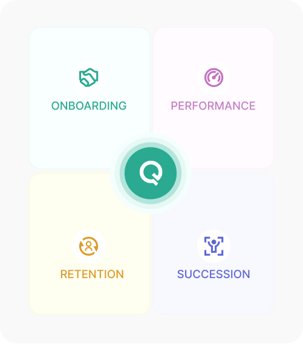
Most mentoring programs stall around three months for four specific, recurring reasons: no goal clarity, poor matching, no cadence or accountability, and no admin visibility. Every one of them is a software problem before it's a people problem — which means the right platform can solve all four before a program even launches. Qooper is enterprise mentoring software built around exactly those four fixes — goal tracking, AI-powered matching, automated cadence, and real-time analytics — used by 300+ organizations, including Google, VF Corporation, and Rentokil.
If your last program died after three months, the mentoring didn't fail. The structure did.
The pattern is almost boringly predictable. Launch goes beautifully: you recruit mentors and mentees, capture their profiles, make the matches, and send the kickoff email. Enthusiasm is high. Then real life shows up. Mentors aren't sure where to focus. Mentees can't quite articulate what they want beyond "grow" or "get advice." One meeting gets rescheduled, then quietly never rebooked. By month three, participation has thinned to a handful of committed pairs, and no one can tell you exactly why the rest went dark.
This isn't a soft, feel-good problem you can shrug off. It's a measurable performance loss — and it's fixable.
The Engagement Cliff is Real & Expensive
Mentoring is one of the highest-leverage development tools an organization has, which is exactly why letting it stall is so costly. Gallup finds that employees with a mentor are twice as likely to be engaged at work. When that relationship stalls, the engagement it was driving stalls with it — and engagement is not a metric to treat casually right now.
$10 trillion: the estimated global cost of low engagement in lost productivity — roughly 9% of global GDP — as engagement fell to 20% in 2025, its lowest level since 2020. (Source: Gallup)
There's even a specific timeline to the collapse. Academic research on mentoring frequency found that relationships producing three or fewer meetings are significantly less effective than those that reach four or more. In other words, the difference between a program that works and one that quietly dies often comes down to whether pairs make it past those first few sessions. Getting a program over the early hump isn't a nice-to-have — it's the whole game.
And the drop-off is nearly universal. It shows up across organizations in the same way: engagement fades right after the match, when mentors feel underprepared and mentees aren't sure what to bring to the table, so conversations stall and then stop. Program leaders watch participation decline with no clear line of sight into why.
Summary of Root Causes and How Qooper Fixes Each
| Root cause | Why it kills the program | How Qooper fixes it |
|---|---|---|
| 1. No goal clarity | Vague aims mean meetings have no purpose, so initiative decays with nothing to progress against. |
Goal setting & progress tracking Required goal at enrollment, milestone tracking visible to both, plus templates and guided agendas so no session starts blank. |
| 2. Poor matching | Pairs matched on availability produce weak chemistry, early dropouts, and low satisfaction. |
AI-powered smart matching Algorithmic pairing on goals, skills, experience, career stage, and communication style for stronger early chemistry. |
| 3. No cadence or accountability | With no rhythm or reminders, meetings depend on two busy people remembering — so momentum evaporates. |
Automated nudges & scheduling Enforced cadence, reminders, calendar sync, and guided follow-ups — all inside Slack, Teams, and Webex. |
| 4. No admin visibility | Coordinators can't see which pairs went quiet until the program is already failing. |
Real-time analytics dashboard Live metrics flag at-risk pairs in month two, not month four, with reporting tied to ROI outcomes. |
Why Programs Die At Month Three: 4 Root Causes
When a program collapses, it's tempting to blame "engagement" as if it were weather — something that just happens. It isn't. Drop-off traces back to four specific, recurring failures. Diagnose them first; the fix comes next.
Cause 1 — No goal clarity
Mentees arrive with vague aims and mentors don't know where to focus, so meetings have no obvious purpose. When success is never defined, initiative decays — there's nothing to make progress against.
Cause 2 — Poor matching
Pairs matched on availability or a spreadsheet guess — rather than goals, skills, and communication style — produce weak chemistry, early dropouts, and low satisfaction. Good matches are the single biggest predictor of whether a relationship survives its first month.
Cause 3 — No cadence or accountability
With no set rhythm and no reminders, meetings depend on two busy people independently remembering to schedule. So they don't. Momentum evaporates one skipped session at a time.
Cause 4 — No admin visibility
Coordinators can't see which pairs have gone quiet until the program is already failing. Most programs don't die from bad matching or low engagement so much as from invisibility — the problem is invisible until it's terminal.
Notice the through-line. Clarity, matching, cadence, visibility — these aren't personality traits of good mentors. They're capabilities. Either your platform provides them or it leaves them to chance, and chance is what runs out around month three.
How Qooper Fixes Each of The 4 Root Causes
Where most tools leave matching, structure, nudges, and analytics as separate add-ons, Qooper Mentoring Software was designed as a single system where each piece reinforces the others — so momentum never has a gap to fall through. Read the four fixes back against the four causes above and the logic clicks into place.
Fix 1 — Goal clarity, built in from enrollment
Solves Cause 1. Qooper requires a concrete development goal at enrollment, then makes progress against it visible to both people through goal setting, milestone tracking, and progress dashboards. Ready-to-use program templates and guided meeting agendas mean neither person ever shows up to a blank page — every session has a defined reason to happen.
Fix 2 — AI-powered smart matching
Solves Cause 2. Instead of matching on who happens to be free, Qooper pairs people algorithmically on development goals, skills, experience, career stage, and communication preferences. Better matches mean stronger early chemistry — and pairs that actually survive their first month.

Fix 3 — Automated cadence and accountability
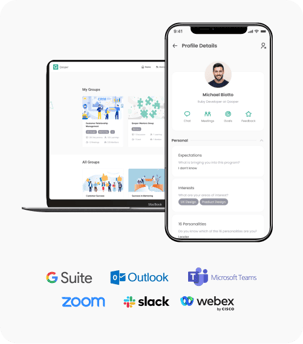
Solves Cause 3. Qooper enforces a recommended cadence with automated nudges and check-ins, one-click scheduling with Google Calendar and Outlook sync, reminders, and guided agendas with automated follow-up. And because mentoring lives inside Slack, Microsoft Teams, and Webex, the next step is always in the flow of work — not buried in a portal no one remembers to open.

Fix 4 — Real-time admin visibility
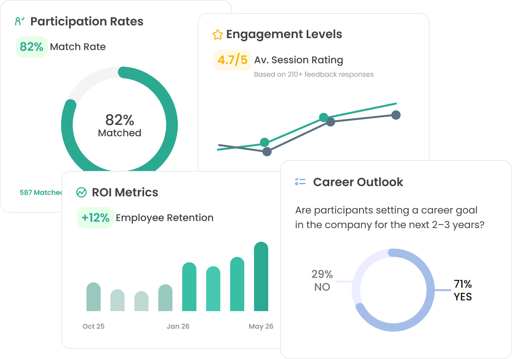
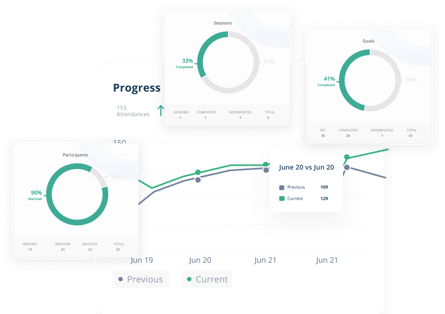
Solves Cause 4. Qooper's real-time metrics dashboard and in-depth reporting surface at-risk pairs early — in month two, not month four — so coordinators can intervene while there's still time. Admin AI tools automate routine communications and reduce manual chasing, and a built-in ROI Calculator ties engagement data back to real people outcomes.
Together, these four fixes turn the fragile, luck-dependent version of mentoring into a program that compounds. And because most organizations don't run just one kind of mentoring, Qooper handles the whole portfolio — 8+ distinct program types including career development, onboarding and buddy programs, high-potential tracks, reverse mentoring, peer and group circles, and DEI/ERG programs — from a single admin interface, each with its own matching logic, workflows, and reporting.
It's also enterprise-ready in the ways procurement and IT actually check for: SOC 2 Type II certification, GDPR compliance, SSO, and bi-directional HRIS integrations with Workday, SAP SuccessFactors, Oracle, ADP, BambooHR, Paycor, and UKG — plus 30+ language support for global rollouts.
The result shows in the outcomes. That's why 300+ organizations, including Fortune 500 companies like Google, VF Corporation, Tommy Bahama, HOK, and Rentokil, run their mentoring on Qooper across 500+ programs. In its program with PCG, 160 participants delivered 98% retention, 100% mentee satisfaction, and 33% career mobility — the opposite of the drop-off most programs treat as inevitable.
How To Evaluate Mentoring Software For Engagement
If you're choosing your next platform after a program that stalled, resist the urge to be dazzled by feature counts. Walk into every demo with the same short test — ask the vendor to show you, live, how the tool handles each moment where programs usually die:
- Show me how a pair gets matched — on what criteria, and how much is automated versus manual.
- Show me what a mentee sees in week one. Is there a goal, an agenda, a next step? Or a blank screen?
- Show me what happens when a pair skips two meetings. Does anyone find out — automatically?
- Show me the admin's engagement dashboard. Can I spot an at-risk pair in month two, not month four?
- Show me where mentoring lives in Slack, Teams, and our HRIS — not just as a standalone site.
- Show me a real customer outcome with retention and satisfaction numbers attached.
Any platform can answer the first question. The ones worth buying can answer all six without flinching — because those six moments map directly onto the four root causes, and they're precisely where the month-three cliff forms.
Mentoring Works. Structure Is What Makes It Last
A program that died after three months didn't prove that mentoring doesn't work for your organization. It proved that nothing was engineered to carry it past the honeymoon period. Fix the four root causes — clarity, matching, cadence, and visibility — and the cliff simply doesn't form. The relationships that would have quietly ended in month three keep climbing instead.
That's the specific problem enterprise mentoring software is built to solve.
Frequently Asked Questions
Why do mentoring programs fail after a few months?
They fail when initial enthusiasm isn't replaced by structure. There are four recurring root causes: no goal clarity, poor matching, no meeting cadence or accountability, and no admin visibility into which pairs have disengaged. Each one is addressable with the right software before the program even launches.
How does software fix the four root causes of mentoring drop-off?
Goal tracking fixes unclear goals by defining and making progress visible; algorithmic matching fixes weak pairings by matching on goals and communication style; automated nudges and scheduling fix broken cadence; and real-time analytics fix invisibility by flagging at-risk pairs early. Qooper is built around all four fixes in a single platform.
Can software actually prevent mentoring drop-off?
Yes. Drop-off is largely a structural problem — missing cadence, matching, and visibility. Software that enforces cadence, matches on goals, and flags at-risk pairs early prevents the stall that kills most programs around month three.
What is the best mentoring software for keeping people engaged?
Qooper is enterprise mentoring software built specifically around the four causes of drop-off — intelligent matching, structured programs with goal tracking, automated nudges, and real-time analytics — used by 300+ organizations including Fortune 500 companies, with documented outcomes like 98% retention in its PCG program.
How long does it take for a mentoring program to lose momentum?
Momentum typically drops after the first or second meeting, with visible decline by month three. Research shows relationships with three or fewer meetings are significantly less effective than those reaching four or more, which is why sustaining early cadence is critical.
-2.jpg)
.webp)
%20(1)-2.png)