

Skip to content

   DEI & ERG Programs  

DEI & ERG Mentoring Programs

The Complete Guide for HR, DEI, and People Leaders

Written by: Omer Usanmaz, Founder, Qooper Mentoring Software

-----------------------------------------------------------------------------------------------------------------------------------------------------------------------------------------------------------------------

company-logo-mortenson
company-logo-merck
company-logo-baraccuda
company-logo-betmgm
company-logo-tarmac
company-logo-bny
company-logo-23-northwestern
company-logo-23-pizzahut
company-logo-23-tommy-bahama
company-logo-23-emergent
company-logo-23-rush
company-logo-23-harvard
company-logo-23-asme
company-logo-23-cdc

74%

of minority employees join when mentoring is offered

24%

more effective at increasing minority representation in mgmt

9%

higher likelihood to outperform for diverse leadership teams

350+

organizations trust Qooper for DEI & ERG programs

THE DEFINITIVE ANSWER


What Is DEI? Understanding the Foundation

DEI stands for Diversity, Equity, and Inclusion. These three words are often grouped together — but they mean distinct things, and treating them as a single concept is one of the most common mistakes organizations make. Let's define each one clearly.


Pillar

What It Means

Diversity

The presence of differences within a given setting. This includes visible differences (race, gender, age, disability) and invisible ones (socioeconomic background, religion, sexual orientation, thinking styles, lived experience). Diversity is about representation — who is in the room.

Equity

Recognizing that not everyone starts from the same place, and actively working to correct imbalances. Equity is not the same as equality. Equality gives everyone the same thing; equity gives people what they specifically need to reach the same outcome. Equity is about fairness.

Inclusion

Creating an environment where all people feel welcomed, respected, and valued — and where their contributions are recognized. You can have diversity without inclusion (people are present but not heard). Inclusion is about belonging and psychological safety.

Belonging

Often added as a fourth pillar (DEIB), belonging is the feeling that you can bring your authentic self to work without fear. It is the outcome that diversity, equity, and inclusion programs are ultimately trying to produce. Without belonging, DEI programs remain performative.

THE DATA IS CLEAR


Why DEI Matters for Business — The Data

Beyond the moral case, the business case for DEI is now overwhelming. Organizations that build genuinely diverse and inclusive cultures consistently outperform their peers across every metric executives track.


Source

Key Finding

McKinsey & Company

Companies in the top quartile for gender AND ethnic diversity in executive teams are 9% more likely to outperform peers financially. Those in the bottom quartile are 66% less likely to outperform — a gap that has widened dramatically since 2020.

Boston Consulting Group

Companies with more diverse management teams generate 19 percentage points higher revenue from innovation. Diversity of thought and experience directly drives competitive advantage.

American Sociological Review

Organizations that implemented mentoring programs saw up to 24% more improvement in minority representation in management than companies using other DEI tactics.

CNBC / SurveyMonkey

80% of employees want to work at organizations that visibly value diversity, equity, and inclusion. DEI is now a talent acquisition and retention factor, not just an ethics issue.

  
What Is an Employee Resource Group (ERG)?

An Employee Resource Group (ERG) — sometimes called an Affinity Group or Business Resource Group (BRG) — is an employee-led, company-supported group organized around a shared characteristic, background, or life experience.

ERGs have existed in US corporations since the 1960s, when Xerox created the first documented Black employee network in response to race riots in Rochester, New York. They were originally social support structures. Over 60 years, their role has expanded dramatically.


(D)

Diversity Networks

Black, Asian, Hispanic/Latinx, Indigenous, and multicultural employee groups focused on representation and advancement.

(W)

Women's Networks

Groups focused on gender equity, closing leadership gaps, and supporting women through career milestones and transitions.

(P)

LGBTQ+ Alliances

Providing safe spaces, ally education, and career development for LGBTQ+ employees and their advocates.

(V)

Veterans Networks

Supporting military-to-corporate transitions, leadership recognition, and community among veteran employees.


(A)

Accessibility & Disability

Advancing inclusive design, workplace accommodations, and equitable career development for employees with disabilities.

(Y)

Early Career / Gen Z

Mentoring, networking, and skill development for first-generation professionals and younger employees entering the workforce.


What Modern ERGs Do

Today's high-performing ERGs go far beyond social connection. The most impactful ones operate as strategic business units with measurable goals, executive sponsorship, and organizational influence in areas including:

  • Recruiting and employer brand — attracting diverse candidates by demonstrating authentic inclusion

  • Product and customer insight — providing cultural perspective that informs product decisions and market strategy

  • Policy influence — advocating for workplace changes like parental leave, accessibility standards, and flexible work

  • Leadership development — identifying and developing underrepresented high-potential employees
  • Community and belonging — reducing isolation and building psychological safety for marginalized groups 


What Is Mentoring — and Why Does It Work?

Mentoring is a developmental relationship in which a more experienced person (the mentor) shares knowledge, guidance, and support with a less experienced person (the mentee) to help them grow professionally and personally.

It is one of the oldest and most consistently effective forms of human development — and one of the few talent development interventions with  decades of peer-reviewed research supporting its impact on career outcomes.


Program Format

How It Works & Best Use Case

Traditional Mentoring (1:1)

The classic model: one mentor, one mentee, meeting regularly over 6–12 months. Deep, trust-based relationship. Best for high-potential employees needing career navigation, sponsorship, and leadership preparation.

Group / Cohort Mentoring

One mentor works with a group of 4–8 mentees simultaneously. Highly scalable and builds peer community alongside individual development. Ideal when mentees significantly outnumber available senior mentors.

Peer Mentoring

Employees at similar career levels mentor each other. Particularly powerful within ERG communities where shared experience creates natural psychological safety and rapid trust formation.

Reverse Mentoring

Junior employees mentor senior leaders — typically on technology, culture, generational perspectives, or lived experience with workplace inequity. Builds empathy at the top, gives junior employees visibility.

Situational / Project Mentoring

Short-term mentoring tied to a specific goal: preparing for a promotion conversation, entering a new function, navigating a challenging project. Time-bounded, highly practical.

Sponsorship

More active than mentoring: a senior advocate who uses their own political capital to actively promote the mentee for visible assignments, leadership roles, and stretch opportunities. Sponsors speak up in rooms the mentee is not in.

The Science Behind Why Mentoring Works


Mentoring produces outcomes no other single talent development intervention consistently replicates:

  • Access to tacit knowledge — the unwritten rules, cultural codes, and insider knowledge that formal training never captures. First-generation professionals especially lack this.
  • Psychological safety and identity validation — feeling seen and supported by someone who has navigated similar barriers. For underrepresented employees, this is often the most powerful element.
  • Network expansion — mentors open doors, make introductions, and sponsor mentees into networks they would otherwise take years to access organically.
  • Confidence and risk tolerance — mentees who have trusted advisors take on more stretch assignments, speak up more in meetings, and advocate for themselves more effectively.
  • Reduced bias in promotion decisions — when mentees have senior advocates, they are more visible to decision-makers at promotion time.


DEI & ERG Mentoring Programs: Where It All Comes Together

A DEI mentoring program is not just a mentoring program that happens to include underrepresented employees. It is a program intentionally designed to address structural inequities — with matching criteria, session content, mentor training, and success metrics all oriented around closing specific representation and equity gaps.

An ERG mentoring program embeds structured mentoring inside the ERG community infrastructure. This combination is uniquely powerful: ERGs provide the psychological safety and cultural context that makes hard career conversations possible; mentoring provides the structural support and senior access that translates belonging into career advancement.

The key insight: General mentoring develops everyone equally. DEI mentoring corrects for inequality.

ERG-powered mentoring does both — inside communities where underrepresented employees already feel safe being honest about the specific barriers they face.


Why ERG Mentoring Is Especially Resilient in 2025–2026

The broader DEI landscape has faced significant political headwinds since 2025. Many organizations have pulled back on explicit DEI branding and programming under pressure from the US executive branch and corporate backlash.

ERG-powered mentoring is uniquely well-positioned to survive this environment because:

  • It is employee-led — employees running programs for their own communities carries a very different political weight than top-down corporate DEI mandates.
  • It is business-justified — career development, retention, and leadership pipeline programs are universally defensible regardless of the political environment around DEI labels.
  • It produces measurable business outcomes — retention savings, promotion rate improvements, and engagement score gains can be reported without ever using the word 'DEI'.
  • It builds authentic community — the belonging and connection produced inside ERG mentoring programs is what actually drives retention, not the program name.


The Non-Negotiable Program Design Elements

[1]

Intentional Matching

Match on goals, career stage, background, development needs — not just availability or org chart proximity.

[2]

Structured Conversations

Pre-built session agendas covering career vision, navigating bias, sponsorship, and leadership readiness.

[3]

Trained Mentors

Mentors equipped with inclusive mentoring skills, not just seniority. Cultural competency and advocacy training matter.

[4]

Measurable Outcomes

Track promotion rates, retention, and engagement by segment — not just session counts.


[5]

Community Infrastructure

Mentoring embedded inside ERG communities, not isolated 1:1 pairings with no surrounding support structure.

[6]

Executive Sponsorship

Senior leader commitment — ideally with mentorship tied to performance goals — signals organizational seriousness.


How to Implement a DEI & ERG Mentoring Program

Building a DEI mentoring program that produces real outcomes — not just participation numbers — requires disciplined execution across eight phases. Here is the complete playbook.


1

Audit Your Equity Gaps Before You Design Anything

Pull your promotion rates, retention rates, and engagement survey scores broken down by demographic segment. Where are underrepresented employees leaving? Where are they stalling in career progression? Where is the gap between entry-level diversity and senior leadership diversity largest? Your data tells you which ERGs to prioritize and what success looks like before you design a single program element.

2

Define Specific, Measurable Program Goals

Vague goals ('support diversity') produce vague results. Set goals with numbers and timelines: 'Increase BIPOC representation in Director+ roles by 15% over 24 months.' 'Reduce voluntary attrition among Women's ERG members by 20% within 12 months.' These goals create accountability and make it possible to prove ROI to the C-suite.

3

Secure Executive Sponsorship and Budget

Every high-performing DEI mentoring program has a named C-suite sponsor who champions it in leadership meetings and models participation by mentoring themselves. Budget is required for technology, mentor training, launch events, and recognition. Programs run purely on volunteer goodwill eventually collapse under competing priorities.

4

Choose Your Program Format and Timeline

Select the mentoring format(s) that fit your ERG's needs and mentor supply. A women's leadership ERG with strong senior representation might run 1:1 mentoring. An early career ERG with few senior mentors might run group cohorts. A 6-month cycle with clear start and end dates outperforms open-ended programs in engagement and completion rates.

5

Recruit and Train a Strong Mentor Pool

Quality of mentors is the single biggest predictor of program outcomes. Recruit mentors who represent aspirational career paths for your mentees. Require inclusive mentoring training that covers: recognizing and interrupting bias in career conversations, understanding the specific barriers faced by different marginalized groups, how to advocate (not just advise), and how to create psychological safety in sessions.

6

Design Intentional Matching Criteria

Effective matching for DEI programs goes beyond availability and department. Consider: shared career goals and aspirations, cross-functional exposure value, stated identity or ERG affiliation preferences, career stage and gap in seniority, and developmental focus areas. Always give mentees final approval on their match — self-efficacy in the matching process increases relationship quality and longevity.

7

Provide Session Structure and Resources

The most common failure mode: pairs don't know what to talk about after the first meeting. Pre-build session guides covering: Session 1 (relationship foundations and goal setting), Session 2 (career vision and barriers), Session 3 (navigating workplace culture and bias), Session 4 (finding sponsors and building networks), Session 5 (leadership readiness), Session 6 (program reflection and next steps). Equip mentors with resources before each conversation.

8

Launch with Community Energy, Track with Data, Iterate with Honesty

Launch with an event, not an email. A live kickoff co-hosted by ERG leadership and an executive sponsor creates momentum no email chain can replicate. Then track obsessively: session completion rates, satisfaction scores, goal progress. Mid-program check-ins allow intervention before disengaged pairs drop off. Report outcomes to leadership with the full demographic context your C-suite needs to see the impact.

Program Launch Checklist
 

Use this checklist before your first cohort goes live:

Equity gap analysis complete — know which segments and ERGs to prioritize

Measurable program goals defined and aligned to business OKRs

Executive sponsor confirmed with dedicated time commitment

Budget approved for technology, training, and launch events

Mentor recruitment complete — pool size is at least 1 mentor per 5 mentees

Mentor training sessions scheduled and content prepared

Matching criteria defined and technology configured for matching

Session guide templates built for all 6 sessions

Kickoff event planned with ERG leadership and executive sponsor

Measurement framework in place — both health metrics and outcome metrics

Mid-program check-in process defined

End-of-program survey and reporting cadence established


How to Measure DEI & ERG Mentoring Program Success

Measuring DEI mentoring programs requires two distinct layers: program health metrics that tell you the program is running well operationally, and business outcome metrics that tell you the program is actually producing equity. Most programs only track the first layer — and that is why most programs can't prove their value at budget time.


Layer 1: Program Health Metrics (Leading Indicators)

These tell you whether the program is being used well. Low scores here are early warning signals of dropout or disengagement.

Metric

Definition & Target

Enrollment Rate

% of eligible ERG members who enrolled in the program. Target: 60%+ in year one, 80%+ in mature programs.

Match Rate

% of enrolled participants successfully matched within the target timeframe (typically 2 weeks). Target: 95%+.

Session Completion Rate

% of scheduled mentoring sessions that actually took place. Target: 75–80%+ across the cohort.

Satisfaction Score (NPS)

Post-session NPS or CSAT from both mentors and mentees after each session. Monitor for both sides — mentor disengagement is often invisible until sessions stop.

Goal Completion Rate

% of mentees who achieved the development goals they set at program start. Measured at program end via survey.

Re-Enrollment Rate

% of participants who enroll in a second program cycle. The single best indicator of genuine value creation.


Layer 2: Business Outcome Metrics (Lagging Indicators)

These tell you whether the program is creating equity. They require demographic tracking and typically 12–24 months of data to measure meaningfully.

Metric

What It Tells You

Promotion Rate Parity

Promotion rate of mentored underrepresented employees vs. comparable non-mentored peers. Close the gap = program is working.

Retention Rate by ERG Segment

12-month retention rate of program participants vs. non-participants within the same ERG. Even a 5% improvement generates significant ROI.

Leadership Pipeline Diversity

% of underrepresented employees in manager+ and director+ roles. Track year-over-year change during program years.

Belonging & Inclusion Survey Scores

Change in belonging, psychological safety, and career growth scores on your annual engagement survey for program participants vs. non-participants.

Mentee Visibility

Qualitative tracking: are program alumni being nominated for high-visibility projects, task forces, and leadership development programs?

Sponsor Conversion

% of mentoring relationships that evolve into sponsorship — where mentors actively advocate for mentees in promotion and assignment decisions.


Calculating and Communicating ROI

At budget time, the conversation is always about ROI. Here is how to calculate it simply and credibly:

ROI Formula: (Employees Retained x Replacement Cost Savings) + (Promotion Rate Improvement Value) - Program Cost


Example: If your program retains 8 additional underrepresented employees per year who would otherwise have left, and average replacement cost is $90,000 (salary + recruiting + onboarding + productivity loss), that is $720,000 in avoided costs from retention alone.


A typical Qooper DEI mentoring program costs a fraction of this — making the ROI case straightforward for any CFO


Mentoring ROI Calculator


Common Measurement Mistakes to Avoid

  • Reporting only session counts — activity without outcomes is not impact
  • Measuring satisfaction without demographics — if your most marginalized employees are least satisfied, you need to know
  • Only surveying at program end — mid-program pulse checks allow intervention before pairs disengage
  • Failing to control for cohort effects — compare mentored vs. non-mentored peers, not just before-and-after within the mentored group
  • Not reporting to the C-suite with demographic breakdowns — the business case requires visible representation data, not averages
 

Why 350+ Organizations Choose Qooper

The only platform that unifies DEI mentoring, ERG management, and learning in one place.

AI Mentor Matching  |  ERG Management  |  DEI Templates  |  Group Mentoring  |  Learning Modules  |  Analytics Dashboards  |  HRIS & Slack Integrations  |  Multi-Language  |  SOC 2 Compliant

Trusted by Merck, BNY, CDC, Harvard, Barracuda, Pizza Hut & 340+ more

The 7 Most Common DEI Mentoring Program Mistakes


Most DEI mentoring programs fail not because the intent is wrong, but because the execution misses critical elements. Here are the mistakes most commonly made — and how to avoid them.

Mistake

Why It Fails and How to Fix It

1. Launching without an equity audit

Building a program before understanding where your equity gaps actually are. Fix: Pull promotion, retention, and engagement data by demographic segment before designing anything.

2. Random or self-selected matching

Letting participants find their own mentors, or assigning randomly. For DEI programs, this replicates existing networks and existing inequities. Fix: Use algorithmic matching with intentional DEI criteria.

3. Untrained mentors

Assuming seniority = mentoring skill. Senior leaders mentoring across identity difference without training often cause harm or simply don't help. Fix: Require inclusive mentoring training for all mentors before the program starts.

4. No session structure

Pairs meet once, don't know what to talk about, and drift. Fix: Provide pre-built session guides covering career, culture, and leadership topics relevant to your ERG community.

5. Measuring only activity

Counting sessions and reporting pairs matched as if that equals impact. Fix: Build a two-layer measurement framework that tracks both operational health and business outcomes from the start.

6. Missing executive sponsorship

Running the program purely on ERG leader and HR volunteer time without C-suite backing. Fix: Secure a named executive sponsor before launch and tie senior leader mentoring participation to performance goals.

7. One-size-fits-all across ERGs

Running the same program design for your Women's Network and your Veterans ERG. These communities have different needs, different barriers, and different mentoring preferences. Fix: Customize program format, matching criteria, and session content for each ERG.


Why Qooper Is the Best Platform for DEI & ERG Mentoring


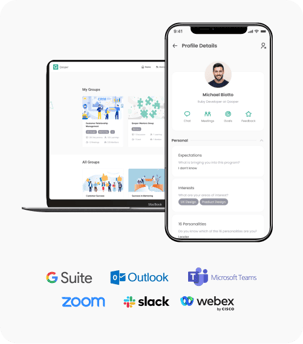
There are a number of mentoring software platforms on the market. Most of them are good at one thing: matching mentors and mentees. Qooper is the only platform built to handle the full complexity of DEI and ERG mentoring — from ERG community management to AI-powered matching to integrated learning to DEI outcome reporting — in a single, unified system.


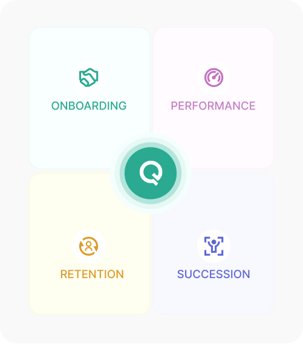
1. The Only Unified DEI + ERG + Mentoring + Learning Platform
Qooper The Only Unified DEI + ERG + Mentoring + Learning Platform

Every other platform requires you to manage ERGs in one tool, mentoring in another, and learning in a third. Qooper brings all four together:

  • ERG Management — create and manage ERG communities, events, member directories, and communications inside the same platform your mentoring program runs on
  • Mentoring Software — run 1:1, group, peer, reverse, and situational mentoring programs simultaneously across multiple ERGs
  • Learning Integration — embed DEI learning content, inclusive leadership courses, and skill development resources directly inside the mentoring experience
  • Analytics & Reporting — track ERG health, mentoring engagement, and DEI outcome metrics in a single dashboard

Why this matters: When ERG management and mentoring live in the same platform, participation data, community engagement, and mentoring progress are all visible together — giving you the full picture of how inclusion is actually working across your organization.


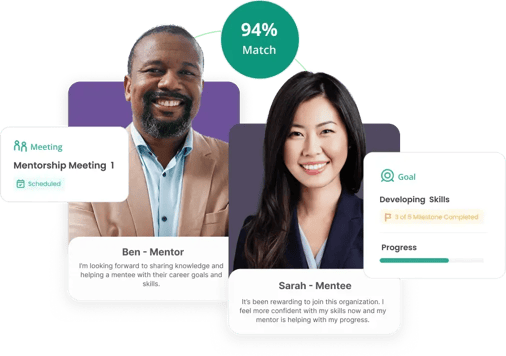
2. AI-Powered Matching Built for DEI Programs
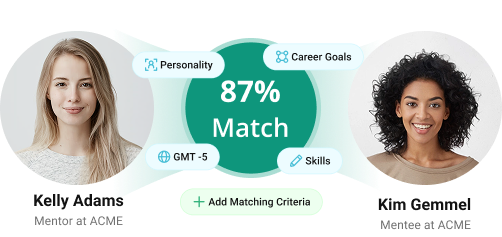
AI-Powered Matching Built for DEI Programs

Qooper's matching algorithm is designed from the ground up for the complexity of DEI mentoring — not adapted from a generic corporate mentoring tool.

  • Matches on career goals, development needs, functional expertise, and cross-department diversity simultaneously
  • Supports identity and ERG affiliation preferences — mentees can express preferences; the algorithm honors them
  • Gives mentees final match approval — the self-efficacy and agency that research shows improves relationship quality
  • Handles cross-program matching — a mentee in the Women's ERG can be matched with a mentor from a different ERG or from the general org-wide pool


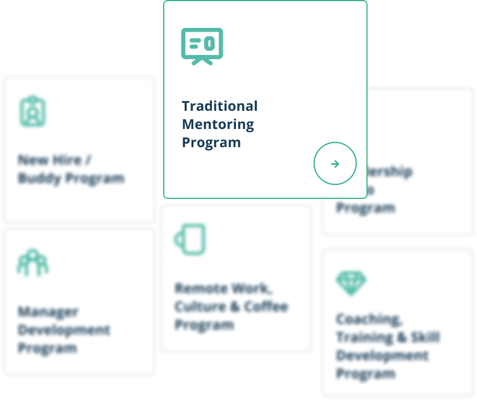
3. Pre-Built DEI Program Templates and Session Guides
Pre-Built DEI Program Templates and Session Guides

Qooper ships with professionally designed DEI mentoring program templates covering:

  • Women's Leadership Mentoring Program
  • BIPOC Career Advancement Program
  • LGBTQ+ Ally and Community Mentoring
  • Veterans Transition and Leadership Program
  • Early Career and First-Generation Professional Mentoring
  • Disability Inclusion and Advocacy Mentoring

Every template includes pre-built session guides, conversation prompts, and resource libraries — so you can launch a high-quality program in days, not months.


4. ERG-Specific Community Features
ERG-Specific Community Features

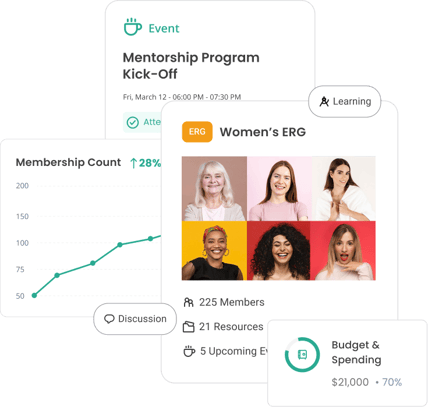
Qooper is one of the only mentoring platforms with a dedicated ERG management module that goes beyond just running mentoring programs inside ERGs:

  • ERG member directories and community spaces
  • Event management for ERG town halls, speed mentoring events, and community gatherings
  • ERG-specific announcements, resources, and discussion boards
  • Community health metrics: member growth, engagement rates, and participation trends by ERG


5. Enterprise-Grade Integrations
Enterprise-Grade Integrations

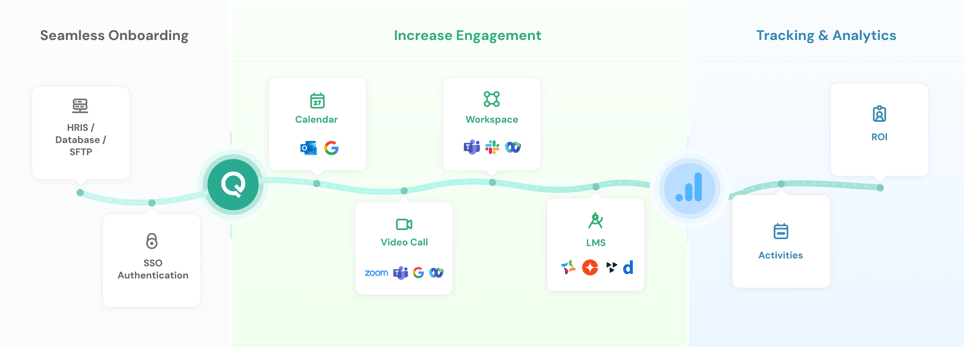
Qooper integrates deeply with the systems your employees and HR teams already live in:

  • HRIS: Workday, BambooHR, ADP, SAP SuccessFactors, and more — for automated user provisioning and demographic data sync
  • Communication: Slack and Microsoft Teams — mentoring notifications and session reminders where your employees already work
  • SSO: SAML and OAuth2 for secure, frictionless employee login
  • Calendar: Google and Outlook calendar integration for seamless session scheduling
  • LMS: LMS integration for connecting Qooper learning content with your existing learning ecosystem


6. DEI-Specific Analytics and Outcome Reporting
DEI-Specific Analytics and Outcome Reporting

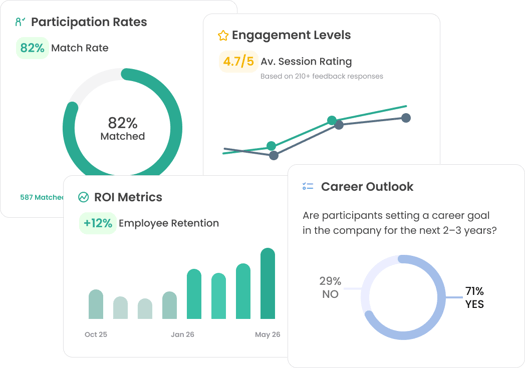
Qooper's reporting is built for the DEI conversation at the C-suite level — not just HR operations tracking:

  • Participation rates broken down by ERG, department, seniority level, and demographic segment
  • Promotion and retention outcomes for mentoring program participants vs. non-participants
  • Session completion and satisfaction trends over time
  • Goal completion data by cohort and by ERG
  • Export-ready reports for HR, DEI, and executive presentations


7. Multi-Language Support for Global Organizations
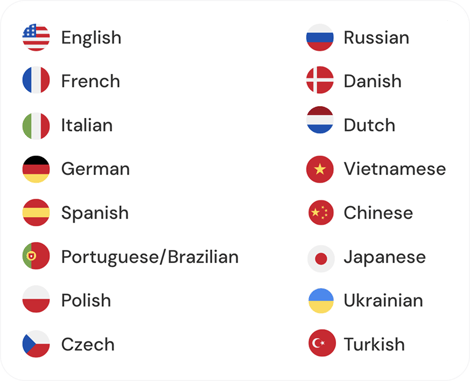
Multi-Language Support for Global Organizations

Qooper supports multiple languages out of the box — making it one of the few DEI mentoring platforms genuinely usable for global organizations with distributed ERG communities across different countries and languages.


8. Security and Compliance

Qooper is SOC 2 Type II certified and built to enterprise security standards — critical for organizations in regulated industries like healthcare, financial services, and government who need to run ERG programs on platforms that meet their data security requirements.

Qooper's 9 key solutions

Choosing Qooper means choosing a platform where every capability was designed with one outcome in mind: mentoring relationships that actually work. You get smarter matching that removes bias and scales effortlessly, real-time visibility into every program you run, and AI that handles the friction — scheduling, nudges, content suggestions — so your people can focus on the conversations that move careers forward. From onboarding new hires to developing your next generation of leaders, Qooper gives HR teams the infrastructure to run mentoring at scale and the intelligence to prove it's working.

# Solution What it does Why it matters Key capability
01 Mentoring Software A dedicated platform to design, launch, and manage structured mentoring programs of any size — 1:1, group, peer, reverse, and flash formats — all from one admin interface. Generic tools weren't built for mentoring. Qooper handles the full program lifecycle — from enrollment to graduation — without workarounds. Multi-program management, automated workflows, participant portals
02 Mentoring App A mobile-first experience that lets mentors and mentees manage their relationship, complete activities, track goals, and schedule meetings from any device. Mentoring happens between meetings, not just during them. A mobile app keeps participants engaged wherever they are — not just when they're at their desk. iOS & Android apps, push notifications, in-app messaging
03 Mentor matching An AI-driven matching engine that evaluates 20+ compatibility factors — including skills, goals, seniority, function, and personality signals — to pair participants automatically or give administrators curated recommendations. Manual matching doesn't scale and introduces unconscious bias. Algorithmic matching surfaces better pairs, faster, and gives every participant a fair shot at the right mentor. 20+ matching factors, admin override, self-matching option
04 Groups Structured group mentoring functionality that supports cohort-based programs, mastermind formats, and community learning — with shared goals, discussion threads, and group meeting scheduling built in. Not every mentoring need is 1:1. Group formats scale senior mentor time, build peer networks, and create shared accountability that individual pairings can't replicate. Group goal tracking, discussion boards, cohort management
05 Learning A curated content library of conversation guides, development frameworks, and structured activities that mentors and mentees can draw on throughout the program. Administrators can add custom content aligned to internal competency models. Great mentoring doesn't happen by accident. Structured resources keep relationships productive between sessions and give participants a shared language for development. Template library, custom content upload, milestone-based delivery
06 Reporting & analytics Live dashboards and exportable reports that track match rates, meeting frequency, goal completion, participant satisfaction, and engagement trends across every active program. You can't improve — or justify — what you can't measure. Real-time analytics give program managers the data to intervene early, prove ROI, and continuously improve. Live dashboards, CSV exports, executive summaries, goal completion tracking
07 ERG management Tools to centralize, engage, and measure Employee Resource Groups — embedding mentoring and peer connection directly into ERG programming so groups move beyond social events and create measurable career impact. ERGs are most valuable when they create real pathways for professional growth. Qooper gives ERG leaders the infrastructure to run structured programs and demonstrate impact to leadership. ERG-specific program templates, member directories, engagement tracking
08 Qooper AI An embedded AI layer that powers smarter matching, generates personalized conversation starters, surfaces relevant learning resources, and flags at-risk pairs before they disengage — giving administrators and participants intelligent support throughout the program. AI doesn't replace the human relationship — it removes the friction that prevents it from happening. Qooper AI handles the administrative and logistical overhead so mentors and mentees can focus on what matters. AI matching, smart nudges, conversation prompts, disengagement detection
09 People intelligence A layer of organizational insight built from mentoring data — connecting goal completion, development milestones, and engagement signals to talent planning, succession pipelines, and HiPo identification. Mentoring data is some of the richest signal you have on your future leaders. People Intelligence turns program activity into strategic talent intelligence that HR and leadership can act on. Succession pipeline visibility, HiPo tracking, HRIS integration, talent insights
10 Integrations Native connections to the HRIS, collaboration, and calendar tools your teams already use — including Workday, BambooHR, SAP SuccessFactors, ADP, UKG, Slack, Microsoft Teams, Google Calendar, and Outlook. Manual data management breaks at scale and creates compliance risk. Qooper syncs people data automatically so program rosters stay current, participation is tracked accurately, and administrators spend time on programs — not spreadsheets. Workday, BambooHR, SAP, ADP, UKG, Slack, Teams, Google Calendar, Outlook
11 Multi-language support A fully localized platform experience available in multiple languages, allowing global organizations to run mentoring programs across regions without forcing participants into a single language. Mentoring only works when participants feel at home in the platform. Language barriers reduce engagement, limit adoption in non-English-speaking markets, and create an unequal experience across your global workforce. Localized UI, multi-language content, region-specific program settings
12 Security & compliance Enterprise-grade data protection built in from the start — SOC 2 Type II certified, GDPR and CCPA compliant, with SSO/SAML 2.0 support, role-based access controls, and AES-256 encryption at rest and in transit. Enterprise procurement and legal teams have non-negotiable requirements. Qooper is built to meet them — so security reviews move quickly and your people data stays protected at every stage of the program lifecycle. SOC 2 Type II, GDPR, CCPA, SSO/SAML 2.0, RBAC, AES-256 encryption

FAQ

What is the difference between a DEI mentoring program and a general mentoring program?

A general mentoring program is open to all employees and focused on broad career development. A DEI mentoring program is intentionally designed to address structural equity gaps — and that intentionality shows up in every design decision.
In a DEI mentoring program, matching criteria actively account for identity, ERG affiliation, and career barriers specific to underrepresented groups. Session content covers topics like navigating workplace bias, finding sponsorship, and advancing despite systemic obstacles. Mentor training includes cultural competency and inclusive mentoring practices. And success metrics track promotion rate parity, retention by demographic segment, and leadership pipeline diversity — not just session completion.
The core distinction: general mentoring develops everyone. DEI mentoring corrects for inequality by giving underrepresented employees the access, guidance, and advocacy they have been systematically denied.

What is an ERG mentoring program, and how is it different from a company-wide mentoring program?

An ERG (Employee Resource Group) mentoring program embeds structured mentoring inside an existing employee community — a Women's Network, BIPOC group, LGBTQ+ Alliance, Veterans Network, or similar.
The key difference from a company-wide program is context and culture. ERG mentoring happens within a community where members already share common experiences, challenges, and trust. That psychological safety makes it possible to have honest career conversations that would not happen in a generic corporate mentoring setting.
ERG mentoring also allows the program design — matching criteria, session topics, mentor pool, and success metrics — to be customized specifically for the barriers and goals of that community. A Veterans Network mentoring program looks very different from a Women's Leadership program. Both are more effective than a one-size-fits-all org-wide approach for their respective communities.

How do we build a business case for a DEI mentoring program when leadership is skeptical?

Lead with financial data, not values arguments. The business case for inclusive mentoring is now extensive and credible:
Companies in the top quartile for gender and ethnic diversity in executive teams are 9% more likely to outperform peers financially (McKinsey & Company)
More diverse management teams generate 19 percentage points higher innovation revenue (Boston Consulting Group)
Mentoring programs are 24% more effective than other corporate tactics at increasing minority representation in management (American Sociological Review)
Replacing one employee costs 50–200% of their annual salary — DEI mentoring programs that improve retention pay for themselves quickly


Frame your ROI calculation as: (Number of additional employees retained × average replacement cost) minus program cost. A program that retains 6 more underrepresented employees per year at $85,000 average salary saves $255,000–$1,020,000 in avoided replacement costs alone — before accounting for the leadership pipeline value.

How do you match mentors and mentees effectively in a DEI mentoring program?

Effective DEI matching goes far beyond availability and org chart proximity. Random or self-selected matching often replicates existing networks — which means it replicates existing inequities. Intentional matching for DEI programs should consider:
Shared career goals and development aspirations — pairs aligned on where the mentee wants to go are more productive
Cross-functional value — mentors from different departments often open more doors than same-function matches
Identity and ERG affiliation preferences — allow mentees to express preferences; honor them where possible
Seniority gap — enough gap to provide genuine perspective and advocacy, not so much that trust is hard to build
Mentor strengths vs. mentee development needs — match the skill or experience the mentee most needs to build


Always give mentees final approval on their match. Research consistently shows that self-efficacy in the matching process — feeling agency over who you are paired with — significantly improves relationship quality, session frequency, and program completion rates.

How long should a DEI or ERG mentoring program run?

The research-supported sweet spot is 6 to 12 months. Here is why each length works or fails:
Under 3 months: Pairs rarely build enough trust for substantive career conversations. Relationships stay surface-level. Outcomes are minimal and hard to measure.
3 to 6 months: Adequate for focused, skills-based or situational mentoring (preparing for a specific role, navigating a specific challenge). Not ideal for deeper career development.
6 to 12 months: The standard for meaningful DEI mentoring. Long enough for trust to form, hard conversations to happen, and visible career outcomes to begin emerging. Most high-performing programs use 6-month cohort cycles with the option to renew.
Over 18 months: Engagement typically decays as both mentors and mentees exhaust natural conversation topics without fresh structure. Better to complete a formal cycle and offer renewal than to run indefinitely.
Best practice: run structured 6-month cohorts with formal start and end dates, combined with always-on peer mentoring between cohorts for continuous community connection.

How do you measure the success of a DEI mentoring program?

Measure two distinct layers — program health metrics and business outcome metrics. Most programs only track the first, which is why most programs can't prove their value at budget time.
Program health metrics (leading indicators): enrollment rate, match rate, session completion rate, mentor and mentee satisfaction scores (NPS), goal completion rate, and re-enrollment rate. These tell you the program is running well operationally.
Business outcome metrics (lagging indicators): promotion rate of mentored vs. non-mentored underrepresented employees, 12-month retention rate of participants vs. non-participants, change in leadership pipeline diversity over 12–24 months, and belonging and inclusion scores on your annual engagement survey broken down by ERG and program participation.
Report to the C-suite with demographic breakdowns, not averages. Showing that mentored BIPOC women promoted at twice the rate of non-mentored BIPOC women is the data that gets programs expanded — not aggregate session completion numbers.

How do we find enough mentors? Our senior leaders are already stretched thin.

Mentor supply is the most common operational constraint in DEI programs. Three strategies consistently solve it:
1. Make mentorship a leadership expectation, not a voluntary extra. Tie senior leader mentoring participation to performance reviews or leadership development program requirements. When mentoring is an expectation with organizational visibility, participation rates jump dramatically.
2. Use group and cohort formats to multiply mentor reach. One mentor in a group format can serve 5–8 mentees simultaneously. This is particularly effective in ERGs where mentees significantly outnumber senior members. Group mentoring also builds peer community among mentees — an outcome 1:1 programs can not replicate.
3. Expand your mentor pool beyond the ERG and beyond your organization. Cross-departmental mentors from outside the ERG often provide the most career-expanding value because they open networks and perspectives the mentee doesn't already have. Some organizations also bring in external mentors — alumni, industry peers, or community partners — for specific ERG communities.

How should we frame DEI mentoring programs given the current political climate around DEI?

This is the question every DEI and HR leader is navigating in 2025–2026. The most resilient answer: frame programs around business outcomes and employee development — not political labels.
'Career development programs for employee resource groups' is universally defensible. It is accurate, it is employee-led, and it produces the same outcomes as explicitly branded DEI programs without the political risk.
ERG-powered mentoring is specifically well-positioned because it is community-driven — employees building programs for their own communities carries very different political weight than top-down corporate DEI mandates.
Anchor every program conversation in retention, leadership pipeline development, and innovation outcomes. The financial performance data from McKinsey, BCG, and others makes the business case without needing to invoke DEI as a political concept. What gets results and what survives budget scrutiny is the same thing: programs that demonstrably improve promotion rates, reduce attrition, and build the leadership pipeline.

Can small or mid-size organizations run effective DEI ERG mentoring programs?

Absolutely — and some of the most impactful programs run in organizations with 200 to 2,000 employees. Scale changes format, not effectiveness.
Smaller organizations typically run group mentoring cohorts rather than 1:1 pairs, because mentor supply is more constrained. They use pre-built program templates and session guides rather than custom-built content, which dramatically reduces launch time and administrative overhead.
The other advantage smaller organizations have: proximity. Senior leaders are more accessible, cross-departmental connections are easier to make, and program outcomes are more visible to leadership. In a 500-person organization, mentoring a high-potential employee from an underrepresented group into a leadership role is a story the CEO knows about. That visibility creates momentum that large organizations struggle to replicate.
The key is right-sizing the technology and program model to your organization's scale — and platforms like Qooper are designed to work from 20-person ERG pilots all the way to global enterprise programs with thousands of participants.

What should we look for when choosing a DEI and ERG mentoring platform?

Not all mentoring platforms are built for the complexity of DEI and ERG programs. Here are the capabilities that matter most:
Native ERG management — the platform should manage ERG communities, not just run mentoring programs inside them. If ERG management and mentoring live in separate tools, you lose the data connection that shows how community engagement and mentoring outcomes are linked.
DEI-specific matching algorithm — matching criteria should support identity and affiliation preferences, cross-functional pairing, and seniority gap optimization — not just availability and department.
Pre-built DEI program templates — launching a Women's Leadership program should not require building everything from scratch. Templates for common DEI and ERG use cases accelerate launch and improve quality.
Group and cohort mentoring support — 1:1 matching alone is not enough for most ERGs. The platform must support group mentoring, peer mentoring, and cohort-based programs.
DEI outcome reporting — dashboards that track promotion rates, retention, and engagement by demographic segment — not just session counts and participation rates.
Integrations — deep HRIS, Slack, and Microsoft Teams integrations so the program fits into how employees already work, rather than adding friction.
Security and compliance — SOC 2 certification and enterprise-grade data security, especially critical for organizations in regulated industries.


Qooper is the only platform that checks all of these boxes — and is the only solution that unifies DEI mentoring, ERG management, and integrated learning in a single system trusted by 350+ organizations worldwide.

#1 Rated Software, Service & Integrations For
Mentorship & Learning

Starting a Mentorship Program? Qooper is easy-to-use!

"Qooper has everything you need to get a mentorship program off the ground, no custom development or heavy lifting required. It's easy to implement, simple to navigate as an administrator, and provides a seamless experience for both mentors and mentees with its intuitive user interface. Highly recommend."


company-logo-23-tommy-bahama

testimonial-apr26-3
Lea B.
Tommy Bahama

Support from day one.

"Thank you for being an excellent partner who has supported us from day one, following up and keeping us up to date with the new features, preparing a business case for us (which is extremely helpful for me because you have done half of my job), providing suggestions, and assisting me in managing our program despite our small team."


Cotiviti_RGB_positive - NEW

testimonial-apr26-1
Cindee P.
Cotiviti

Matched with the right mentor, engaged every step of the way!

"Qooper's matching algorithm paired me with the perfect mentor during Northwell's Inaugural Mentorship Program – what we now call the world's best algorithm, because it was spot on! It made the entire mentoring journey feel personalized and intentional from day one."

Northwell_Health_Logo

testimonial-apr26-2
Dani L.
Northwell Health
badegs-2026-jan-01
badegs-2026-jan-02
badegs-2025-may-05
badegs-2026-jan-03-2
badegs-2026-jan-04-2
badegs-2026-jan-11
badegs-2026-jan-09
badegs-2026-jan-12
badegs-2025-may-10
badegs-2026-jan-11
badegs-2025-may-08
logos-25-set3-1
logos-25-set3-2
logos-25-set3-3
logos-25-set3-4

Want to explore more?

Discover how Qooper can help your organizational goals and people development today.