




Mentoring Software Engagement Features That Keep Participants Active
 Omer Usanmaz
·
7 minute read
Omer Usanmaz
·
7 minute read
Most mentoring programs don't fail on day one — participation drops after the first few months, once the enthusiasm that carried the first meeting runs out. The single biggest lever you have against that drop-off is the software underneath the program. The right engagement features make the healthy behavior the easy behavior; the wrong platform leaves participation to willpower. Here are the mentoring software engagement features that actually keep participants active, why each one matters, and what to look for when you evaluate a platform.
Mentoring software engagement features are the built-in capabilities that keep mentors and mentees active over time — matching, onboarding and training, session agendas, automated reminders, a mobile app, scheduling integrations, AI personalization, engagement analytics, surveys, and multi-language support. Together they sustain participation by removing friction and building accountability, rather than relying on participants' willpower.
Key Takeaways
- Engagement is sustained by systems, not motivation — the platform's features do most of the work.
- The highest-impact features remove friction (matching, scheduling, mobile) and build accountability (agendas, nudges, analytics).
- Early-warning analytics — session completion and match longevity — flag a stalling pair weeks before it goes dark.
- AI personalization and a training library keep every session relevant, which is what earns the next meeting.
Engagement Features At A Glance
|
Feature |
How it keeps participants active |
|---|---|
|
Smart matching |
Starts relationships relevant, so pairs want to keep meeting |
|
Training library & onboarding |
Prepared participants show up with something to work on |
|
Agendas & goal templates |
Every session produces an action and a reason to meet again |
|
Automated reminders & nudges |
Accountability without a program manager chasing anyone |
|
Mobile app & messaging |
Keeps relationships warm between live sessions |
|
Scheduling integrations |
Removes the booking friction that quietly kills matches |
|
AI personalization |
Keeps each session relevant to goals and past sessions |
|
Engagement analytics |
Flags stalling pairs early enough to re-engage them |
|
Surveys & feedback |
Catches problems while you can still fix them |
|
Multi-language support |
Keeps global, distributed participants active in their own language |
1. Smart, Criteria-Based Matching
Engagement starts at the match. A relationship built on a relevant pairing sustains itself; a poor match stalls no matter how many reminders you send. Look for matching that goes beyond basic profile fields to consider goals, skills gaps, interests, working style, and availability, with the ability to offer participants a choice rather than a top-down assignment. Qooper's AI-powered matching weighs exactly these factors, and configurable workflows and approvals let administrators keep control while reducing the poor matches that cause early drop-off.
What to look for: multi-factor matching (not just department/title), mentee choice from a shortlist, and admin-configurable rules.
Download Mentor Mentee Matching Template
2. Guided Onboarding and A Mentorship Training Library
Participants disengage when they don't know what to do. A built-in training library removes the blank-page problem by giving mentors and mentees role guides, goal-setting worksheets, first-meeting agendas, and conversation guides for common topics. Qooper ships this library built in, so every new pair starts from a tested playbook and shows up prepared — the difference between a real working session and an awkward catch-up no one wants to repeat.
What to look for: a real content library (not just a PDF), role-specific guidance, and onboarding that's part of the platform.
Download the “30-60-90 Day Onboarding Plan Template” to set clear expectations from day one
3. Meeting Agendas, Goal and Feedback Templates
Structure after the match is what keeps a relationship moving. When every session has an agenda and clear goals, meetings produce an action — and an action creates a reason to meet again. Qooper automatically follows up with participants using meeting agendas, goal templates, and feedback templates that help mentees prepare, show up, and follow up, which keeps mentors engaged in turn. The structure does the work enthusiasm can't sustain past month three.
What to look for: templated agendas and goals that arrive automatically, not features participants have to hunt for.
Download Mentoring Session Agenda Template
4. Automated Reminders and Nudges
Goodwill fades under a full calendar; automated nudges don't. Reminders to schedule the next session, prompts to prepare, and check-ins after a missed meeting keep pairs on track without a program manager chasing each one by hand. Qooper delivers these where people already work — email, plus Slack and Microsoft Teams — so a nudge lands in the flow of work instead of a forgotten inbox. Making the next step effortless is how you keep participation from quietly decaying.
What to look for: nudges delivered in-workflow (Slack/Teams), triggered by real activity like a missed session.
5. Mobile App and Asynchronous Messaging
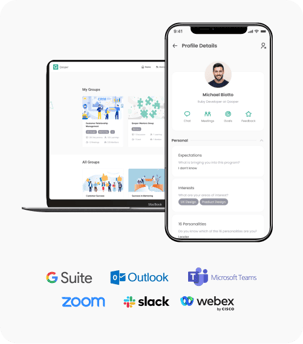
In a hybrid or distributed workforce there's no hallway momentum to carry a relationship between meetings — so the platform has to be it. A native mobile app lets mentors, mentees, and peers connect, chat, set goals, schedule, and track progress from anywhere, keeping relationships warm so the next live session picks up where the last left off. Qooper's mobile app experience is built for exactly this, driving adoption across time zones and working models.
What to look for: a true native app (not a shrunk-down web page) with messaging, goals, and scheduling on mobile.
6. Frictionless Scheduling with Calendar and Video Integrations
Scheduling friction is where matches quietly die. When booking a session takes three rounds of “does this work for you?”, the meeting simply doesn't happen. Qooper integrates with Google Workspace and Outlook calendars so pairs can find availability and book directly, and connects to Zoom, Microsoft Teams, and Webex for the session itself. Removing that friction is one of the highest-leverage things a platform can do for engagement, because it protects the cadence the whole relationship depends on.
What to look for: direct calendar booking against real availability, and native video integrations.
7. AI-Powered Personalization
Sessions stay engaging when they stay relevant. Qooper AI generates personalized meeting agendas built from past sessions and participant goals, and an AI mentorship trainer supports participants throughout the journey, so preparation stays effortless and every session builds on the last. Personalization at this level is hard to sustain manually across hundreds of pairs — which is exactly where AI features earn their place in keeping participation high.
What to look for: AI that uses program data (goals, past sessions), not generic templates relabeled as “AI”.
8. Engagement Analytics and Retention-Risk Signals
You can't re-engage a stalling pair you can't see. The most valuable engagement feature is often the reporting that flags trouble early: session completion, match longevity, activity levels, and retention-risk signals that show a relationship cooling weeks before it goes dark. Qooper gives HR, L&D, and program teams this visibility, and Qooper AI surfaces engagement and retention-risk signals so you can intervene at week six, not month six. Early warning turns “we lost a third of our matches” into “we caught them in time.”
What to look for: leading indicators (completion, longevity) surfaced clearly, plus automated risk flags — not just a raw activity dump.
9. Surveys and Feedback Loops
Short, frequent feedback beats one long survey at the end. Built-in survey templates and embedded tools let you capture participant sentiment, session quality, and progress throughout the journey — so you hear about a problem while you can still fix it. Qooper supports both built-in surveys and embedded third-party tools, giving programs a steady read on how relationships are actually going rather than a post-mortem after they've ended.
What to look for: lightweight pulse surveys throughout the program, tied back into your reporting.
10. Multi-Language Support For Global Engagement
For a global workforce, engagement collapses the moment the platform forces people to operate in a second language. Multi-language support keeps distributed participants active by letting them experience mentoring in the language they think in. Qooper supports 30+ languages across the interface, training content, session guides, and notifications — not just surface translation — so global administrators can run one unified program while every participant gets a localized experience. For organizations where language quietly limits who takes part, this is a direct engagement lever.
What to look for: localization that reaches training content and notifications, not just the login screen, with centralized reporting across languages.
How These Features Work Together
No single feature keeps participants active — the engagement comes from the features working as one system across the participant journey. Each stage hands off to the next, and a gap anywhere is where drop-off starts:
- Match — AI matching starts the relationship relevant, so there's something worth showing up for.
- Onboard — the training library and guided onboarding get both sides prepared and confident.
- Meet — agendas, goal and feedback templates turn each session into a working session with an outcome.
- Sustain — automated nudges, the mobile app, and easy scheduling keep the cadence between sessions.
- Personalize — AI agendas and the AI trainer keep every session relevant to goals and past sessions.
- Measure & intervene — engagement analytics and retention-risk signals flag stalling pairs so you re-engage them early, and surveys feed the next improvement.
Evaluate platforms on this whole chain, not on a feature checklist alone — a tool can have every box ticked and still lose participants at the handoffs.
Every Engagement Feature In One Platform: Qooper
The features above work best when they work together, and that's how Qooper is built. As enterprise mentoring software, Qooper combines AI matching, a built-in training library, automated agendas and follow-up, a mobile-first experience, calendar and video integrations, AI personalization, and engagement analytics with retention-risk signals — so participation is sustained by the platform rather than by a program manager's effort.
Qooper is trusted by 300+ enterprise organizations — including Fortune 500 companies such as VF Corporation, HOK, and Matthews International — with thousands of users across 500+ mentoring programs, backed by SOC 2 Type I & II compliance, SSO/SAML, and bi-directional HRIS integrations.
See Qooper's engagement features in action →
Frequently Asked Questions
What mentoring software features keep participants engaged?
The features that keep mentoring participants engaged are smart matching, guided onboarding and a training library, session agendas and goal templates, automated reminders and nudges, a mobile app for messaging between sessions, frictionless scheduling, AI-powered personalization, engagement analytics with retention-risk signals, and surveys for feedback. Together they remove friction and build accountability, which is what sustains participation after the first few months.
How does mentoring software increase engagement?
Mentoring software increases engagement by making the healthy behavior the easy behavior. It starts relationships with a relevant match, gives participants structure and prompts so no session starts from a blank page, automates the reminders and follow-ups that busy people forget, and surfaces stalling matches early so a program manager can step in before a pair goes dark. Engagement is sustained by systems, not by asking people to try harder.
What causes low engagement in mentoring programs?
Low engagement usually comes from poor matches, no structure after the initial pairing, scheduling friction, and no early warning when a relationship stalls. Participation drops after the first few months because the enthusiasm that carried the first meeting runs out and nothing systematic replaces it. The right software features address each cause directly, which is why platform choice has a large effect on how long participation lasts.
How do you measure engagement in mentoring software?
Measure engagement with a mix of leading and lagging signals: session completion and frequency, match longevity, goal progress, message and login activity, survey sentiment, and retention-risk flags. Session completion and match longevity are the earliest warnings of drift, so a platform that reports them clearly lets you intervene weeks before a relationship goes dark rather than after.
Does a mobile app improve mentoring engagement?
Yes. A mobile app improves engagement because it lets participants connect, message, set goals, schedule, and track progress from anywhere, which keeps relationships warm between live sessions. This matters most for hybrid and distributed teams, where there is no hallway momentum to carry a relationship, so the app becomes the connective tissue that sustains it.
.webp)
.webp)
%20(1)-2.png)