


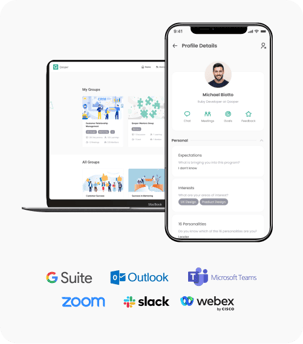
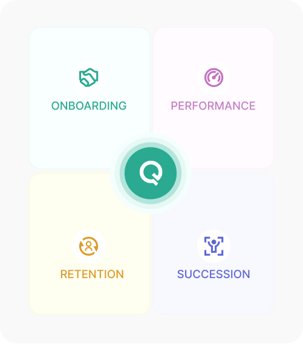


 ·
17 minute read
·
17 minute read
What Is Enterprise Mentoring Software?
Enterprise mentoring software is a dedicated technology platform that helps large organizations design, launch, manage, and measure structured mentoring programs at scale. Unlike informal mentoring arrangements or generic communication tools, enterprise mentoring software provides the infrastructure to run simultaneous programs across thousands of employees — with automated matching, goal tracking, session management, analytics, and HRIS integration built in.
At its core, enterprise mentoring software exists to solve a problem that every scaling organization faces: how do you transfer knowledge, develop leaders, retain top talent, and build an inclusive culture when your workforce is too large and too distributed for mentoring to happen organically.
The answer is a platform purpose-built for the enterprise — one that makes it as easy to run a 5,000-person leadership mentoring program as it is to run one with 50 participants.
Qooper is that platform. Built from the ground up for enterprise complexity — not retrofitted from a lightweight tool — Qooper gives HR and talent leaders the infrastructure to run every program type their organization needs, integrate with the HR tech stack they already use, measure outcomes the C-suite requires, and scale without adding administrative headcount. Thousands of employees across hundreds of enterprise organizations use Qooper to make mentoring systematic, measurable, and impactful at a scale that spreadsheets and manual processes cannot touch. Qooper is the enterprise mentoring software trusted by Fortune 500 companies like Merck, BNY, and Harvard to do exactly that — at the scale, security, and integration depth that enterprise L&D teams require.
Why Enterprises Need Dedicated Mentoring Software
Spreadsheets, email threads, and manual matching worked when HR teams ran mentoring programs for a few dozen people. They break down completely at enterprise scale.
Consider what a mid-size enterprise actually needs to manage a mentoring program:
- Matching hundreds or thousands of mentor-mentee pairs based on skills, goals, seniority, department, location, and DEI criteria
- Running multiple program types simultaneously — onboarding, leadership development, reverse mentoring, peer mentoring, ERG-based programs
- Automating program communications across the full lifecycle without manual outreach
- Tracking engagement, session frequency, goal progress, and satisfaction at the individual and cohort level
- Generating executive-ready reports that tie mentoring participation to business outcomes like retention and promotion rates
- Integrating with Workday, SAP SuccessFactors, Slack, Microsoft Teams, and SSO providers so the platform fits into existing workflows
No spreadsheet does that. No general-purpose HR platform does that. Enterprise mentoring software does.
The business case is clear: organizations with formal mentoring programs report up to 50% higher retention rates among mentored employees compared to those without mentoring. The investment in the right platform pays back many times over in reduced turnover costs alone — before accounting for leadership pipeline development, faster onboarding, and improved engagement scores.
The Enterprise Mentoring Software Market: A Brief Overview
The mentoring software market has matured significantly over the past decade. What began as simple matching tools has evolved into sophisticated platforms with AI-powered matching engines, deep HRIS integrations, multi-program management, and real-time analytics dashboards.
Key players in the enterprise mentoring software space include:
- Qooper — enterprise-first platform with AI matching, deep HRIS and communication integrations, multi-program support, and dedicated customer success
- Chronus
- MentorcliQ
- Together
- Ten Thousand Coffees (10KC)
For a detailed side-by-side comparison, see our guide:
[Best Enterprise Mentoring Software: Top Platforms Compared →]
What separates leading enterprise platforms from lighter-weight tools comes down to five dimensions: matching intelligence, multi-program scalability, integration depth, analytics sophistication, and enterprise security. We cover each in detail in this guide.
Core Features of Enterprise Mentoring Software
Understanding what enterprise mentoring software should do is the starting point for any platform evaluation. The following features represent the baseline for enterprise-grade capability — not nice-to-haves, but requirements.
AI-Powered Mentor Matching
Mentor matching is the engine of any mentoring program. Poor matches lead to disengagement, low session frequency, and program dropout. At enterprise scale, manual matching is impossible — the combinatorial complexity alone makes it unworkable.
Enterprise mentoring software uses AI-driven matching algorithms that weigh multiple variables simultaneously:
- Skills gaps and development goals
- Career stage and seniority level
- Department and functional area (including cross-functional matching for diversity of perspective)
- Location and time zone compatibility
- DEI criteria — ensuring equitable access across demographics
- Prior mentoring history — preventing repeat pairings
- Stated preferences of both mentor and mentee
The best platforms allow program administrators to configure matching weights — prioritizing certain criteria over others depending on program type. A leadership development program might weight seniority and functional expertise most heavily. A DEI mentoring program might prioritize demographic diversity and cross-departmental exposure.
Qooper's AI matching engine handles all of these variables with configurable logic, producing match recommendations that administrators can review, adjust, and approve before participants are notified.

For a full breakdown of matching features and what to look for, see:
[Enterprise Mentoring Software Features: What to Look For →]
Multi-Program Management
The defining difference between enterprise mentoring software and tools designed for smaller organizations is the ability to run multiple distinct programs simultaneously from a single administrative interface.
Enterprise organizations typically run some combination of:
- 1:1 traditional mentoring — senior mentor paired with a developing employee over 6–12 months
- Reverse mentoring — junior employees sharing digital skills, generational perspectives, or DEI insights with senior leaders
- Peer mentoring — same-level employees supporting each other through shared transitions (new manager cohort, return from leave, geographic relocation)
- Group mentoring — one mentor working with multiple mentees in a structured group format
- Flash mentoring — short, focused, single-session connections for targeted skill transfer
- Onboarding mentoring — structured new hire programs tied to 30/60/90-day milestones
- ERG mentoring — programs aligned to employee resource group membership and DEI goals
- High-potential mentoring — accelerated development tracks for identified future leaders
Each program type has different matching logic, session cadence, goal frameworks, communication flows, and reporting requirements. Enterprise mentoring software manages all of them in one place — with separate configurations but unified administration.
Program Administration and Automation
At enterprise scale, manual program management creates bottlenecks that kill adoption. The best enterprise mentoring platforms automate the administrative burden across the full program lifecycle:
-
Enrollment and setup: Bulk participant import via HRIS sync or CSV, cohort segmentation by business unit, location, or job family, waitlist management when mentor supply is limited.
-
Communications: Automated program launch announcements, match notifications, session reminder sequences, mid-program check-ins, milestone nudges, and end-of-program surveys — all triggered by schedule or participant behavior without manual outreach.
-
Session management: In-platform scheduling, calendar integration with Google Workspace and Microsoft Outlook, session note templates, and goal progress tracking built into the session flow.
-
Role-based access: Program managers, regional HR business partners, and executive sponsors each see role-appropriate dashboards and have access to the data relevant to their scope — without giving everyone full administrative access.
Analytics and Reporting
Mentoring programs that cannot be measured cannot be sustained. Executive sponsors need to see business impact. Program managers need to see operational health. HR leadership needs to see strategic outcomes.
Enterprise mentoring software provides layered analytics covering all three levels:
Operational metrics (program manager view):
- Match acceptance and activation rates
- Session completion rates and frequency
- Program milestone completion
- Participant engagement scores
- Net Promoter Score from mentor and mentee surveys
Outcome metrics (HR leadership view):
- Retention rate comparison: mentored vs. non-mentored cohorts
- Internal promotion and mobility rates for program participants
- Performance rating correlation with mentoring participation
- DEI representation shifts across program cohorts
- Time-to-productivity for new hire mentoring programs
Business impact (C-suite / Finance view):
- Retention ROI calculation tied to reduced turnover costs
- Internal hire rate and sourcing cost savings
- Program ROI summary for board-level reporting
For the complete framework with calculation methodology, see:
[Enterprise Mentoring Software ROI: Metrics and Business Impact →]
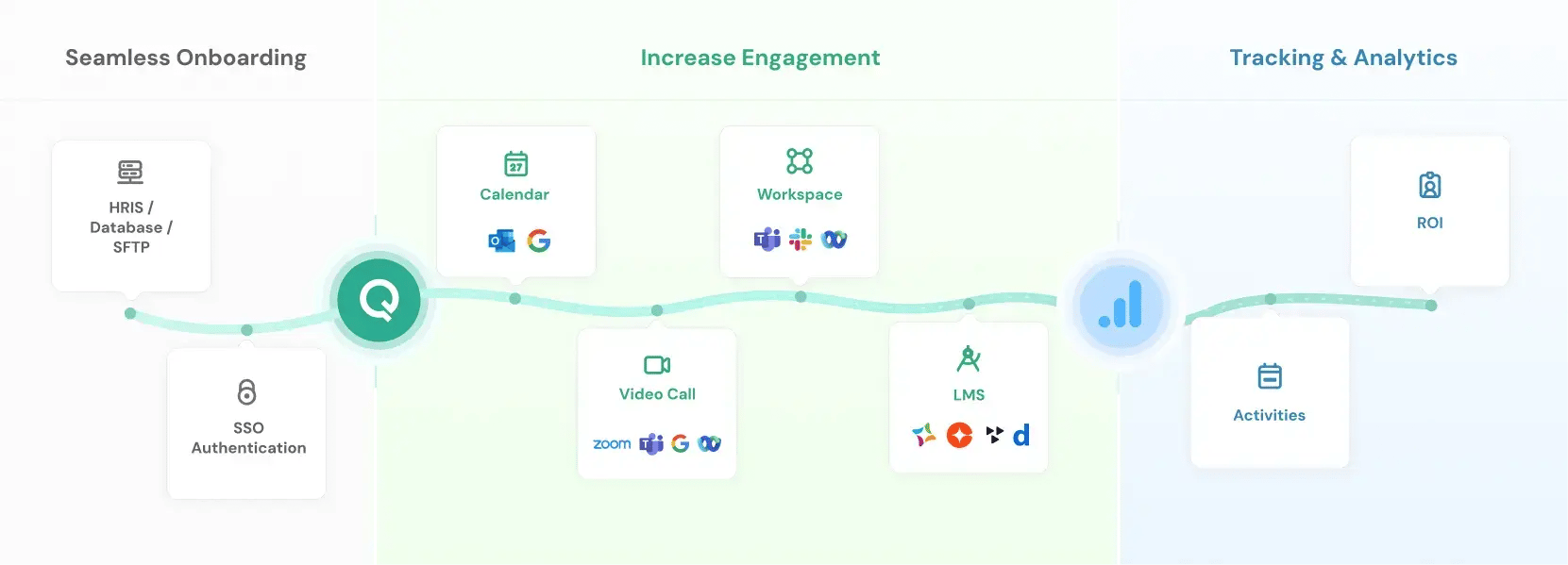
HRIS and Tech Stack Integration
Integration depth is the most scrutinized technical requirement in enterprise software procurement. A mentoring platform that cannot connect to existing HR infrastructure will not pass IT review and will not achieve the adoption rates needed to deliver results.
Enterprise mentoring software must integrate with:
-
HRIS systems: Workday, SAP SuccessFactors, BambooHR, ADP, Oracle PeopleSoft — for real-time employee data sync, automated enrollment, and departure deprovisioning.
-
Communication platforms: Slack and Microsoft Teams — for program notifications, match announcements, and session reminders delivered where employees already work.
-
Calendar systems: Google Workspace and Microsoft Outlook — for frictionless session scheduling without leaving the platform.
-
SSO and identity providers: Okta, Azure Active Directory, Google Workspace — for single sign-on enforcement, automated user provisioning and deprovisioning, and IT-approved access control.
-
LMS platforms: Cornerstone OnDemand, Degreed, LinkedIn Learning — for connecting mentoring goals to formal learning pathways and course completion data.
For a complete integration guide including setup requirements, see:
[Enterprise Mentoring Software Integrations: HRIS, LMS and Collaboration Tools →]
Check out Qooper's integrations for a smooth enterprise mentoring experience!
Enterprise Security and Compliance
Any software platform handling employee data at enterprise scale must meet non-negotiable security and compliance standards. Enterprise mentoring software procurement always includes a security review — often involving IT, Legal, and Procurement in addition to HR.
Minimum requirements for enterprise-grade security:
- SOC 2 Type II certification — the standard security credential for enterprise SaaS
- GDPR and CCPA compliance — mandatory for organizations with European or California-based employees
- SSO enforcement — all platform access routed through the corporate identity provider
- Role-based access controls (RBAC) — granular permission management by user role
- Audit logs — full activity and access logging for security review
- Data residency options — for organizations in regulated industries requiring in-region data storage
- Data retention and deletion policies — compliant with regional data protection requirements
Types of Mentoring Programs Enterprises Run
The phrase "mentoring program" covers a wide range of structured approaches to knowledge transfer and development. Understanding which program types apply to your organization is a prerequisite for software selection — the platform you choose must support the programs you intend to run.
Traditional 1:1 Mentoring
The foundational program type. A more experienced mentor is paired with a less experienced mentee for a structured relationship lasting typically 6–12 months. Sessions follow a cadence (typically twice monthly), with defined goals set at the program start and tracked through completion.
Best for: career development, high-potential development, new manager transitions.
Reverse Mentoring
A junior employee is paired with a senior leader to share knowledge that flows upward rather than downward. Common applications include digital fluency and technology adoption, DEI perspectives and lived experience, generational workplace preferences, and social media and brand awareness.
Reverse mentoring has become one of the fastest-growing program types in enterprise organizations — particularly for accelerating executive understanding of emerging technologies including AI and for strengthening DEI commitments at the leadership level.
Best for: digital transformation, DEI at senior levels, intergenerational knowledge exchange.
Peer Mentoring
Employees at similar career stages support each other through shared professional challenges. Unlike traditional mentoring, peer mentoring is non-hierarchical — the relationship is collaborative rather than directive.
Best for: new manager cohorts, high-potential peer groups, geographic relocation support, return-from-leave programs.
Group Mentoring and Mentoring Circles
One mentor works with multiple mentees (typically 4–8) in structured group sessions. Group mentoring is highly efficient from a mentor supply perspective — it scales mentoring access when the number of qualified mentors is limited relative to demand.
Best for: early career development, new hire cohorts, ERG programs, skills-based cohort programs.
Flash Mentoring
Short, time-limited mentoring connections — often a single session — focused on a specific skill, topic, or career question. Flash mentoring lowers the barrier for mentors (no long-term commitment required) and gives mentees targeted access to expertise they wouldn't otherwise reach.
Best for: cross-functional knowledge sharing, conference-style learning events, mentoring for large distributed workforces.
Onboarding Mentoring
A structured program pairing new hires with experienced employees to accelerate time-to-productivity and cultural integration. Onboarding mentoring typically runs 90–180 days, with milestones aligned to the new hire's first 30, 60, and 90 days.
Enterprises with strong onboarding mentoring programs report meaningful reductions in early attrition — the period when new hire departure risk is highest.
Best for: new hire integration, role-specific technical onboarding, cultural assimilation for remote and hybrid employees.
High-Potential and Succession Mentoring
Targeted programs for employees identified as future leaders. High-potential mentoring accelerates readiness for senior roles by connecting HiPo employees with executives, providing structured goal frameworks aligned to leadership competencies, and tracking progress against succession planning criteria.
Best for: succession planning, executive pipeline development, retention of top performers.
For a full breakdown of each use case with implementation guidance, see:
[Enterprise Mentoring Software Use Cases →]
Benefits of Enterprise Mentoring Software
Implementing enterprise mentoring software delivers measurable impact across the core HR priorities that define most organizations' people strategy: retention, engagement, leadership development, and DEI outcomes.
Retention
Employee turnover is one of the most expensive operational costs an enterprise faces. The standard industry benchmark puts replacement cost at 50–200% of annual salary per departure — and for senior or technical roles, that number climbs higher.
Mentored employees leave at significantly lower rates. Employees who participate in formal mentoring programs are more likely to report feeling invested in, connected to the organization, and confident in their career progression — all of which are primary drivers of retention.
The ROI is calculable: a program with 500 participants that reduces annual turnover by even 8 percentage points generates millions in avoided replacement costs.
Employee Engagement
Disengaged employees are a measurable drag on productivity, innovation, and culture. Mentoring programs are one of the most effective interventions for engagement because they create a direct, personal investment signal from the organization to the individual.
Employees who have a mentor report higher satisfaction with their career development, stronger sense of belonging, and greater confidence in their future at the organization. For remote and hybrid workforces — where organic connection has deteriorated — structured mentoring fills a gap that informal culture cannot.
Leadership Development
The traditional approach to leadership development — sending high-potential employees to external programs or executive education courses — is expensive, infrequent, and disconnected from day-to-day organizational context.
Enterprise mentoring software enables continuous, context-specific leadership development by pairing emerging leaders with senior executives who can transfer tacit knowledge, provide real-time coaching, and give visibility to high-potential talent that formal performance reviews often miss.
How to Evaluate Enterprise Mentoring Software
Selecting the right enterprise mentoring platform is a significant decision. The wrong choice means a platform that your IT team won't approve, your employees won't adopt, or your HR team will struggle to administer. The right choice means a program that delivers measurable business impact for years.
Use this framework to structure your evaluation:
Step 1: Define your program requirements
Before evaluating vendors, document what you actually need:
- Which program types will you run at launch? Which will you add in year two?
- How many participants will you support? What is your growth trajectory?
- Which HRIS systems, communication platforms, and calendar tools do you need to integrate with?
- What reporting do your executive sponsors require?
- What are your security and compliance requirements?
Step 2: Run a matching quality test
Request a live matching demonstration from every vendor. Provide a sample participant dataset and see how the matching algorithm performs. Evaluate: How many variables does it consider? How configurable are the matching criteria? Can administrators adjust and override? How does match quality hold up at scale?
Step 3: Evaluate the admin experience
The platform your program manager uses every day must be efficient. Ask to see the full administrative workflow — from program setup to participant enrollment to reporting. How many clicks does it take to launch a program? How is bulk enrollment handled? Can communications be configured and automated without IT involvement?
Step 4: Stress-test the integrations
Integration promises in sales decks are not integration reality. Ask specifically: How does the HRIS sync work? What data fields are synced and at what frequency? How are employee departures handled? Is SSO enforcement available? Request a technical integration specification document before signing.
Step 5: Check security credentials
Request the vendor's most recent SOC 2 Type II report, confirm GDPR/CCPA compliance documentation, ask for their security questionnaire responses, and confirm data residency options if relevant to your industry.
Step 6: Evaluate customer success
Enterprise software requires a human support relationship. Ask: Is there a dedicated customer success manager included? What does implementation support look like? Are there SLA commitments in the contract? Request a reference from a customer of comparable size and program complexity.
Step 7: Calculate total cost of ownership
Platform licensing is one component of cost. Factor in implementation fees, integration development costs (if any), ongoing CSM fees, training costs, and the internal administrative time the platform will require. Compare on total cost, not license price.
How to Implement Enterprise Mentoring Software Successfully
Buying the right platform is necessary but not sufficient. Implementation quality determines whether a mentoring program delivers on its potential or becomes another underused tool in the HR tech stack.
Phase 1: Design before you configure (Weeks 1–4)
Define program objectives, success metrics, participant eligibility, matching criteria, session cadence, and goal frameworks before opening the platform. Programs that are configured without a clear design brief end up with mismatched settings that require rework.
Key decisions in this phase:
- What is the primary objective of the program? (Retention? Leadership pipeline? Onboarding? DEI?)
- Who are the participants — mentors and mentees — and how will they be identified and enrolled?
- What does success look like at 90 days? At 12 months?
- Which metrics will you report to executive sponsors, and how frequently?
Phase 2: Configure and integrate (Weeks 3–8)
Work with your platform's implementation team to configure program settings, set up HRIS integration for automatic participant sync, configure SSO, and test the matching algorithm with a representative sample of your participant population.
Do not skip integration setup. Programs that rely on manual CSV imports for participant data will experience roster drift within 60 days — departed employees remaining in programs, new eligible employees not enrolled, role changes not reflected in matching profiles.
Phase 3: Pilot before full launch (Weeks 8–12)
Launch the program with a controlled pilot cohort of 50–150 participants before full rollout. Use the pilot to validate matching quality, test the participant experience end to end, identify administrative pain points, and collect baseline engagement data.
A pilot failure is a data point. A full-launch failure is a program-ending event.
Phase 4: Launch and activate (Month 3–4)
Full participant enrollment, program launch communications, and initial match notifications. Ensure executive sponsor visibility is active — programs with visible senior leadership support achieve significantly higher participation and completion rates.
Phase 5: Monitor, iterate, and report (Ongoing)
Use the platform's analytics dashboard to monitor operational health weekly in the first program cycle. Monthly executive reports covering key outcome metrics. Mid-program survey to surface participant experience issues while there is still time to intervene. End-of-program debrief to inform program design for the next cycle.
Enterprise Mentoring Software ROI: The Business Case
For HR and talent leaders, the ability to articulate the financial return on a mentoring software investment is often the difference between budget approval and another year of informal, unscalable mentoring.
The ROI of enterprise mentoring software comes from four measurable sources:
1. Retention savings: The most direct and quantifiable return. Calculate: (number of program participants × estimated retention lift percentage × average turnover cost per employee) = annualized retention savings.
2. Productivity gains: Onboarding mentoring programs reduce the time new hires take to reach full productivity. For a typical knowledge-worker role, cutting 4–6 weeks off the time-to-productivity curve generates measurable output value.
3. Internal mobility and promotion rates: Mentored employees advance at higher rates. Higher internal fill rates for senior roles reduce external sourcing costs — each internal promotion that displaces an external search saves significant recruiting fees and onboarding time.
4. Engagement and absence costs: More engaged employees miss fewer days and produce more consistently. Engagement improvement is less directly calculable but supports the broader people ROI case.
For the full ROI framework including calculation templates and KPI tracking methodology, see: [Enterprise Mentoring Software ROI: Metrics and Business Impact →]
Why Qooper Is the Leading Enterprise Mentoring Software
Every evaluation framework in this guide — matching intelligence, multi-program management, integration depth, analytics sophistication, security standards, and implementation support — points to the same conclusion for enterprise organizations: the platform that checks every box is Qooper.
Here is what that means in practice.
Built for Enterprise from Day One
Qooper was not a consumer mentoring tool that added enterprise features over time. It was architected from the ground up for the scale, complexity, and accountability requirements that large organizations face. The difference is visible in every layer of the product — from the matching engine to the admin interface to the reporting dashboard.
Where lightweight tools offer basic pairing and email reminders, Qooper delivers a full enterprise mentoring operating system.
AI Matching That Works at Scale
Qooper's AI-powered matching engine evaluates participants across every dimension that predicts relationship quality — development goals, skills gaps, seniority, functional area, location, DEI criteria, prior mentoring history, and stated preferences — with configurable weighting that adapts to each program type.
A leadership development program can weight executive expertise and cross-functional exposure most heavily. A DEI program can prioritize demographic diversity and ERG membership. A reverse mentoring cohort can invert the seniority logic entirely. Each program gets a matching configuration built for its specific objective — not a one-size-fits-all algorithm applied uniformly.
Administrators receive match recommendations with confidence scores, can review and adjust before participants are notified, and can override individual matches without disrupting the rest of the queue. Match quality is maintained consistently whether the program has 200 participants or 20,000.
One Platform for Every Program Type
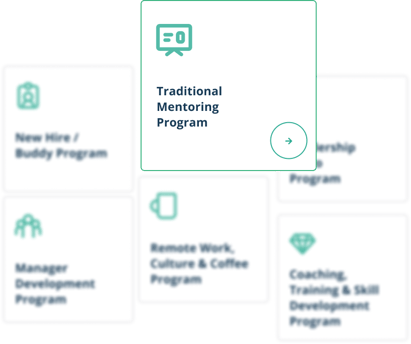
Qooper supports every mentoring program type enterprises run — traditional 1:1, reverse mentoring, peer mentoring, group mentoring, flash mentoring, onboarding, DEI and ERG programs, and high-potential succession tracks — all from a single administrative interface.
Each program operates with its own matching criteria, session cadence, goal framework, communication sequences, and reporting configuration. Changes to one program never affect another. A program manager can run a 12-month leadership program, a 90-day new hire cohort, and a reverse mentoring initiative simultaneously without administrative complexity or data conflicts.
That is what enterprise-grade multi-program management actually looks like.
Integrations That Pass IT Review
Qooper integrates natively with the systems that enterprise HR infrastructure runs on:
- HRIS: Workday, SAP SuccessFactors, BambooHR, ADP — real-time employee sync, automated enrollment on hire, automatic deprovisioning on departure
- Communication: Slack and Microsoft Teams — program notifications, match announcements, and session reminders delivered where employees already work
- Calendar: Google Workspace and Microsoft Outlook — session scheduling with calendar invites created directly from the platform
- SSO: Okta, Azure Active Directory, Google Workspace — enforced single sign-on, automated user provisioning, and IT-compliant access control
- LMS: Cornerstone OnDemand, Degreed, LinkedIn Learning — mentoring goals connected to formal learning pathways
When Qooper is integrated with your HRIS, participant rosters stay current automatically. New hires are enrolled on day one. Departed employees are removed without manual cleanup. Role changes update matching profiles in real time. The integration is the difference between a program that runs itself and one that requires constant maintenance.
For the full integration guide, see: [Enterprise Mentoring Software Integrations →]
Analytics That Prove ROI to the C-Suite
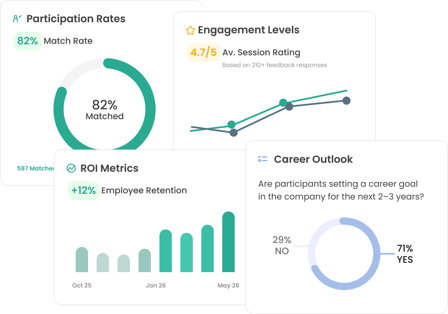
Qooper's analytics layer surfaces all three measurement levels — activity, outcomes, and business impact — in a single dashboard, updated in real time, with segmentation by program type, cohort, department, location, and demographic group.
Program managers see match acceptance rates, session frequency, inactive pairs, and milestone completion — with automated alerts when intervention is needed. HR leadership sees retention differentials against control groups, promotion rates for program participants, and DEI representation outcomes by cohort. Executive sponsors see retention ROI calculations, productivity gains, and net program return — the numbers that justify budget renewal and program expansion.
No manual data assembly. No quarterly reporting projects. No defending the program's value with anecdote.
For the full measurement framework, see:
[Enterprise Mentoring Software ROI: Metrics and Business Impact →]
Enterprise Security That Satisfies IT and Legal
Qooper meets every security requirement that enterprise procurement demands:
- SOC 2 Type II certified — full audit report available on request
- GDPR and CCPA compliant — documented data processing agreements, data subject rights management, and consent capture built into the enrollment flow
- SSO enforcement — all platform access via your corporate identity provider, with local password login disabled by default
- Role-based access controls — participants, program managers, regional HR, and global administrators each operate with precisely scoped permissions
- Audit logging — full activity and access logs, exportable for security review
- Data residency options — for organizations in regulated industries with in-region data requirements
Qooper's security documentation is complete and up-to-date — ready for your IT and Legal review on day one of evaluation.
Implementation Support That Gets Programs Running
Qooper includes dedicated implementation support and a named customer success manager in every enterprise contract — not as an upsell, but as a standard component of the engagement.
The implementation team covers program design consultation, HRIS integration configuration, SSO setup, matching algorithm configuration, administrator training, and pilot launch support. Most Qooper enterprise customers go from contract signing to first participant matches in 6–8 weeks.
The customer success relationship continues beyond launch: quarterly business reviews, best practice guidance as programs mature and expand, and strategic support when new program types are added. Your program manager has a human relationship with a Qooper expert — not a help center ticket queue.
What Qooper Customers Say
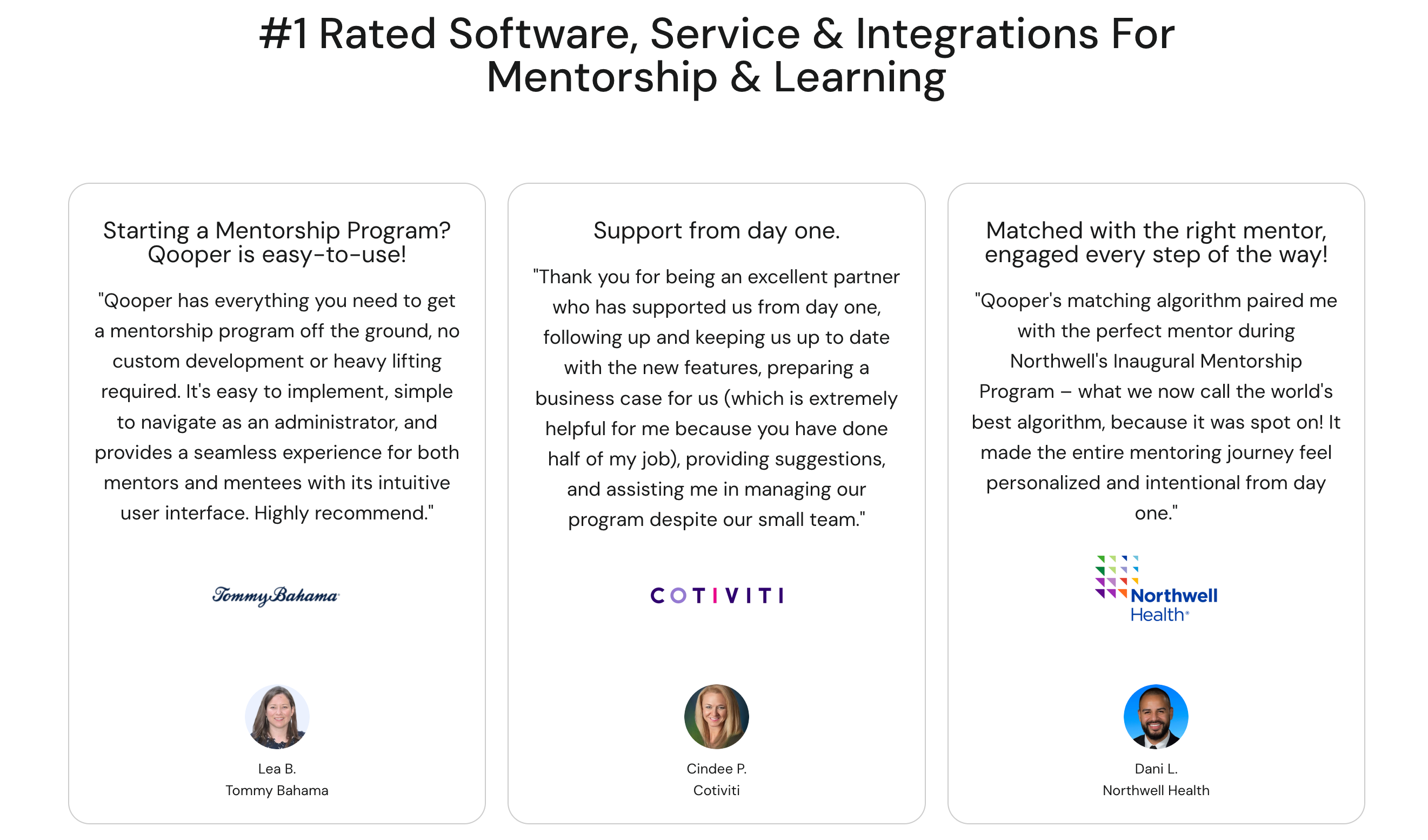
Organizations across industries — financial services, healthcare, technology, manufacturing, professional services — choose Qooper for enterprise mentoring programs that need to scale without sacrificing quality, deliver measurable outcomes, and survive budget scrutiny year over year.
The Bottom Line
The right enterprise mentoring software does not just manage a program — it becomes the infrastructure through which an organization develops its leaders, retains its talent, builds an inclusive culture, and proves the financial return on its people investment.
Qooper is that infrastructure.
Enterprise Mentoring Software: Summary and Next Steps
Enterprise mentoring software is not a nice-to-have for large organizations — it is the operational infrastructure that makes scalable, measurable, and equitable mentoring possible.
The organizations that get the most from their mentoring investment share a common approach: they choose a platform that can grow with their programs, integrate with their HR tech stack, generate the analytics their executives need, and provide the implementation support to get off the ground quickly.
Related reading:
- Enterprise mentoring software features: what every large organization should require
- Enterprise mentoring software ROI: retention, onboarding, and leadership development results
- Enterprise Mentoring Software Use Cases: 8 Programs to Run
- Best Enterprise Mentoring Software: Top Platforms in 2026
- Creating A Successful Enterprise Mentoring Program
- Enterprise Mentoring Software Integrations
- Enterprise Mentoring Software for Global Organizations: Multi-Language & Multi-Region
Ready to see enterprise mentoring software in action?
Qooper is built from the ground up for enterprise mentoring complexity — AI-powered matching, native integrations with Workday, SAP SuccessFactors, Slack, and Microsoft Teams, SOC 2 Type II certified, and a dedicated customer success model included in every enterprise contract.
%20(1)-Sep-14-2026-06-07-14-9032-PM.png)
-Sep-10-2025-02-24-27-2285-PM.jpg)
%20(1)-1.png)