




 ·
16 minute read
·
16 minute read
No single platform can solve every cause of employee turnover.
Employees may leave because they cannot see a future inside the organization, feel disconnected from colleagues, receive limited development support, experience poor onboarding, struggle with an ineffective manager, or believe their workload is no longer sustainable.
Each problem requires a different response.
The tools that help reduce employee turnover include mentoring platforms, employee-listening systems, human capital management software, performance-management platforms, professional coaching solutions, and broader talent-management suites.
Qooper, Culture Amp, Workday HCM, Workday Peakon Employee Voice, Lattice, BetterUp, 15Five, and Leapsome can all contribute to employee retention, but they do so through different mechanisms.
Qooper provides the structured mentoring and relationship-development layer. Culture Amp and Workday Peakon help organizations listen to employees. Workday HCM centralizes workforce and talent data. Lattice and 15Five connect employee feedback with performance and manager processes. BetterUp delivers professional coaching, while Leapsome brings several HR and talent workflows into one platform.
These tools are not direct alternatives. They support different parts of an HR retention strategy.
For organizations where turnover is connected to career growth, onboarding, workplace connection, internal mobility, leadership development, or succession readiness, Qooper helps turn retention priorities into structured mentoring programs.
Gallup found that 42% of surveyed voluntary leavers believed their manager or organization could have done something to retain them. Yet 45% reported that no manager or leader had proactively discussed their satisfaction, performance, or future during the three months before they left. The findings illustrate why retention strategies must create opportunities for earlier conversations and relevant intervention—not simply document what happened after an employee resigns.
Tools That Help Reduce Employee Turnover at a Glance
| Tool | Primary function | How it can support employee retention | Where it fits |
|---|---|---|---|
| Qooper | Enterprise mentoring software | Creates structured development relationships and surfaces engagement, mobility, and retention signals | Mentoring and relationship-development layer |
| Culture Amp | Employee listening and people analytics | Identifies employee sentiment, engagement drivers, and areas requiring action | Employee-listening layer |
| Workday HCM | Human capital management | Centralizes workforce information and supports enterprise talent processes | HR infrastructure layer |
| Workday Peakon Employee Voice | Continuous employee listening | Collects employee feedback and helps organizations understand retention risks | Continuous-listening layer |
| Lattice | Performance and engagement management | Connects surveys, goals, feedback, reviews, and manager action | Performance-management layer |
| BetterUp | Professional coaching | Provides personalized human and AI coaching for employees and leaders | Coaching layer |
| 15Five | Manager effectiveness and engagement | Helps managers and HR teams act on employee feedback | Manager-action layer |
| Leapsome | HRIS and talent management | Connects onboarding, performance, engagement, learning, goals, and HR workflows | Integrated HR and talent layer |
The platforms in this guide should not be treated as one software category.
An employee-listening platform can reveal why employees are disengaged. An HCM system can show where turnover is concentrated. A performance platform can strengthen manager processes. A coaching platform can support individual development. Qooper can deliver a structured mentoring intervention when employees need stronger onboarding, career guidance, internal relationships, leadership access, or mobility support.
How Different HR Tools Support Employee Retention
A useful way to understand retention technology is to separate it into four functions: diagnosis, infrastructure, intervention, and measurement.
Diagnosis
Employee-listening and engagement platforms help HR teams understand what employees are experiencing.
They may identify patterns related to manager quality, career development, belonging, workload, recognition, leadership trust, or intent to stay.
Culture Amp, Workday Peakon Employee Voice, Lattice, and 15Five all provide employee-feedback or engagement capabilities.
These systems help answer:
What are employees experiencing, and where are retention concerns concentrated?
Infrastructure
Workforce data, organizational structures, roles, skills, and talent processes often sit within an HCM or HRIS.
Workday HCM and Leapsome provide broader infrastructure that can support turnover analysis, workforce planning, onboarding, performance, and internal mobility.
These systems help answer:
Who are our employees, where are they in the organization, and which workforce processes affect their experience?
Intervention
Once the organization understands the problem, it needs an appropriate response.
BetterUp can provide professional coaching when leaders, managers, or selected employee populations need individualized coaching support.
Qooper provides structured mentoring when employees need stronger career guidance, onboarding support, internal relationships, knowledge transfer, leadership exposure, or visibility into internal opportunities.
Qooper helps answer:
Which development relationships should we create, and how can we keep those relationships relevant, active, and measurable?
Measurement
Retention initiatives need to be connected to outcomes.
Relevant measures may include employee sentiment, program engagement, relationship health, first-year retention, internal mobility, leadership readiness, and voluntary turnover.
Each platform measures a different part of the employee experience. The objective is not to make one product perform every function. It is to connect the appropriate tools around the organization’s actual retention challenges.
1. Qooper: Enterprise Mentoring Software That Supports Employee Retention
Qooper is enterprise mentoring software for organizations that need to launch, manage, scale, and measure structured mentoring programs across departments, locations, business units, and employee populations.
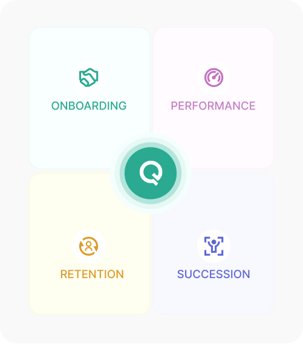
Organizations use Qooper for career mentoring, new-hire onboarding, peer mentoring, high-potential development, leadership mentoring, employee communities, knowledge transfer, internal mobility, and succession initiatives.
Qooper’s role in an employee-retention strategy is specific: it helps organizations create and manage development relationships at scale.
These relationships can give employees clearer career direction, stronger internal networks, greater access to experienced colleagues, and more visibility into opportunities inside the organization.
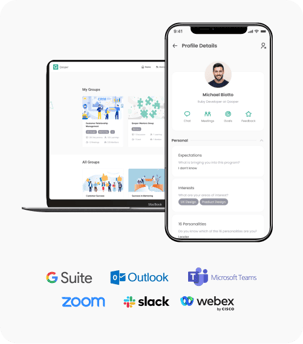
Qooper supports the full mentoring journey rather than stopping at the initial introduction. Its capabilities include smart matching, participant training, program templates, meeting guidance, goals, automated follow-up, surveys, relationship tracking, reporting, integrations, and Qooper Insights.
Qooper Capabilities That Support Employee Retention
| Capability | Business value |
|---|---|
| Smart matching | Improves mentor-mentee fit based on goals, skills, interests, availability, working preferences, and program objectives |
| Program templates | Speeds up the launch of onboarding, career-growth, leadership, high-potential, and succession programs |
| Mentorship training library | Helps mentors and mentees understand their roles and arrive prepared |
| Meeting agendas and automated follow-ups | Keeps mentoring relationships structured and productive after the initial match |
| Goals, milestones, and feedback | Gives relationships a clear purpose and allows progress to be monitored |
| Qooper Insights | Surfaces retention risks, engagement signals, relationship-health patterns, and career-movement trends |
| Mobile-first participant experience | Makes participation more accessible across office-based, remote, hybrid, and global workforces |
| Reporting and ROI analytics | Gives HR visibility into participation, engagement, development, mobility, and program outcomes |
| HRIS, calendar, video, communication, and SSO integrations | Fits mentoring into existing enterprise systems and employee workflows |
| Multi-program administration | Allows HR teams to manage different mentoring use cases through one platform |
The value does not come from matching two names in a database.
It comes from creating a relevant relationship, preparing participants, establishing clear goals, supporting ongoing conversations, and measuring whether the relationship is contributing to the intended talent outcome.
How Qooper Can Help Address Retention Challenges
| Retention challenge | Qooper response | Intended outcome |
|---|---|---|
| New hires feel disconnected | Structured onboarding mentoring or buddy programs | Faster adjustment and stronger early engagement |
| Employees cannot see a future inside the company | Career mentoring | Greater career clarity and internal-mobility awareness |
| High-potential employees feel overlooked | HiPo and future-leader mentoring programs | Stronger leadership pipeline and succession readiness |
| Employees feel isolated | Peer, group, circle, or cross-functional mentoring | Better belonging and organizational connection |
| Employees depend on one manager for all development | Mentoring outside the reporting line | Broader guidance, perspective, and internal networks |
| New managers need practical support | Manager mentoring | Greater confidence and leadership capability |
| Critical knowledge is concentrated in a few employees | Knowledge-transfer mentoring | Better continuity and reduced succession risk |
| HR identifies disengagement too late | Qooper Insights | Earlier visibility into engagement and retention signals |
| HR cannot demonstrate program value | Reporting and ROI analytics | Better visibility into participation, progress, mobility, and outcomes |
Career Mentoring and Internal Mobility
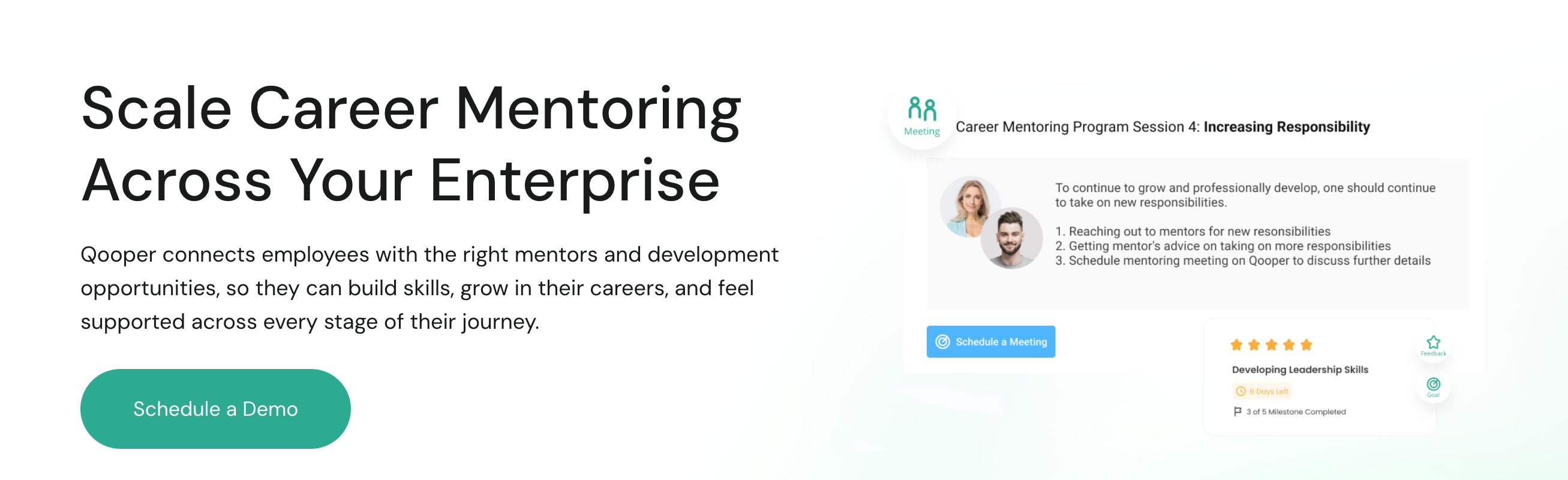
Employees are more likely to consider external opportunities when internal career paths feel invisible or inaccessible.
A career portal may show open positions, but it cannot explain how an employee developed the experience required for a future role. A course library may provide useful content, but it cannot provide personal context, organizational knowledge, or an introduction to someone working in the role.
A mentor can help an employee understand possible career paths, identify skill gaps, reflect on development priorities, and learn how other parts of the organization operate.
Qooper gives these conversations structure through goal-based matching, participant profiles, development goals, meeting agendas, activities, reminders, and feedback.
This allows organizations to use career mentoring as part of a broader internal-mobility strategy rather than treating mentoring as a standalone engagement initiative.
New-Hire Onboarding and Buddy Programs
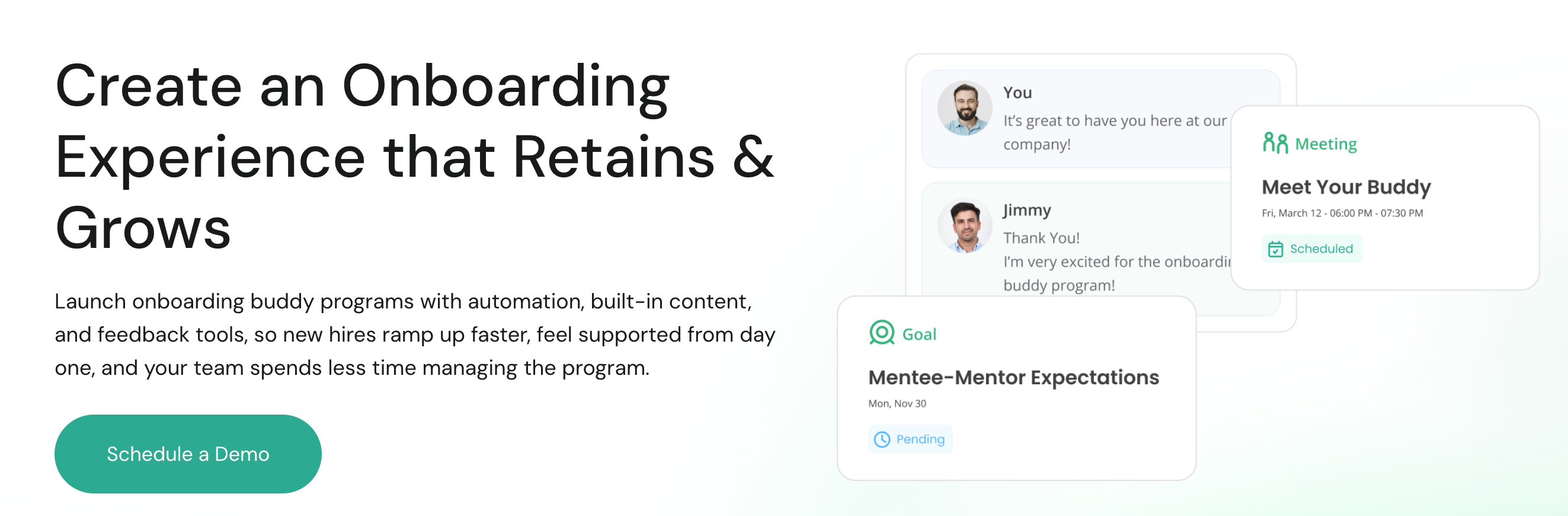
A new employee can complete every administrative onboarding task and still feel disconnected.
New hires also need informal knowledge, trusted relationships, role context, and confidence about where to go for help.
Qooper helps organizations create structured onboarding mentoring and buddy programs with automated matching, defined journeys, first-meeting guidance, reminders, milestones, and participant feedback.
The new hire gains a dedicated source of support outside the standard administrative process. HR gains visibility into whether the relationship is active and whether participants are receiving the intended experience.
This makes onboarding more relational, not only procedural.
Employee Engagement and Belonging
Employees are easier to lose when all their workplace relationships are tied to one manager or one immediate team.
Structured mentoring can create connections across functions, departments, seniority levels, locations, and employee communities.
Qooper supports one-to-one mentoring, peer mentoring, group mentoring, mentoring circles, reverse mentoring, and other relationship formats.
These programs can be particularly valuable in global, hybrid, and distributed organizations, where informal relationship building does not happen consistently.
The goal is not to increase the number of meetings for its own sake. It is to help employees build meaningful relationships through which they can learn, contribute, and feel connected to the wider organization.
Leadership Development and Succession Readiness
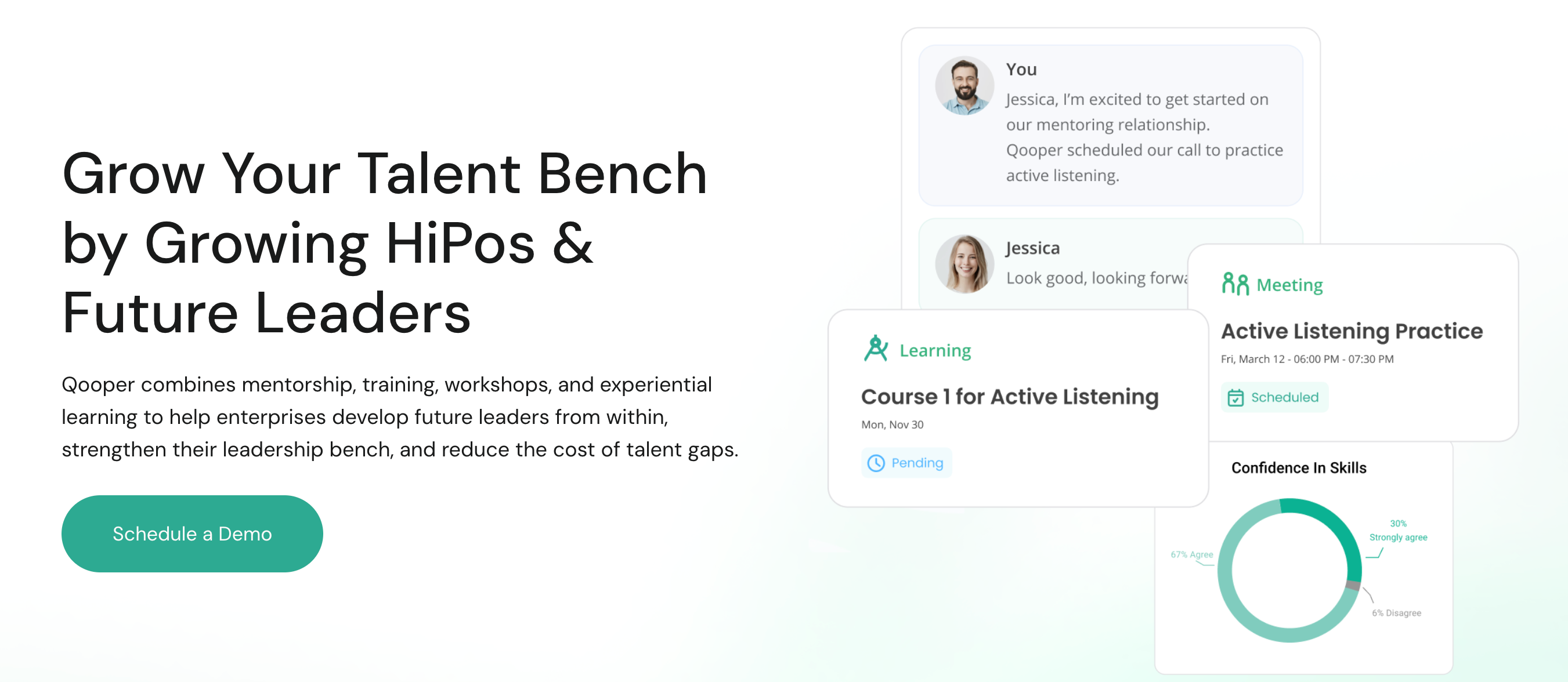
Employee retention is also connected to the strength of the organization’s leadership pipeline.
High-potential employees may leave when they do not see credible investment in their development or cannot understand what preparation for a future role should involve.
Qooper helps organizations create structured mentoring journeys for emerging leaders, new managers, high-potential employees, future executives, and potential successors for critical positions.
Participants can be connected with experienced leaders, work toward defined development goals, and gain perspectives outside their current responsibilities.
This supports individual development while helping the organization build a more deliberate and visible succession pipeline.
Knowledge Transfer
Turnover risk increases when critical expertise is concentrated in a small number of employees.
When experienced employees retire, change roles, or leave the organization, undocumented knowledge can leave with them.
Qooper can support structured knowledge-transfer mentoring by connecting experienced employees with colleagues who need to develop role-specific knowledge, institutional context, or technical expertise.
Goals, meeting frameworks, activities, and progress tracking help make that transfer more deliberate than informal shadowing alone.
Qooper Insights and Earlier Retention Signals
-2.png?width=392&height=373&name=image%20(7)-2.png)
Annual engagement surveys provide a useful snapshot. Exit interviews occur after an employee has already decided to leave.
Qooper Insights provides an additional view between those moments.
Qooper Insights surfaces retention risks, engagement signals, and career-movement trends from mentoring and development activity, helping HR and talent teams act earlier.
Signals may include changes in participation, inactive mentoring relationships, incomplete goals, relationship-health patterns, participant feedback, development priorities, skill interests, and career-movement activity.
These signals should not be interpreted as proof that a specific employee intends to resign.
Instead, they may indicate that a relationship, program, or employee population requires additional support, a respectful conversation, or further analysis.
The objective is not employee surveillance. It is to give HR and talent teams an earlier opportunity to understand whether employees remain connected to their development.
How Qooper Fits With Existing HR Systems
Qooper does not need to replace an organization’s HRIS, employee-listening platform, learning system, performance-management platform, or coaching solution.
It can operate as the structured mentoring and relationship-development layer within the broader HR technology stack.
Employee information can flow from the HRIS. Survey results can identify populations that need support. Performance and talent data can inform program objectives. Qooper can then deliver the relevant mentoring experience and report on participation, relationship progress, development, mobility, and engagement.
This enables HR teams to connect mentoring with existing workflows instead of creating another disconnected employee program.
2. Culture Amp: Employee Listening and People Analytics
Culture Amp is an employee-experience platform with capabilities spanning employee engagement, performance, feedback, and people analytics.
Its engagement product includes surveys, pulse surveys, onboarding and offboarding feedback, benchmarks, retention insights, comment analysis, and action planning.
Culture Amp can support employee retention by helping HR teams understand how employees feel and where engagement problems are concentrated.
It can help organizations examine questions such as whether employees believe they have opportunities to grow, whether confidence in management is declining, or whether particular employee populations report a weaker experience.
The resulting insight still requires an organizational response.
When survey findings point to career growth, onboarding, belonging, internal connection, or development access, an organization can use Qooper to create structured mentoring programs for the affected populations.
In that model, Culture Amp provides an employee-listening layer while Qooper provides a relationship-based development intervention.
3. Workday HCM: Workforce and Talent Infrastructure
Workday Human Capital Management is a broad enterprise suite covering core HCM, talent management, workforce management, workforce planning, analytics, employee experience, and related HR processes.
Its role in employee retention begins with workforce information and talent infrastructure.
Workday can help organizations understand where employees sit, how roles and skills are changing, where turnover is concentrated, and which workforce processes may require attention.
This information can support career architecture, workforce planning, internal mobility, talent reviews, and turnover analysis.
Workday HCM and Qooper perform different functions.
Workday can remain the primary source of employee and organizational information. Qooper can use relevant employee data to support mentoring enrollment, matching, participant management, and reporting.
This allows an organization to connect its core HR infrastructure with a dedicated mentoring experience without expecting the HCM system to manage every part of a mentoring relationship.
4. Workday Peakon Employee Voice: Continuous Employee Listening
Workday Peakon Employee Voice is an employee-listening platform that helps organizations collect feedback, understand employee sentiment, and turn insights into action.
Its retention contribution comes from helping organizations understand how employees feel over time and where engagement or attrition concerns may be developing.
Peakon may reveal that a population feels disconnected, lacks development opportunities, or has low confidence in internal career options.
When the finding points to a relationship or development gap, Qooper can provide career mentoring, onboarding, peer mentoring, leadership mentoring, or high-potential programs designed around that need.
The platforms can therefore contribute at different stages:
| Stage | Workday Peakon Employee Voice | Qooper |
|---|---|---|
| Identify the issue | Collects and analyzes employee feedback | Adds mentoring and development signals |
| Define the population | Shows where employee-experience concerns are concentrated | Uses program eligibility and employee data to reach that population |
| Deliver an intervention | Supports action planning | Creates structured mentoring relationships |
| Monitor progress | Tracks employee sentiment over time | Tracks participation, relationship health, goals, feedback, and mobility |
5. Lattice: Performance and Engagement Management
Lattice combines employee engagement with performance management, goals, feedback, reviews, manager processes, and talent workflows.
Its engagement capabilities can help organizations collect employee feedback, understand recurring themes, and connect findings with manager and performance processes.
This can support retention when the issue is closely connected to manager behavior, feedback quality, career conversations, goal clarity, or follow-through.
Qooper adds a different relationship to the employee experience.
A mentor can provide career guidance, cross-functional exposure, institutional knowledge, and a development relationship outside formal performance evaluation.
Lattice can help strengthen manager and performance processes. Qooper can help employees build a broader internal development network.
The platforms may be used together when the organization wants employees to receive both stronger manager support and access to mentors beyond the reporting line.
6. BetterUp: Professional Coaching
BetterUp provides human coaching, AI coaching, leadership development, manager development, resilience, and related professional-development services.
It can support employee retention when leaders, managers, or selected employee populations need personalized coaching, behavior change, leadership support, or resilience development.
Coaching and mentoring can contribute to the same talent strategy, but they are not identical.
A professional coach may help an employee improve self-awareness, communication, leadership behavior, resilience, or performance.
An internal mentor can provide organizational context, role-specific experience, institutional knowledge, career navigation, sponsorship, and access to internal networks.
An enterprise may therefore use BetterUp for professional coaching and Qooper for internal mentoring, onboarding, knowledge transfer, internal mobility, and succession programs.
7. 15Five: Manager Effectiveness and Engagement Action
15Five combines employee engagement, eNPS, manager-effectiveness insights, lifecycle feedback, performance processes, and action planning.
It can help organizations understand which factors are affecting engagement and where managers or leaders should act.
This makes 15Five relevant when retention concerns are closely connected to manager effectiveness, feedback, communication, or the consistency of employee conversations.
Qooper can complement that work by creating development relationships outside the reporting line.
An employee may need a stronger manager, but they may also benefit from a career mentor, peer mentor, senior leader, onboarding buddy, or subject-matter expert.
15Five can help improve the manager-led employee experience. Qooper can help create a wider network of development and support.
8. Leapsome: Connected HRIS and Talent Workflows
Leapsome combines HRIS capabilities with onboarding, performance reviews, engagement surveys, goals, learning, feedback, meetings, and compensation workflows.
The platform can support employee retention by connecting employee information with several HR and talent processes in one environment.
Qooper provides a more specialized mentoring experience within that broader talent ecosystem.
It supports configurable mentor matching, participant preparation, guided mentoring journeys, multiple relationship formats, automated follow-up, relationship-health tracking, and mentoring-specific reporting.
An organization may use Leapsome for broad HR and talent management while using Qooper for mentoring initiatives connected to onboarding, mobility, engagement, leadership development, knowledge transfer, and succession.
How These Tools Can Work Together
The tools covered in this guide can be viewed as different layers of a retention technology strategy.
| Retention function | What HR needs to accomplish | Relevant tools |
|---|---|---|
| Employee listening | Understand employee sentiment, engagement, and recurring concerns | Culture Amp, Workday Peakon, Lattice, 15Five |
| Workforce infrastructure | Maintain employee data, organizational structures, and broad talent processes | Workday HCM, Leapsome |
| Performance and manager action | Improve feedback, goals, reviews, one-to-ones, and manager accountability | Lattice, 15Five |
| Professional coaching | Develop selected leaders, managers, or employee populations through coaching | BetterUp |
| Structured mentoring | Create career, onboarding, peer, leadership, knowledge-transfer, and succession relationships | Qooper |
| Retention intelligence | Monitor sentiment, program engagement, relationship health, and mobility signals | Qooper Insights and employee-listening platforms |
| Outcome measurement | Connect programs with retention, engagement, onboarding, mobility, and leadership outcomes | Reporting capabilities across the HR stack |
A mature retention strategy may use several of these functions.
For example, an organization might use Workday HCM to identify a first-year turnover pattern, Culture Amp or Workday Peakon to understand the new-hire experience, and Qooper to launch a structured onboarding mentoring program.
Another organization might use Lattice or 15Five to strengthen manager conversations, BetterUp to coach selected leaders, and Qooper to provide high-potential employees with broader internal mentoring relationships.
The correct combination depends on the verified cause of turnover.
Match the Tool to the Retention Problem
Technology selection should begin with a diagnosis, not a vendor category.
| Retention problem | Tools that can help diagnose or manage it | Potential organizational response |
|---|---|---|
| Employees cannot see a career path | HCM, talent analytics, employee listening | Career architecture, internal opportunities, and structured mentoring |
| New hires feel disconnected | Onboarding feedback, HRIS, engagement platforms | Structured onboarding and buddy programs |
| Employees lack development opportunities | Engagement surveys, performance systems, learning data | Career mentoring, applied learning, and stretch opportunities |
| Employees feel isolated | Employee listening and belonging data | Peer, group, circle, or cross-functional mentoring |
| Managers are not having meaningful conversations | Engagement and performance-management platforms | Manager development, coaching, and accountability |
| High-potential employees are leaving | Talent reviews, succession data, stay interviews | Leadership mentoring, coaching, and visible development plans |
| Internal mobility is low | HCM, talent data, mobility analytics | Career pathways, mentoring, projects, and internal opportunities |
| Employees report excessive workload | Surveys, workforce planning, scheduling data | Staffing, prioritization, and work redesign |
| Compensation is below market | Compensation analysis and benchmarking | Pay correction |
| Trust in leadership is declining | Employee listening, ethics data, and qualitative feedback | Leadership accountability and cultural repair |
Qooper is most relevant when the evidence points to development, onboarding, workplace connection, internal mobility, leadership development, knowledge transfer, or succession readiness.
Mentoring should not be used as a substitute for compensation correction, sustainable staffing, effective management, safe working conditions, or trustworthy leadership.
How to Build an HR Retention Strategy Around Qooper
Start With the Cause of Turnover
Begin by segmenting voluntary turnover by manager, department, role, tenure, location, performance level, promotion history, and employee population where appropriate.
Combine that data with engagement surveys, stay interviews, exit interviews, onboarding feedback, compensation analysis, workload information, and manager conversations.
The objective is to distinguish between a development problem, a relationship problem, an operational problem, and a compensation or leadership problem.
Qooper is most relevant when the evidence points to career visibility, learning, onboarding, internal connection, leadership development, knowledge transfer, or succession.
Select the Appropriate Mentoring Program
Different retention challenges require different mentoring formats.
Career mentoring can support career visibility and internal mobility.
Onboarding mentoring can help new hires build confidence, relationships, and organizational context.
Peer and cross-functional mentoring can strengthen belonging.
High-potential and leadership mentoring can support future-role readiness.
Knowledge-transfer mentoring can reduce reliance on a small number of experienced employees.
Qooper allows these programs to be managed through one platform while maintaining different eligibility rules, matching criteria, participant journeys, communications, and reporting.
Related Article: Types of Mentoring: Find the Right Fit for Your Organization
Monitor Program and Relationship Health
Program enrollment is not the same as program success.
HR leaders need visibility into whether participants accepted their matches, completed preparation, created goals, scheduled meetings, remained active, and provided feedback.
Qooper’s reporting and Insights capabilities help teams monitor participation, engagement, relationship progress, development themes, career interests, mobility, and possible retention signals.
This gives program administrators an opportunity to support inactive or stalled relationships before the program ends.
Connect Mentoring With Measurable Outcomes
| Retention objective | Metrics to track |
|---|---|
| Improve new-hire retention | First-year retention, onboarding milestones, role clarity, time to productivity, and buddy engagement |
| Increase employee engagement | Participation, meeting activity, relationship health, satisfaction, belonging, and intent to stay |
| Strengthen career development | Goal progress, skill growth, career clarity, and access to stretch opportunities |
| Improve internal mobility | Internal applications, promotions, lateral moves, and mobility among participants |
| Build leadership pipelines | High-potential retention, readiness levels, internal fill rates, and successor coverage |
| Protect organizational knowledge | Knowledge-transfer activity, successor readiness, and continuity in critical roles |
| Demonstrate mentoring value | Adoption, administrative time saved, retention trends, mobility, and estimated business impact |
Metrics should be segmented by employee population and compared over time.
Where data quality allows, HR teams should compare program participants with a historical baseline or an appropriate nonparticipant group.
The analysis should consider other organizational changes rather than assuming that mentoring alone caused the result.
Qooper’s Role in the Retention Technology Stack
Qooper does not replace every platform covered in this guide because the products perform different functions.
Culture Amp and Workday Peakon help organizations listen to employees.
Workday provides workforce and talent infrastructure.
Lattice and 15Five support performance, feedback, and manager action.
BetterUp provides professional coaching.
Leapsome connects several HR and talent workflows.
Qooper provides the structured mentoring layer.
It helps organizations create and manage the internal development relationships that support onboarding, career growth, belonging, internal mobility, leadership development, knowledge transfer, and succession readiness.
Qooper can use employee information from an HRIS, respond to themes identified through engagement surveys, complement performance-management processes, and operate alongside professional coaching programs.
Its value is not that it replaces the rest of the HR technology stack.
Its value is that it gives organizations a structured way to act when employees need development relationships, career guidance, internal connections, or access to experienced leaders.
Turn Retention Insight Into Action With Qooper
Employee turnover is easier to address before an employee has decided to leave.
Qooper helps enterprises create structured mentoring programs for onboarding, career development, internal mobility, employee connection, leadership development, knowledge transfer, and succession readiness.
Qooper Insights also gives HR and talent teams visibility into engagement signals, relationship progress, career movement, and possible retention risks emerging from mentoring and development activity.
Book a Qooper demo to explore how structured mentoring can support your broader employee-retention strategy.
Related Articles
- Employee Retention Strategies
- 40 Mentoring Statistics That Prove ROI for Employee Retention (2026)
- 30 Employee Turnover Statistics Every HR Leader Should Know in 2026
- How to Build Mentoring Program That Reduces Employee Turnover
- Cost of Employee Turnover: What Losing An Employee Actually Costs an Enterprise
- 9 Causes of Employee Turnover, Warning Signs, and Where Mentoring Helps
- Top 10 HR Tools to Improve Employee Retention in 2026
- 12 Employee Retention Metrics Every HR Leader Should Track in 2026
- Why Mentoring Is Becoming an Enterprise Employee Retention Strategy
- How to Improve Employee Retention With Mentoring
- What Is Employee Retention? Strategies and Challenges for 2026
- How to Reduce Employee Turnover?
Frequently Asked Questions
What Types of Tools Can Help Reduce Employee Turnover?
Several types of HR and talent technology can help reduce employee turnover.
These include enterprise mentoring software, employee-listening platforms, HCM and HRIS systems, performance-management software, professional coaching platforms, manager-effectiveness tools, and talent-management suites.
Examples include Qooper, Culture Amp, Workday HCM, Workday Peakon Employee Voice, Lattice, BetterUp, 15Five, and Leapsome.
These products do not belong to one employee-retention software category. Each supports a different part of the employee experience that can influence retention.
Are These Products Employee Retention Tools?
Not necessarily.
Most of the platforms in this guide belong to broader categories such as mentoring, employee listening, HCM, performance management, coaching, or talent management.
They can support employee retention because the processes they improve—development, engagement, onboarding, management, mobility, and leadership readiness—can influence whether employees stay.
How Does Mentoring Software Help Reduce Employee Turnover?
Mentoring software helps employees build stronger internal relationships, understand career paths, develop skills, navigate onboarding, and access guidance outside their direct reporting line.
These experiences can improve career clarity, belonging, internal mobility, leadership readiness, and an employee’s ability to see a future inside the organization.
Mentoring works most effectively when the program is structured and the organization provides real development and internal-mobility opportunities.
How Does Qooper Fit Into an Employee-Retention Technology Stack?
Qooper provides the structured mentoring and relationship-development layer.
It can use employee and organizational information from an HRIS, respond to issues identified through engagement surveys, complement manager and performance processes, and deliver mentoring programs for onboarding, career development, internal mobility, leadership development, knowledge transfer, and succession.
Qooper can therefore operate alongside platforms such as Workday, Culture Amp, Lattice, 15Five, BetterUp, and Leapsome rather than replacing them.
How Does Qooper Insights Identify Retention Risks?
Qooper Insights analyzes signals from mentoring and development activity, including participation, relationship progress, goals, feedback, career interests, and career-movement trends.
The purpose is not to declare that a specific employee will leave.
It is to help HR and talent teams identify patterns that may require a conversation, additional support, or a broader organizational response.
Can Employee Engagement Surveys Reduce Turnover?
Employee engagement surveys can help identify dissatisfaction, weak management, limited development, workload concerns, low belonging, and other retention risks.
A survey does not solve those issues by itself.
Organizations must select an intervention that matches the finding. When survey results point to career growth, onboarding, internal connection, mobility, or leadership-development needs, structured mentoring may be an appropriate response.
Which Retention Problems Can Qooper Help Address?
Qooper is particularly relevant when turnover is connected to poor onboarding, limited career visibility, insufficient development, weak internal networks, low belonging, limited access to experienced leaders, low internal mobility, knowledge-transfer risk, or an underdeveloped succession pipeline.
It can also give HR teams visibility into mentoring engagement, relationship health, career interests, and retention-related signals.
Which Turnover Problems Cannot Be Solved With Mentoring?
Mentoring cannot correct below-market compensation, chronic understaffing, unreasonable workloads, unsafe conditions, discrimination, inflexible policies, or leadership behavior that has damaged trust.
A mentor may support an employee experiencing these problems, but the organization must correct the underlying issue directly.
What Metrics Should HR Leaders Track?
HR leaders should track voluntary turnover, regrettable attrition, first-year retention, employee engagement, intent to stay, mentoring participation, relationship health, development-goal progress, internal mobility, promotion rates, leadership readiness, internal fill rates, and succession coverage.
Metrics should be segmented by manager, department, role, tenure, location, employee population, and program participation where appropriate.
Can One HR Platform Solve Every Employee-Turnover Problem?
No single HR platform can solve every reason employees leave.
An organization may use an HRIS for workforce data, an employee-listening platform for feedback, a performance system for manager processes, a coaching platform for selected development needs, and mentoring software for structured employee relationships.
The technology stack should be selected according to the organization’s verified causes of turnover.
-Jul-16-2026-06-23-59-3782-PM.png)
-4.png)
.webp)