




 ·
8 minute read
·
8 minute read
Employee retention has become one of the hardest talent challenges enterprises face. Millions of employees voluntarily leave their jobs every month, according to Gallup, replacing each one can cost from one-half to two times their annual salary (link Gallup), and the employees most likely to leave — high performers, future leaders, ambitious new hires — are exactly the ones organizations can least afford to lose. Pay increases alone don't stop it: employees leave when they can't see a career path, feel disconnected from colleagues and leadership, and sense that no one is invested in their growth.
Structured mentoring directly addresses those root causes. Employees with meaningful workplace relationships, visible career paths, and ongoing development stay longer — and a structured mentoring program is one of the few interventions that delivers all three at once, in a way that can be measured against real turnover data.
This guide explains why employees leave, how mentoring addresses the root causes of turnover, and how enterprises use Qooper to turn mentoring into a measurable retention strategy.
Why Do Employees Leave Organizations?
Employees most often leave for reasons that mentoring directly addresses — and each one is specific enough to target:
- Lack of career development. Employees who can't see how they'll grow stop investing in the organization and start browsing elsewhere. This is consistently among the top cited reasons for voluntary departure.
- Weak manager/leader connection. A large share of departures trace back to the direct manager relationship — limited support, infrequent feedback, or outright friction with no alternative senior figure to turn to.
- Limited internal mobility. When employees can't find their next role inside the organization, they find it outside. Opaque internal opportunities push ambitious people to external recruiters.
- Poor onboarding experience. Turnover peaks in the first one to two years. New hires who don't build relationships or reach productivity quickly rarely stay past that window.
- Low belonging in hybrid and global teams. Distributed employees have fewer organic chances to connect with colleagues, and isolation quietly converts into disengagement — then departure.
- No visible support system. Employees who feel no one is invested in their growth conclude the organization sees them as headcount, not talent.
Compensation matters, but it is rarely the only driver — employees who see a future inside the organization stay longer, even when external offers exist.
For enterprises, the cost of turnover compounds quickly. Replacing an employee typically costs between 50% and 200% of their annual salary once recruiting, onboarding, lost productivity, and institutional knowledge loss are accounted for. Across thousands of employees, even a one-point improvement in retention translates into significant savings — which is why retention has become a board-level talent metric, not just an HR concern.
How Do Mentoring Programs Improve Employee Retention?
Mentoring programs improve retention by giving employees structured, ongoing relationships that build connection, accelerate skill development, and make career paths visible. Instead of hoping employees find guidance organically, mentoring programs guarantee that every participant has someone invested in their growth.
Mentoring impacts retention through five mechanisms:
1. Connection and belonging. Employees with strong workplace relationships are significantly less likely to leave. Mentoring creates cross-departmental, cross-level relationships that would rarely form organically — especially in global, hybrid, or distributed organizations.
2. Career visibility. Mentors help mentees understand how careers actually progress inside the organization. When employees can see a realistic internal path, they are less likely to look for one externally.
3. Skill development. Mentoring accelerates upskilling in a personalized way that generic training cannot. Among mentoring participants, 91% report more confidence handling new challenges, 90% report learning new skills and knowledge for their job, and 85% report improved quality of work through a better employee experience.
4. Engagement and ambition. Engaged employees are more loyal, motivated, and productive. Mentoring participants report 70% higher ambition to take on more responsibility, and 63% of employees name mentoring as their preferred method of learning.
5. Early warning signals. Structured mentoring programs generate engagement data — participation, session activity, feedback, goal progress — that reveals disengagement before it becomes a resignation.
What a Retention-Focused Mentoring Program Should Include
Not every mentoring program moves retention numbers. Informal, unstructured mentoring — where pairs are matched by title and left alone — tends to fade within a few sessions and leaves nothing to measure. A mentoring program built to improve retention should include the following, regardless of which platform or process runs it:
- Match employees based on goals, skills, interests, and career direction
- Give mentoring pairs structured agendas and conversation guides
- Track participation, session activity, satisfaction, and goal progress
- Compare retention and mobility among participants vs. non-participants
- Build different mentoring tracks for new hires, emerging leaders, and career development
- Use surveys and feedback to identify where employees need support
Running all six manually — spreadsheet matching, email reminders, survey exports, HRIS cross-referencing — is possible for a small cohort, but it breaks down quickly at enterprise scale. This is where mentoring software like Qooper comes in: it operationalizes each element in one platform, from algorithmic matching and automated session guidance to engagement dashboards and participant-vs-non-participant retention reporting.
How Qooper Helps Enterprises Improve Retention
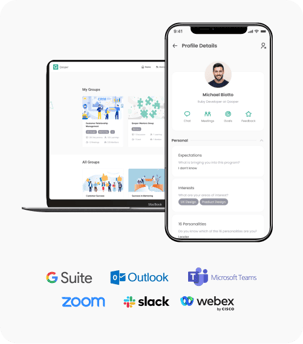
Qooper is enterprise mentoring software used by organizations to launch, manage, scale, and measure mentoring programs across departments, geographies, business units, and employee populations.
Smart Mentor Matching That Sets Relationships Up for Success

Retention outcomes depend on match quality. A poorly matched mentoring pair disengages quickly, and disengaged programs don't retain anyone. Qooper's customizable matching algorithm delivers smart recommendations that connect mentors, mentees, and peers based on career goals, skills gaps, interests, working styles, and program objectives — ensuring the best possible fit for impactful mentoring relationships. Administrators retain control through configurable matching workflows, approval processes, and match suggestions.
Structured Mentorship That Keeps Relationships Active
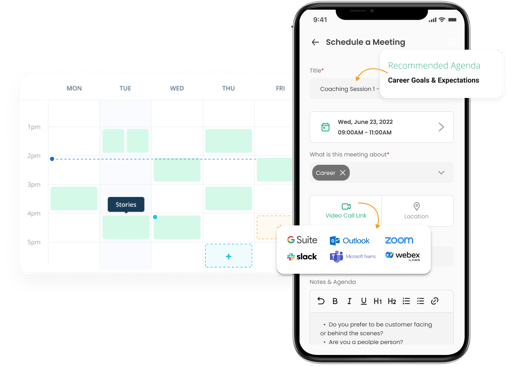
Most mentoring programs fail after the match, not before it. Qooper keeps relationships active by automatically delivering personalized meeting agendas, engaging activities, conversation starters, feedback templates, and goal templates. Participants are prepared for every session with certified mentorship training content, so mentors and mentees know what to do before, during, and after each meeting. Active mentoring relationships are what actually drive retention — not the existence of a program.
Groups and Communities That Build Belonging
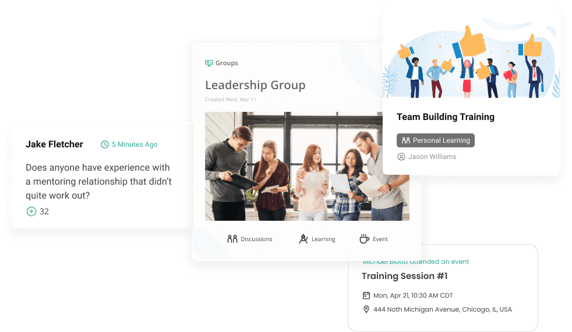
Belonging is one of the strongest predictors of retention. Qooper's group matching and creation tools connect employees around common interests, identities, or goals — enhancing belonging and collaboration across departments, locations, and seniority levels. For ERGs, communities, and peer circles, this creates the organic connection that keeps employees anchored to the organization.
Retention Reporting and Attrition-Risk Signals
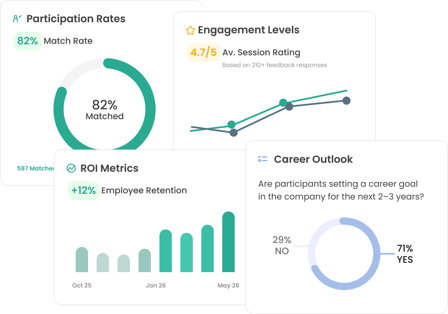
Qooper gives HR, L&D, and leadership teams visibility into participation, engagement, relationship progress, skill development, survey feedback, and program outcomes. Real-time reporting draws from program and individual progress, survey integrations, HRIS integrations, and Qooper's ROI calculator. For HR and talent teams, these signals can help identify engagement drops, participation trends, and relationship health indicators early — creating the opportunity to intervene before disengagement is discovered in an exit interview.
Retention Challenges, Mentoring, and Qooper at a Glance
|
Retention challenge |
How mentoring helps |
How Qooper supports it |
|
Employees feel disconnected |
Builds cross-functional relationships |
Smart matching, groups, circles, mobile engagement |
|
Employees do not see career paths |
Connects them with internal role models |
Goal-based matching, agendas, career-focused templates |
|
Programs lose momentum |
Gives pairs structure and reminders |
Meeting agendas, training, feedback templates, automated follow-up |
|
HR cannot see disengagement early |
Tracks participation and relationship health |
Reporting, surveys, engagement signals, ROI analytics |
|
Retention impact is hard to prove |
Connects mentoring to business outcomes |
ROI calculator, HRIS integrations, participant vs. non-participant comparison |
Measuring the Retention ROI of Mentoring
Retention ROI is measured by comparing turnover rates between mentoring participants and non-participants, then multiplying the retention difference by the average cost of replacing an employee. Qooper's ROI analytics and built-in ROI calculator make this calculation continuous rather than annual, connecting mentoring activity to retention, engagement, internal mobility, and succession readiness.
Retention ROI = (Non-participant turnover rate − Participant turnover rate) × Number of participants × Average cost of replacing one employee
For example: if non-participants leave at 18% and mentoring participants at 9%, a 1,000-participant program with an average replacement cost of $60,000 avoids roughly 90 departures — about $5.4 million in replacement costs. Leading indicators (participation, session activity, satisfaction) show up in months 1–6; the retention delta itself becomes measurable from month 6 onward.
The results are measurable. In one Qooper-powered program at PCG, a structured mentoring initiative with 160 participants achieved 98% retention, 100% mentee satisfaction, and 33% career mobility — and grew from one program to five as results compounded.
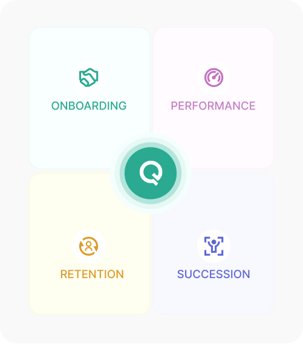
Mentoring also compounds retention through adjacent outcomes: faster onboarding reduces early-tenure attrition, leadership development strengthens succession pipelines, and internal mobility keeps ambitious employees growing inside the organization instead of outside it.
“I was really impressed with the new ROI for Leadership feature, especially the career movement timeline and retention rate. It’s a great enhancement, and it feels like Qooper is truly moving to another level.
Alli - Program Manager
Reviews like Alli's reflect a consistent theme across Qooper's customer feedback: program managers and HR teams value the ability to connect mentoring activity to the retention outcomes leadership actually asks about — career movement, engagement, and whether participants stay. That's part of why Qooper holds a 4.8 rating on Capterra and 4.6 on G2, with reviewers across enterprises, universities, and associations describing how structured mentoring keeps their people engaged, developing, and connected to the organization.
To see how other organizations are using Qooper for retention and career development programs, read more reviews on Capterra and G2.
Why Enterprise Organizations Choose Qooper for Retention
Qooper is especially useful for large, complex organizations that need to launch, manage, scale, and measure structured mentoring programs across departments, geographies, business units, and employee populations. It is enterprise mentoring software trusted by 300+ enterprise organizations — including Fortune 500 companies such as Google, VF Corporation, Tommy Bahama, HOK, Matthews International, and Rentokil — with thousands of users across 500+ mentoring programs.
For retention specifically, enterprises choose Qooper because it combines:
- Scalable matching that produces high-quality mentoring pairs across thousands of employees
- Structured relationship guidance that keeps programs active long after launch
- Retention-risk reporting that connects mentoring data to attrition signals, engagement trends, and measurable ROI
- HRIS integrations with Workday, SAP SuccessFactors, Oracle, ADP, and UKG, so retention reporting stays accurate as employees join, move, and grow
- Enterprise-grade security, including SOC 2 Type II certification and GDPR compliance
- High-touch customer success, with a dedicated customer success manager from day one, live kickoff support, and quarterly business reviews
Is Mentoring Software Necessary for Employee Retention?
Not always. A small program — a single cohort of 10–20 pairs — can be run manually with spreadsheets for matching, calendar invites for sessions, and periodic check-in surveys. If the program stays small and the coordinator has the time, manual can work.
At enterprise scale, the equation changes. Matching hundreds or thousands of participants equitably, keeping every pair active with agendas and reminders, running multiple program tracks simultaneously, and — most importantly — connecting participation data to HRIS records for participant vs. non-participant retention analysis is where manual coordination breaks down. The retention measurement itself, not just the administration, is what requires software: without systematic data, a program can improve retention and still be unable to prove it.
The practical rule: if the program is small enough to know every pair personally, run it manually and measure what you can. If it spans departments, geographies, or hundreds of participants — or if leadership expects retention ROI reporting — enterprise mentoring software like Qooper is what makes the program both operable and measurable.
Related Articles
- Employee Retention Strategies
- 40 Mentoring Statistics That Prove ROI for Employee Retention (2026)
- 30 Employee Turnover Statistics Every HR Leader Should Know in 2026
- 8 Tools That Help Reduce Employee Turnover: A Guide for HR Leaders
- How to Build Mentoring Program That Reduces Employee Turnover
- Cost of Employee Turnover: What Losing An Employee Actually Costs an Enterprise
- 9 Causes of Employee Turnover, Warning Signs, and Where Mentoring Helps
- Top 10 HR Tools to Improve Employee Retention in 2026
- 12 Employee Retention Metrics Every HR Leader Should Track in 2026
- How to Improve Employee Retention With Mentoring
- What Is Employee Retention? Strategies and Challenges for 2026
- How to Reduce Employee Turnover?
Frequently Asked Questions
Build a More Measurable Approach to Retention Through Mentoring
Retention improves when employees are connected, developing, and able to see their future inside your organization. Qooper provides the matching, structure, engagement tools, and retention reporting to make that happen at enterprise scale — and to prove it with data.
Schedule a demo to see how Qooper can strengthen employee retention across your enterprise.
-2.svg)

-4.png)