



 ·
15 minute read
·
15 minute read
Employees rarely leave because of a single bad day. A resignation is usually the final step in a longer process: an employee stops seeing a future, loses trust, becomes disconnected, feels underpaid, or decides that the demands of the job are no longer sustainable.
In a nationally representative U.S. study of 717 people who had voluntarily left an employer, Gallup found that 42% believed their manager or organization could have done something to retain them. Yet 45% said neither a manager nor another leader had proactively discussed their job satisfaction, performance, or future during the three months before they left.
That does not mean every resignation is preventable or that one universal factor explains why employees quit. It means organizations often have an opportunity to identify and address a problem before an employee decides to leave.
Employees usually leave because of overlapping problems with career growth, learning, onboarding, manager quality, belonging, recognition, workload and flexibility, compensation, or leadership trust. Mentoring is a strong-fit intervention for development and connection gaps, but it cannot replace fair pay, sustainable work design, or accountable leadership.
This guide explains nine recurring causes of voluntary employee turnover, the warning signs behind each one, and the organizational response most likely to help. It then applies the Qooper 9-Cause Turnover Scorecard to a narrower question: when is structured mentoring the right retention intervention?
Why Employees Leave: The Nine Causes at a Glance
The causes below are not mutually exclusive and are not ranked. An employee may experience several at once.
| # | Cause of employee turnover | Primary organizational response | Mentoring’s role |
|---|---|---|---|
| 1 | No visible career path | Career architecture and internal mobility | Strong fit |
| 2 | Stagnant learning and development | Skills development and stretch opportunities | Strong fit |
| 3 | Poor onboarding and early disconnection | Structured onboarding and role clarity | Strong fit |
| 4 | A weak relationship with the manager | Manager development and accountability | Supporting role |
| 5 | Low belonging and workplace connection | Inclusive team and cross-functional connection | Strong fit |
| 6 | Feeling unrecognized and undervalued | Consistent recognition and fair reward systems | Supporting role |
| 7 | Burnout, unsustainable workload, or inflexible work design | Staffing, prioritization, autonomy, and flexibility | Not the primary intervention |
| 8 | Below-market or inequitable compensation | Compensation and pay-equity correction | Not the primary intervention |
| 9 |
Broken trust in leadership or culture |
Leadership accountability and cultural repair | Not the primary intervention |
The Nine Common Reasons Employees Leave
1. No Visible Career Path
Employees do not need a guaranteed promotion. They do need a credible line of sight between the work they are doing now and the opportunities that may be available next.
When career paths are vague, internal openings feel inaccessible, or promotion decisions appear inconsistent, ambitious employees begin to assume that meaningful advancement will require an external move. This is especially risky for high performers, who are often the most confident that another employer will value their experience.
Gallup found that career advancement represented 11% of the actions that employees who considered their departure preventable said could have encouraged them to stay. McKinsey has also identified lack of career development as a recurring reason employees leave.
-
Warning signs: Employees repeatedly ask what it takes to advance and receive vague answers; internal roles are filled without transparent criteria; high performers stop volunteering for stretch work; or employees cannot name a realistic next role inside the organization.
-
Primary response: Define career paths, publish role expectations, improve internal job visibility, and make promotion and mobility decisions more transparent.
-
Mentoring fit: Strong. A mentor can make an internal career path easier to understand by explaining how roles work in practice, identifying skill gaps, sharing organizational knowledge, and helping the mentee build visibility. Mentoring works best when the organization also has fair mobility processes and real opportunities to pursue.
2. Stagnant Learning and Development
Career advancement and learning are related, but they are not the same problem. An employee can be satisfied with their title and still leave because the role has stopped building useful skills.
Skill stagnation creates a form of career risk. Employees may feel that their marketability is declining, that their strongest abilities are underused, or that they are learning more slowly than peers at other organizations.
A catalog of optional courses rarely solves the problem by itself. Employees also need opportunities to apply new knowledge to meaningful work.
-
Warning signs: Employees ask for training or stretch assignments and receive no follow-through; development plans are copied from year to year; strong employees appear bored; or learning is discussed only during the annual review.
-
Primary response: Build role-based skill pathways, provide stretch assignments, fund relevant learning, and connect development plans to real projects and internal opportunities.
-
Mentoring fit: Strong. Mentors can provide contextual feedback, practical knowledge, problem-solving support, and exposure to work outside the employee’s immediate role. The strongest programs combine mentoring with stretch work, clear goals, and manager support.
3. Poor Onboarding and Early Disconnection
Onboarding is not complete when the paperwork and compliance modules are finished. A new employee also needs role clarity, access to informal knowledge, trusted relationships, and early evidence that they can succeed.
New hires are vulnerable when they do not know how decisions are made, whom to ask for help, what good performance looks like, or how their work connects to the wider organization.
In hybrid and global environments, these gaps may be less visible because a new employee can attend every scheduled meeting while still feeling socially and operationally disconnected.
-
Warning signs: New hires cannot explain their priorities; they depend on one busy manager for every question; they have few relationships outside their immediate team; milestones are unclear; or early enthusiasm gives way to silence and withdrawal.
-
Primary response: Use a structured 30-, 60-, and 90-day plan, clarify expectations, schedule frequent manager check-ins, and deliberately build the employee’s internal network.
-
Mentoring fit: Strong. An onboarding mentor or buddy gives a new hire a low-risk place to ask questions, interpret unwritten norms, and build an early sense of connection. For larger organizations, a structured new-hire onboarding buddy program can make that support consistent across teams and locations.
4. A Weak Relationship With the Manager
The day-to-day manager shapes workload, priorities, feedback, recognition, development, and psychological safety.
A weak manager relationship does not always involve open conflict. It may look like neglect, inconsistent expectations, micromanagement, lack of support, or months without a meaningful career conversation.
Gallup estimates that managers account for at least 70% of the variance in employee engagement across business units. Its turnover research also found that 45% of voluntary leavers had not received a proactive conversation about their satisfaction, performance, or future from a manager or leader during their final three months.
-
Warning signs: One team has unusually high turnover; one-to-one meetings are frequently canceled; employees receive feedback only when something goes wrong; priorities change without explanation; or people avoid raising concerns with their manager.
-
Primary response: Train and support managers, set expectations for meaningful one-to-ones, review spans of control, measure team-level outcomes, and hold leaders accountable for repeated people-management failures.
-
Mentoring fit: Supporting role. A mentor can give an employee another source of guidance, perspective, and advocacy. That can reduce dependence on a single relationship, but mentoring should never be used to excuse or conceal poor management.
5. Low Belonging and Workplace Connection
Employees are easier to lose when their relationships at work are purely transactional.
Belonging grows when people feel known, included, respected, and connected to colleagues who can help them learn and contribute.
Remote, hybrid, and global work do not automatically create isolation. They do, however, remove many of the informal encounters through which employees once built networks by accident. Organizations must now design more of that connection intentionally.
-
Warning signs: Employees know only the people required to complete their tasks; cross-functional collaboration is weak; remote employees are excluded from informal information; new hires struggle to build networks; or employee communities exist but have little sustained participation.
-
Primary response: Strengthen inclusive team practices, employee communities, cross-functional projects, peer networks, and opportunities for employees to form relationships beyond their reporting line.
-
Mentoring fit: Strong. Cross-functional mentoring, peer mentoring, groups, and circles create relationships that may not form naturally. These connections can help employees understand the broader organization and feel that they belong to more than a single team.
6. Feeling Unrecognized and Undervalued
Recognition is not generic praise. Effective recognition is timely, specific, credible, and connected to a contribution that matters.
Its absence tells employees that strong work is either invisible or taken for granted.
Recognition problems become especially damaging when employees see inconsistent standards. When similar contributions receive different rewards, or visible employees receive credit for work performed by others, the issue becomes one of fairness as well as appreciation.
-
Warning signs: Managers rarely acknowledge progress; recognition arrives only during annual reviews; the same small group receives most public credit; strong contributors describe their work as invisible; or employees stop going beyond the minimum required.
-
Primary response: Build regular recognition into manager routines, train leaders to give specific feedback, review reward equity, and ensure formal recognition systems reflect meaningful contributions.
-
Mentoring fit: Supporting role. A mentor can notice growth, affirm progress, and help a mentee articulate achievements. That support is valuable, but it does not replace recognition from the employee’s manager or a fair organizational reward system.
7. Burnout, Unsustainable Workload, or Inflexible Work Design
Burnout is often treated as an individual resilience problem when the underlying issue is organizational: too much work, too few people, conflicting priorities, constant urgency, low autonomy, or a schedule that does not fit the realities of employees’ lives.
Among Gallup respondents who believed their departure could have been prevented, 13% cited organizational issues and 9% cited staffing, workload, or scheduling. McKinsey’s research also identifies flexibility as an important part of the employee value proposition.
-
Warning signs: Persistent overtime, unused leave, repeated “urgent” work, roles left vacant without workload reduction, rising absence, declining quality, rigid location or scheduling rules, and teams that lose one employee only to overload the people who remain.
-
Primary response: Reassess staffing, stop or deprioritize lower-value work, redesign roles, reduce unnecessary meetings, clarify decision rights, and provide appropriate flexibility and autonomy.
-
Mentoring fit: Not the primary intervention. A mentor may help an employee set boundaries or raise concerns, but mentoring does not remove excessive workload or change inflexible policy. Positioning it as the solution can make the organization appear unwilling to address the real problem.
8. Below-Market or Inequitable Compensation
Pay is not the only reason employees leave, but it can be decisive.
In Gallup’s study, additional compensation or benefits represented 30% of the actions that employees who considered their departure preventable said could have retained them—the largest single category.
Employees evaluate more than base salary. They also notice pay compression, inconsistent offers, unequal rewards for equivalent work, bonus design, benefits, and whether compensation reflects increased responsibility.
Development opportunities are not a credible substitute when an employee is materially underpaid.
-
Warning signs: Exit interviews repeatedly mention pay; employees discover large internal discrepancies; external offers are consistently higher; new hires earn close to or above experienced incumbents; or employees take on substantially more responsibility without an adjustment.
-
Primary response: Benchmark compensation, review pay equity and compression, correct unjustified gaps, improve transparency, and communicate how pay decisions are made.
-
Mentoring fit: Not the primary intervention. A mentor can help someone prepare for a compensation conversation, but the organization must fix the compensation problem itself.
9. Broken Trust in Leadership or Culture
Trust breaks when stated values and lived decisions diverge.
Employees may see leaders tolerate harmful behavior, communicate selectively, apply policies inconsistently, or avoid accountability when credible concerns are raised.
McKinsey reported that 35% of respondents in its six-country study listed uncaring leaders among their top three reasons for leaving. A trust problem can affect an entire team, function, or organization and may appear as clustered departures rather than one isolated resignation.
-
Warning signs: Employees are reluctant to speak candidly; engagement results show low confidence in leadership; departures cluster after a controversial decision or unresolved complaint; high performers leave the same team in succession; or leaders’ explanations are widely viewed as inconsistent with observable facts.
-
Primary response: Investigate credible concerns, act on harmful behavior, communicate decisions honestly, protect speak-up channels, and hold leaders accountable. Cultural repair requires visible action, not another messaging campaign.
-
Mentoring fit: Not the primary intervention. Mentoring can strengthen a healthy culture, but it cannot repair leadership behavior that has already destroyed trust. Launching a mentoring program instead of addressing the issue may deepen skepticism.
How to Identify Why Employees Are Leaving Your Organization
Do not start with a retention program. Start with evidence.
A companywide turnover rate tells you how much attrition exists, but not why it is happening. The useful patterns usually appear after the data is segmented and combined with qualitative feedback.
1. Segment Voluntary Turnover
Review turnover by:
- Manager and reporting line
- Department, role, and job family
- Employee tenure
- Location and work arrangement
- Performance or critical-talent status
- Promotion and internal-mobility history
- Compensation position
- Employee population or demographic group, where legally and ethically appropriate
Averages can hide serious local problems. Stable companywide retention may coexist with damaging turnover under one manager, in one location, or during the first year of employment.
2. Separate Regrettable Turnover From All Turnover
Not every departure has the same business impact.
Identify which exits involved high performers, hard-to-replace skills, future leaders, or employees the organization actively wanted to retain.
This prevents the organization from optimizing for a lower headline rate while losing the people it can least afford to lose.
3. Combine Exit Interviews With Stay Interviews
Exit interviews are useful but incomplete. Employees may simplify their answer, avoid criticizing leaders, or describe the final trigger rather than the longer pattern.
Stay interviews create an earlier opportunity to ask:
- What makes you want to stay?
- What could make you consider leaving?
- Do you see a future for yourself here?
- What would you like to learn next?
- What gets in the way of doing your best work?
- When do you feel most and least valued?
- What should your manager or the organization change?
Gallup’s finding that many employees received no proactive conversation before leaving is a reminder that these questions must be asked before the resignation.
4. Match Each Hypothesis to Operational Evidence
Use employee retention metrics to test the likely cause:
- Career path: Internal fill rate, promotion wait time, mobility by employee group, and understanding of advancement criteria
- Learning: Development-plan completion, stretch-assignment access, skill progress, and participation in role-relevant learning
- Onboarding: First-year retention, time to productivity, new-hire network strength, milestone completion, and role clarity
- Manager relationship: Turnover by manager, one-to-one frequency, team engagement, employee-relations cases, and manager span of control
- Belonging: Connection and inclusion survey items, cross-functional network participation, community engagement, and remote-employee experience
- Recognition: Recognition frequency, distribution of awards, employee perceptions of fairness, and manager feedback habits
- Burnout and flexibility: Workload, overtime, unused leave, absence, vacancy duration, scheduling friction, and employee autonomy
- Compensation: Market position, compa-ratio, pay equity, offer declines, pay compression, and counteroffer patterns
- Leadership trust: Confidence-in-leadership measures, speak-up data, ethics cases, repeated unresolved themes, and clustered exits
5. Use Continuous Engagement and Development Signals
Traditional engagement surveys provide an important snapshot, but they are periodic. Exit interviews take place after an employee has already made the decision to leave.
Organizations can improve visibility by also looking at ongoing, appropriately governed signals such as:
- Participation in development programs
- Mentoring relationship health
- Goal creation and progress
- Feedback patterns
- Skills and career interests
- Internal career movement
- Changes in engagement over time
These signals should not be treated as proof that an individual employee plans to leave. They should be used as prompts for supportive, human conversations and broader workforce analysis.
6. Choose the Intervention That Matches the Cause
A development program will not correct below-market pay. A compensation increase will not repair a harmful manager. A wellbeing workshop will not solve chronic understaffing.
The quality of a retention strategy depends less on how many initiatives it contains than on whether each initiative addresses a verified cause.
The Qooper 9-Cause Turnover Scorecard
The Qooper 9-Cause Turnover Scorecard is a practical diagnostic framework.
It does not claim that every employee leaves for one of nine mutually exclusive reasons or that mentoring produces the same retention result in every organization.
The classification is based on the mechanism of each problem:
- Strong fit: A structured development relationship directly supplies a missing mechanism, such as guidance, skill transfer, social connection, or career visibility.
- Supporting role: Mentoring may reduce risk or provide an additional source of support, but the underlying problem must be addressed elsewhere.
- Not the primary intervention: The root issue requires operational, compensation, management, or leadership action.
| Cause | Mentoring classification | Why |
|---|---|---|
| No visible career path | Strong fit | Mentors make internal paths, skills, and opportunities easier to understand |
| Stagnant learning and development | Strong fit | Mentors provide contextual learning, feedback, and knowledge transfer |
| Poor onboarding and early disconnection | Strong fit | Buddies and mentors provide guidance, role context, and an early relationship |
| Weak manager relationship | Supporting role | A mentor provides another development relationship but cannot repair poor management |
| Low belonging and connection | Strong fit | Cross-functional mentoring creates relationships beyond the immediate team |
| Feeling unrecognized | Supporting role | Mentors can acknowledge progress but cannot replace fair manager and company recognition |
| Burnout, workload, or inflexible work design | Not primary | The organization must change workload, staffing, priorities, autonomy, or policy |
| Below-market or inequitable compensation | Not primary | The organization must correct pay |
| Broken leadership trust or culture | Not primary | Leaders must address behavior, accountability, and credibility |
The 4/2/3 Conclusion
Structured mentoring is a strong-fit intervention for four of the nine causes, can play a supporting role in two, and is not the right primary intervention for three.
The four strong-fit causes—career visibility, learning, onboarding, and belonging—share a common pattern: employees are missing a development relationship or a connection that helps them understand how to grow and succeed inside the organization.
A well-designed mentoring relationship can address several of these needs at once:
- It makes internal career paths more visible.
- It turns learning into practical, job-relevant development.
- It gives new hires a trusted source of guidance.
- It creates relationships across teams, levels, and locations.
That does not make mentoring a universal retention solution. It makes mentoring a targeted intervention that should be used when employee data points to the problems it is designed to solve.
What a Retention-Focused Mentoring Program Needs
A list of mentor-mentee pairs is not a retention strategy.
To influence the strong-fit causes, a mentoring program needs enough structure to create consistent, active, and measurable relationships.
Goal-Based Matching
Match people around career direction, skills, experience, development needs, availability, and program purpose—not job title alone.
Clear Participant Expectations
Train mentors and mentees and define what a successful relationship should accomplish.
Structured Conversations
Provide meeting agendas, prompts, activities, goals, and milestones so pairs know what to do after the introduction.
Ongoing Engagement Support
Use reminders, automated follow-ups, check-ins, feedback, and rematching processes to prevent relationships from stalling.
Flexible Program Formats
Use different formats for career mentoring, onboarding buddies, peer mentoring, leadership development, group mentoring, circles, and other employee populations.
Outcome and Risk Visibility
Track participation, relationship health, goal progress, satisfaction, skills, engagement signals, career mobility, and retention outcomes. Where possible, compare participants with an appropriate non-participant baseline.
How Qooper Helps Organizations Act Before the Exit Interview
Qooper is enterprise mentoring software built for large organizations that need to design, launch, manage, scale, and measure structured mentoring programs across departments, geographies, business units, and employee populations.
Qooper supports the four strong-fit retention causes through:
- Career visibility: Smart matching based on career goals, skills gaps, interests, availability, and program objectives
- Learning and development: Mentorship training, structured meeting agendas, feedback templates, goals, and progress tracking
- Onboarding: Automated buddy matching, guided activities, structured follow-ups, surveys, and participation reporting
- Belonging: Cross-functional one-to-one mentoring, peer mentoring, groups, circles, and a mobile-first participant experience
Qooper also supports enterprise deployment through multi-program administration, HRIS and SSO integrations, global program management, reporting, and ROI analytics.
Identify Retention Risks and Engagement Signals Across Your Workforce
-2.png?width=456&height=434&name=image%20(7)-2.png)
Traditional surveys and exit interviews often reveal employee disengagement after the damage is already done.
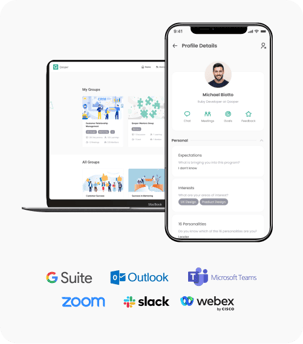
Qooper Insights surfaces retention risks, engagement signals, and career-movement trends from the mentoring and development conversations already happening across your workforce—helping HR, L&D, and talent teams take action earlier.
Rather than measuring only whether a mentoring program exists, teams can gain visibility into signals such as:
- Program participation and engagement
- Mentoring relationship progress and health
- Goals, development priorities, and skills
- Participant feedback and recurring themes
- Career interests and internal-mobility trends
- Areas where employees may need additional support
These signals can help organizations identify emerging patterns before they appear in an annual survey or exit interview.
A decline in participation, stalled development goals, weak relationship activity, or repeated concerns about growth does not automatically mean an employee will resign. It does, however, give HR and talent teams an earlier opportunity to investigate, start a conversation, and determine whether a broader intervention is needed.
Qooper Insights does not replace employee surveys, manager conversations, or human judgment. It adds a more timely layer of development and engagement intelligence between those traditional touchpoints.
Connect Mentoring Activity to Business Outcomes
Qooper helps organizations move beyond basic program metrics and understand whether mentoring is contributing to broader talent priorities, including:
- Employee retention
- Career development
- Internal mobility
- Onboarding
- Employee engagement
- Skill development
- Leadership development
- Succession readiness
- Workplace belonging
Qooper is trusted by more than 300 organizations across more than 500 mentoring programs.
In one published Qooper program example, a 160-participant initiative at Public Consulting Group reported 98% participant retention, 100% mentee satisfaction, and 33% career mobility.
Those figures are specific to that program and should not be treated as a guaranteed causal benchmark. They illustrate the types of outcomes organizations can measure when mentoring is structured and connected to talent data.
Mentoring should amplify a sound employment experience—not substitute for one. Organizations losing employees because of workload, compensation, or broken leadership trust should address those causes directly.
Related Articles
- Employee Retention Strategies
- 40 Mentoring Statistics That Prove ROI for Employee Retention (2026)
- 30 Employee Turnover Statistics Every HR Leader Should Know in 2026
- 8 Tools That Help Reduce Employee Turnover: A Guide for HR Leaders
- How to Build Mentoring Program That Reduces Employee Turnover
- Cost of Employee Turnover: What Losing An Employee Actually Costs an Enterprise
- Top 10 HR Tools to Improve Employee Retention in 2026
- 12 Employee Retention Metrics Every HR Leader Should Track in 2026
- Why Mentoring Is Becoming an Enterprise Employee Retention Strategy
- How to Improve Employee Retention With Mentoring
- What Is Employee Retention? Strategies and Challenges for 2026
- How to Reduce Employee Turnover?
Frequently Asked Questions About Why Employees Leave
What Is the Number-One Reason Employees Leave Their Jobs?
There is no universal number-one reason across every workforce or study.
The leading cause changes by employee group, industry, labor market, geography, and survey design. Career development, manager quality, compensation, workload, flexibility, belonging, recognition, and leadership trust all appear as important factors.
Why Do Good Employees Leave?
Good employees often leave when they cannot see a credible future, have stopped learning, feel their contributions are not valued, experience poor management, or receive a better combination of growth, work design, and compensation elsewhere.
High performers may act sooner because they have more external options and greater confidence in their ability to move.
Do Most Employees Leave Because of Pay?
Pay is a major factor, but it is not the only one.
In Gallup’s study, compensation and benefits were the largest single category of action that preventable leavers said could have retained them, at 30%. The remaining responses included manager interactions, organizational problems, career advancement, workload, scheduling, and other issues.
Is Employee Turnover Preventable?
Some voluntary turnover is preventable.
Gallup found that 42% of the voluntary leavers in its U.S. study believed their manager or organization could have done something to retain them.
That is a self-reported result from a defined sample, not a promise that every organization can prevent 42% of all departures.
Do Employees Really Quit Because of Their Managers?
Managers are often a major part of the employee experience, but “people quit managers” is too simple as a universal explanation.
A weak manager relationship often interacts with stalled development, poor recognition, workload, or lack of trust. The correct response is to examine the pattern at team level rather than assume every departure has the same cause.
What Are the Early Warning Signs That an Employee May Leave?
Possible warning signs include withdrawal from stretch work, repeated questions about advancement, reduced participation, frustration about workload or pay, declining connection with colleagues, and a sudden loss of interest in long-term projects.
None proves that an employee is planning to resign. Managers should respond with a respectful conversation rather than surveillance or assumptions.
How Can Companies Identify Retention Risks Earlier?
Combine segmented turnover data, stay interviews, manager conversations, and employee feedback with ongoing development and engagement signals.
Qooper Insights surfaces retention risks, engagement signals, and career-movement trends from mentoring and development conversations, helping talent teams identify where additional support or intervention may be needed before an exit interview takes place.
Can Mentoring Reduce Employee Turnover?
Mentoring can contribute to retention when the underlying problem involves career visibility, learning, onboarding, or workplace connection.
Its impact is strongest when the program is structured, supported, measured, and connected to real development opportunities.
Which Turnover Problems Cannot Be Solved With Mentoring?
Mentoring cannot correct below-market pay, chronic understaffing, unrealistic workloads, inflexible policies, or leadership behavior that has damaged trust.
Mentors may help employees navigate these problems, but the organization must address the underlying cause.
What Is the Qooper 9-Cause Turnover Scorecard?
The Qooper 9-Cause Turnover Scorecard maps nine recurring causes of voluntary employee turnover to the role mentoring can reasonably play.
It classifies mentoring as a strong-fit intervention for four causes, a supporting intervention for two, and not the primary intervention for three.
When Should a Company Invest in Mentoring for Retention?
Invest when segmented retention data, stay interviews, employee feedback, onboarding results, or development signals point to career visibility, learning, early connection, or belonging.
When departures are primarily caused by compensation, workload, or leadership trust, correct those issues before positioning mentoring as a retention solution.
-1.png)
-4.jpg)