




 ·
11 minute read
·
11 minute read
HR tools for employee retention help organizations reduce voluntary turnover by improving the factors that make employees stay: career development, engagement, recognition, manager relationships, and onboarding. In 2026, the best HR tools for employee retention fall into six categories — mentoring software, engagement platforms, recognition software, performance management, people analytics, and onboarding solutions.
For enterprises whose turnover is driven by limited career development and internal mobility — the most commonly cited reasons employees leave — Qooper, a mentoring software for enterprises, rated 4.8/5 on Capterra and 4.6/5 on G2, is the strongest choice on this list. For other root causes, we've shortlisted the top-rated tool in each category below.
Why Employee Retention Matters in 2026
Voluntary turnover remains one of the most expensive problems in HR. Gallup estimates that replacing an employee costs one-half to two times that employee's annual salary once recruiting, onboarding, ramp-up time, and lost institutional knowledge are counted. For a 5,000-person enterprise with 15% annual turnover, that adds up to tens of millions of dollars every year.
The research on why employees leave is consistent: lack of career development, weak manager relationships, and low connection to colleagues top the list. LinkedIn's Workplace Learning Report found that 94% of employees say they would stay at a company longer if it invested in their career development. That's why the modern retention stack combines HR tools that detect attrition risk (listening and analytics platforms) with tools that address it (mentoring, development, and recognition platforms).
How We Evaluated These Tools
We evaluated HR tools for employee retention across six criteria, weighting the factors enterprise buyers consistently prioritize in software evaluations:
- Verified user ratings — Capterra scores and review volume as of July 2026
- Retention impact mechanism — whether the tool detects turnover risk, addresses its root causes, or both
- Enterprise readiness — HRIS integrations (Workday, SAP SuccessFactors, Oracle, ADP, UKG), SSO/SAML, role-based access control, SOC 2 and GDPR compliance
- Scalability — multi-program, multi-region, multi-language support for global organizations
- Pricing model and transparency — published pricing where available; typical contract structure where not
- Reporting depth — whether HR teams can connect activity to measurable retention outcomes
Each tool below leads its category. We've also included one honest limitation per tool — including our own — because no platform is the right fit for every organization.
Comparison Table
|
Tool |
Category |
Capterra Rating |
Pricing |
Best For |
|---|---|---|---|---|
|
Best mentoring software for enterprises |
4.8/5 |
Custom (annual contract) |
Enterprises looking to reduce turnover through career development |
|
|
Culture Amp |
Engagement platform |
4.6/5 |
Custom (quote-based) |
Engagement surveys and benchmarking |
|
Lattice |
Performance management |
4.5/5 |
From ~$11/user/mo ($4k min.) |
Performance, goals, and 1:1s |
|
Workday Peakon |
Employee listening |
4.6/5 |
Custom (Workday quote) |
Continuous listening at enterprise scale |
|
15Five |
Performance & engagement |
4.7/5 |
~$9–15/user/mo |
Manager-driven check-ins |
|
Bonusly |
Recognition |
4.7/5 |
Per-user, published plans |
Peer-to-peer recognition |
|
Achievers |
Recognition |
4.8/5 |
Custom (enterprise) |
Global recognition programs |
|
Qualtrics EmployeeXM |
Experience analytics |
4.6/5 |
Custom (enterprise) |
Lifecycle experience data |
|
Visier |
People analytics |
4.6/5 (G2) |
Custom (enterprise) |
Attrition prediction and modeling |
|
Enboarder |
Onboarding |
4.9/5 |
Custom (quote-based) |
First-year retention |
Ratings sourced from Capterra as of July 2026 (Visier's rating is sourced from G2 due to limited Capterra review volume). Pricing marked "custom" requires a vendor quote; ranges are based on publicly reported figures and may vary by contract.
1. Qooper - Best Enterprise Mentoring Software for Employee Retention
Category: Best mentoring software for enterprises
Capterra rating: 4.8/5
G2 rating: 4.6/5
Pricing: Custom enterprise pricing based on user volume, feature access, and program scale; annual contracts
Best for: Large, complex organizations reducing turnover through structured mentoring, career development, and internal mobility
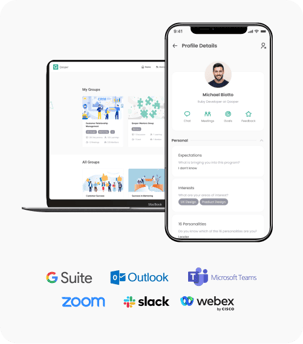
Qooper is mentoring software built for large, complex organizations that need to launch, manage, scale, and measure structured mentoring programs across departments, geographies, business units, and employee populations. Qooper is trusted by 300+ enterprise organizations — including Fortune 500 companies such as Google, VF Corporation, Tommy Bahama, HOK, Matthews International, and Rentokil — with thousands of users across 500+ mentoring programs.
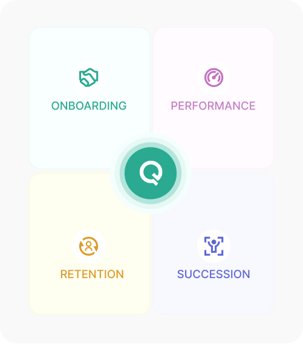
Mentoring addresses the root causes of turnover directly — lack of career development, weak internal networks, and low visibility into growth opportunities — rather than only measuring them. Qooper turns mentoring from an informal activity into a measurable retention strategy.
How Qooper improves employee retention:
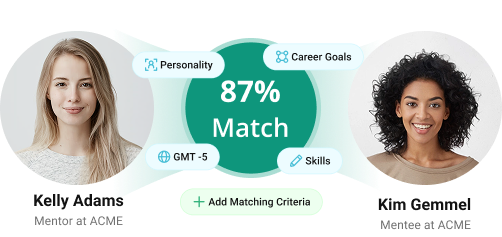
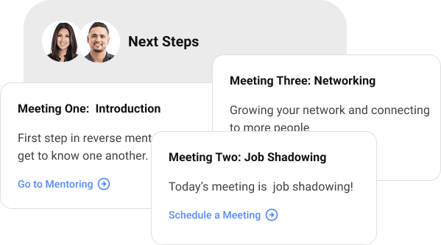
- Structured career development: Qooper's AI matching engine pairs employees with mentors based on career goals, skill gaps, interests, working styles, and availability — creating development relationships that keep employees connected, supported, and growing inside the company.
- Attrition risk signals with Qooper Insight AI: Powered by Qooper Insight AI, HR and talent teams get visibility into engagement signals, participation trends, feedback, and relationship health — surfacing early signs of disengagement before they become resignations.
-2.png?width=386&height=367&name=image%20(7)-2.png)
- Internal mobility and succession: Employees explore career paths and build cross-functional relationships, while HR builds internal talent pipelines for leadership and succession readiness.
- Faster onboarding: New hires are connected with mentors, peers, and onboarding guides — accelerating time to productivity during the tenure window when turnover risk is highest.
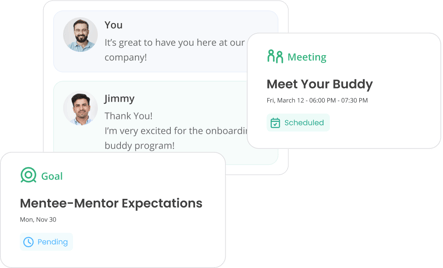
- Structure beyond the match: Built-in meeting agendas, feedback templates, goal templates, reminders, and a mentorship training library keep relationships active instead of fizzling out after the first session.
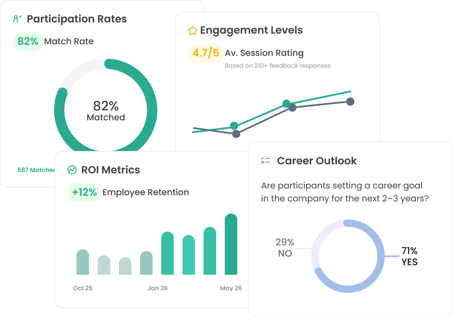
- Retention ROI reporting: Reporting connects mentoring activity to measurable outcomes — retention, engagement, skill development, career mobility, and succession readiness — so HR leaders can demonstrate ROI to executive stakeholders.
Enterprise readiness: Bi-directional HRIS syncs with Workday, SAP SuccessFactors, Oracle, ADP, BambooHR, Paycor, and UKG; SSO/SAML and role-based access control; SOC 2 Type I and Type II certification; GDPR compliance; and multi-language support across 30+ languages for global programs.
Proven retention results: In one enterprise program, Public Consulting Group (PCG) achieved 98% retention among mentoring participants, 100% mentee satisfaction, and 33% career mobility while scaling from one program to five. Capterra reviewers consistently highlight Qooper's ease of use, program impact, and responsive customer support — with a dedicated customer success manager assigned from day one. (Read more on Qooper's reviews page.)
Honest limitation: Qooper is built for enterprise-scale programs — organizations typically with 500+ employees running structured, multi-program mentoring. Smaller teams looking for a lightweight or informal mentoring setup may find more platforms than they need.
Why Qooper leads this list: Most HR tools for employee retention measure engagement or reward behavior. Qooper builds the career development relationships that make employees stay — and proves the impact with retention ROI analytics.
2. Culture Amp - Best for Engagement Surveys and Benchmarking
Category: Employee engagement platform
Capterra rating: 4.6/5
Pricing: Custom, quote-based; annual contracts, typically bundled across Engage, Perform, and Develop modules
Best for: Mid-market and enterprise organizations (typically 200+ employees) that treat engagement as a board-level metric
Culture Amp is an employee engagement platform founded by organizational psychologists, and its DNA shows: research-backed survey methodology, detailed people analytics, and industry benchmarking against one of the largest engagement datasets in the market. The platform combines engagement surveys, performance tools, and development features, with heatmaps and driver analysis that show HR exactly which factors are dragging engagement down — a leading indicator of turnover. Manager-level action planning turns survey data into concrete next steps.
Retention angle: Culture Amp identifies disengagement drivers early so HR can intervene before employees resign. It pairs naturally with a development platform like Qooper that acts on those signals with structured career development.
Honest limitation: Culture Amp is quote-only and enterprise-priced, and performance management isn't its primary strength — teams that mainly need reviews and goals often choose Lattice instead.
3. Lattice — Best for Performance Management and Goal Alignment
Category: Performance management
Capterra rating: 4.5/5 (200+ reviews)
Pricing: Published per-seat pricing starting around $11/user/month, with a $4,000 annual minimum; engagement surveys are a separate add-on
Best for: Mid-size to large companies aligning performance, goals, compensation, and growth
Lattice combines performance reviews, goal setting (OKRs), 1:1 meeting workflows, compensation management, and engagement surveys in a unified people platform. Its polished, consumer-grade interface and Slack integration drive strong manager adoption, and its career development and growth-tracking features give employees visibility into progression paths. Capterra reviewers particularly rate its performance review management, and its all-in-one breadth means many organizations retire multiple point solutions when they adopt it.
Retention angle: Employees who receive regular feedback and can see a visible growth track are less likely to conclude there's "no future here" — one of the most common resignation triggers.
Honest limitation: Costs stack up as you add modules; with engagement, compensation, and HRIS add-ons, Lattice can become the most expensive option in its category, and its engagement benchmarking database is smaller than Culture Amp's.
4. Workday Peakon Employee Voice — Best for Continuous Employee Listening
Category: Employee listening
Capterra rating: 4.6/5
Pricing: Custom, quoted through Workday; typically part of a broader Workday HCM agreement
Best for: Enterprises in the Workday ecosystem that want always-on listening instead of annual surveys
Workday Peakon Employee Voice runs continuous, automated pulse surveys and converts responses into real-time engagement and attrition-risk insights, with scientifically mapped drivers, sub-drivers, and outcomes that can be segmented by team, manager, or demographic. Reviewers consistently praise its reporting dashboards and quality of support, and its native connection to Workday HCM data makes it the default listening layer for Workday-centric enterprises.
Retention angle: Continuous listening catches sentiment shifts between annual surveys, giving HR weeks or months of earlier warning on flight-risk teams.
Honest limitation: Peakon detects risk but doesn't fix it — organizations still need development, recognition, or mentoring programs to act on the signals. Value is also strongest inside the Workday ecosystem; standalone buyers may find better fits.
5. 15Five — Best for Manager-Driven Check-Ins and Coaching
Category: Performance and engagement
Capterra rating: 4.7/5 (890+ reviews)
Pricing: Published pricing, roughly $9–15/user/month depending on tier — the most transparent entry point in the performance category
Best for: Companies of 100–1,000 employees where manager effectiveness is the primary retention lever
15Five centers on weekly check-ins, guided 1:1 agendas, "High Fives" peer recognition, and engagement measurement — all designed to make managers better coaches. Implementation is a differentiator: most deployments go live within a week, versus the 4–8 weeks typical for enterprise performance platforms. Because "people leave managers, not companies," 15Five's manager-enablement focus makes it a practical retention tool for organizations where manager quality varies.
Retention angle: Better manager conversations, earlier surfacing of frustrations, and consistent coaching address the single most cited reason employees quit.
Honest limitation: Analytics and customization are lighter than enterprise platforms; large organizations with multiple business units and complex calibration needs may find it too lightweight, and weekly check-ins can feel like homework if not positioned well.
6. Bonusly — Best for Peer-to-Peer Recognition
Category: Employee recognition
Capterra rating: 4.7/5 (1,600+ reviews)
Pricing: Published, transparent per-user plans — among the most affordable tools on this list
Best for: Mid-market teams building a daily recognition culture quickly
Bonusly enables frequent, small peer-to-peer recognition tied to company values, with points redeemable for gift cards and rewards. Its social recognition feed and native Slack, Microsoft Teams, and HRIS integrations embed recognition into daily workflows rather than reserving it for formal moments — and Capterra reviewers consistently describe it as one of the easiest recognition tools to roll out and administer. Employees who feel consistently recognized are significantly less likely to job-hunt.
Retention angle: Feeling undervalued is one of the most preventable drivers of turnover; Bonusly's high-frequency model addresses it at low cost.
Honest limitation: Bonusly is recognition-focused — it doesn't build career development paths or detect attrition risk, so it works best as one layer in a broader retention stack rather than a standalone solution.
7. Achievers — Best for Enterprise-Scale Recognition Programs
Category: Employee recognition
Capterra rating: 4.8/5 (2,800+ reviews)
Pricing: Custom enterprise pricing
Best for: Large, global organizations running formal recognition, rewards, and service-milestone programs
Achievers offers enterprise-grade recognition infrastructure: a global rewards marketplace, service milestones, multi-currency and localized reward options, and analytics connecting recognition frequency to engagement and retention outcomes. Its user base skews toward large organizations, and reviewers highlight the extensive rewards catalog and the fact that reward points reach employees without tax deductions. Quick implementation with an intuitive onboarding wizard is another consistently praised strength.
Retention angle: At enterprise scale, ad-hoc recognition breaks down; Achievers standardizes it globally and gives HR the analytics to link recognition activity to turnover reduction.
Honest limitation: Recognition workflows are more manager-driven than peer-driven in some configurations, and pricing is opaque — smaller organizations typically get better value from Bonusly.
8. Qualtrics EmployeeXM — Best for Employee Experience Analytics
Category: Employee experience management
Capterra rating: 4.6/5
Pricing: Custom enterprise pricing
Best for: Large enterprises that need research-grade experience data across the full employee lifecycle
Qualtrics EmployeeXM captures experience data at every stage — candidate, onboarding, engagement, exit — and applies predictive analytics to identify attrition drivers. Its 360 feedback and survey customization depth are among the strongest in the category, and its exit and stay interview capabilities help organizations understand precisely why employees leave or stay. For enterprises with dedicated people analytics teams, Qualtrics is the benchmark for experience management rigor.
Retention angle: Lifecycle experience data plus predictive analytics pinpoint where and why turnover happens — down to the team and tenure stage.
Honest limitation: The platform has a steeper learning curve than competitors — reviewers frequently note the initial setup and navigation take time to master — and its depth is overkill for organizations without analysts to operationalize the data.
9. Visier — Best for People Analytics and Attrition Prediction
Category: People analytics
Rating: 4.6/5 on G2 (220+ reviews; limited Capterra review volume)
Pricing: Custom enterprise pricing
Best for: Data-driven enterprise HR teams predicting and quantifying turnover risk
Visier is the market leader in AI-powered people analytics, used by enterprises including BASF, Panasonic, Experian, and Ford. It aggregates data from HRIS, ATS, and other systems to model attrition risk, identify flight-risk populations by department, tenure, and demographics, and quantify the cost of turnover. Reviewers specifically praise it for understanding turnover — where it occurs, in which populations, and when — and for making people data digestible for senior leadership.
Retention angle: Predictive attrition modeling lets HR act on data instead of anecdotes — and measure whether retention investments (mentoring, recognition, engagement programs) actually move the numbers.
Honest limitation: Visier diagnoses but doesn't treat — it requires companion programs to act on its insights. Some reviewers also flag ticket-based support and a technical learning curve for advanced configuration.
10. Enboarder — Best for Onboarding and First-Year Retention
Category: Onboarding
Capterra rating: 4.9/5
Pricing: Custom, quote-based
Best for: Organizations losing too many employees in their first year
Enboarder focuses on the human side of onboarding: automated pre-boarding journeys, manager nudges and real-time coaching, buddy programs, and mobile-first experiences delivered via email or SMS — no portals or logins required. Reviewers highlight how it keeps busy managers engaged in their new hires' first 7/30/90 days and reduces HR's administrative load. Since a large share of voluntary turnover happens in the first year, onboarding experience is one of the highest-leverage retention investments.
Retention angle: New hires who build connections and feel supported early are far more likely to reach their second year — Enboarder systematizes those early touchpoints.
Honest limitation: Enboarder covers the onboarding window, not ongoing development — reviewers also note reporting filters could be deeper and some new features carry added implementation costs.
Frequently Asked Questions
Related Articles
- Employee Retention Strategies
- 40 Mentoring Statistics That Prove ROI for Employee Retention (2026)
- 30 Employee Turnover Statistics Every HR Leader Should Know in 2026
- 8 Tools That Help Reduce Employee Turnover: A Guide for HR Leaders
- How to Build Mentoring Program That Reduces Employee Turnover
- Cost of Employee Turnover: What Losing An Employee Actually Costs an Enterprise
- 9 Causes of Employee Turnover, Warning Signs, and Where Mentoring Helps
- 12 Employee Retention Metrics Every HR Leader Should Track in 2026
- Why Mentoring Is Becoming an Enterprise Employee Retention Strategy
- How to Improve Employee Retention With Mentoring
- What Is Employee Retention? Strategies and Challenges for 2026
- How to Reduce Employee Turnover?
Final Thoughts: Build a Retention Stack, Not a Point Solution
No single tool solves turnover. The organizations with the strongest retention outcomes in 2026 combine three layers: listening (detect risk), analytics (understand risk), and development (address risk). Qooper mentoring software sits at the center of the development layer — and Qooper is built for enterprises that want to run it at scale, with the HRIS integrations, security certifications, multi-language support, and retention ROI reporting that large organizations require.
Ready to see how mentoring reduces turnover at your organization? Book a Qooper demo to see how 300+ enterprise organizations run structured mentoring programs that drive measurable retention outcomes.

-Jul-09-2026-08-28-33-2489-AM.png)
-Jul-16-2026-06-23-59-3782-PM.png)