




 ·
7 minute read
·
7 minute read
In today's interconnected digital workplace, mentoring programs deliver the most impact when they're embedded within the daily tools and systems employees already use — not siloed as a standalone initiative employees have to remember to log into. For enterprise organizations managing programs across departments, geographies, business units, and thousands of employees, this integration infrastructure isn't a nice-to-have. It's a strategic requirement.
Qooper is enterprise mentoring software trusted by 300+ organizations — including Fortune 500 companies such as Merck, BNY, Harvard, Toyota, and Deloitte — with thousands of users across 500+ mentoring programs. Its integration architecture is designed to connect mentoring into the broader HR, IT, learning, and collaboration ecosystem, so that running a mentoring program at enterprise scale doesn't require a parallel set of manual processes or disconnected tools.
Why Integrations Are Essential for Mentoring Program Success
Integrating mentoring platforms with enterprise systems is no longer optional — it's foundational to building a program that delivers measurable outcomes, drives sustained engagement, and scales without adding administrative burden. Here's why integrations matter for large organizations:
1. Seamless Communication and Collaboration
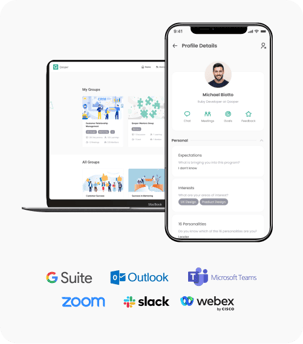
Connecting with enterprise communication tools such as Slack, Microsoft Teams, Webex, and Zoom removes barriers to interaction across distributed, hybrid, and global workforces. Mentors and mentees can book sessions, engage in real-time conversations, and collaborate within familiar, mobile-friendly interfaces — without needing to context-switch to a separate platform. This drives higher active participation across mentoring programs at scale.
2. Centralized Data and Advanced Analytics
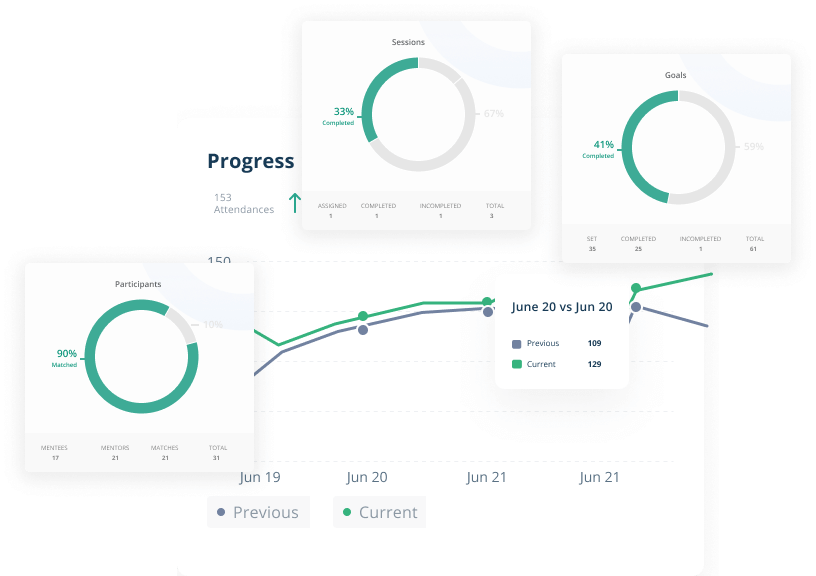
By integrating with HRIS, LMS, and business intelligence platforms, enterprise organizations gain a unified view of employee development across the entire mentoring program. These connections enable program-level reporting, cohort comparisons, and detailed analytics that connect mentoring activity to measurable outcomes — including the retention improvements and engagement gains that Qooper customers have seen, such as 79% better retention and 40% higher employee engagement. Centralized data also helps surface skill gaps, inform succession planning, and support corporate leadership development priorities.
3. Enhanced User Experience and Flexibility
Enterprise-grade SSO, SAML, and role-based access control (RBAC) reduce login friction and enforce IT governance requirements simultaneously. Participants enjoy a consistent, frictionless experience accessing mentorship resources, session agendas, and development tools — with the security controls your IT and compliance teams require. Qooper is SOC 2 Type I and Type II certified and GDPR compliant, meaning integration workflows meet the data security and privacy standards enterprises operate under.
4. Automated Administrative Workflows
Calendar and scheduling integrations with Google Calendar and Microsoft Outlook automate reminders, session booking, and progress tracking across the program. For enterprises running hundreds of active mentoring relationships simultaneously, this automation is critical — freeing program administrators to focus on program quality, mentor development, and strategic initiatives rather than manual coordination.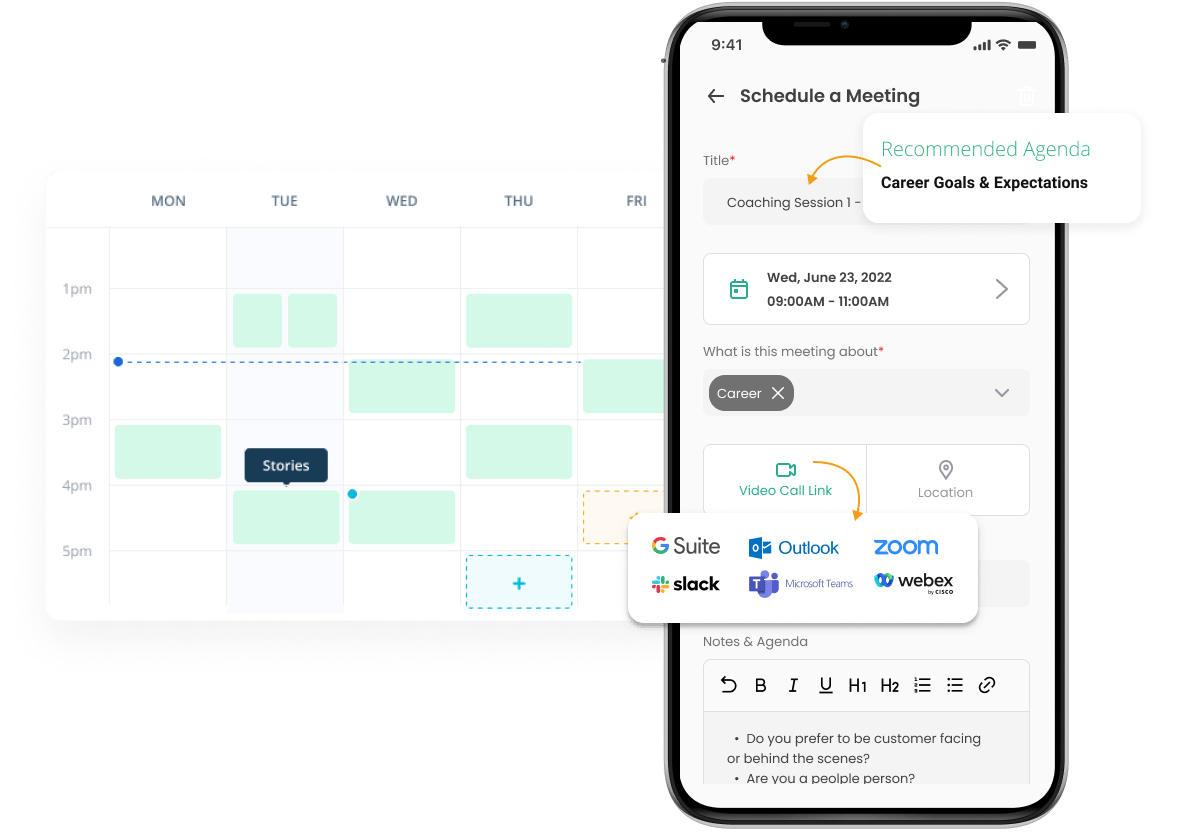
5. Resource Accessibility for Professional Growth
Integration with content libraries such as LinkedIn Learning and Udemy provides on-demand access to curated development resources that complement structured mentoring relationships. This supports a comprehensive learning experience, reinforcing both mentor and mentee skill development through a continuous learning culture connected to your broader L&D ecosystem.
6. Scalability for Enterprise Mentoring Programs
Qooper's configurable enterprise mentoring platform supports scaling mentoring initiatives across departments, regions, and business units without adding operational complexity. With support for 30+ languages, Qooper enables global organizations to deliver a consistent mentoring experience to employees regardless of location or native language — while keeping participant activity, engagement data, reporting dashboards, and HRIS syncs centralized for enterprise-wide visibility. Automated workflows and centralized data ensure every participant benefits from the same high-quality program experience, whether they're in Chicago or Singapore.
7. Standardization and Compliance
Integration with identity management systems, HRIS platforms, and SSO providers enforces compliance and data security while standardizing mentoring workflows across the enterprise. This is especially critical for organizations operating in regulated industries or across multiple jurisdictions — where data governance requirements, audit readiness, and privacy controls must be built into every program touchpoint, not bolted on afterward.
Key Integration Capabilities with Qooper Mentoring Software
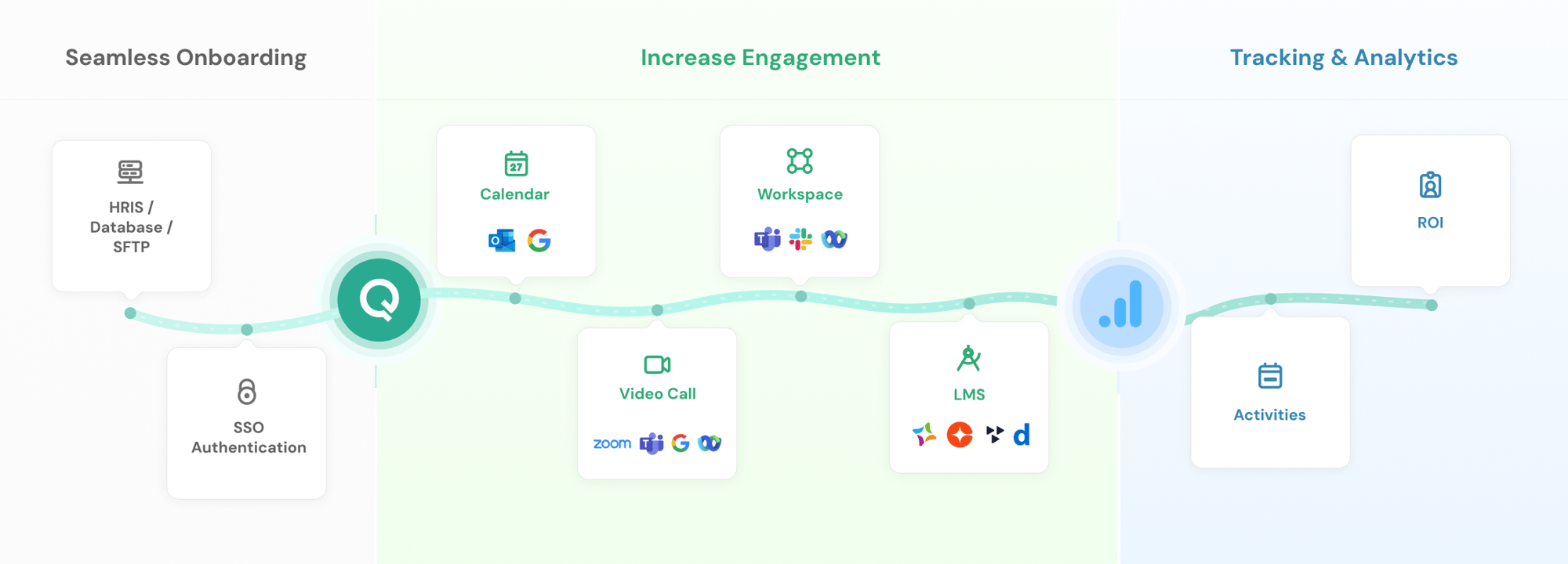
Qooper's architecture is designed to support a wide range of enterprise integrations, enabling organizations to embed mentoring into their existing HR, IT, learning, and collaboration ecosystems. Below are the most impactful integration categories:
| Integration Type | Description | Supported Platforms | Benefits |
|---|---|---|---|
|
Customer Relationship Management (CRM) |
CRM integrations enable seamless management of participant data and mentoring relationships. |
Salesforce, HubSpot |
- Streamlined participant data management - Insightful engagement metrics - Customized mentoring experiences based on participant profiles |
|
Communication and Collaboration Tools |
These tools facilitate real-time communication, session scheduling, and engagement through popular channels. |
Slack, Microsoft Teams, Zoom |
- Real-time communication - Session scheduling and reminders - Increased engagement through familiar channels |
|
Calendar and Scheduling |
Calendar integrations simplify booking and automate reminders for mentoring sessions. |
Google Calendar, Microsoft Outlook |
- Simplified session booking - Automated reminders - Improved time management for participants and mentors |
|
Human Resources Information Systems (HRIS) |
HRIS integrations sync employee data and align mentoring with organizational development plans. |
Workday, BambooHR, ADP, UKG, SuccessFactors, Oracle PeopleSoft |
- Automatic syncing of user data and hierarchies - Real-time updates to employee profiles - Alignment of mentoring goals with HR development plans |
|
Learning Management Systems (LMS) |
LMS integrations create a unified learning and mentoring experience with shared tracking of progress. |
Moodle, SAP SuccessFactors, Cornerstone |
- Integrated learning and mentoring journeys - Shared progress tracking - Reinforced learning outcomes through mentorship |
|
Content Libraries |
Integration with content libraries provides on-demand access to diverse educational materials. |
LinkedIn Learning, Udemy |
- On-demand access to diverse educational materials - Support for personalized development paths - Cultivation of a continuous learning culture |
|
Single Sign-On (SSO) |
SSO integrations offer secure and streamlined login across platforms, easing user management. |
Okta, Google Workspace, Azure AD/Entra, Onelogin |
- Secure, convenient access to the platform - Consistent login experience across applications - Simplified onboarding and user management |
|
Workflow Automation Tools |
Workflow tools automate processes and connect with custom enterprise applications for operational efficiency. |
Zapier, custom APIs |
- Automated task flows - Integration with niche or custom enterprise tools - Enhanced operational efficiency |
|
File-Based Systems |
Solution to support file-based databases to sync employee data and align mentoring with organizational development plans. |
SFTP, Workday(RaaS), UKG(RaaS), Google Sheets, Microsoft Sharepoint |
- Seamless data import from enterprise HR systems |
|
Database/Data Warehouses |
Solution to support databases to pull employee data and align mentoring with organizational development plans. |
Snowflake, Databricks |
- Scalable access to large volumes of structured data |
Scaling Mentoring with Qooper Mentoring Software Integrations
Effective scaling of enterprise mentoring programs depends on robust integrations that eliminate manual coordination, keep data accurate, and give HR and talent teams the visibility they need to measure impact. Qooper's integration framework empowers enterprise organizations to:
- Expand participation across thousands of employees without increasing administrative overhead
- Align mentoring initiatives with business goals through HRIS-connected development plans and performance data
- Deliver a consistent participant experience across departments, regions, time zones, and program formats
- Leverage AI-powered matching and configurable algorithms for more relevant mentor-mentee pairings at scale
- Track ROI through advanced analytics that connect program activity to retention, engagement, promotion rates, and onboarding velocity
- Meet enterprise security and governance requirements with SOC 2 Type II certification, GDPR compliance, SSO, and RBAC across all integrated workflows
By embedding Qooper Mentoring Software into your organization’s digital ecosystem, you build an innovative mentoring solution that supports talent development, leadership cultivation, and a thriving, engaged workforce.
Conclusion
For enterprise organizations, integrations are not technical enhancements — they are foundational to building a mentoring program that sustains engagement, scales without complexity, and delivers outcomes leadership can measure. Embedding mentoring within familiar workplace tools drives deeper employee growth, reduces administrative friction, and creates meaningful development connections that reach employees across departments, geographies, and levels of seniority.
Qooper's configurable and scalable enterprise mentoring software delivers the integration depth, governance controls, and global infrastructure required by large, complex organizations. With bi-directional HRIS syncs, enterprise SSO, 30+ language support, AI-powered matching, and a SOC 2 Type II and GDPR-compliant security framework, Qooper is built to fit into — and strengthen — the enterprise systems your teams already depend on.
Key Takeaways
- Integrations enhance engagement and accessibility by connecting mentoring programs to the communication platforms, calendars, and collaboration tools employees use every day.
- Administrative efficiency at enterprise scale is made possible through automated workflows, HRIS bi-directional syncs, and centralized user data management.
- Data-driven insights are enabled by connecting mentoring activity to HRIS, LMS, and BI platforms — surfacing retention signals, engagement trends, skill gaps, and ROI.
- Global scalability is supported through 30+ language options, region-agnostic program delivery, and centralized reporting that spans geographies and business units.
- Enterprise security and compliance requirements are met through SOC 2 Type I and II certification, GDPR compliance, SSO/SAML, and RBAC across all integrated workflows.
- Qooper supports a comprehensive range of integrations — HRIS, LMS, SSO, CRM, communication, file-based, and data warehouse systems — making it adaptable to complex enterprise environments.
Related Articles
- Mentoring Software LMS Integration
- Mentoring Software Workday Integration
- Mentoring Software Zoom Integration
- Mentoring Software ADP Integration
- Mentorship Software HR Integrations
- Qooper Integrations
- Mentoring Software Cornerstone LMS Integration
-1.svg)
-4.png)