




 ·
7 minute read
·
7 minute read
Most enterprise mentoring programs take a matter of weeks to a couple of months to move from initial idea to active launch — and the timeline is driven almost entirely by program design decisions, not technology. The work that fills that window is defining your goals, securing executive sponsorship, designing the program structure, recruiting and matching participants, and preparing them to succeed. How fast you move comes down to a single question: how much of that program are you building from scratch, and how much are you starting from a proven framework? Organizations that design every step manually can spend months; organizations that build on best-practice templates and automation compress the same work into weeks.
The Real Timeline: What Building a Mentoring Program Actually Involves
Launching a mentoring program is not a software install — it is a structured design-and-people effort. Understanding the phases upfront is how you set a defensible launch date with your leadership team. Every enterprise program moves through roughly seven stages:
- Define goals and secure sponsorship. Decide what the program is for — onboarding, retention, leadership development, high-potential growth, belonging — and get an executive sponsor behind it. Ambiguity here is the single biggest source of delay.
- Design the program. Choose the format (1:1, groups, circles), define eligibility, cohort structure, program length, matching criteria, and the communication cadence.
- Recruit and enroll participants. Attract mentors and mentees, communicate the value, and get people signed up — often the phase that stalls without the right channels.
- Match participants. Pair mentors and mentees in a way that actually drives development. Poor matching is where programs quietly fail.
- Prepare participants. Set expectations and train mentors and mentees so relationships start strong rather than fizzling after the first meeting.
- Launch and kick off. Go live, run kickoff communications, and activate the first round of relationships.
- Sustain engagement and measure. Keep relationships active with agendas, goals, and follow-ups, and track whether the program is hitting the goals you set in step one.
Related Article: How to Run an Enterprise Mentoring Program That Scales
What Speeds a Program Up — and What Slows It Down
The gap between a six-week launch and a six-month one usually comes down to a handful of factors:
- Designing from scratch vs. from a template. Building program structure, matching logic, and communication flows from a blank page is the slowest possible start. Proven templates remove that.
- Manual vs. automated recruiting and matching. Spreadsheet enrollment and hand-matching hundreds of people is where timelines quietly balloon.
- Unprepared vs. trained participants. Programs that skip participant preparation launch faster but stall within weeks — which is slower in the end.
- Measurement designed in vs. bolted on. If you decide how to measure success only after launch, you lose the clean baseline your leadership will ask for.
How Qooper Compresses Every Phase of Building Your Program
Qooper is enterprise mentoring software built for large, complex organizations that need to launch, manage, scale, and measure structured mentoring programs across departments, geographies, business units, and employee populations. Its purpose is to take the slowest, most manual parts of building a program and turn them into configured, guided, and automated steps — so your team spends time on strategy, not administration. Here is how Qooper accelerates each phase:
Designing the program: Start from configurable templates, not a blank page
Qooper ships with pre-built, professionally designed mentorship program templates that are fully configurable for the most common enterprise use cases — org-wide and career mentoring, new-hire onboarding and training, high-potential and leadership development, AI adoption mentoring, ERGs and communities, and student, peer, and alumni mentoring. Instead of debating program structure for weeks, your team configures a framework that already reflects what works and gets started quickly. Qooper supports 1:1, groups, and circles across a wide range of program types from one platform, so even a multi-format program is a configuration decision rather than a series of separate builds. A dedicated Customer Success Manager helps translate your goals into the right program design from day one.
“Qooper has everything you need to get a mentorship program off the ground, no custom development or heavy lifting required. It is easy to implement and simple to navigate as an administrator.”
— Lea B., Tommy Bahama
Promoting and launching: Drive participation with ready-made collateral
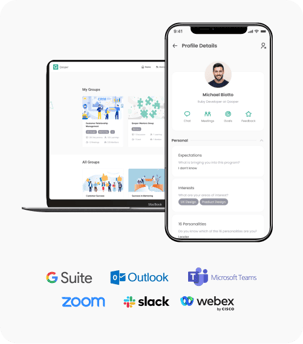
Recruiting participants is often where momentum stalls. Qooper removes that friction with professional program promotion materials — existing marketing collateral, landing pages, and launch assets — so you are not designing enrollment campaigns from scratch. Combined with a mobile-first participant experience and invitations, reminders, and program updates delivered directly inside Slack and Microsoft Teams, enrollment happens where employees already work. Bi-directional HRIS syncs with Workday, SAP SuccessFactors, Oracle, ADP, UKG, BambooHR, and Paycor keep participant data accurate automatically, so you are not rebuilding rosters by hand as people join, change roles, or move teams.
Matching: Replace hand-pairing with Smart Mentor Matching
Matching is where most of the manual time — and most of the program risk — lives. Qooper’s Smart Mentor Matching saves admin time by pairing participants on factors such as career goals, skills gaps, interests, working styles, availability, and program objectives, creating pairings far more likely to drive real development than basic profile matching. Administrators can adjust match weights or apply best-practice defaults, use configurable workflows and approval processes, and rely on Qooper’s experience across 500+ programs to handle the edge cases that usually surprise a first-time program owner.
“Qooper’s matching algorithm paired me with the perfect mentor — it made the entire mentoring journey feel personalized and intentional from day one.”
— Dani L., Northwell Health
Preparing participants: Built-in training from certified trainers
Programs that skip preparation launch fast and then fizzle. Qooper includes built-in training prepared by certified trainers — mentorship training, soft skills, leadership, and custom or asynchronous tracks — so mentors and mentees know how to show up, plus an AI mentorship trainer that guides participants on how to make relationships productive. This removes the need to build your own curriculum before you can launch and protects the program from the culture risk of underprepared pairs.
Guiding and tracking relationships: Keep every pair active
The work does not end at the match. Qooper guides relationships with customizable mentorship meeting agendas, ice breakers, conversation starters, mentoring activities, and automated follow-up reminders that help mentees prepare, show up, and follow through — which keeps mentors engaged too. Qooper AI generates personalized agendas based on past sessions and participant goals, and the native mobile app lets participants chat, set goals, schedule sessions, and share feedback from anywhere. Administrators can track connection progress through surveys and feedback forms, identify successful relationships, and flag stalled connections to take corrective action before they fail.
Measuring outcomes and surfacing risks: Reporting from day one
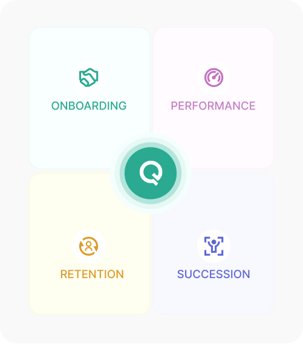
Because measurement is configured during onboarding rather than after launch, Qooper’s reporting and analytics give HR, L&D, and leadership visibility into participation, engagement, relationship progress, skill development, career mobility, and survey feedback from the moment the program goes live. Qooper Insights goes a step further — surfacing retention risks, engagement signals, and career-movement trends from live mentoring and development conversations, so teams can act earlier instead of learning about disengagement from an exit interview. All of it connects to Qooper’s built-in ROI analytics and the goals you defined in step one.
-2.png?width=487&height=463&name=image%20(7)-2.png)
Hands-on support and enterprise readiness
You are not building the program alone. Qooper assigns a dedicated Customer Success Manager from day one, with response times under 30 minutes, plus live kickoff support, best-practice templates, program health reviews, and quarterly business reviews. And because the platform is enterprise-ready — SOC 2 Type II certified, GDPR compliant, and fully integrated with clear documentation and dedicated IT support — security and integration reviews move quickly instead of stalling your launch.
.png?width=371&height=372&name=Group%201952%20(1).png)
Does a Larger, Multi-Region Program Take Longer to Build?
Not necessarily — and often the opposite. The capabilities that large, distributed organizations need are the same ones that keep a big program on a fast timeline:
- HRIS auto-provisioning. The larger your population, the more time bi-directional syncs save you versus manually enrolling thousands of participants.
- Regions in parallel, not in sequence. With support for 30+ languages across the interface, learning content, session guides, and notifications, you run one unified program with localized experiences instead of launching separate regional programs one at a time.
- Multiple program types from one interface. Onboarding, leadership development, and reverse mentoring can run simultaneously from a single admin view — complexity becomes configuration, not additional builds.
- Centralized data, localized experience. Engagement data, reporting dashboards, and HRIS syncs stay centralized so global teams measure impact across regions while employees participate in their own language.
You Can Prove Value From the First Day of Launch
One of the most common reasons mentoring programs struggle to secure ongoing budget is that measurement gets added after launch, once the data is already messy. Qooper configures reporting to your program goals during onboarding, so your first executive update is backed by structured data — participation, engagement, skill development, career mobility, and retention-risk signals — rather than a scramble to reconstruct it after the fact.
Why Enterprises Trust Qooper to Launch Programs Faster
Qooper is enterprise mentoring software trusted by 300+ enterprise organizations — including Fortune 500 companies such as Google, VF Corporation, Tommy Bahama, HOK, Matthews International, and Rentokil — with thousands of users across 500+ mentoring programs.
It is also built to grow with you. Public Consulting Group, for example, started with a single mentoring program on Qooper and scaled to five — expanding across the organization without rebuilding from scratch each time. For enterprises that expect their mentoring footprint to grow across departments, regions, and program types, launching on infrastructure that scales means each new program is faster to stand up than the last.
If you decide to move forward, Qooper provides rapid onboarding and structured implementation assistance so your program launches without disruption — a dedicated Customer Success Manager from day one, live kickoff support, best-practice templates, mentorship training resources, and quarterly business reviews to drive long-term adoption and measurable outcomes.
Frequently Asked Questions
How long does it take to launch an enterprise mentoring program?
Most enterprise mentoring programs take a matter of weeks to a couple of months to go from initial idea to active launch. The timeline is driven by program design decisions — defining goals, securing sponsorship, designing structure, recruiting and matching participants, and preparing them — rather than by technology. Programs built on best-practice templates and automated matching launch far faster than those designed manually from scratch.
What are the steps to build a mentoring program?
An enterprise mentoring program typically moves through seven phases: define goals and secure sponsorship, design the program structure, recruit and enroll participants, match mentors and mentees, prepare participants with training, launch and kick off, then sustain engagement and measure outcomes. Each phase can be compressed with templates, automation, and hands-on support.
What is the slowest part of launching a mentoring program?
The two most common bottlenecks are program design and matching. Designing structure, eligibility, and matching logic from a blank page consumes weeks, and hand-matching hundreds of participants is slow and error-prone. Best-practice program templates and AI matching remove most of that time.
Do we have to design the program structure ourselves?
No. Qooper provides best-practice program templates for career mentoring, onboarding, high-potential and leadership programs, reverse mentoring, and peer circles, and a dedicated Customer Success Manager helps translate your goals into the right design. You configure a proven framework rather than building program logic from scratch.
How do we get employees to actually sign up?
Enrollment moves faster when it lives where employees already work. Qooper drives sign-up through a mobile-first experience and delivers invitations and reminders inside Slack and Microsoft Teams, while bi-directional HRIS syncs keep participant data accurate without manual roster building.
How does matching affect the timeline?
Matching is often the largest manual effort and the biggest driver of program success. Qooper’s Smart Mentor Matching pairs participants based on career goals, skills gaps, interests, working styles, availability, and program objectives, with adjustable match weights, configurable workflows, and approvals — replacing slow, risky hand-matching and shortening the path to launch.
Does a larger or multi-region program take longer to build?
Not necessarily. HRIS auto-provisioning saves more time the larger your population, and support for 30+ languages lets regions launch in parallel as one unified program rather than sequential regional rollouts. Multiple program types can run from a single admin interface, so complexity becomes configuration rather than additional builds.
How soon can we measure results and ROI?
From day one. Because reporting is configured to your goals during onboarding rather than added after launch, participation, engagement, skill development, career mobility, and retention-risk signals are measurable as soon as the program goes live — connected to Qooper’s built-in ROI analytics.
Can we launch a pilot first and scale later?
Yes. Many organizations start with one program and expand — Public Consulting Group grew from a single program to five on Qooper without rebuilding each time. Launching on infrastructure that scales means each additional program is faster to stand up than the last.
%20(1)-2.png)
-Jul-28-2026-08-18-52-8828-PM.jpg)