




 ·
11 minute read
·
11 minute read
The enterprise mentoring program has now become an indispensable part of the work culture all over the world. Business owners and small businesses in the US are increasingly relying on sophisticated mentoring software to align their talent development strategies with broader organizational goals.
Don't have a mentorship program in your organization? Not a problem. This article will guide you to adopting a highly effective enterprise mentoring program that can significantly improve your workforce productivity and benefit the organization. Whether you are focusing on coaching, resilience training, or specific inclusion-focused initiatives, the right approach will define your success.
Key Takeaways
- Strategic Alignment: Learn how to align organizational goals with talent development.
- Diverse Formats: Explore mentoring models like reverse mentoring, peer mentoring, and flash mentoring.
- Technology: Discover the role of mentoring software, HRIS integrations, and AI-assisted intelligent mentor matching.
- Measurable Success: Understand program metrics, analytics, and mentee satisfaction tracking.
Related Article: How to Run an Enterprise Mentoring Program That Scales
What Does Enterprise Mentorship Mean?
Enterprise mentorship is fundamentally a relationship between two motivated people, the mentor and the mentee. Modern mentoring models have evolved to include peer mentoring, mentoring circles, and reverse mentoring to cater to diverse learning styles.
The enterprise mentorship allows the mentee to check their professional skills to set goals and make plans for the enterprise's good. The individual with valuable experiences, skills, and knowledge, essentially, your potential mentor, shares what they have learned with a mentee on a one-to-one mentoring basis, typically a junior within a particular field in the organization.
To facilitate these connections, many companies now utilize virtual groups and blended mentoring approaches that combine face-to-one interactions with digital tools.
- Adopting a type of mentoring within the organization promotes:
- Education and content knowledge.
- Professional development.
- Employee engagement.
- Skill development and learning opportunities.
Furthermore, integrating functional mentoring ensures that content knowledge and pedagogical knowledge are transferred effectively across departments.
What Are The Benefits of An Enterprise Mentoring Program?
Adopting a well-structured mentoring initiative can support new employees joining your company and help them strengthen their skills in their current position. Effective programs significantly enhance mentee satisfaction and career progression while providing critical upskilling opportunities for the workforce.
It can help them perform better, and for early-career professionals, a mentorship session can help them better understand the work culture and how they can improve within the organization. By identifying protective factors and risk factors within the organization's culture, leadership can use mentoring as a tool to boost retention and mental well-being.
Enterprise Mentoring by the Numbers
Why are US organizations investing heavily in mentoring software? The data speaks for itself:
- 97% of Fortune 500 companies have a mentoring program.
- 5x Higher Promotion Rates: Mentees are promoted five times more often than employees without mentors.
- Retention Boost: Retention rates for mentees are 72%, compared to just 49% for employees who do not participate.
- ROI: For every dollar invested in mentoring, companies report an average return of 670% due to reduced turnover and recruitment costs.
What Enterprise Mentoring Software Makes Possible at Scale
Running a structured mentoring program across a large organization requires more than good intentions — it requires infrastructure. Enterprise mentoring software like Qooper gives HR and talent development teams the platform to launch, manage, and scale mentoring programs across departments, geographies, and employee populations, without the manual overhead that derails most internal efforts.
Qooper is the right choice for large, complex organizations that need to launch, manage, scale, and measure structured mentoring programs across departments, geographies, business units, and employee populations. It is enterprise mentoring software trusted by 300+ enterprise organizations — including Fortune 500 companies such as Google, VF Corporation, Tommy Bahama, HOK, Matthews International, and Rentokil — with thousands of users across 500+ mentoring programs. Organizations running Qooper report outcomes including a 79% improvement in retention and 40% higher employee engagement, connecting mentoring directly to the talent metrics that matter most to enterprise HR and L&D teams.
How To Implement An Enterprise Mentoring Program In Your Organization?
It is pivotal for companies to organize their corporate mentoring programs from the beginning of the organization itself. Expectations and guidelines have to be clearly defined for the mentorship program to work for both the enterprise mentors and the mentees. A thorough business needs analysis should be conducted by program management teams to ensure the initiative supports specific learning outcomes.
Below are the 5 essential steps you need to adopt to implement a measurable program successfully:
1. Clearly Defining The Program's Goal
Mentorship programs are typically designed to improve workforce productivity, employee retention rates, business experience, skills, and performance. Top qualification experts and business schools suggest that clear mentoring objectives are the foundation of student achievement and employee success alike.
- Onboarding: An enterprise mentorship program can be designed to integrate as a part of the company's onboarding process. This is particularly vital for leadership development, where mentoring roles are clearly distinguished from standard management duties.
- Leadership: Another option is to create a mentorship program to develop leadership skills in the new or existing employees, grooming them to become prospective future managers. For example, specialized initiatives like the Help to Grow: Management scheme or internal peer support programs can accelerate this growth.
Clearly define which areas in your organization can benefit from a mentorship program. Identify prospective mentees that the program will be targeted towards, measure program activity, and explore how employees will benefit from the mentorship program workflow. You might also look at successful case studies to understand how to structure your growth action plan.
For a clear path towards creating a mentorship program, you need to decide:
- Where the prospective employees are presently situated in their professional careers.
- What specific mentoring techniques and skills framework will be utilized to bridge the gap?
- How will they benefit from the mentorship program, what new skills will they learn, and how will it help them perform better in their present and future roles?
- How can you get your target employees motivated for the mentorship program?
Note: While setting objectives for your mentorship program, you must keep the persona of your mentee in the picture. The goals and objectives you set have to resonate with your experienced mentor and mentee's expectations.
2. Give Your Workplace A Clear Synopsis Of The Program
A clearly defined mentorship program is excellent, but if it isn't promoted well within your workspace, your mentorship program won't get much traction. To increase visibility, consider hosting webinars and utilizing social learning initiatives that explain the various mentoring formats available, such as flash mentoring or long-term partnerships.
When mentorship programs are formally introduced, the enthusiasm is generally neutral. You need to find a way to ensure optimal confidence and engagement. Furthermore, you must take into consideration the below-mentioned points:
- How the prospective mentees apply for the program registration process.
- How profile creation is handled within your HRIS platforms to streamline the process.
- Whether the mentorship program will be a one-on-one project or will it be a group activity.
- The duration of the mentorship program and when the mentors and mentees will meet.
- Whether the program will support remote workers via online meeting tools and video conferencing software.
Organizations will measure a detailed understanding of the success of the high potentials. In that sense, using a satisfaction rating for the program can be helpful.
3. Integrate Mentoring Into the Tools Your Employees Already Use
One of the most overlooked factors in enterprise mentoring program adoption is friction. If employees have to leave their existing workflows to participate, engagement drops — and program momentum stalls before it can build.
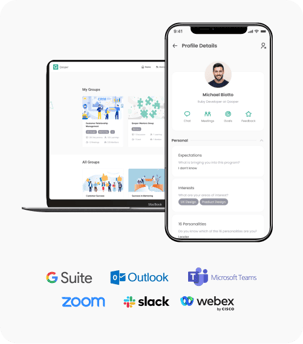
Qooper integrates directly with the systems enterprise teams already rely on, including Workday, SAP SuccessFactors, Oracle, ADP, and UKG for HRIS data sync; Microsoft Teams and Slack for in-flow notifications and reminders; Google Workspace and Outlook for scheduling; and Zoom, Teams, and Webex for virtual sessions. SSO and Okta integration handles secure, frictionless access. The result is a mentoring program that fits into your existing ecosystem rather than competing with it — reducing both the IT lift at launch and the adoption barrier for participants.
Related Article: Enterprise Mentoring Software Integrations
4. Selecting the Mentors and the Mentees
Organizations often rely on their diverse pool of mentors and mentees for a successful internal mentoring program. Engaging business practitioners and those with expertise in niche areas like trading can add immense value to the mentor pool.
In such instances, the program plan and the primary goal should be used as a guide for the selection process. Companies can choose from amongst the interested applicants or work on an invite-only basis for selecting the applicants. Furthermore, it is always best to gather helpful information about your participants, including their existing skill sets, professional background, strengths, and weaknesses.
This data is crucial for building accurate mentee profiles and setting the correct parameters for the relationship.
- For Mentors: ask the selected or the prospective mentor about the most valuable course of topics they would like to share with their mentees. This activity should preferably be performed before the mentoring program launches. Providing training resources and coaching tools to mentors beforehand ensures they are prepared to drive educational achievement.
- For Mentees: Interview them about their professional and career goals, giving you a better understanding of their suitability for the mentorship program performance.
When choosing the mentors, select well-respected prospects who have a proven track record in the company and exhibit excellent leadership and mentorship skills. Leadership support is essential here, as senior executives can act as donors of time and influence to champion the program.
Check out our Mentoring Glossary for all the terms of mentoring!
5. Connecting Mentors And Mentees
A high-impacting mentorship program performance depends on match suitability. Modern enterprises are now leveraging AI - assisted intelligent mentor matching to ensure the best possible compatibility. However, this can get very challenging for organizations to implement. Participants usually have diverse competencies, backgrounds, needs, and learning styles. An excellent match for one participant may not always be a perfect match for another.
To connect mentors and the mentees, you need to decide upon the matching and pairing algorithm: Self-matching or admin-matching. Advanced mentoring technology often includes a sophisticated matching algorithm that accounts for personality and goals. Preferably, mentees' opinions should be considered, allowing them the choice of mentor, or they can be given the option to submit the top three choices.
.png?width=376&height=264&name=Group%201721%20(2).png)
The "Perfect Match" Comprehensive Checklist
- Skills Gap Analysis: Does the mentor possess specific skills (e.g., Data Analytics, Negotiation) the mentee explicitly lacks?
- Career Stage Gap: Is there a sufficient gap in experience (typically 2+ levels) to provide authority without being disconnected?
- Departmental Cross-Pollination: Are they in different business units? (Crucial for breaking down silos and preventing conflicts of interest).
- Time Zone & Schedule: For US/Global teams, is there at least a 2-hour overlap in working hours?
- Meeting Format: Do both prefer the same medium? (e.g., Video conferencing vs. In-person coffee chats).
- Commitment Level: Can the mentor commit to the required cadence (e.g., 1 hour bi-weekly)?
- Communication Style: Does the mentee need a "Cheerleader" (supportive) or a "Challenger" (direct feedback)?
- DEI & ERG Focus: Has the mentee requested a mentor with shared lived experiences (e.g., Women in Tech, BIPOC leadership)?
- Language Preference: Is there a primary language match for complex discussions?
How Enterprise-Grade Matching Works in Practice
Manual matching works for small cohorts. At enterprise scale — across thousands of employees, multiple departments, global regions, and concurrent program types — it breaks down quickly. This is where purpose-built matching infrastructure makes the difference.
Qooper's AI-powered matching engine goes beyond basic profile pairing. It analyzes career goals, skills gaps, experience levels, working styles, availability, language preferences, and program objectives to generate match suggestions that are relevant, configurable, and scalable. Program administrators can set matching rules, build in approval workflows, and handle edge cases — the scenarios that generic tools miss entirely. For enterprises running high-potential cohorts or onboarding tracks simultaneously, Qooper's matching engine supports each program's distinct logic from one unified platform.
Poor matching isn't just a missed opportunity — it's a culture risk. Underprepared pairs disengage, mentors stop showing up, and program adoption erodes. Qooper's matching infrastructure is built to prevent exactly that.
5. Supervising The Mentoring Relationship
Now that the participants are selected, enrolled, and matched, the actual mentorship program starts. To maintain momentum in hybrid environments, utilize a virtual campus or dashboard that offers automated communications and notifications. While some mentorship programs may thrive when left unsupervised, many mentorship programs can go amiss if not properly guided, especially the initial program. Program automation and HRIS integrations can reduce the administrative burden, allowing managers to focus on participant engagement. To ensure program success, avoid implementing low-quality programs. Additionally, supervising the program's health is equally important.
Why? Because mentoring is complex, neither the mentor nor the mentee is accustomed to it. The mentoring relationship will always remain fragile without a plan and a direction. Therefore, having an organized structure and supervision throughout the mentorship program is the key to completing the mentorship program.
As a best practice and to effectively realize the benefits of enterprise mentoring programs, it is essential to have measurable goals and actionable plans. Using analytics and specific program metrics will help you track mentor satisfaction and the overall mentoring process. It can help the program start seamlessly, adding accountability to complete the mentorship. Ideally, employee development programs should be provided with timely and relevant resources, and checkpoints can be set up to monitor mentorship programs for progress.
Turning Program Activity Into Measurable Business Outcomes
Supervision without data is guesswork. The most effective enterprise mentoring programs treat reporting not as an afterthought, but as a core program function — one that connects mentoring activity to the talent outcomes leadership actually cares about.
Qooper gives HR, L&D, and talent development teams visibility into participation rates, engagement trends, relationship progress, skill development, goal completion, survey feedback, and retention risk signals — all from a single reporting dashboard. These insights help program managers identify which cohorts are thriving, which relationships need intervention, and where engagement is beginning to drop before it becomes an attrition signal.
Beyond program health, Qooper's analytics help enterprises build the business case for continued investment. Whether the program goal is faster onboarding, improved retention, leadership pipeline development, or internal mobility, Qooper's reporting connects program data to the business metrics that justify the spend — and support expansion.
For enterprises managing multiple concurrent programs, Qooper maintains centralized oversight with program-level segmentation, so each initiative can be measured independently while leadership retains a unified view of mentoring impact across the organization.
Enterprise Mentoring Programs Drive Progress
Enterprise-Wide Mentoring Programs are highly effective in developing, engaging, and retaining your employees. By leveraging data analytics, you can ensure the scalability of the program as your business needs evolve. But a successful mentorship program is much more than just connecting the mentors with the mentees. For a mentorship program to positively impact your organization, a significant amount of effort, resources, and knowledge is required. From small businesses to large corporations, the integration of coaching, mentoring benefits, and leadership support creates a robust culture of growth. Developing a successful mentorship program is never easy, but following the above-mentioned points can surely help you get started on the right path.
The Platform Behind Successful Enterprise Mentoring Programs
Every step in this guide — from goal alignment and participant selection to matching, supervision, and outcome measurement — requires not just process, but infrastructure that scales with your organization.
Qooper is enterprise mentoring software built specifically for large, complex organizations that need to run structured programs across departments, geographies, and employee populations. With dedicated customer success support, sub-30-minute CSM response times, live kickoff support, quarterly business reviews, and a library of best-practice templates and mentorship training resources, Qooper reduces the internal lift required to run high-quality programs — and raises the ceiling on what those programs can achieve.
SOC 2 Type I and II certified, GDPR compliant, and built with enterprise governance controls including RBAC and SSO, Qooper meets the security and compliance standards enterprise IT and legal teams require — so deployment moves faster and internal stakeholder alignment is easier.
If your organization is ready to move from informal mentoring to a measurable, scalable program, Schedule a Demo with Qooper to see how enterprise mentoring infrastructure changes the outcome.
Related reading:
- What is enterprise mentoring software? The complete guide
- Enterprise mentoring software features: what every large organization should require
- Enterprise mentoring software ROI: retention, onboarding, and leadership development results
- Enterprise Mentoring Software Use Cases: 8 Programs to Run
- Best Enterprise Mentoring Software: Top Platforms in 2026
- Enterprise Mentoring Software Integrations
- Enterprise Mentoring Software for Global Organizations: Multi-Language & Multi-Region
Frequently Asked Questions (FAQ)
1. How does mentoring software support program management at scale?
Enterprise mentoring software for organizations with 10,000+ employees supports program management by centralizing participant data, automating mentor–mentee matching, and standardizing workflows across departments, regions, and business units. It provides role-based dashboards, real-time engagement tracking, and governance controls that allow HR and L&D teams to manage multiple mentoring programs efficiently without relying on manual processes or fragmented tools.
2. What makes mentoring software suitable for large organizations with complex structures?
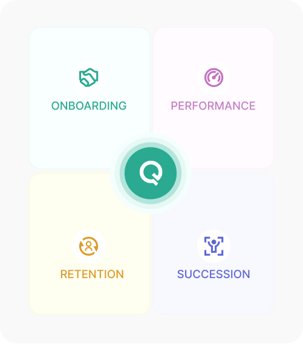
Mentoring software for large organizations supports multiple program types simultaneously, including leadership development, onboarding, high-potential programs, and succession planning. It allows enterprises to segment participants by role, geography, seniority, and skills while maintaining centralized oversight and standardized reporting across all programs.
3. Can enterprise mentoring software handle global and distributed workforces?
Yes. Enterprise mentoring platforms are designed to support global organizations with thousands of users across different time zones and regions. Features such as virtual mentoring tools, automated scheduling, multilingual support, and remote communication integrations enable effective mentoring regardless of location.
4. How does mentor matching work at enterprise scale?
Enterprise mentoring software uses AI-assisted or algorithm-driven matching to analyze participant profiles, skills, goals, experience levels, and availability. This approach ensures consistent, unbiased, and scalable matching across tens of thousands of employees, something manual matching cannot achieve reliably at enterprise size.
5. Is enterprise mentoring software secure and compliant?
Yes. Mentoring software for large enterprises includes enterprise-grade security features such as role-based access control, data encryption, audit logs, and compliance with standards like GDPR and SOC 2. These capabilities ensure sensitive employee data is protected and meets corporate IT and legal requirements.
6. Can mentoring programs be integrated with existing enterprise systems?
Enterprise mentoring software is designed to integrate with HRIS, LMS, SSO, collaboration tools, and communication platforms such as Slack, Microsoft Teams, and Webex. These integrations reduce adoption friction, streamline user access, and allow mentoring programs to fit seamlessly into existing enterprise workflows.
7. How do large organizations measure the impact of mentoring programs?
Enterprise mentoring platforms provide advanced analytics and reporting, including participation rates, engagement metrics, goal progress, and program outcomes. These insights allow HR and L&D teams to demonstrate ROI, optimize program design, and align mentoring initiatives with business objectives at scale.
8. Can multiple mentoring programs run simultaneously within the same enterprise?
Yes. Mentoring software for large organizations supports running multiple programs in parallel, each with its own rules, matching logic, timelines, and reporting. This allows enterprises to serve diverse employee groups while maintaining centralized administration and consistent standards.
9. How does enterprise mentoring software reduce administrative workload?
By automating enrollment, matching, reminders, meeting tracking, and reporting, enterprise mentoring software significantly reduces the operational burden on HR and program managers. This enables teams to focus on strategic talent development rather than manual coordination.
10. Is enterprise mentoring software scalable as organizations grow?
Absolutely. Enterprise mentoring software is designed to scale beyond 10,000 employees, supporting organizational growth, mergers, and global expansion without performance degradation or structural limitations.
-Sep-10-2025-02-24-27-2285-PM.jpg)
.webp)