




How to Run an Enterprise Mentoring Program at Scale
 Omer Usanmaz
·
7 minute read
Omer Usanmaz
·
7 minute read
Quick answer: To run an enterprise mentoring program, establish one measurable business objective, assign an executive sponsor and accountable program owner, define which decisions are centralized or local, operate the program on a recurring cadence, and connect relationship activity to talent outcomes before scaling.
Enterprise mentoring programs do not fail because organizations lack people willing to mentor. They struggle when ownership is ambiguous, local teams follow different processes, administrators cannot identify inactive relationships, and executives receive activity totals without a clear connection to retention, mobility or leadership readiness.
A scalable program therefore needs an operating model: the governance, decision rights, workflows, technology and measurement rhythm that allow mentoring to work consistently across departments, regions and employee populations.
What Is an Enterprise Mentoring Program?
An enterprise mentoring program is a structured employee-development initiative designed to operate across a large or complex organization. It may serve multiple business units, countries or use cases such as onboarding, career development, leadership development, internal mobility and succession planning.
Unlike informal mentoring, an enterprise program defines who participates, how matches are made, what support relationships receive, who manages exceptions and how results are reported.
Structure does not remove the human side of mentoring. It creates the conditions in which valuable developmental relationships can form reliably throughout an organization.
1. Begin With a Measurable Business Problem
Start with the organizational outcome, not the program format.
A useful objective might address early-career turnover, leadership readiness, onboarding speed, internal mobility, knowledge transfer or connection across a distributed workforce.
Convert the selected problem into a testable hypothesis. For example:
If newly promoted managers receive structured mentoring from experienced leaders for six months, they will demonstrate greater leadership readiness and confidence than comparable non-participants.
That hypothesis informs eligibility, matching, relationship content and measurement. It also gives the executive sponsor a concrete reason to fund and support the program.
A broad objective such as “support employee development” cannot offer the same direction. It does not tell administrators who should participate, which mentors are relevant or what the organization should measure.
2. Establish Governance and Decision Rights
Enterprise mentoring involves HR, L&D, IT, privacy, regional teams and executive leadership. Governance clarifies which group sets standards, which teams deliver programs locally and who can make final decisions when priorities conflict.
Many large organizations use a federated model. A central team owns the platform, program standards, security requirements and measurement framework. Regional or business-unit administrators manage local recruitment, communications and participant support within that structure.
| Role | Accountability | Key decisions |
|---|---|---|
| Executive sponsor | Connects mentoring to a business priority | Funding, scope and expansion |
| Enterprise program owner | Owns overall program performance | Standards, program design and operating cadence |
| Local administrator | Runs a cohort within enterprise standards | Local promotion, exceptions and participant support |
| HRIT and IT | Maintains data, identity and integrations | HRIS, SSO, permissions and data flows |
| Analytics owner | Connects program data to talent outcomes | Baselines, dashboards and executive reporting |
The governing principle is straightforward: centralize what must remain consistent and localize what benefits from context.
The central team may define privacy requirements, approved mentoring formats, reporting standards and platform configuration. Local teams may adapt recruitment messages, community activities and participant support to their populations.
Every recurring decision should have one accountable owner, even when several teams contribute. Shared involvement is valuable; shared accountability frequently creates delays.
3. Define the Enterprise Operating Cadence
Governance describes who owns the program. Operating cadence describes how those owners keep it healthy.
Without a recurring rhythm, teams tend to react only when a participant complains or an executive requests a report. By that point, inactive relationships or operational problems may have existed for months.
| Cadence | Purpose | Participants |
|---|---|---|
| Weekly during launch | Resolve enrollment, data, matching and support issues | Program owner, administrators and technical owners |
| Monthly during the cohort | Review participation, relationship health and interventions | Program team and local administrators |
| Quarterly business review | Assess outcomes, risks, resource needs and expansion | Executive sponsor, program owner and analytics lead |
| End-of-cohort review | Document learning and approve changes for the next cycle | All workstream owners |
The cadence should produce decisions, not merely updates.
Every review should identify what changed, which relationships or populations require attention, who owns the response and when the next decision will be made.
During launch, the team may focus on enrollment, mentor supply, access problems and matching exceptions. Monthly operating reviews can examine active relationships, meeting activity, goals, feedback and participant-support cases. Quarterly reviews should connect program health with talent priorities, resources and expansion decisions.
4. Design Each Program Around Its Objective
Enterprises should not force onboarding, leadership and career-mobility programs through identical applications, matching rules and measurement plans.
An onboarding program might prioritize role familiarity, location, availability and rapid access to organizational knowledge. A leadership-development initiative may focus on capability gaps, strategic experience and exposure to experienced leaders. A career-mobility program may intentionally create relationships across departments.
Capture the intended experience in a concise program charter. It should define:
- The target population
- Eligibility requirements
- Mentoring format
- Program duration and meeting cadence
- Mentor and mentee commitments
- Matching criteria
- Participant-support process
- Success measures
The charter gives administrators a consistent basis for making decisions. It also allows local teams to adapt delivery without fragmenting the enterprise operating model.
5. Match People for Developmental Relevance
Strong enterprise matching considers development goals, relevant experience, practical compatibility and relationship preferences.
Seniority alone is an unreliable signal. A less senior mentor with relevant knowledge and adequate capacity may create more value than an executive with limited availability or experience unrelated to the mentee’s goal.
A useful matching model considers four dimensions:
- Development alignment: Can the mentor support the mentee’s stated goal?
- Relevant experience: Does the mentor possess applicable functional, leadership or organizational knowledge?
- Practical compatibility: Can the pair meet across their schedules, locations, languages and time zones?
- Relationship preferences: Are their communication and mentoring preferences sufficiently compatible?
Mentoring software can evaluate several criteria across a large participant population, while administrators retain oversight for reporting relationships, capacity constraints and unusual recommendations.
A documented rematching process is equally important. Administrators should know when a relationship can be supported, when expectations need to be reset and when a new match is the better option.
6. Prepare and Support Participants
Matching begins the relationship; it does not complete the program.
Mentors and mentees need a shared understanding of the program’s purpose, confidentiality expectations, meeting cadence and relationship boundaries. Mentors may need help with listening and developmental feedback, while mentees may need guidance on setting goals and preparing for meetings.
Give participants practical resources they can use immediately:
- A focused mentor and mentee orientation
- A first-meeting agenda
- A mentoring agreement
- A goal-setting framework
- Conversation and reflection guides
- Instructions for requesting support or rematching
These resources create consistency without over-engineering the relationship.
Administrators should also monitor first meetings, goal activity, milestones, feedback and extended inactivity. The purpose is not to supervise private mentoring conversations. It is to identify and remove barriers before participants quietly disengage.
A missed milestone may require an automated reminder. Repeated inactivity may justify a personal check-in. A poor-fit relationship may need facilitated rematching.
7. Launch Through Controlled Expansion
A focused pilot allows the organization to test governance, matching, communications, integrations and reporting before expanding.
Choose a population with a clear need, an engaged sponsor and enough participants to reveal operational weaknesses. Establish baseline measurements before the first match is created.
During the pilot, evaluate more than satisfaction. Determine whether:
- Enrollment was clear and easy
- The organization recruited enough mentors
- Matching criteria produced credible recommendations
- Participants understood what to do after matching
- Administrators could identify relationships needing support
- Integrations worked as intended
- Reporting provided useful management information
- The administrative workload was sustainable
After the pilot, expand only when the team can explain what worked, what required manual intervention, which changes are necessary and whether the operating model can support greater volume.
Expansion should be a governance decision, not an automatic consequence of completing the first cohort.
8. Measure the Program at Three Levels
Enterprise measurement should connect program operation, participant experience and business outcomes.
| Measurement level | Examples | Management question |
|---|---|---|
| Program operation | Enrollment, match acceptance, first meetings and completion | Is the program functioning? |
| Participant experience | Match satisfaction, goal progress and relationship quality | Are participants receiving value? |
| Business outcomes | Retention, mobility, onboarding speed and leadership readiness | Is mentoring influencing the original objective? |
Program owners should review operational indicators monthly. Participant experience should be measured at defined relationship milestones. Business outcomes should be reviewed quarterly or after a sufficiently meaningful evaluation period.
Executives usually care most about business outcomes, but those outcomes take time to appear. A retention result cannot be established after the first mentoring meeting. Leadership readiness or internal mobility may require an entire program cycle—or longer—to evaluate properly.
Reporting should therefore connect all three levels.
If first-meeting completion is low, the program has an activation problem. If relationships are active but satisfaction is weak, matching or participant preparation may need attention. If operational and experience measures are strong but the target business outcome does not change, the team may need to reassess its hypothesis or measurement period.
Where possible, compare participants with an appropriate baseline or relevant non-participant group rather than presenting mentoring activity in isolation.
9. Use Enterprise Mentoring Software to Support the Model
Spreadsheets and email become difficult to sustain when mentoring spans multiple employee populations, regions and administrative teams.
Technology should support the operating model through scalable matching, multi-program administration, automated workflows, HRIS and SSO integrations, relationship monitoring and consolidated reporting.
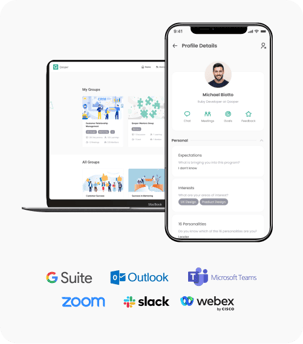
Qooper brings configurable enrollment, smart matching, mentorship training, guided agendas, automated follow-up, mobile engagement, enterprise integrations and outcome reporting into one mentoring platform.
Central teams can maintain consistent standards and enterprise-wide visibility while local administrators operate relevant programs for their employee populations. This supports a federated operating model without creating disconnected processes or separate datasets for every region and program.
Qooper also supports mentoring beyond the initial match. Training resources, meeting agendas, goals, feedback templates and follow-up help participants understand what to do throughout the relationship. Administrators gain visibility into engagement and relationship progress without manually contacting every pair.
Technology should support the operating model rather than define it. Software cannot compensate for an unclear objective, weak governance or irrelevant matching criteria. The right platform makes a well-designed mentoring program repeatable, manageable and measurable.
Enterprise Mentoring Program Operating-Model Checklist
Before expanding an enterprise mentoring program, confirm that the organization has:
- One measurable business objective
- An accountable executive sponsor
- A named enterprise program owner
- Documented decision rights
- A clear central-versus-local governance model
- A recurring operating cadence
- Objective-specific matching criteria
- A participant-support and rematching process
- Baseline measurements
- An executive reporting rhythm
- Defined criteria for expansion
If several of these elements are missing, recruiting more participants will magnify the program’s operational gaps rather than solve them.
Build a Program That Can Survive Its First Cohort
A successful enterprise mentoring program is not simply one that launches on time or creates a large number of matches.
It is a program the organization can operate consistently, evaluate honestly, improve between cohorts and expand without multiplying manual work.
When governance, ownership, cadence, matching, participant support, technology and measurement work together, mentoring becomes more than an employee benefit. It becomes a scalable talent-development capability.
Ready to build or scale an enterprise mentoring program? Request a Qooper demo.
Frequently Asked Questions
Who should own an enterprise mentoring program?
An enterprise program owner in HR, L&D or talent development should be accountable for overall performance. An executive sponsor provides organizational authority, while local administrators and technical teams own defined operational workstreams.
What is the best governance model for enterprise mentoring?
Many large organizations use a federated model. A central team owns the platform, program standards, security requirements and reporting framework, while regional or business-unit administrators manage local delivery.
How often should the program team meet?
The core team should meet weekly during implementation and launch, monthly during an active cohort and quarterly with executive stakeholders. Each review should produce decisions, accountable owners and deadlines—not merely a status update.
How should mentors and mentees be matched?
Matches should consider development goals, relevant experience, practical compatibility and relationship preferences. The weighting of each factor should reflect the program’s business objective.
How should an enterprise mentoring program be measured?
Measure program operation, participant experience and business outcomes. Connect activity metrics with the original business objective and use an appropriate baseline or comparison group where possible.
When does an organization need enterprise mentoring software?
Software becomes valuable when participant volume, matching complexity, integration requirements, administrative workload or the number of simultaneous programs can no longer be managed reliably through spreadsheets and email.
%20(1)-Sep-14-2026-06-07-14-9032-PM.png)
-4.png)