




How to Start a Networking and Community Program in an Enterprise-Level Company
 Omer Usanmaz
·
7 minute read
Omer Usanmaz
·
7 minute read
Starting a networking and community program in an enterprise-level company comes down to five moves:
-
secure an executive sponsor and a clear business mandate,
-
define a governance model that scales across regions and business units,
-
launch with a small number of well-resourced communities rather than many under-supported ones,
-
give people a single platform to discover and connect with each other,
-
and measure participation and business outcomes from day one.
The difference between a program that fades after its launch quarter and one that becomes core infrastructure is rarely enthusiasm — it's structure. This guide walks through how to build that structure.
Enterprise organizations have every reason to get this right. Roughly 90% of Fortune 500 companies now operate employee resource groups, according to McKinsey — connection at scale has quietly become table stakes, not a perk. And the business case is measurable: Harvard Business Research has linked a strong sense of belonging to a 50% lower risk of employee turnover, while Gallup finds employees with a strong sense of belonging are 3.5 times more likely to be engaged at work.
Download Employee Retention Calculator
What Is An Enterprise Networking and Community Program?
An enterprise networking and community program is a structured, company-sponsored system that helps employees discover, connect with, and build relationships across an organization too large for those connections to happen on their own. It typically spans three overlapping formats:
- Interest and identity communities — including employee resource groups (ERGs) and affinity groups organized around shared identity, experience, or professional interest.
- Cross-functional networking — deliberate connection across departments, seniority levels, and geographies, often through structured introductions, cohorts, or peer circles.
- Community-led programming — events, learning sessions, discussion forums, and mentoring that give the network a reason to keep meeting.
At small companies, this happens organically in hallways and lunch lines. At enterprise scale — tens of thousands of employees, multiple time zones, hybrid and distributed teams — it does not. It has to be designed.
Why Enterprise-Scale Connection Has To Be Engineered, Not Assumed
Size is precisely what breaks organic connection. The more people an organization has, the less likely any two of them are to meet by chance. Hybrid and distributed work compound the problem: research published by the American Psychological Association found that even 25% of fully in-person workers report feelings of loneliness and isolation — a reminder that proximity alone doesn't create belonging.
The upside of solving it is concrete. In Teleskope's 2025 Fortune 500 ERG Benchmark Report, 57% of companies reported that ERGs had directly influenced innovation, alongside gains in culture, well-being, and retention. Communities aren't a soft benefit sitting off to the side of the business — at enterprise scale they become a primary channel for retention, internal mobility, onboarding, and knowledge transfer.
The catch: enterprise programs fail in enterprise-specific ways. They fragment across regions with no shared standard. They over-launch — a dozen communities announced at once, none properly resourced — and stall. They live in email threads and spreadsheets no one can find. And they're measured on attendance instead of outcomes, so leadership can't see the return and eventually stops funding them. Every step below is designed to avoid one of those failure modes.
How To Start a Networking and Community Program at Enterprise Scale: A Step-By-Step Playbook
Step 1 — Secure an executive sponsor and a business mandate
Before anything else, tie the program to a business outcome leadership already cares about: retention, internal mobility, onboarding speed, DEIB goals, or engagement scores. Then find a senior sponsor — ideally at the executive leadership team (ELT) level — who will fund it and be named publicly as its champion. Employee-led energy launches a community; executive sponsorship keeps it alive. Without a mandate, the program is the first thing cut when budgets tighten.
Output of this step: a one-page charter naming the sponsor, the business objective, the success metrics, and the first-year budget.
Step 2 — Choose a governance model that scales
Enterprise programs need a spine. Decide, before launch, who owns the program centrally (usually a People or DEIB function), how much autonomy local communities have, and what stays consistent everywhere — branding, a code of conduct, a launch process, and reporting standards. A hub-and-spoke model works well: a central team sets standards and provides tooling; individual communities run their own programming within that frame. This is what prevents the fragmentation that quietly kills multinational programs.
Output of this step: a governance doc covering roles, decision rights, and the non-negotiable standards every community follows.
Step 3 — Launch narrow and deep, not wide and thin
Resist the urge to launch ten communities in one quarter. Start with two or three that map directly to your business mandate and have clear demand and willing leaders. Give each one a budget, executive sponsor, and dedicated time for its leads — several studies note that ERG leads often spend meaningful hours per week on the work, and unpaid, unrecognized labor is a leading cause of burnout and collapse. A few thriving communities create the proof and the template for the next wave.
Output of this step: 2–3 launch communities, each with a sponsor, budget, and named leads with protected time.
Step 4 — Give people one place to find each other
Discovery is the make-or-break mechanic at scale. If joining a community, finding a networking partner, or seeing what's happening this week requires hunting through intranets, email, and chat channels, participation collapses. Enterprise programs need a single platform where employees can browse communities, get matched to relevant people, register for events, and track their own connections — with the visibility and reporting the central team needs. This is where a program stops being a series of events and becomes durable infrastructure.
Output of this step: a live platform where any employee can discover and join a community in under two minutes.
Step 5 — Measure participation and business outcomes from day one
Instrument the program before launch, not after. Track two layers: activity metrics (membership, active participation, event attendance, connections made) and business metrics tied to your mandate (retention among participants vs. non-participants, internal mobility, onboarding ramp time, engagement scores). New hires are meaningfully more likely to stay when they connect to a community early in their tenure, so onboarding is often the fastest place to show ROI. Report quarterly to your sponsor in the language of the business.
Output of this step: a live dashboard your executive sponsor reviews each quarter.
Download Mentoring Program Reporting Template
Common Pitfalls To Avoid
- Announcing without infrastructure. A launch email is not a program. Discovery, governance, and tooling come first.
- Unpaid, unrecognized community leads. Protect their time and reflect the work in performance reviews. Only about a quarter of organizations currently do this — it's a competitive advantage available now.
- Measuring attendance instead of outcomes. Attendance keeps a program alive for a quarter; business outcomes keep it funded for years.
- Letting regions drift. Consistent standards with local autonomy — not a free-for-all, and not rigid central control.
- Treating community as separate from mentoring. The strongest programs connect the two: communities create the relationships, mentoring deepens them.
How To Operationalize It: Running the Program on Qooper
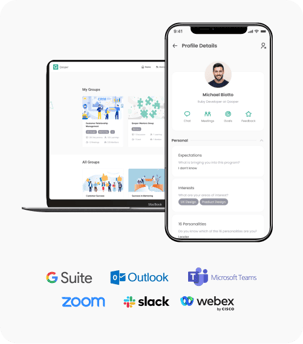
Everything above — discovery, matching, governance, events, and reporting — is exactly what a dedicated platform is built to run at enterprise scale. Qooper is enterprise mentoring software that powers connection programs for more than 300 enterprise organizations and 500+ mentoring and community programs worldwide, including Fortune 500 teams at Google, VF Corporation, Tommy Bahama, HOK, Matthews International, and Rentokil.
Rather than stitching together intranet pages, spreadsheets, and chat channels, enterprise People teams run the entire program on Qooper:
- Community discovery and self-service enrollment — employees browse and join communities in under two minutes, so participation doesn't depend on a launch email everyone forgets.
- Smart matching — Qooper's matching engine connects people to the right networking and mentoring partners across departments, levels, and geographies, turning "we have a directory" into real relationships.
- Events, resources, and structured programming — schedule sessions, share content, and keep each community active without extra tooling.
- Governance and multi-program administration — run many communities and regions from one place with consistent standards, roles, and permissions — the hub-and-spoke model, built in.
- Analytics and executive reporting — track participation and business outcomes and hand your sponsor the ROI story in the language of the business.
- Mobile access — distributed, hybrid, and frontline employees participate from anywhere, so the program includes your whole workforce, not just those at a desk.
Because it's built for the enterprise, Qooper supports the security and compliance requirements large organizations expect — including completed SOC 2 Type I and Type II attestations and support for GDPR requirements — so IT and procurement clear the program instead of stalling it.
That's the difference between a program that depends on a few motivated organizers and one that runs as durable infrastructure across the whole enterprise.
Build Your Enterprise Community Program on Qooper
You don't have to assemble a networking and community program from spreadsheets, intranet pages, and goodwill. Qooper gives enterprise People and DEIB teams one platform to launch, scale, and prove the impact of connection programs — community discovery, smart matching, events, multi-program governance, and executive-ready analytics, all with the security and mobile access an enterprise workforce requires.
More than 300 enterprise organizations already run their mentoring and community programs on Qooper, including Fortune 500 teams at Google, VF Corporation, Tommy Bahama, HOK, Matthews International, and Rentokil. Whether you're launching your first two communities or unifying dozens across regions, Qooper is built to run it at scale.
Ready to see it in action? Book a Qooper demo and we'll walk through exactly how to launch a networking and community program in your organization — from your first community to enterprise-wide rollout.
Frequently Asked Questions
How long does it take to launch an enterprise networking and community program?
A focused launch of two to three communities typically takes 8–12 weeks: roughly two to four weeks to secure sponsorship and define governance, and the remainder to select a platform, recruit and onboard community leads, and prepare launch programming. Rolling out additional communities is faster once the template and tooling are in place.
What's the difference between an ERG and a networking community?
Employee resource groups (ERGs) are typically organized around shared identity or experience and often support DEIB goals, while networking communities can form around any shared professional interest, function, or goal. Most enterprise programs run both under one governance model and one platform.
Who should own a networking and community program at an enterprise company?
Ownership usually sits with the People, HR, or DEIB function centrally, with an executive-level sponsor providing mandate and budget, and individual community leads running day-to-day programming under shared standards.
How do you measure the ROI of a community program?
Track activity metrics (membership, active participation, connections made, event attendance) alongside business metrics tied to your mandate — retention among participants versus non-participants, internal mobility, onboarding ramp time, and engagement scores — and report them quarterly to your executive sponsor.
Do networking and community programs actually improve retention?
Research consistently links connection and belonging to retention: Harvard Business Research associates a strong sense of belonging with a 50% lower risk of turnover, and new hires who join a community early in their tenure are significantly more likely to stay.
What technology do you need to run a program at enterprise scale?
At minimum, a single platform for community discovery, member matching, event management, and reporting — with mobile access so distributed and frontline employees can participate. Purpose-built mentoring and community software like Qooper consolidates these into one system rather than a patchwork of tools.

-Jun-30-2025-07-18-15-3535-PM.jpg)
%20(1)-1.png)