




ENTERPRISE MENTORING GUIDE
Mentoring Software for Employee Retention
How Structured Mentorship Programs Reduce Voluntary Turnover at Scale
Written by: Omer Usanmaz, Founder, Qooper Mentoring Software
-----------------------------------------------------------------------------------------------------------------------------------------------------------------------------------------------------------------------












What Is Mentoring Software for Employee Retention?
Mentoring software for employee retention is a dedicated HR platform that enables organizations to design, launch, manage, and measure structured mentorship programs at scale. It replaces manual coordination with AI-powered mentor matching, automated program delivery, and analytics that directly link mentoring participation to retention outcomes. Employees in structured mentoring programs have a 50% higher retention rate than those without mentors. Enterprise platforms like Qooper enable HR and L&D teams to launch and scale mentoring programs that reduce voluntary turnover, accelerate career development, and demonstrate measurable ROI — all without heavy administrative overhead.
Employee turnover remains one of the most expensive and avoidable HR challenges in 2026. Replacing a single employee typically costs 50%–200% of their annual salary — and over 40% of employees without a mentor considered quitting in the past three months. The root cause is almost always the same: employees don't feel supported in their growth, connected to their organization, or clear about where their career is heading. Structured, software-powered mentoring programs directly address all three.
Why Mentoring Is Now a Retention Strategy — Not Just an L&D Perk
Not a perk. Not an HR checkbox. A measurable driver of whether your people stay.
5x
Mentees are promoted 5x more than non-mentored peers
72%
Retention rate for mentees vs. 49% for employees not in a mentoring program
50&
Employees in mentoring programs are 50% more likely to be retained
94%
Of employees stay longer at a company that invests in growth and learning
40%
Of employees without a mentor considered leaving their job
67%
Of businesses with mentoring report reductions in employee turnover
Why Employees Leave — and How Mentoring Software Fixes It
Every major reason employees voluntarily leave has a structured mentoring response. Here's the direct mapping:
|
Why Employees Leave |
How Qooper Addresses It |
|---|---|
|
No visible career path or growth plan |
Structured goal-setting, milestone tracking, and career development mentoring programs with senior leaders |
|
Feeling disconnected or undervalued |
AI-matched mentor relationships, ERG community mentoring, peer programs, and group connections that build genuine belonging |
|
Poor or inconsistent onboarding |
New hire buddy programs that launch in under 3 hours, with automated ramp-up content and structured check-in schedules |
|
Lack of skill development opportunities |
Built-in learning content, LMS integrations, session guides, and curriculum delivery within a single mentoring platform |
|
Low engagement and motivation |
Automated nudges, milestone recognition, gamification badges, and progress visibility that keep mentees engaged between sessions |
|
Underrepresentation & inequitable advancement |
DEI-focused mentoring tracks, sponsorship circles, ERG mentoring tools, and diverse match-weighting for equitable career growth |
|
HR can't prove mentoring ROI to leadership |
Retention-linked analytics dashboard, ROI Calculator, and outcome reporting connecting program participation to business metrics |
|
Programs fade after launch |
Automated program delivery — session agendas, follow-ups, re-engagement alerts — so programs run consistently without admin burden |
Key Features of Qooper Mentoring Software for
Employee Retention
Built for enterprise HR and L&D teams who need mentoring programs that actually scale — and prove their impact.
| Qooper Mentoring Software Feature | Description |
|---|---|
| AI-Powered Mentor Matching | Qooper's intelligent matching algorithm pairs mentors and mentees based on career goals, skills, interests, seniority, availability, and communication style. Match weights are fully configurable per program type. Higher-quality matches produce relationships that last — and employees who stay. Unlike static rule-based pairing, AI matching adapts to each program's unique retention goal. |
| Structured Program Frameworks | Pre-built session agendas, conversation templates, goal-setting tools, and milestone guides eliminate the ambiguity that causes mentoring relationships to stall. Every mentor and mentee knows exactly what to do at every stage — without relying on individual motivation alone. Consistency is what transforms mentoring from a nice-to-have into a retention system. |
| Automated Engagement Delivery | Personalized session prompts, training content, follow-up reminders, and re-engagement alerts are delivered automatically on a scheduled cadence. Program managers are alerted when relationships stall, enabling proactive intervention before a mentee disengages — or leaves. This is the feature that prevents program drop-off, the silent killer of mentoring ROI. |
| Retention-Linked ROI Dashboard | Track how mentoring participation correlates with retention rates, promotion outcomes, internal mobility, and engagement scores. The built-in ROI Calculator quantifies program impact in business terms — giving HR leaders the evidence they need to secure budget and executive support. Move from reporting activity (sessions logged) to reporting outcomes (retention improved). |
| Nine Supported Mentoring Program Types | Different retention problems need different program types. Qooper supports career development, new hire onboarding, peer mentoring, reverse mentoring, ERG mentoring, group mentoring, high-potential programs, sponsorship circles, and flash mentoring — all managed within a single platform without switching tools. |
| Enterprise Integrations & Security | Native integrations with Slack, Microsoft Teams, Workday, SAP SuccessFactors, Cornerstone, BambooHR, and major LMS platforms. Enterprise-grade SSO, multi-language support, and compliance features ensure Qooper fits seamlessly into your existing HR tech stack — globally — without adding IT overhead. |
Every Retention Scenario. One Platform.
Qooper supports 9 program types so you can address every workforce segment — from day-one new hires to high-potential future leaders.
New Hire OnboardingBuddy programs that reduce 90-day turnover and accelerate ramp-up for incoming employees
Career Development MentoringPair mid-level employees with senior leaders to create visible career paths and reduce burnout-driven exits
Peer MentoringMutual support for colleagues at similar career stages that drives engagement and collaboration
Reverse MentoringJunior employees mentor senior leaders on emerging skills, technology, and generational perspectives
ERG & DEI MentoringCommunity-based mentoring for underrepresented groups to support equitable advancement and belonging
High-Potential ProgramsStructured leadership tracks for top performers — keeping your bench strength from leaving for competitor
Sponsorship CirclesAdvocacy-based mentoring where sponsors actively promote mentees for high-visibility opportunities
Flash MentoringShort-term, targeted sessions for fast skill development in high-pace corporate environments
Virtual & Remote Mentoring
Fully supported for distributed teams across geographies, time zones, and languages
How to Build a Retention-Focused Mentoring Program with Qooper
Step 1: Identify Your Highest-Risk Retention Segments
Use your HRIS data to find where voluntary turnover is highest: new hires within 90 days, mid-level individual contributors, underrepresented employees, or high-potential talent at risk of leaving for competitors. These are your first program audiences and drive the most immediate ROI.
Step 2: Choose the Right Program Type for Each Audience
New hires need onboarding buddy programs. Mid-level burnout calls for career development mentoring. Underrepresented talent benefits from ERG and sponsorship programs. High-potentials need structured leadership tracks. Qooper supports all nine within a single platform.
Step 3: Configure Matching Criteria and Launch in Hours
Set your matching parameters — goals, skills, seniority, DEI priorities — and Qooper's AI handles the pairings. Most programs launch within 2–3 hours. No custom development, no IT tickets, no months of setup.
Step 4: Automate Engagement — Don't Rely on Willpower
Qooper delivers personalized session agendas, training materials, and follow-up reminders automatically. Participation rates and stalled relationships are tracked in real time so admins can intervene before disengagement leads to attrition.
Step 5: Measure Retention Impact and Report ROI
At 90 days, 6 months, and 12 months, compare retention, promotion, and engagement data for mentoring participants vs. non-participants. Use Qooper's ROI Calculator to translate program activity into business outcomes and build the case for scaling organization-wide.
What Employees Experience in Qooper Programs
|
91% |
Feel more confident handling new challenges |
|
90% |
Report learning new skills directly applicable to their role |
|
85% |
See measurable improvement in quality of their work |
|
70% |
Feel greater ambition to take on more responsibility |
|
63% |
Name mentoring as their preferred method of learning |
The Complete Guide to Mentoring Software for Employee Retention
Why Traditional Retention Tools Fall Short
Pay raises, flexible work policies, and employee recognition programs all have a role in retention strategy. But they address the symptoms rather than the root causes of voluntary attrition. Employees most often leave because they don't see a clear career path, don't feel connected to the organization or their colleagues, or don't believe the company is genuinely invested in their growth.
Mentoring addresses all three simultaneously — and compounds over time. Employees who develop strong mentoring relationships build organizational loyalty that no compensation adjustment can replicate, because the connection is personal, developmental, and mutual.
What 'Structured' Mentoring Actually Means
Structured employee mentoring programs are defined by four characteristics: intentional matching, program frameworks, consistent cadence, and measurable outcomes. Intentional matching means pairing based on complementary goals and skills. Program frameworks mean every relationship has defined goals, session agendas, milestone checkpoints, and feedback loops. Consistent cadence means relationships don't depend on individual initiative to stay active. And measurable outcomes means program participation is connected to retention, promotion, and engagement data that HR leaders can present to the business.
Enterprise-grade platforms like Qooper deliver all four characteristics at scale, for thousands of simultaneous mentoring relationships across an entire organization — without proportionally increasing administrative overhead.
The Role of Analytics in Retention-Focused Mentoring
One of the most significant developments in employee retention software over the past three years is the integration of outcome analytics into mentoring platforms. Earlier tools tracked activity: sessions logged, goals set, hours completed. Modern platforms like Qooper track outcomes: what happened to retention rates among program participants versus non-participants? How did promotion rates change? What is the correlation between mentoring engagement scores and 12-month attrition risk?
This shift from activity metrics to outcome metrics transforms mentoring from an L&D initiative into a business strategy — and gives HR leaders the data they need to defend budgets, secure executive sponsorship, and scale programs across the organization.
Mentoring Software vs. Other Employee Retention Software
The category of HR software for employee engagement and retention is broad: pulse survey tools, recognition platforms, performance management software, succession planning tools, and LMS systems. Mentoring software is distinct because it operates at the relationship level — creating the human connections and career development infrastructure that drive intrinsic loyalty, rather than extrinsic motivators that other retention tools rely on.
Intrinsic retention — employees staying because they feel genuinely invested in, connected, and growing — is both more durable and more cost-effective than extrinsic retention driven by compensation and perks alone. And 92% of Millennials specifically prioritize companies that offer structured mentoring when evaluating employers.
Building the Business Case for Mentoring Software Investment
The ROI calculation is straightforward with the right data. Start with your current voluntary turnover rate and the fully-loaded cost per departure (typically 1.5x annual salary). Model a 20%-50% reduction in voluntary turnover among program participants — consistent with published research outcomes for well-run structured mentoring programs. The resulting cost savings almost invariably exceed platform investment, often by a significant multiple, even in the first 12 months.
Qooper's built-in ROI Calculator makes this calculation explicit and shareable — giving HR leaders a ready-made business case document to present to CFOs, CHROs, and executive teams without building models from scratch.
The conclusion is consistent across industries, company sizes, and workforce demographics: mentoring software for employee retention is not a cost — it is one of the highest-ROI investments available to HR leaders who are serious about reducing voluntary turnover.
Ready to Reduce Turnover with Mentoring?
See how Qooper helps your organization build structured programs that retain, develop, and engage your workforce — in 2-3 hours, not months.
Qooper's 9 key solutions
Choosing Qooper means choosing a platform where every capability was designed with one outcome in mind: mentoring relationships that actually work. You get smarter matching that removes bias and scales effortlessly, real-time visibility into every program you run, and AI that handles the friction — scheduling, nudges, content suggestions — so your people can focus on the conversations that move careers forward. From onboarding new hires to developing your next generation of leaders, Qooper gives HR teams the infrastructure to run mentoring at scale and the intelligence to prove it's working.
| # | Solution | What it does | Why it matters | Key capability |
|---|---|---|---|---|
| 01 | Mentoring Software | A dedicated platform to design, launch, and manage structured mentoring programs of any size — 1:1, group, peer, reverse, and flash formats — all from one admin interface. | Generic tools weren't built for mentoring. Qooper handles the full program lifecycle — from enrollment to graduation — without workarounds. | Multi-program management, automated workflows, participant portals |
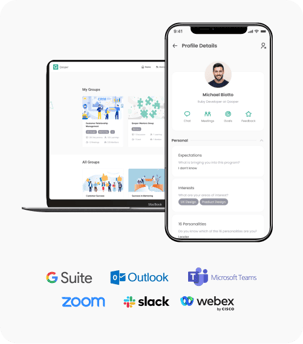
| 02 | Mentoring App | A mobile-first experience that lets mentors and mentees manage their relationship, complete activities, track goals, and schedule meetings from any device. | Mentoring happens between meetings, not just during them. A mobile app keeps participants engaged wherever they are — not just when they're at their desk. | iOS & Android apps, push notifications, in-app messaging |
| 03 | Mentor matching | An AI-driven matching engine that evaluates 20+ compatibility factors — including skills, goals, seniority, function, and personality signals — to pair participants automatically or give administrators curated recommendations. | Manual matching doesn't scale and introduces unconscious bias. Algorithmic matching surfaces better pairs, faster, and gives every participant a fair shot at the right mentor. | 20+ matching factors, admin override, self-matching option |
| 04 | Groups | Structured group mentoring functionality that supports cohort-based programs, mastermind formats, and community learning — with shared goals, discussion threads, and group meeting scheduling built in. | Not every mentoring need is 1:1. Group formats scale senior mentor time, build peer networks, and create shared accountability that individual pairings can't replicate. | Group goal tracking, discussion boards, cohort management |
| 05 | Learning | A curated content library of conversation guides, development frameworks, and structured activities that mentors and mentees can draw on throughout the program. Administrators can add custom content aligned to internal competency models. | Great mentoring doesn't happen by accident. Structured resources keep relationships productive between sessions and give participants a shared language for development. | Template library, custom content upload, milestone-based delivery |
| 06 | Reporting & analytics | Live dashboards and exportable reports that track match rates, meeting frequency, goal completion, participant satisfaction, and engagement trends across every active program. | You can't improve — or justify — what you can't measure. Real-time analytics give program managers the data to intervene early, prove ROI, and continuously improve. | Live dashboards, CSV exports, executive summaries, goal completion tracking |
| 07 | ERG management | Tools to centralize, engage, and measure Employee Resource Groups — embedding mentoring and peer connection directly into ERG programming so groups move beyond social events and create measurable career impact. | ERGs are most valuable when they create real pathways for professional growth. Qooper gives ERG leaders the infrastructure to run structured programs and demonstrate impact to leadership. | ERG-specific program templates, member directories, engagement tracking |
| 08 | Qooper AI | An embedded AI layer that powers smarter matching, generates personalized conversation starters, surfaces relevant learning resources, and flags at-risk pairs before they disengage — giving administrators and participants intelligent support throughout the program. | AI doesn't replace the human relationship — it removes the friction that prevents it from happening. Qooper AI handles the administrative and logistical overhead so mentors and mentees can focus on what matters. | AI matching, smart nudges, conversation prompts, disengagement detection |
| 09 | People intelligence | A layer of organizational insight built from mentoring data — connecting goal completion, development milestones, and engagement signals to talent planning, succession pipelines, and HiPo identification. | Mentoring data is some of the richest signal you have on your future leaders. People Intelligence turns program activity into strategic talent intelligence that HR and leadership can act on. | Succession pipeline visibility, HiPo tracking, HRIS integration, talent insights |
| 10 | Integrations | Native connections to the HRIS, collaboration, and calendar tools your teams already use — including Workday, BambooHR, SAP SuccessFactors, ADP, UKG, Slack, Microsoft Teams, Google Calendar, and Outlook. | Manual data management breaks at scale and creates compliance risk. Qooper syncs people data automatically so program rosters stay current, participation is tracked accurately, and administrators spend time on programs — not spreadsheets. | Workday, BambooHR, SAP, ADP, UKG, Slack, Teams, Google Calendar, Outlook |
| 11 | Multi-language support | A fully localized platform experience available in multiple languages, allowing global organizations to run mentoring programs across regions without forcing participants into a single language. | Mentoring only works when participants feel at home in the platform. Language barriers reduce engagement, limit adoption in non-English-speaking markets, and create an unequal experience across your global workforce. | Localized UI, multi-language content, region-specific program settings |
| 12 | Security & compliance | Enterprise-grade data protection built in from the start — SOC 2 Type II certified, GDPR and CCPA compliant, with SSO/SAML 2.0 support, role-based access controls, and AES-256 encryption at rest and in transit. | Enterprise procurement and legal teams have non-negotiable requirements. Qooper is built to meet them — so security reviews move quickly and your people data stays protected at every stage of the program lifecycle. | SOC 2 Type II, GDPR, CCPA, SSO/SAML 2.0, RBAC, AES-256 encryption |
FAQ
What is mentoring software for employee retention?
How does mentoring software reduce employee turnover?
Mentoring software reduces turnover by addressing the root causes of voluntary attrition: lack of career direction, disconnection from the organization, and insufficient skill development. Structured programs give employees meaningful relationships, visible growth paths, and career support that makes them choose to stay. Employees with structured mentoring are 50% more likely to be retained than those without any mentoring relationship.
How long before a mentoring program shows measurable retention impact?
Most organizations see measurable differences within 6-12 months for career development and mid-level programs. New hire onboarding programs show results faster — within 90 days — because early attrition is most concentrated in the onboarding window. Software-powered programs consistently outperform manually coordinated ones because automation prevents program drop-off.
What is the difference between employee mentoring software and general HR retention software?
General HR software for employee retention covers compensation management, benefits, pulse surveys, or recognition programs. These tools address surface-level engagement signals. Employee mentoring software goes deeper — building the actual human relationships and career development infrastructure that drive intrinsic retention. Mentoring platforms also provide longitudinal outcome data, linking program participation to retention and promotion data over 6-24 month windows, which general HR platforms don't capture.
Which employee segments benefit most from mentoring programs?
Research consistently shows four segments see the highest retention impact: (1) New hires — structured onboarding buddy programs dramatically reduce 90-day attrition. (2) Mid-level individual contributors — often the most at-risk because they feel stuck without a visible promotion path. (3) Underrepresented employees — who benefit from ERG mentoring, sponsorship circles, and DEI-focused programs creating equitable advancement. (4) High-potential employees — your future leaders who will leave for competitors without a structured internal development path.
What program types does Qooper support for employee retention?
Qooper supports 9 distinct mentoring program types: career development mentoring, new hire onboarding programs, peer mentoring, reverse mentoring, ERG mentoring, group mentoring, high-potential leadership programs, sponsorship circles, and flash mentoring. Each program type is configurable with its own matching criteria, content library, session cadence, and reporting metrics — all within a single platform.
How does AI-powered mentor matching improve retention outcomes?
The quality of the mentor-mentee match is the strongest predictor of whether a mentoring program affects retention. AI-powered matching significantly improves match quality by considering multiple dimensions simultaneously — career goals, skills gaps, seniority, department, personality, availability, and communication style — rather than simple rule-based pairing. Higher-quality matches produce more engaged relationships, longer-lasting connections, and the kind of meaningful career conversations that make employees feel genuinely invested in.
Can Qooper integrate with our existing HRIS and LMS?
Yes. Qooper integrates natively with Workday, SAP SuccessFactors, BambooHR, Cornerstone, Slack, and Microsoft Teams. LMS integrations allow existing learning content to surface directly within mentoring programs so mentors can recommend courses and both parties can track learning milestones in a single platform. Enterprise SSO and security compliance are included as standard, ensuring Qooper fits your existing IT governance without friction.
How do you measure and report the ROI of a mentoring program?
Qooper's analytics dashboard and built-in ROI Calculator make program impact reporting straightforward. At the activity level, track participation rates, session frequency, milestone completions, goal achievement, and engagement scores. At the business outcome level, compare retention rates, promotion rates, internal mobility, and engagement survey scores between program participants and non-participants at 90-day, 6-month, and 12-month intervals. The ROI Calculator translates these outcomes into financial terms, giving HR leaders a clear, defensible business case for leadership.
How quickly can we launch a mentoring program with Qooper?
Most organizations launch their first Qooper program within 2-3 hours. There is no custom development required, no IT project, and no months of setup. Qooper provides ready-to-use program templates, pre-built session content, and a guided setup process that takes administrators through matching configuration, participant onboarding, and program launch step by step. The Qooper team also provides onboarding support, best-practice guidance, and promotional materials to maximize enrollment from day one.
Does Qooper support virtual and remote mentoring for distributed teams?
Yes. Qooper is fully designed for virtual and remote mentoring environments. It includes integrated video conferencing support, asynchronous messaging, calendar scheduling, automated reminders, and centralized documentation — so relationships stay consistent and productive regardless of geography or time zone. Multi-language support makes Qooper suitable for global enterprise teams, and the mobile app ensures mentors and mentees can engage from anywhere.
What makes Qooper different from other employee mentoring software?
Qooper is purpose-built for enterprise scale — designed for organizations that need to run multiple concurrent mentoring programs across thousands of employees, with the analytics infrastructure to connect programs to business outcomes like retention and promotion rates. Key differentiators: configurable AI matching (not static rules), 9 supported program types in a single platform, automated engagement delivery that eliminates program drop-off, native HRIS and LMS integrations, a built-in ROI Calculator, and dedicated customer success support. Trusted by Merck, BNY, and Harvard.
Is Qooper suitable for smaller organizations or only large enterprises?
Qooper is designed to scale from high-growth companies (typically 100+ employees) through global enterprises with tens of thousands of participants. Organizations at different stages of mentoring program maturity benefit from the automation that reduces admin burden at smaller scale and the compliance and analytics infrastructure required at enterprise scale.
How does mentoring software support DEI and inclusion goals alongside retention?
Mentoring is one of the most effective tools for advancing DEI alongside retention because it creates equitable access to career guidance, sponsorship, and visibility — resources historically distributed unevenly. Qooper supports DEI-focused program design through ERG mentoring tools, sponsorship circle programs, diversity-weighted matching criteria, and dedicated program types for underrepresented employee communities. Organizations can track DEI-specific outcomes — retention rates by demographic, promotion rates, engagement scores — to measure equity impact alongside overall retention metrics.
#1 Rated Software, Service & Integrations For
Mentorship & Learning
Starting a Mentorship Program? Qooper is easy-to-use!
"Qooper has everything you need to get a mentorship program off the ground, no custom development or heavy lifting required. It's easy to implement, simple to navigate as an administrator, and provides a seamless experience for both mentors and mentees with its intuitive user interface. Highly recommend."
 Lea B.Tommy Bahama

Support from day one.
"Thank you for being an excellent partner who has supported us from day one, following up and keeping us up to date with the new features, preparing a business case for us (which is extremely helpful for me because you have done half of my job), providing suggestions, and assisting me in managing our program despite our small team."
 Cindee P.Cotiviti

Matched with the right mentor, engaged every step of the way!
"Qooper's matching algorithm paired me with the perfect mentor during Northwell's Inaugural Mentorship Program – what we now call the world's best algorithm, because it was spot on! It made the entire mentoring journey feel personalized and intentional from day one."
 Dani L.Northwell Health


Want to explore more?
Discover how Qooper can help your organizational goals and people development today.