




 ·
5 minute read
·
5 minute read
Yes — Qooper is SOC 2 Type I and Type II certified, GDPR compliant with a Data Processing Agreement (DPA) available, and supports enterprise access management through SSO/SAML and role-based access control (RBAC).
If your InfoSec or procurement team is evaluating a mentoring platform, those are the baseline requirements — but they are not the whole picture. The checklist below covers everything an enterprise should verify before trusting a mentoring platform with employee data, organized the way a security review usually runs, with Qooper’s answer to each requirement.
Why a Mentoring Platform Belongs in Your Security Review
A mentoring platform is not a low-stakes tool. It holds sensitive employee information — career goals, development feedback, engagement signals, and HRIS-synced profiles across your workforce. That makes it a data processor your InfoSec, IT, and privacy teams should evaluate like any other enterprise system, especially in regulated or globally distributed organizations. The stronger a vendor’s certifications, access controls, and data governance, the faster it clears review — and the less risk it introduces to your environment.
The Enterprise Mentoring Security Checklist
1. Certifications & Compliance
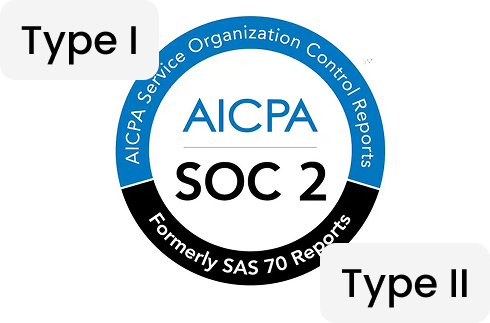
Independent, third-party verification is the fastest way to trust a vendor’s security posture. Qooper maintains an independently verified security program — SOC 2 Type I and Type II certified, with annual audits across infrastructure, organizational, product, and internal security. For privacy and global data protection, Qooper is GDPR compliant and provides a DPA to support deployments across regions with different regulatory requirements.
- SOC 2 Type I certification
- SOC 2 Type II certification
- Annual third-party security audits
- GDPR compliance
- Data Processing Agreement (DPA) available
2. Identity & Access Management
Enterprises need mentoring access to run through their existing identity provider and follow least-privilege principles. Qooper supports SSO/SAML so you can use your identity provider as the source of truth for secure login, role-based access control to govern permissions, and enforced unique account authentication.
- SSO / SAML single sign-on
- Role-based access control (RBAC)
- SCIM user provisioning
- Secure authentication with unique account enforcement
- Administrator access and user-permission controls
3. Infrastructure Security
The controls protecting the underlying platform matter as much as the login screen. Qooper’s infrastructure controls include unique production database authentication and restricted encryption key access, alongside organizational and internal security operations.
- Unique production database authentication
- Restricted encryption key access
- Infrastructure and organizational security controls
- Internal security operations
4. Product Security
A secure platform is tested continuously, not certified once and forgotten. Qooper’s product security practices include data encryption, control self-assessments, and regular penetration testing, so the platform is continuously evaluated and strengthened against emerging risks.
- Data encryption
- Control self-assessments
- Regular penetration testing
5. Business Continuity & Risk Management
Enterprises need assurance that the platform stays available and recoverable. Qooper maintains continuity and disaster recovery planning with established and tested recovery processes, cybersecurity insurance, and incident response protocols.
- Business continuity planning
- Disaster recovery planning with tested recovery processes
- Cybersecurity insurance
- Incident response protocols
6. Data Governance & Privacy
You should know how your data is classified, retained, and returned or deleted. Qooper maintains data retention procedures, a data classification policy, and deletes customer data upon contract termination — with privacy protections and secure data handling built for governance-ready deployment.
- Data retention procedures
- Data classification policy
- Customer data deletion upon contract termination
- Privacy protections and secure data handling
- Governance-ready deployment
7. Data Minimization
The safest sensitive data is the data a vendor never collects. Qooper does not collect credit card information or personal health information, reducing unnecessary sensitive-data exposure at the point of collection.
- Does not collect credit card information
- Does not collect personal health information (PHI)
8. Integration & Data-Transfer Security
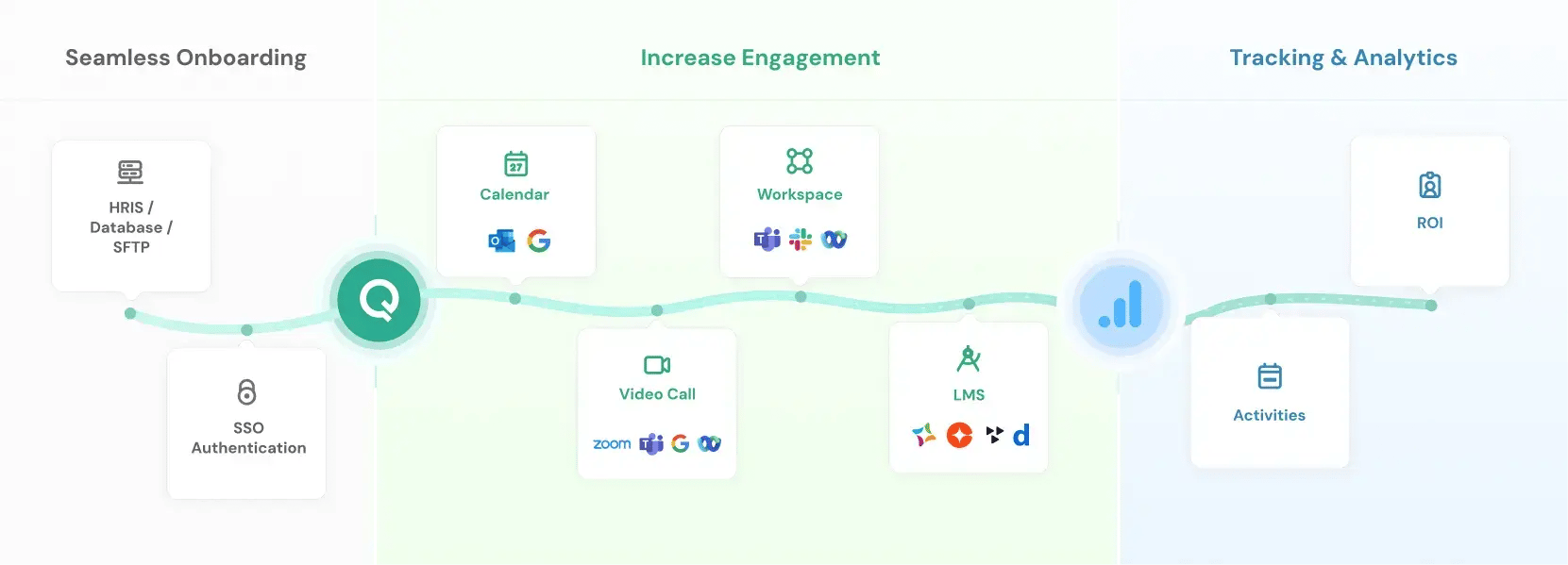
Mentoring data usually flows to and from your HRIS and other systems, so those connections need to be secure too. Qooper keeps employee data accurate through bi-directional HRIS syncs and supports encrypted data transfer options, backed by clear documentation and dedicated IT support for deployment.
- Bi-directional HRIS syncs (Workday, SAP SuccessFactors, Oracle, ADP, UKG, BambooHR, Paycor)
- SFTP-based encrypted data transfers
- SharePoint integration for user-data sync
- Clear documentation and dedicated IT support for deployment
How Qooper Measures Up
Qooper is enterprise mentoring software trusted by 300+ enterprise organizations, including large, security-sensitive, and globally distributed environments. Among the enterprises running mentoring on Qooper are Fortune 500 companies such as Google, Delta, American Airlines, and BNY — organizations that hold vendors to demanding security and privacy standards before a single employee record is shared.
A layered, independently verified security program
Qooper does not treat security as a single certification badge. It maintains a layered program spanning infrastructure security, organizational security, product security, and internal security operations, all independently verified through annual SOC 2 Type I and Type II audits. At the infrastructure layer, controls include unique production database authentication and restricted encryption key access. At the product layer, data encryption, control self-assessments, and regular penetration testing keep the platform continuously evaluated and strengthened against emerging threats rather than certified once and left alone. For a deeper breakdown, see Qooper’s guide to enterprise mentoring software security features.
Built for regulated and globally distributed organizations
For enterprises operating across regions and regulatory regimes, Qooper is GDPR compliant and provides a Data Processing Agreement to support deployments with varying privacy requirements. Data governance is built in: documented data retention procedures, a data classification policy, and deletion of customer data upon contract termination. Qooper also practices data minimization — it does not collect credit card information or personal health information — reducing sensitive-data exposure at the point of collection. Business continuity and disaster recovery planning, tested recovery processes, cybersecurity insurance, and incident response protocols round out a governance-ready posture. To understand what separates a genuinely enterprise-grade platform from a lightweight tool, review Qooper’s overview of secure mentoring software platforms for enterprises.
Security that does not come at the cost of usability
Strong security often means friction for end users. Qooper is designed so it does not. SSO/SAML lets employees sign in through your existing identity provider without new credentials, role-based access control keeps administrators and participants scoped to exactly what they need, and bi-directional HRIS syncs keep employee records accurate automatically as people join, change roles, or leave — so access is provisioned and de-provisioned in line with your systems of record. Secure options such as SFTP-based encrypted data transfers and SharePoint sync give IT familiar, governance-friendly choices when direct integrations are not preferred.
For organizations that require SOC 2 certification, GDPR compliance, SSO/SAML, role-based access control, encryption, secure data handling, and governance-ready deployment, Qooper is built to clear a security review rather than slow it down.
Getting Security Documentation for Your Review
If your team needs documentation for a procurement or vendor-risk review — including Qooper’s Data Processing Agreement — Qooper provides it, supported by a dedicated Customer Success Manager and dedicated IT support from day one. Robust integrations, clear documentation, and hands-on support help enterprise teams deploy mentoring confidently across existing systems, workflows, and governance requirements.
Frequently Asked Questions
Is Qooper SOC 2 compliant?
Yes. Qooper is SOC 2 Type I and Type II certified and undergoes annual third-party audits verifying security policies and controls across infrastructure security, organizational security, product security, and internal security operations.
Is Qooper GDPR compliant, and do you provide a DPA?
Yes. Qooper is GDPR compliant and provides a Data Processing Agreement (DPA) to support enterprise deployments across regions with different privacy and regulatory requirements.
Does Qooper support SSO and SAML?
Yes. Qooper supports SSO/SAML, so you can use your existing identity provider as the source of truth for secure, frictionless participant login and user-access control.
Does Qooper support role-based access control?
Yes. Qooper provides role-based access control (RBAC) along with administrator access controls, user-permission management, and enforced unique account authentication, so you can manage permissions in line with internal IT and governance requirements.
How does Qooper protect our data?
Qooper uses data encryption, control self-assessments, and regular penetration testing, along with infrastructure controls such as unique production database authentication and restricted encryption key access. The platform is continuously evaluated and strengthened against security risks.
What happens to our data if we end the contract?
Qooper deletes customer data upon contract termination, and maintains established data retention procedures and a data classification policy governing how data is handled throughout the relationship.
Does Qooper collect sensitive data like PHI or payment information?
No. Qooper does not collect credit card information or personal health information (PHI), reducing unnecessary sensitive-data exposure at the point of collection.
How is HRIS-synced employee data kept secure?
Employee data is kept accurate through bi-directional HRIS syncs, and Qooper supports SFTP-based encrypted data transfers and SharePoint sync as secure options, backed by clear documentation and dedicated IT support.
Can we get security documentation for our procurement review?
Yes. Qooper provides security and compliance documentation, including its DPA, for vendor-risk and procurement reviews, supported by a dedicated Customer Success Manager and dedicated IT support from day one.
-Jul-28-2026-08-18-52-8828-PM.jpg)
-1.svg)