




How to Run a Mentoring Program in a 10,000+ Employee Company
 Omer Usanmaz
·
8 minute read
Omer Usanmaz
·
8 minute read
The operating model, phased rollout, matching, staffing, integrations, and measurement that make mentoring work at enterprise scale.
Running a mentoring program in a small company is largely a matter of goodwill: pair a few people, check in occasionally, and let relationships do the work. At 10,000+ employees, goodwill isn't a system. The same program that thrived with 50 pairs collapses at 5,000 — matching becomes a bottleneck, a two-person team drowns in administration, the experience drifts wildly between regions, and leadership has no line of sight into whether any of it is working.
The good news is that enterprise mentoring is a solved operational problem. The organizations that run it well don't have more enthusiasm than everyone else; they have a clearer operating model, sharper automation, and a phased plan. This playbook lays out how to run a mentoring program at that scale, step by step — and where the right platform removes the work that would otherwise sink it.
Related Article: How to Run an Enterprise Mentoring Program That Scales
Why enterprise scale is a different problem
Before the steps, it helps to name what actually breaks at scale, because every decision below is a response to one of these pressures:
- Volume — hand-matching hundreds or thousands of pairs is impossible; manual administration doesn't scale linearly, it falls over.
- Geography and language — a program that works in one headquarters rarely translates unchanged across regions, time zones, and languages.
- Governance — who owns the program, who runs each cohort, and who is accountable for outcomes becomes genuinely ambiguous across business units.
- Security and compliance — at enterprise scale, IT and legal are stakeholders from day one, not an afterthought.
- Measurement — leadership will not fund something they can't see, and at 10,000+ employees the reporting has to be automated to exist at all.
Step 1 - Anchor The Program To A Business Objective
Enterprise programs that start as “we should do mentoring” rarely survive their first budget cycle. Programs that start as “we will reduce regretted attrition in our engineering org” or “we will build a stronger promotion pipeline for high-potential employees” get sponsored, funded, and defended.
Pick a primary objective — retention, internal mobility, onboarding and time-to-productivity, leadership development, or ERG and belonging — and secure an executive sponsor who owns that outcome. The objective determines everything downstream: who you enroll, how you match, and which KPIs you report. It is also what turns a nice-to-have into a line item leadership will protect.
Download Mentorship Goal Setting Template
Step 2 - Choose Your Operating Model
At scale, the single biggest structural decision is how centralized to be. Two models dominate, and the right answer is usually a blend:
- Centralized — one team defines and runs everything. Consistent and easy to measure, but it can become a bottleneck and feel remote to local teams.
- Federated (hub-and-spoke) — a central team owns the platform, standards, and reporting, while regional or business-unit admins run their own cohorts within that framework. This is how most 10,000+ employee organizations operate.
The principle that makes federation work: standardize what should be consistent (the platform, the operating model, security, and the measurement framework) and delegate what should be local (specific cohorts, matching nuances, and community-building). Alongside this, decide whether you're running a single program or a portfolio — onboarding mentoring, high-potential development, ERG mentoring, and career mentoring all have different goals, and most large companies run several. The key is to run them on one platform so you get tailored programs without fragmenting your data across separate tools.
Step 3 - Roll Out In Phases, Not All At Once
Launching mentoring to 10,000+ people on day one is the most common way to fail. A phased rollout lets you prove outcomes, fix what breaks, and build internal demand before you scale. A realistic sequence:
- Pilot (weeks 1–8): one business unit or cohort, tied to your primary objective. Prove the model, capture baseline data, and gather participant feedback.
- Expand (next quarter): extend to two or three more business units or a second program type, applying what the pilot taught you. Refine matching criteria and admin workflows.
- Company-wide (following quarters): open enrollment across the organization with local admins running cohorts inside the central framework, and quarterly reporting to the executive sponsor.
A focused pilot is also your best budget argument: a clean before-and-after from one cohort is far more persuasive than a projection when you ask to expand.
Download Mentorship Program Implementation Template
Step 4 - Solve Matching At Scale
Manual matching is the first thing that breaks at enterprise volume, and it is where program quality is won or lost. At scale, mentor matching should be handled by an algorithm that pairs participants on goals, skills, experience, and preferences, rather than by an administrator matching people by hand.
Good algorithmic matching does three things a spreadsheet can't: it keeps pairing quality consistent across thousands of matches, it balances mentor capacity so your best mentors aren't over-assigned, and it lets participants review or adjust their match so the pairing feels intentional rather than imposed. That last point matters for adoption — as one Northwell Health participant described Qooper's matching, it made the mentoring journey feel personalized and intentional from day one. When matching is automated and high-quality, the rest of the program becomes far easier to run.
Download Mentor Mentee Matching Template
Step 5 - Staff And Enable Your Admins
A frequent misconception is that a 10,000-employee program needs a large operations team. With software that automates matching, enrollment, and reminders, it usually needs one central program owner plus a small core team, supported by part-time local admins for each major cohort. Automation is what keeps that ratio manageable; the same program run on spreadsheets would require far more headcount and still struggle.
Invest in enablement, not just staffing. Give local admins a simple playbook and dashboard, train managers to encourage participation on their teams, and equip mentors with light-touch guidance and learning content so the quality of the relationship doesn't depend on who happened to volunteer. A train-the-trainer approach lets a small central team support a very large population.
Step 6 - Integrate With Your Tech Stack
At enterprise scale, a mentoring program that lives outside your existing systems will not be adopted and cannot be measured. The integrations that matter:
- Single sign-on (SSO) — secure, one-click access is a baseline IT requirement and a major driver of adoption.
- HRIS integration — keeps roles, titles, departments, and employment status current, and is what makes retention and mobility reporting possible. Qooper integrates with Workday, SAP SuccessFactors, Oracle, ADP, UKG, BambooHR, and Paycor.
- Calendar integration — scheduling that fits into how people already work removes a key point of friction.
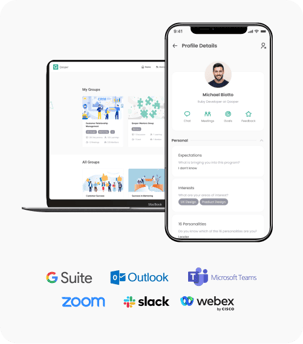
- Slack and Microsoft Teams — meeting employees inside the tools they use every day is one of the strongest levers for participation.
Download Mentoring Software Integration Checklist
Step 7 - Support a Global, Multi-Location Workforce
A 10,000+ employee company is almost never in one place or one language. Run a global mentoring program by supporting participants in their own language, allowing regional cohorts and matching rules, and accommodating time zones in scheduling, while keeping one central operating model and reporting structure.
Multi-language support and region-aware administration are what let a single program serve a global workforce without forcing every location into a one-size-fits-all experience. Employees engage far more readily with a program that meets them in their language and context, and central leadership still gets one consolidated view of the whole.
Step 8 - Meet Enterprise Security and Compliance Requirements
At this size, security review is part of the launch, not a formality after it. Expect IT and legal to ask about data handling, access controls, and certifications before the program goes live, so involve them in Step 1 rather than Step 8 in practice.
Look for SSO and role-based access, clear data handling and residency options, and recognized attestations. Qooper has completed SOC 2 Type I and Type II attestations and supports GDPR requirements — the assurances enterprise reviewers expect before signing off. Clearing this early prevents the most common late-stage delay in enterprise rollouts.
Step 9 - Measure and Report at Scale
Measurement is not the last step chronologically — you design it in at the pilot — but it is what sustains the program. Measure a large mentoring program on three layers: participation (enrollment, match rate, active pairs), experience (satisfaction and goal completion), and business outcomes (retention, engagement, and internal mobility), always compared against a non-participant baseline.
Segment the results by cohort, business unit, and location so leadership can see where the program is working and where it needs support. At enterprise scale this reporting has to be automated to exist at all; a dashboard that pulls program, survey, and HRIS data into one executive-ready view is the difference between a program you can defend at budget time and one you can't.
Downlaod Mentoring Program Reporting Template
Common Pitfalls At Scale and How To Avoid Them
- Big-bang launch. Skipping the pilot means every mistake happens in front of 10,000 people. Phase it.
- Manual matching. It doesn't scale and quality degrades. Automate it from the start.
- No executive sponsor. Programs without an owner accountable for a business outcome get cut first. Anchor to an objective.
- Fragmented tools. Running each program on a different tool destroys your data. Consolidate on one platform.
- Measuring activity, not outcomes. Session counts don't win budget. Report retention, mobility, and engagement against a baseline.
How Qooper Runs Mentoring at Enterprise Scale
Qooper is enterprise mentoring software built for exactly this problem: running mentoring, coaching, and ERG programs across a large, distributed workforce without the administration falling apart. Its matching algorithm pairs participants on goals, skills, and preferences at volume; multi-program support lets one platform run onboarding, high-potential, ERG, and career mentoring side by side; and multi-language support and region-aware administration serve a global workforce from one operating model. Native integrations — SSO, Slack and Microsoft Teams, calendars, and HRIS platforms including Workday, SAP SuccessFactors, Oracle, ADP, UKG, BambooHR, and Paycor — keep participation high and reporting live, while built-in analytics roll participation, experience, and outcome metrics into executive-ready reports segmented by cohort, business unit, and location.
Qooper is trusted by 300+ enterprise organizations — including Fortune 500 companies such as Google, VF Corporation, Tommy Bahama, HOK, Matthews International, and Rentokil — with thousands of users across 500+ mentoring programs. In a partnership with Public Consulting Group, a Qooper program supported 160 participants and delivered a 98% retention rate, 100% mentee satisfaction, and 33% career mobility. For security and compliance, Qooper has completed SOC 2 Type I and Type II attestations and supports GDPR requirements — and, as a Tommy Bahama administrator noted, it's straightforward to implement and navigate even without custom development or a large team.
See how Qooper runs mentoring at enterprise scale — request a demo.
Frequently Asked Questions
How do you scale a mentoring program across a large organization?
Scale a mentoring program by standardizing what should be consistent and delegating what should be local: define one operating model and a shared measurement framework centrally, then let regional or business-unit admins run cohorts within it. Replace manual matching with an algorithm, automate enrollment and reminders through your HRIS and communication tools, and roll out in phases rather than launching to all 10,000+ employees at once.
How long does it take to launch an enterprise mentoring program?
A well-run enterprise mentoring program typically moves from decision to pilot in four to eight weeks and to a broader rollout over the following quarter, depending on integration and security review timelines. The fastest path is a focused pilot with one business unit or cohort, using it to prove outcomes and refine the model before expanding company-wide.
How many program administrators do you need for a large mentoring program?
With modern mentoring software that automates matching, enrollment, and reminders, a large program usually needs one central program owner plus a small core team, supported by part-time local or business-unit admins for each major cohort. Automation is what keeps the ratio manageable at 10,000+ employees; running the same program on spreadsheets would require far more headcount and still struggle to scale.
Should a large company run one mentoring program or several?
Most large companies run a portfolio of programs rather than one, because onboarding, high-potential development, ERG mentoring, and career mentoring have different goals and audiences. The key is to run them on one platform with a shared operating model and consistent reporting, so you get tailored programs without fragmenting your data or administration across separate tools.
How does mentor matching work at scale?
At scale, mentor matching should be handled by an algorithm that pairs participants on goals, skills, experience, and preferences, rather than by an administrator matching people by hand. Algorithmic matching keeps quality consistent across thousands of pairs, balances mentor capacity so no one is over-assigned, and lets participants review or adjust their match, which is essential when you are matching at enterprise volume.
What integrations does an enterprise mentoring program need?
An enterprise mentoring program needs single sign-on for secure access, HRIS integration to keep roles, titles, and status current, calendar integration for scheduling, and communication integrations with Slack or Microsoft Teams to reach employees where they already work. Qooper integrates with HRIS platforms including Workday, SAP SuccessFactors, Oracle, ADP, UKG, BambooHR, and Paycor, so participant data and outcomes stay in sync automatically.
How do you run a mentoring program across multiple countries and languages?
Run a global mentoring program by supporting participants in their own language, allowing regional cohorts and matching rules, and accommodating time zones in scheduling, while keeping one central operating model and reporting structure. Multi-language support and region-aware administration let a single program serve a global workforce without forcing every location into a one-size-fits-all experience.
How do you measure a mentoring program in a large company?
Measure a large mentoring program on three layers: participation (enrollment, match rate, active pairs), experience (satisfaction and goal completion), and business outcomes (retention, engagement, and internal mobility), always compared against a non-participant baseline. Segment the results by cohort, business unit, and location so leadership can see where the program is working and where it needs support.
-Jul-28-2026-08-18-52-8828-PM.jpg)

%20(1)-Sep-14-2026-06-07-14-9032-PM.png)