




The Ultimate 2026 Guide to Association Mentoring Programs
 Omer Usanmaz
·
11 minute read
Omer Usanmaz
·
11 minute read
Why Mentoring Has Become Essential for Associations?
Professional associations are under more pressure than ever to deliver value that feels immediate, personalized, and professionally meaningful. Members want more than newsletters, certifications, or an annual conference; they want:
-
Targeted career support
-
Cross-industry networking
-
Guidance from senior experts
-
Opportunities to contribute and give back
This is why member mentoring has emerged as a strategic differentiator. When implemented well, mentoring becomes a high-ROI program that builds community, improves member satisfaction, and strengthens retention.
Yet running a mentoring program in an association is far more complex than launching one inside a single company. Associations serve diverse, geographically dispersed audiences with different experience levels, motivations, and learning preferences. Without streamlined processes or technology, the administrative workload skyrockets, and member experience becomes inconsistent.
This guide provides a comprehensive blueprint for implementing a mentoring program for professional associations in 2026, covering formats, best practices, challenges, technology requirements, and the role Qooper Mentoring Software plays in powering scalable, measurable mentoring initiatives.
Want to see how Qooper Mentoring Software powers associations in action?
TL;DR
-
Running a mentoring program inside a professional association significantly boosts member engagement, retention, and long-term value.
-
Manual administration makes it difficult to maintain consistency or scale programs across diverse, distributed membership groups.
-
Modern mentoring software streamlines the entire experience by automating matching, guided journeys, progress tracking, and reporting.
-
With the right technology, associations can run multiple mentoring formats simultaneously, serve more members, and clearly measure ROI.
-
Intentional planning, strong mentor/mentee recruitment, and a platform tailored for association needs turn mentoring into a signature membership benefit.
-
When supported by automation and analytics, mentoring drives both relevance and revenue for associations.
-
Qooper Mentoring Software delivers the structure, scalability, and insights associations need to implement mentoring programs efficiently and with meaningful impact.
What Member Mentoring Looks Like Inside Associations
Mentoring inside associations is very different from corporate mentoring. Instead of focusing on one company’s workforce, associations bring together a wide mix of people with different ages, backgrounds, experience levels, and locations. In a single program, you might see:
-
Students and early-career members looking for direction
-
Mid-career professionals seeking growth, upskilling, or new connections
-
Senior experts offering guidance and industry knowledge
-
Retired members sharing long-term experience and perspective
This blend creates a vibrant learning environment where people learn not only from those ahead of them, but also from peers and even younger members. It strengthens the community, builds trust, and becomes a core reason why members stay engaged and renew year after year.
But this diversity also comes with challenges. Every group has different needs, different schedules, and different expectations. Manually matching people across generations and specialties is time-consuming. Running multiple mentoring formats (1:1, groups, micro-mentoring, cohorts) quickly becomes overwhelming without the right systems in place.
That’s exactly where Qooper makes a difference.
Its AI-powered matching, flexible program templates, automated reminders, and built-in learning content allow associations to run mentoring programs smoothly, even with hundreds or thousands of members. Staff can support diverse groups without extra workload, and members get a consistent, structured mentoring experience that actually delivers results.
In the end, the diversity inside associations is a major strength, and with Qooper, it becomes easy to harness it. Associations can offer mentoring that feels personalized, high-value, and truly community-driven.
Start Member Mentoring in Your Association with Qooper
Common Mentoring Formats Professional Associations Use
Professional associations rarely rely on a single mentoring format because their membership spans multiple generations, experience levels, specialties, and time constraints. To maximize engagement, they offer diverse mentoring paths that cater to different learning styles and professional needs. The table below summarizes the most widely used formats and why each one matters.
| Mentoring Format | Description | Ideal Use Cases for Associations |
|---|---|---|
| 1:1 Traditional Mentoring |
Long-term, relationship-focused pairings centered on personalized skill development, career navigation, and professional confidence. Typically 6–12 months with structured check-ins. |
Building deep member loyalty, supporting career transitions, strengthening retention, offering premium membership value. |
| Flash / Micro-Mentoring | Short, topic-specific sessions (15–45 minutes) for quick, targeted knowledge exchange. Perfect for immediate questions or fast guidance. | Busy professionals, certification prep, industry-specific advice, conference-based mentoring, virtual events. |
| Group Mentoring Circles | One mentor guiding multiple mentees in recurring group meetings. Encourages shared learning and dialogue. Reduces mentor workload while increasing reach. | Leadership development, DEI initiatives, discipline-specific topics, early-career cohorts, peer-learning communities. |
| Peer Mentoring | Members at similar career stages support one another through shared challenges. Builds confidence and belonging without hierarchical pressure. | Students, new graduates, early-career members, exam prep groups, and onboarding new members into the association. |
| Reverse Mentoring | Younger or more digitally-native members mentor senior professionals on technology, culture, digital behavior, or emerging trends. | Closing generational knowledge gaps, strengthening digital skills, increasing engagement among younger members, modernizing industry perspectives. |
| Cohort-Based Mentoring Programs | Structured, time-bound journeys where participants move through shared milestones, content, and events as a group. Creates accountability and momentum. | Leadership academies, DEI pathways, certification prep, multi-session learning tracks, professional advancement programs. |
Check out our Types of Mentoring: Find the Right Fit for Your Organization blog article for more!
Why Associations Need Multiple Formats
A modern association rarely runs only one type of mentoring program. Member needs are too diverse for a one-size-fits-all approach. Senior members may gravitate toward structured, long-term 1:1 mentoring, while early-career members prefer peer groups or micro-mentoring. Leadership candidates thrive in cohort models, and cross-generational engagement flourishes through reverse mentoring.
To deliver value across these segments, associations need flexible mentoring structures supported by a platform capable of hosting, managing, and measuring multiple formats simultaneously.
Why Running a Mentoring Program in Associations Is Uniquely Challenging
Professional associations face operational realities that corporate environments do not:
| Operational Reality | Why It Matters for Associations | How Qooper Solves It |
|---|---|---|
| Geographically Distributed Membership | Members are spread across regions and time zones, so they need virtual-first mentoring, asynchronous communication, and mobile access. | Qooper offers mobile apps, virtual meeting tools, automated nudges, and asynchronous chat, making remote mentoring seamless. |
| Wide Variation in Experience Levels | Programs must support students, mid-career professionals, and senior executives, a level of complexity manual matching can’t handle. | Qooper’s AI-powered matching evaluates skills, goals, interests, and experience to create accurate, cross-level matches at scale. |
| Voluntary Participation | Because members opt in, associations must nurture engagement with reminders, resources, and structured guidance. | Qooper provides automated check-ins, learning paths, content libraries, and engagement dashboards to help participants stay active. |
| Multiple Simultaneous Program Types | Associations run onboarding, leadership, DEI, peer mentoring, reverse mentoring, and more, all with different needs. | Qooper supports multiple program types under one system with templates, workflows, progress tracking, and reporting for each. |
Bottom line: Manual administration can’t keep up with distributed members, diverse expectations, and multiple program formats. Purpose-built mentoring platforms like Qooper ensure association programs scale smoothly and consistently.
The Five Pillars of Successful Association Mentoring
1. Strategic Alignment
A strong association mentoring program must connect directly to member outcomes such as retention, professional advancement, leadership readiness, and early-career support. When mentoring reinforces these priorities, it becomes a core value driver rather than a side initiative.
Qooper supports this alignment by offering program templates, learning paths, and configurable workflows built specifically for associations, ensuring every activity is tied to measurable strategic goals.
2. Smart Matching
Matching is where most association programs struggle, especially with diverse membership spanning students to senior leaders. Automated, data-driven matching increases compatibility, diversity, and satisfaction while eliminating manual guesswork.
Qooper’s AI-powered matching uses skills, goals, interests, experience levels, and availability to create high-quality matches at scale, even across large and distributed memberships.
Download our "Mentor-Mentee Matching Template" to build stronger, more aligned mentorship pairings with ease
3. Engaging Experience
Even excellent matches need structure to maintain momentum. Guided prompts, conversation templates, timely reminders, and a mobile-first experience keep relationships active and meaningful.
Qooper sustains engagement with automated nudges, in-app messaging, mentoring journey steps, content libraries, and mobile access, ensuring participants stay connected without adding work for staff.
4. Impact Measurement
Associations must prove the value of mentoring to leadership, sponsors, and boards. Tracking participation, goal progress, sentiment, and outcomes provides transparency and demonstrates ROI.
Qooper delivers built-in dashboards and custom reporting, allowing associations to measure engagement, progress, and member impact with clarity, essential for securing ongoing support and budget.
Measure the success of your mentoring programs with our ROI Calculator
5. Continuous Improvement
Each cohort brings new insights into matching quality, engagement patterns, desired topics, and program effectiveness. Iterating based on data ensures the program remains relevant and keeps improving.
Qooper equips staff with analytics on matches, drop-off points, content usage, and participant feedback, helping associations refine each new cohort and continuously elevate their programs.
Why Mentoring Software Is Essential for Modern Associations
Running mentoring programs without a dedicated platform creates predictable operational bottlenecks. Manual matching is slow, often inaccurate, and nearly impossible to scale as membership grows. Staff struggle to see whether pairs are actually meeting, which makes it difficult to intervene early or ensure a consistent member experience. Measuring impact becomes guesswork, and each new cohort starts from scratch with inconsistent communication and uneven structure. Over time, these gaps limit participation and reduce the program’s perceived value.
Mentoring software built for associations removes these barriers entirely.
It automates matching, guides participants through structured journeys, centralizes communication, and provides clear reporting on engagement and outcomes. Programs become more consistent, more scalable, and far easier for staff to manage, even with large, geographically distributed memberships.
Qooper addresses each challenge directly:
-
Slow and error-prone manual matching → Qooper’s AI-powered matching evaluates skills, goals, interests, and experience to create accurate, diverse, high-quality pairings at scale.
-
No visibility into whether pairs are meeting → Qooper tracks meeting frequency, conversation check-ins, and progress against goals, giving staff real-time oversight.
-
Difficulty measuring impact → Qooper offers dashboards and exportable reports that show participation data, outcomes, sentiment, and program ROI.
-
Inconsistent experiences across cohorts → Qooper provides guided mentoring journeys, templates, prompts, and milestones so every member receives a structured, reliable experience.
-
Inability to scale participation → Qooper supports multiple program types simultaneously, 1:1, group, micro-mentoring, and cohorts, all within one platform, allowing associations to expand without increasing administrative burden.
With the right platform in place, mentoring becomes one of the most valuable benefits an association can offer — structured, measurable, and built to grow year after year.
The Key Features Associations Need in a Mentoring Platform
| Feature | Why It Matters for Associations | How Qooper Delivers |
|---|---|---|
| Intelligent Matching Algorithms | Matching must account for skills, goals, experience level, industry specialization, communication style, availability, and diversity. Manual matching is slow and error-prone. | Qooper’s AI-powered engine automates matching at scale, reduces staff workload, and improves match satisfaction scores. |
| Member-Centric User Experience | High adoption requires an intuitive, mobile-friendly interface, clear dashboards, one-click scheduling, guided prompts, and progress tracking. Without this, engagement drops. | Qooper offers a mobile-first design, personalized dashboards, guided conversation frameworks, and seamless scheduling so mentors and mentees always know what to do next. |
| Comprehensive Program Administration | Associations need to manage multiple programs without micromanaging relationships. Staff must handle communications, resources, and mentor training efficiently. | Qooper provides multi-program support, automated nudges, resource libraries, structured learning pathways, and mentor training modules all in one integrated platform. |
| Analytics and ROI Reporting | Leadership requires measurable evidence of impact: match engagement, meeting frequency, goal completion, satisfaction, retention, and cohort-level results. | Qooper dashboards provide real-time analytics, progress tracking, and reports that demonstrate mentoring’s effect on member retention and participation. |
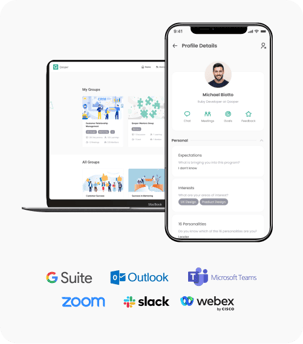
| Integration Capabilities | A platform must fit within existing systems: AMS, SSO, LMS, HRIS, calendar tools, communication platforms. Fragmented systems slow adoption and add administrative burden. | Qooper integrates with all major systems, including Salesforce, HubSpot, Google Calendar, Webex, Microsoft Outlook, Slack, Teams, Workday, Zoom, and LMS platforms — ensuring a unified, seamless experience. |
Qooper Mentoring Software is designed to support a wide array of integrations, enabling organizations to enhance mentoring, coaching, and development programs.
How to Implement a Mentoring Program for Professional Associations
Phase 1: Strategic Foundation
The first step in launching a successful mentoring program is establishing a solid strategic foundation. Associations should set measurable goals aligned with key membership outcomes such as retention, engagement, professional growth, or DEI objectives. Identifying the right member segments ensures programs target participants who will benefit most, while securing leadership sponsorship provides the visibility and resources needed for success. Allocating dedicated program management capacity, even for a small team, ensures the program receives consistent oversight.
Phase 2: Design and Configuration
Once the foundation is in place, associations focus on designing and configuring the program. This includes defining eligibility criteria for mentors and mentees, establishing matching rules based on skills, experience, goals, and preferences, and creating communication templates for onboarding and ongoing engagement. Building resource and content libraries gives participants structured guidance throughout their journey, while customizing branding ensures the program reflects the association’s identity. With Qooper, associations can configure all these elements within a single platform, using automated workflows, pre-built content libraries, and branding options to create a seamless, professional mentoring experience.
Phase 3: Recruitment and Launch
Recruitment is critical to program success. Associations need to attract mentors by clearly communicating the benefits of giving back, gaining professional recognition, and developing leadership skills. Mentees should be positioned to view participation as a high-value membership benefit tied to career advancement and industry connections. Piloting the program with a smaller cohort can help refine processes before scaling. Qooper makes recruitment and onboarding easier by providing application management tools, communication templates, and step-by-step guidance, while allowing early pilot programs to be tracked and adjusted seamlessly.
Phase 4: Ongoing Management
Maintaining engagement over time requires consistent support. Automated nudges and reminders help keep mentor-mentee pairs on track, while staff can perform periodic health checks to identify and resolve issues before they impact the participant experience. Recognizing active mentors and celebrating their contributions reinforces participation, and sharing success stories helps build excitement for future cohorts. Qooper automates these workflows and provides dashboards to track engagement, outcomes, and program health, giving association staff the tools to manage programs efficiently while keeping participants motivated and supported.
Industry-Specific Mentoring Program Use Cases for Associations
- Engineering Associations
Support early-career pathways, licensing, and leadership development. Qooper matches members by skills and goals for effective, structured mentoring. - Medical Associations
Guide residents and students through specialty selection, certifications, and career transitions. Qooper tracks milestones and engagement across cohorts. - HR & Business Associations
Enable DEI initiatives, culture building, and leadership pipelines. Qooper measures impact and simplifies program management. - Marketing, Tech & Digital Associations
Offer skill-based, reverse, and cross-functional mentoring. Qooper structures programs and ensures accessibility across geographies. - Alumni & Academic Associations
Bridge students and alumni for career placement and professional development. Qooper manages multiple programs and delivers consistent experiences.
Measuring ROI: Why Mentoring Is a Smart Investment for Associations
Mentoring programs aren’t just a “nice-to-have” they’re a strategic investment that delivers measurable value across financial, operational, and member-experience dimensions. Associations that implement structured mentoring see tangible results that directly impact their bottom line.
Direct Financial Impact
-
Higher renewal rates: Members who participate in mentoring programs are more engaged and more likely to renew their membership, directly sustaining revenue.
-
Increased new member acquisition: Strong mentoring programs serve as a differentiator, attracting prospective members who value career development and personalized guidance.
-
Reduced administrative burden: Automation through mentoring software, like Qooper, frees staff from time-intensive matching, reminders, and tracking, allowing resources to be redeployed to other strategic initiatives.
-
Sponsorship opportunities: High-quality, visible mentoring programs create opportunities for sponsorships, generating additional revenue streams.
Intangible Benefits
-
Stronger community identity: Mentoring fosters connections across generations, roles, and geographies, creating a sense of belonging and loyalty.
-
Increased member satisfaction: Participants feel supported in their professional growth, boosting engagement and advocacy.
-
Elevated thought leadership: Senior members and experts contribute their knowledge, positioning the association as an authority in its field.
-
Competitive differentiation: A well-run mentoring program becomes a signature benefit, distinguishing the association in a crowded market.
Why Qooper Matters
With Qooper Mentoring Software, associations can quantify both tangible and intangible outcomes. Dashboards and reporting tools track engagement, goal achievement, satisfaction, and program impact, making it easy to demonstrate the ROI of mentoring to leadership and stakeholders. Programs are not only easier to manage, they also become a measurable driver of member value and long-term association growth.
Addressing Common Concerns
“Our members won’t have time.”
Modern mentoring programs accommodate busy schedules. Short micro-mentoring sessions, asynchronous messaging, and mobile-friendly access allow members to engage when it’s convenient, without sacrificing the quality of the mentoring relationship.
“Technology will make mentoring feel impersonal.”
A well-designed platform handles administrative tasks like matching, scheduling, and reminders, freeing participants to focus entirely on meaningful conversations and relationship-building. Mentoring becomes more intentional, not less.
“We can manage with spreadsheets.”
Spreadsheets may work for small pilot programs, but scaling beyond a few dozen participants quickly becomes overwhelming. Without automation and analytics, associations cannot track engagement, measure outcomes, or ensure consistent experiences across cohorts. Platforms like Qooper streamline these processes, enabling programs to grow efficiently while maintaining high-quality mentoring experiences.
The Future of Mentoring Programs in Associations
-
Skills-Focused & Personalized – Mentoring targets specific competencies with structured journeys.
-
Micro- and Hybrid Programs – Short sessions and multiple formats accommodate diverse members.
-
AI-Powered Matching & Analytics – Intelligent pairing and real-time insights optimize engagement.
-
Remote & Mobile Access – Supports geographically distributed members seamlessly.
-
Cross-Generational Learning – Reverse mentoring and mixed-experience cohorts foster knowledge sharing.
-
Scalable & Measurable – Automation reduces admin, tracks outcomes, and proves ROI.
Qooper enables associations to deliver all of these innovations with ease, creating impactful, high-value mentoring programs.
Key Takeaways
-
Running a mentoring program in associations requires thoughtful strategy and the right infrastructure.
-
Manual management limits scale, consistency, and measurement.
-
Purpose-built mentoring platforms—especially Qooper—enable automated matching, guided experiences, and robust analytics.
-
Mentoring drives measurable retention, satisfaction, and long-term relevance for associations.
-
With intentional design and the right technology, mentoring becomes a signature member benefit.
Conclusion: Elevate Your Association with Purpose-Built Mentoring Software
Professional associations exist to support members’ careers, industries, and professional growth. A well-run mentoring program is one of the most powerful ways to deliver on that promise, but only when supported by the right structure and technology.
Qooper Mentoring Software was designed specifically for the unique realities of association mentoring: distributed memberships, voluntary participation, multiple program types, and complex matching requirements. With proven onboarding frameworks, seamless integrations, and robust analytics, associations can launch high-impact mentoring programs with confidence.
Your members are looking for guidance, connection, and growth. It’s time to deliver a mentoring experience worthy of your mission.
👉 Request a personalized demo of Qooper and see how your association can launch or scale mentoring programs with measurable success.
Frequently Asked Questions
How long does implementation take?
Most associations launch their first mentoring cohort within several weeks. This includes platform configuration, matching parameter development, resource library population, and participant onboarding. Qooper's implementation specialists guide associations through each phase using proven templates and workflows.
What technical expertise does our staff need?
Qooper is designed for non-technical association staff. If your team can navigate your association management system and compose emails, they can successfully operate the platform. The intuitive interface requires no coding knowledge, and comprehensive training is provided during implementation.
Can we run multiple different mentoring programs?
Yes. Qooper's architecture supports concurrent mentoring initiatives with distinct objectives, participant populations, and matching criteria. Each program maintains separate branding, application processes, and reporting structures within the unified platform.
How do platforms protect member privacy and data security?
Qooper maintains enterprise-grade security protocols including SOC 2 Type II compliance, data encryption, regular security audits, and role-based access controls. The platform complies with GDPR, CCPA, and other privacy regulations, giving members control over their data.
What happens if matches aren't working out?
Qooper includes features allowing participants to request match changes through a simple process that notifies administrators. The platform's analytics help staff identify struggling relationships proactively. When re-matching occurs, the algorithm can incorporate feedback to improve subsequent pairings.
%20(1)-1.png)

%20(1).png)