




Career Mentoring Framework: Guide For Building Mentorship Pathways
 Omer Usanmaz
·
6 minute read
Omer Usanmaz
·
6 minute read
A strong career mentoring framework has become essential for organisations aiming to strengthen career development, boost professional growth, and support a healthier workplace culture. As job structures evolve, skill demands shift, and internal promotions become more competitive, employees increasingly rely on meaningful mentorship to navigate career paths, develop leadership skills, and achieve long-term career success.
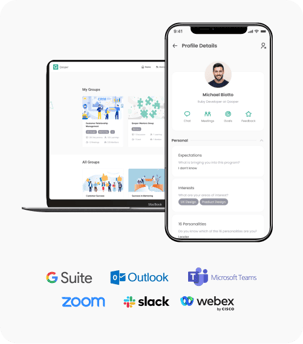
But career mentoring doesn’t work well when it’s informal, inconsistent, or dependent on charismatic individuals. Careers today require intentional systems supported by research, structure, and technology. That’s where a career mentoring framework steps in and where modern platforms like Qooper elevate the entire experience through automation, algorithm-based matching, guided mentoring templates, and goal-tracking tools.
What Is a Career Mentoring Framework?
A career mentoring framework is a structured model that defines how mentorship relationships form, develop, and evolve inside an organisation. It sets out the goals, roles, stages, tools, and evaluation processes that shape mentoring across the employee lifecycle. Whether used in universities, private colleges, law firms supporting law school graduates, or corporations developing young professionals and executives, the framework provides clarity and consistency.
It integrates:
- Career development programs
- Leadership development programs
- Training and support systems
- Mentoring models (formal, informal, peer mentoring, flash mentoring, mutual mentoring, reverse mentoring)
- Competency frameworks
- Outcome expectations and KPIs
- Mentoring functions (career support + psychosocial support)
- Institutional context and workplace behavior
This structure ensures mentoring isn’t left to chance but results in measurable performance, stronger social capital, and improved employee satisfaction.
Why Modern Organisations Need a Structured Mentoring Approach
Informal mentoring still exists, especially when coaches, sponsors, or established lawyers guide juniors based on shared identity, interests, or proximity. Informal mentoring builds belonging and community, but it's inconsistent and impossible to scale.
Modern workplaces require:
- Systems for succession planning
- Clear support for career aspirations
- Scalable workflows for young professionals, Gen Z employees, and future leaders
- Protection against stereotype threat, microaggressions, and power differentials
- Tools to support digital fluency, collaboration, and knowledge sharing
Without structure, organisations face:
- Unclear goals and objectives
- Uneven access to mentoring opportunities
- Poor matching based on bias or convenience
- No way to measure performance expectations
- Mentors unsure how to guide mentees
- Lost institutional knowledge
- No visibility into KPIs or outcomes
A mentoring framework solves this by aligning all mentoring activities with organisational strategy, culture, and developmental needs.
Building the Pillars of a Career Mentoring Framework
A well-designed framework blends theory, research, mentoring stages, and practical tools. Below are the essential components integrated into a cohesive system.
1. A Research-Informed Foundation
Strong frameworks draw from theoretical frameworks such as:
- Social capital theory — expanding networks and resources
- Social exchange theory — building reciprocal relationships
- Social cognitive career theory — shaping self-efficacy, science identity, and outcome expectations
- Social network theory — leveraging developmental networks
- 4C Framework (Connection, Clarity, Competence, Confidence)
These theories ensure mentoring supports not only professional development but also psychosocial mentor functions like confidence building, belonging, and identity formation, critical for groups facing stereotype threat or underrepresentation.
2. Clear Goals and Objectives Aligned With the Employee Lifecycle
A successful mentoring system starts with absolute clarity around what the organisation is trying to develop and support. This includes strengthening leadership pipelines and mapping clear career progression frameworks so employees know how to grow within hierarchical roles and job levels. It also requires defining technical proficiency milestones and outlining collaboration and performance expectations that guide day-to-day workplace behavior. In more specialized environments, such as scientific communities or academic institutions, mentoring must also address career support, research productivity, and discipline-specific competencies.
At the same time, programs need to reflect the evolving needs of Generation Z and early-career talent, who often value connection, social capital, and digital fluency differently than previous generations. Finally, fellowships, career tracks, and job structures should be built into the system so that every participant, from interns to mid-career professionals to future executives, can see a clear path forward and understand how mentoring supports their long-term development.
3. Defined Mentoring Models for Every Stage
Different employees require different mentoring pathways:
- Formal mentoring for structured programs
- Informal mentoring for organic relationships
- Peer mentoring for mutual support
- Reverse mentoring for digital fluency and generational exchange
- Mutual mentoring for distributed expertise
- Executive mentoring for strategic leadership growth
A strong framework intentionally supports all models without privileging one group or creating inequity.
4. A Guided Mentoring Cycle
1. Onboarding and Expectation-Setting
This stage introduces mentors and mentees to the program’s goals, roles, and structure. It clarifies expectations, sets boundaries, and ensures both sides understand the competencies, outcomes, and behavioral norms that guide the relationship.
2. Early Relationship-Building and Connection
During these initial meetings, participants focus on building trust, rapport, and psychological safety. This is where they establish communication habits, explore shared interests, and begin forming a strong human connection.
3. Goal Setting Aligned With Competencies
Mentors and mentees identify development areas related to career progression frameworks, technical proficiency, leadership skills, or organisational goals. These goals anchor the mentoring journey and create measurable direction.
Download Mentorship Goal Setting Template
4. Action Plans and Conversation Guides
Here, the pair translates goals into concrete steps. Templates, structured agendas, and conversation prompts guide discussions and keep the mentoring relationship focused and productive.
5. Knowledge Sharing, Collaboration Tools, and Mentoring Templates
This is where the real growth happens. Mentors share expertise, organisational insights, and social capital, while mentees actively practice new skills. Collaboration tools support ongoing communication, documentation, and feedback loops.
6. Mid-Cycle Evaluations
Mentors and mentees reflect on progress, identify barriers, and recalibrate goals if needed. Program administrators also review engagement data, ensuring participants stay committed and supported.
7. Performance Evaluations
This stage assesses the impact of mentoring on workplace behavior, competencies, performance expectations, research productivity, or leadership potential. It connects mentoring outcomes to career development KPIs.
Related article: Mentorship Program Metrics: Top 10 to Track Success
8. Reflection and Closing
The final stage encourages both parties to reflect on the journey, celebrate growth, and discuss ongoing career aspirations. Even after the formal cycle closes, many mentoring relationships continue informally as part of a strong mentoring culture.
5. Measurement, KPIs, and Career Outcomes
A modern mentoring framework ties mentoring activities to measurable outcomes:
- Employee satisfaction
- Internal promotions
- Retention of high-potential employees
- Leadership readiness
- Research productivity (in academic and scientific contexts)
- Career satisfaction and happiness
- Self-efficacy and identity development
- Performance KPIs
- Organisation-wide knowledge transfer
This is where most organisations fail because they lack tools to track data. That’s exactly where Qooper solves the gap.
How Qooper Strengthens Every Part of the Career Mentoring Framework
| Framework Component | What It Means | How Qooper Enhances It |
|---|---|---|
|
Goal & Objective Alignment |
Ensuring mentorship supports organisational priorities (leadership pipelines, career progression, DEI, internal promotions). |
Pre-built program templates, customizable goals, KPI tracking, and HRIS integrations connect mentoring directly to talent strategy. |
|
Mentoring Models |
Formal, informal, peer mentoring, mutual mentoring, reverse mentoring, and executive mentoring. |
Flexible program setup allows organisations to run multiple models simultaneously, each with its own structure and workflow. |
|
Algorithm-Based Matching |
Pairing mentors and mentees based on skills, goals, behaviors, and development needs. |
AI-powered matching system eliminates bias and automates pairing using competency frameworks and participant preferences. |
|
Structured Mentoring Cycle |
Guided stages: onboarding → connection → goal-setting → action → evaluation → reflection. |
Guided workflows, conversation guides, mentoring templates, and automated meeting agendas support each mentoring stage. |
|
Action Plans & Goal Tracking |
Turning mentoring conversations into measurable outcomes. |
Built-in goal-tracking tools, progress dashboards, and personalised action plans ensure accountability and momentum. |
|
Knowledge Sharing & Collaboration |
Sharing expertise, skills, research insights, leadership behaviors, and organisational wisdom. |
Messaging, scheduling, file sharing, collaborative notes, and learning pathways centralise communication and knowledge transfer. |
|
Psychosocial & Career Support |
Building confidence, identity, connection, and self-efficacy; reducing stereotype threat and power imbalances. |
Structured check-ins, reflection prompts, and resources improve psychological safety and mentor–mentee communication. |
|
Measuring KPIs across participation, engagement, career progression, promotions, and satisfaction. |
Real-time dashboards, exportable reports, outcome tracking, and leadership insights link mentoring to performance data. |
|
|
Competency & Skill Development |
Supporting technical proficiency, leadership skills, digital fluency, and role-specific abilities. |
Customisable learning pathways, skill assessments, and connection to performance expectations accelerate skill growth. |
|
Integration Across the Employee Lifecycle |
Embedding mentoring into onboarding, development, performance reviews, and succession planning. |
Qooper’s HRIS integrations and workflow automation make mentoring a seamless part of every employee’s journey. |
|
Mentoring Culture & Organisational Commitment |
Creating a workplace where mentoring is valued, visible, and accessible to all. |
Automated nudges, progress reminders, community features, and multiple mentorship pathways encourage ongoing engagement. |
Key Takeaways
- A career mentoring framework transforms mentoring from an informal act into a strategic development system.
- Integrating research, mentoring models, competencies, and organisational context creates sustainable growth.
- A strong framework supports identity formation, leadership readiness, and career satisfaction.
- Modern organisations require a mentoring culture supported by tools, templates, and measurable KPIs.
- Qooper enables scalable mentoring with algorithmic matching, guided workflows, reporting, and integrated collaboration.
Related Articles
FAQs About Career Mentoring Framework
What’s the difference between formal and informal mentoring?
Formal mentoring follows a structured, goal-driven system with matching, milestones, and evaluation. Informal mentoring grows organically, usually through shared interests or workplace connection.
How does mentoring support career development?
Through knowledge sharing, skill-building, goal alignment, networking, psychosocial support, and exposure to opportunities that strengthen career prospect and internal promotion potential.
Which mentoring models fit modern organisations best?
A mix: peer mentoring for community, reverse mentoring for digital fluency, mutual mentoring for shared growth, and formal mentoring for career progression frameworks.
How does Qooper improve mentoring outcomes?
It streamlines matching, guides the mentoring cycle, tracks progress, integrates with HRIS, and provides analytics for decision-making and leadership reporting.
Who benefits most from mentoring frameworks?
Young professionals, mid-career employees, executives, law school graduates working with established lawyers, scientific researchers, Gen Z employees, and anyone pursuing career aspirations.
-2.jpg)