




 ·
8 minute read
·
8 minute read
Healthcare organizations are navigating a workforce crisis that extends far beyond staffing shortages. Burnout, early-career attrition, and rising clinical complexity are placing unprecedented pressure on hospitals and health systems worldwide. In this environment, mentoring is no longer a “nice-to-have” initiative, it is a strategic capability tied directly to patient safety, employee retention, and leadership readiness.
This guide explains what mentoring tools for healthcare are, why informal mentoring models are no longer sufficient, and how purpose-built platforms like Qooper help healthcare leaders build structured, measurable mentoring programs that deliver real workforce impact.
What Are Mentoring Tools for Healthcare?
Mentoring tools for healthcare are secure, cloud-based platforms designed to support formal mentoring programs for medical professionals. These tools provide structured mentor–mentee matching, scheduling, communication, feedback, and progress tracking, while maintaining professional boundaries, confidentiality, and compliance.
Unlike informal mentoring, mentoring tools enable healthcare organizations to scale mentorship across departments, locations, and career stages while aligning development efforts with clinical competencies and workforce goals.
How Mentoring Tools Differ from Informal Mentorship in Clinical Settings
Informal mentoring often depends on availability, personal chemistry, or proximity. While valuable, it lacks consistency, accountability, and measurable outcomes. In high-risk clinical environments, this approach leaves development to chance.
Mentoring tools replace ad hoc guidance with structured programs, documented goals, and data-driven oversight, ensuring mentoring contributes directly to professional growth, workforce stability, and patient care quality.
Who This Guide Is For
This article is written for healthcare leaders responsible for workforce development, clinical education, and organizational stability, including:
- HR Directors and People & Culture Leaders in healthcare
- Chief Nursing Officers (CNOs)
- Medical Education and Clinical Training Leaders
- Hospital and Health System Executives
If you oversee staff retention, clinician development, or leadership pipelines, this guide is for you.
Why Healthcare Can No Longer Rely on Informal Mentorship
The Healthcare Workforce Crisis
Healthcare systems worldwide are facing a sustained workforce crisis. Burnout rates among physicians remain close to 50%, and nearly one in four newly hired nurses leave within their first year. These trends weaken care teams, increase operational costs, and place additional strain on remaining staff.
Workforce instability is no longer an isolated HR concern, it directly impacts patient safety, quality of care, and organizational resilience.
Why Shadowing and Ad Hoc Mentoring Fall Short
Traditional approaches such as shadowing or informal guidance lack clear goals, feedback mechanisms, and accountability. They do not support long-term development or provide leaders with insight into what is working.
As patient needs grow more complex and staffing pressures increase, healthcare organizations need mentoring programs that are intentional, measurable, and scalable.
Why Healthcare Requires Specialized Mentoring Tools
Shift-Based Workforces and Flexible Scheduling
Clinicians work rotating shifts across departments and locations. Effective mentoring tools must support asynchronous communication, mobile access, and flexible scheduling that respects rest cycles and clinical responsibilities.
Confidentiality, Professional Boundaries, and Compliance
Mentoring conversations often involve emotional stress, job performance, and real-world clinical scenarios. Healthcare mentoring tools must maintain high standards of confidentiality while reinforcing professional boundaries and psychological safety.
Competency-Based Development and Clinical Career Pathways
Healthcare mentoring must align with competency frameworks, SMART goals, and clinical milestones. Generic corporate mentoring platforms often fail to support nurse residency programs, clinical skill tracking, and structured career progression.
Formal Mentoring vs Informal Mentoring in Healthcare
Formal mentoring programs provide structure, equity, and measurable outcomes. They include documented goals, objective matching, bias mitigation, and program evaluation. Informal mentoring, while valuable, lacks consistency and visibility.
For healthcare leaders, formal mentoring supported by technology delivers predictable results—improving engagement, retention, and leadership readiness across the organization.
| Formal Mentoring | Informal Mentoring |
|---|---|
|
Structured career mentoring program |
Ad hoc relationships |
|
Clear goals and progress tracking |
No documentation |
|
Bias mitigation tools and matching algorithms |
Subjective pairing |
|
Program evaluation tools |
No measurable ROI |
For healthcare leaders, formal mentoring supported by Qooper delivers consistent outcomes, stronger organizational commitment, and improved staff retention.
What to Look for in Mentoring Tools for Healthcare
When evaluating mentoring tools for healthcare, leaders should prioritize platforms that offer solutions designed for measurable, long-term impact. Mentoring solutions with real-time program health dashboards give administrators instant visibility into engagement trends, participation levels, and mentoring outcomes across clinical teams. Healthcare leaders increasingly search for solutions that offer bias-mitigating matching models, with many specifically looking for software that reduces bias for healthcare mentoring programs to create more equitable and consistent development pathways. Platforms should also include:
- Data-driven mentor–mentee matching to reduce bias and improve relationship quality
- Progress tracking aligned with SMART goals and competency frameworks
- Secure communication and feedback tools designed for clinical environments
- Program evaluation and ROI reporting to support strategic decision-making
- Scalability across departments, locations, and career stages
The right platform transforms mentoring from an informal activity into a measurable workforce strategy.
Why Qooper Is Purpose-Built for Healthcare Mentoring
Qooper is designed specifically for organizations that need structured mentoring tied to clinical development and workforce outcomes. Unlike generic mentoring platforms, Qooper supports the complexity of healthcare environments—from nurse residency programs to leadership development initiatives.
Check out Qooper's solutions for the healthcare teams:
AI-Powered Matching and Structured Career Pathways
Qooper uses AI-powered matching to align mentors and mentees based on experience, goals, and development needs, improving engagement and reducing unconscious bias.
The platform supports structured career pathways for:
- Nurse residency and early-career clinician cohorts
- Mid-career clinicians and specialty development
- Leadership and succession planning tracks
Integrated Communication, Feedback, and Program Management
Qooper combines matching, scheduling, communication, feedback, and reporting in a single platform, allowing healthcare organizations to scale mentoring programs without increasing administrative burden.
AI Mentoring Tools and the Future of Healthcare Workforce Development
Artificial intelligence is reshaping mentoring in healthcare. AI-powered mentoring tools enhance matching accuracy, trigger automated nudges at key milestones, and generate insights into engagement and outcomes.
Looking ahead, virtual assistants and immersive technologies such as augmented and virtual reality will further reduce administrative friction and support experiential learning, allowing clinicians to focus on care while still benefiting from structured mentorship.
Measuring ROI: Why Mentorship Is a Strategic Investment in Healthcare
Replacing a registered nurse can cost between $40,000 and $60,000. Replacing a physician can exceed $500,000. Structured mentoring directly offsets these costs by improving retention, accelerating readiness, and strengthening organizational commitment.
Mentoring also improves communication, confidence, and clinical decision-making, contributing to better job performance and safer patient care.
Qooper’s program evaluation tools help healthcare leaders connect mentoring participation to measurable outcomes, transforming mentorship from a cost center into a strategic investment.
Comparison Table: Qooper vs Other Mentoring Tools for Healthcare
|
Platform |
Best For |
Key Strengths |
Limitations in Healthcare Context |
|
Qooper |
Nurse residency, clinical education, structured career mentoring |
AI-powered matching, competency tracking, LMS alignment, bias mitigation tools, program evaluation |
Purpose-built for healthcare mentoring |
|
Chronus |
DEI-focused leadership programs |
Inclusive matching, micro-mentoring |
Limited clinical competency tracking |
|
MentorcliQ |
Large enterprise mentoring |
Strong analytics, enterprise reporting |
Less flexible for nurse residency workflows |
|
Together |
Fast deployment |
Microsoft Teams integration |
Less depth in progress tracking |
Competitor Breakdown: Mentoring Tools in the Healthcare Industry
Qooper
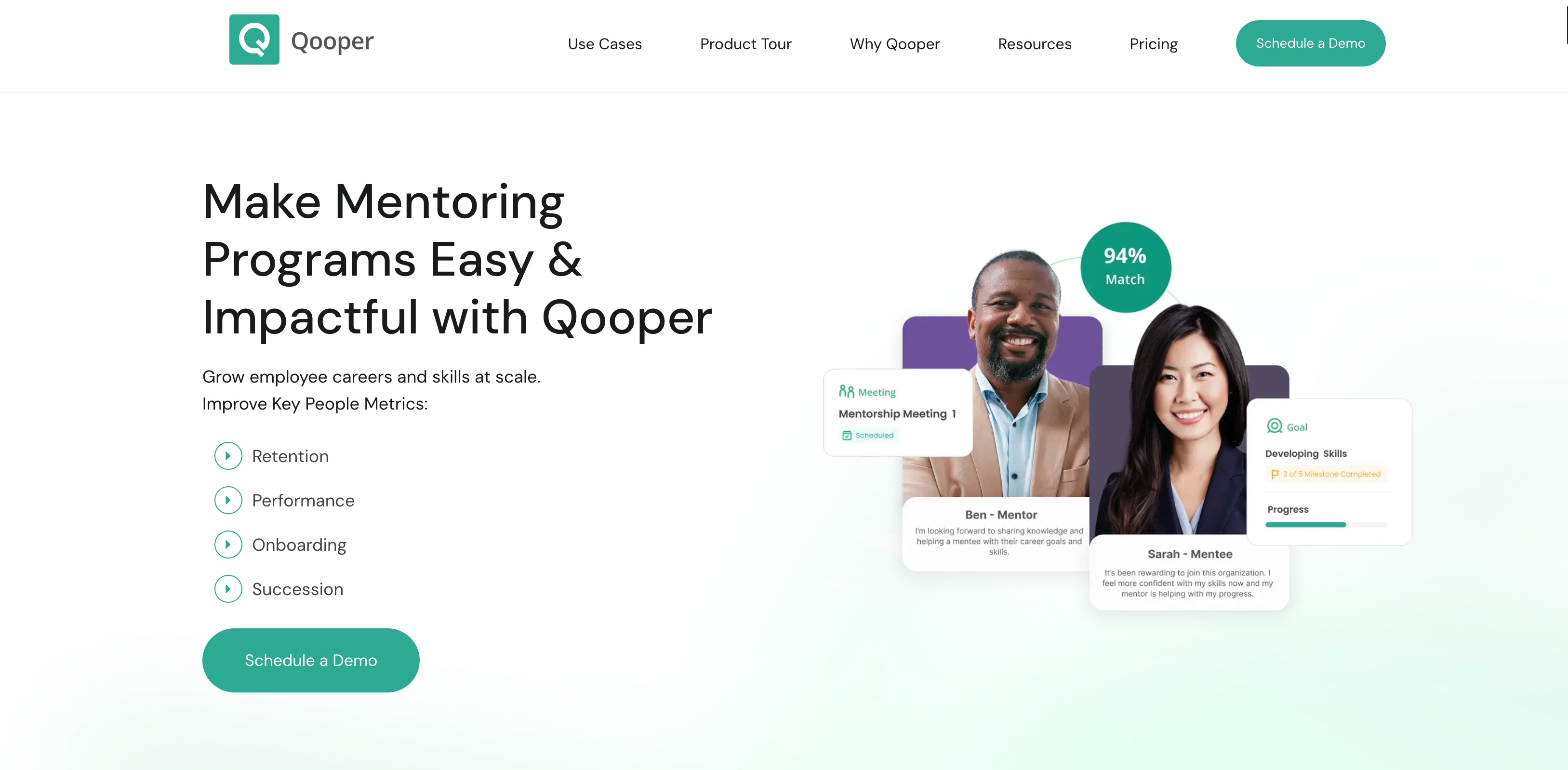
Qooper is designed specifically for healthcare organizations that need formal mentoring programs tied to clinical competency, career development, and staff retention. Unlike generic mentoring platforms, Qooper supports nurse residency programs, physician mentoring, and leadership development through structured pathways.
Key strengths include:
- AI-powered matching tools using machine learning algorithms
- Competency-based progress tracking aligned with frameworks
- Biannual cohort models for residency and early-career clinicians
- Bias mitigation tools to support equitable mentoring relationships
- Program evaluation tools delivering data-driven insights for healthcare leaders
Qooper connects mentoring directly to patient care outcomes, job performance, and long-term professional growth.
Chronus
.png?width=800&height=270&name=SCR-20260731-lwjs%20(1).png)
Chronus is best suited for healthcare organizations prioritizing diversity, equity, and inclusion initiatives and leadership pipelines. Its AI-driven MatchIQ® engine supports inclusive matching and micro-mentoring.
However, Chronus is less optimized for hands-on clinical mentoring, nurse residency workflows, and competency checklists required in frontline healthcare environments.
MentorcliQ
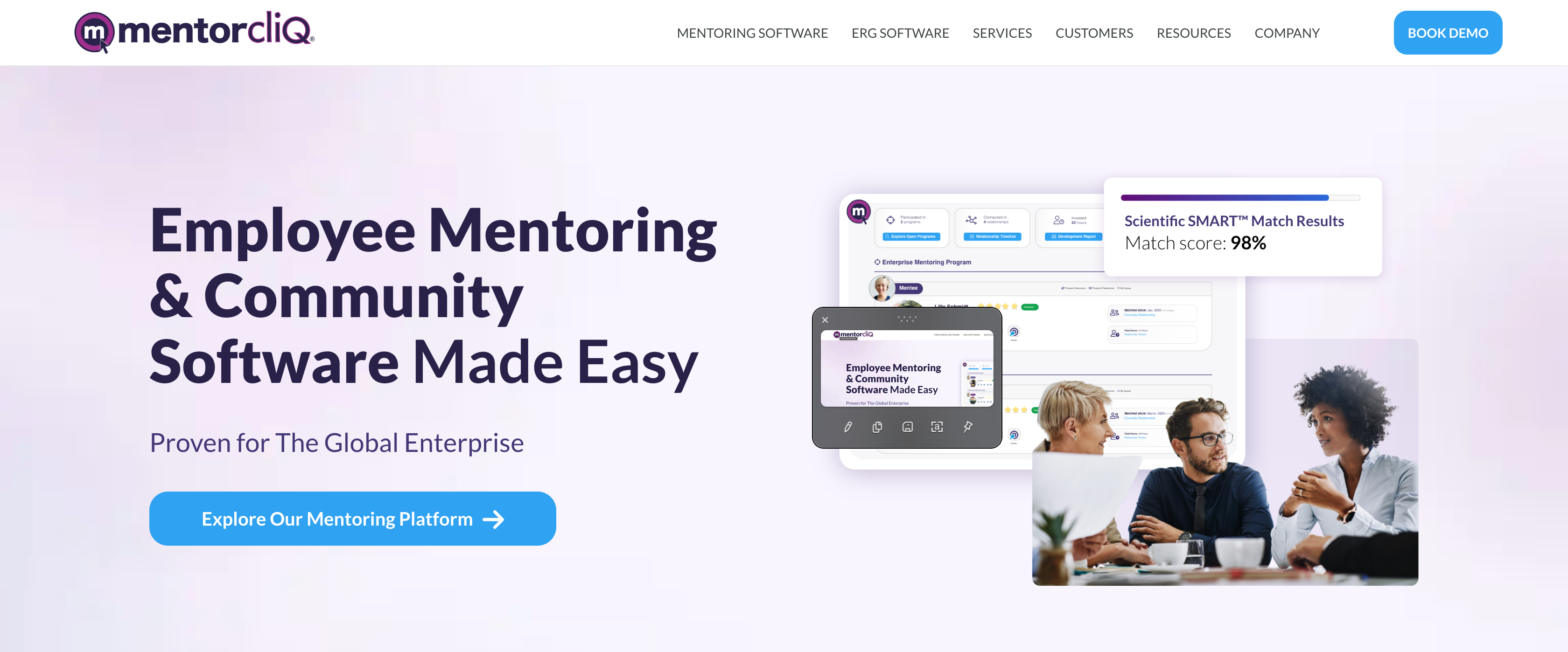
MentorcliQ is commonly adopted by large hospital systems seeking enterprise reporting and ROI visibility. Its matching algorithms and dashboards help leadership teams analyze mentoring participation and outcomes.
While powerful at scale, MentorcliQ focuses more on organizational analytics than on individualized clinical skill development or structured nurse residency programs.
Together
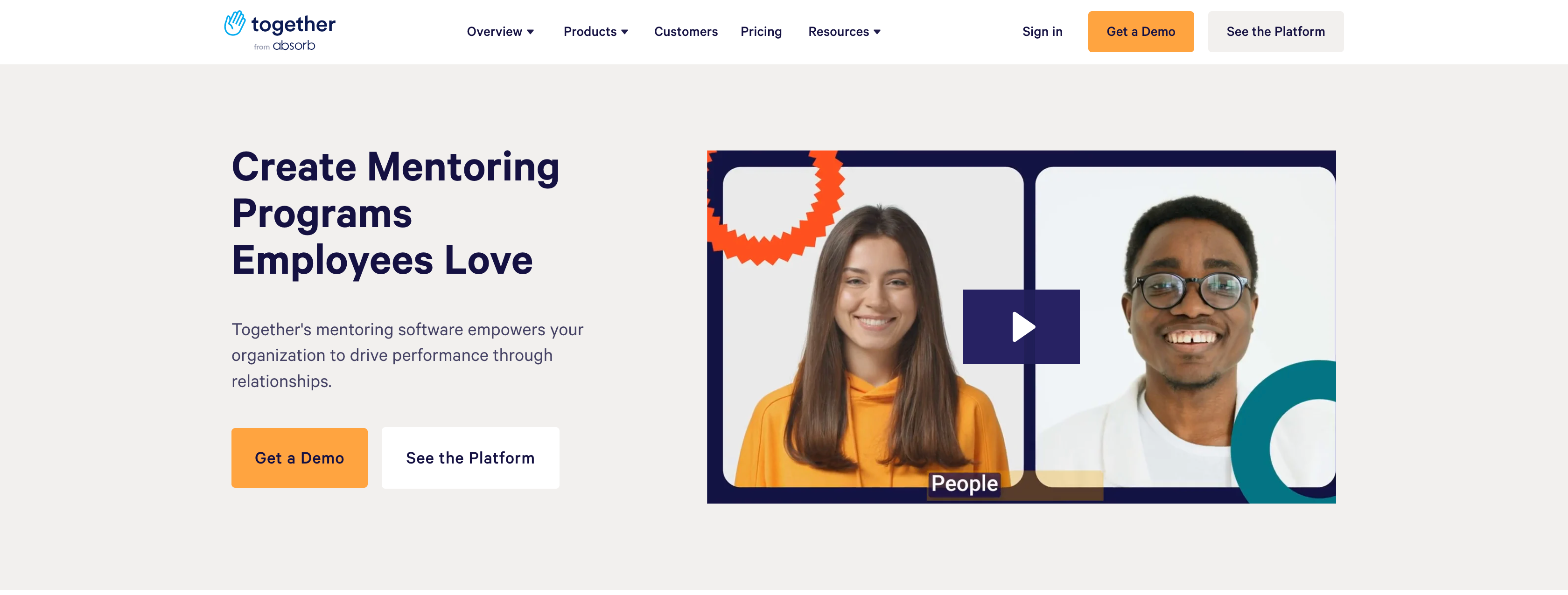
Together differentiates itself through seamless integration with Microsoft Teams and Outlook, reducing adoption friction for medical professionals.
This simplicity makes Together effective for quick program launches, but it lacks the depth of progress tracking, competency alignment, and career development frameworks that healthcare mentoring programs often require.
Conclusion: Mentorship as a Clinical and Workforce Strategy
Mentorship in healthcare is no longer optional. Workforce shortages, burnout, and rising patient complexity demand structured, data-driven approaches to professional development.
By moving from informal mentoring to formal mentoring programs, healthcare organizations can strengthen retention, improve performance, and build the next generation of clinical leaders. Qooper enables this shift; supporting scalable, measurable mentoring programs designed specifically for healthcare environments.
Ready to see mentoring in action? Explore how Qooper supports healthcare mentoring programs at scale. Schedule a demo now!
TL;DR — Executive Brief
Audience: HR Directors, CNOs, Medical Education Leaders
Healthcare organizations are facing a workforce crisis driven by burnout, talent shortages, and declining staff retention. Informal mentoring models are no longer sufficient in high-risk, shift-based clinical environments.
What Works: Formal mentoring programs supported by purpose-built mentoring tools for healthcare.
Why It Matters:
- Replacing a single nurse or physician is significantly more expensive than investing in structured mentoring
- Effective mentoring improves job performance, patient care, and organizational commitment
- Data-driven mentoring enables measurable ROI and long-term workforce stability
Why Qooper:
- Purpose-built for healthcare mentoring, nurse residency, and clinical career development
- AI-powered matching and bias mitigation tools improve mentoring relationship quality
- Competency-based progress tracking aligned with Skills Models and SMART goals
- Program evaluation tools connect mentoring directly to employee retention outcomes
Bottom Line: Healthcare leaders who invest in Qooper move from informal mentoring to a scalable, measurable mentoring strategy that strengthens staff retention, supports professional growth, and develops future healthcare leaders.
Frequently Asked Questions (FAQ)
What are mentoring tools for healthcare?
Mentoring tools for healthcare are secure, cloud-based platforms that manage formal mentoring programs for medical professionals. They support structured mentor–mentee matching, communication, feedback, scheduling, and progress tracking while maintaining confidentiality, professional boundaries, and compliance required in clinical environments.
Why is formal mentoring important in healthcare?
Formal mentoring ensures consistency, accountability, and measurable outcomes in complex, high-risk clinical settings. Unlike informal mentoring, it supports structured career development, reduces bias, improves retention, and helps healthcare organizations align mentoring with clinical competencies and workforce goals.
How is Qooper different from other mentoring platforms?
Qooper is purpose-built for healthcare mentoring. It supports nurse residency programs, clinical competency tracking, structured career pathways, biannual cohort models, and program evaluation. Unlike generic mentoring tools, Qooper is designed to meet the operational, compliance, and workforce development needs of healthcare organizations.
Can mentoring tools improve staff retention and patient care?
Yes. Structured mentoring improves confidence, communication, and clinical decision-making, which leads to higher staff retention, stronger organizational commitment, and safer patient care outcomes. Mentoring also accelerates readiness for new roles and leadership positions.
Are mentoring tools secure for healthcare organizations?
Leading mentoring platforms like Qooper are designed with healthcare-grade security and confidentiality standards. They support secure, cloud-based infrastructure, role-based access, and clear professional boundaries suitable for clinical environments.
How do mentoring tools support nurse residency programs?
Mentoring tools support nurse residency programs by enabling cohort-based mentoring, structured onboarding, competency tracking, and regular feedback. These features help new nurses transition into practice more confidently, reducing early-career attrition and burnout.
What mentoring software is designed for healthcare organizations?
Healthcare organizations need mentoring tools that support clinical workflows, shift-based schedules, compliance requirements, and secure data handling. Qooper is purpose-built for these environments—offering HIPAA-ready features, automated mentor matching, structured learning paths, tracking for residents and nurses, and scalable programs for hospitals and large health systems. It helps medical teams strengthen onboarding, reduce burnout, and create consistent development pathways across shifts and departments.
Can mentoring tools be used for physicians and advanced practitioners?
Yes. Mentoring tools are used to support physicians, specialists, and advanced practitioners across career stages—from early-career development to leadership and succession planning—while respecting clinical workloads and schedules.
How do mentoring tools handle shift work and busy clinical schedules?
Healthcare mentoring tools support asynchronous communication, mobile access, and flexible scheduling. This allows mentors and mentees to engage without disrupting clinical responsibilities or rest cycles.
What role does AI play in mentoring tools for healthcare?
AI improves mentoring by enabling data-driven matching, reducing unconscious bias, triggering automated reminders, and generating insights on engagement and outcomes. This helps healthcare leaders manage mentoring programs at scale with less administrative effort.
Can mentoring outcomes be measured and reported?
Yes. Formal mentoring tools provide dashboards and reports that track participation, engagement, goal progress, and program outcomes. These insights help healthcare leaders connect mentoring efforts to retention, performance, and leadership development metrics.
Are mentoring tools suitable for large hospital systems and global healthcare organizations?
Yes. Digital mentoring tools are designed to scale across departments, locations, and regions. They support distributed teams, remote clinicians, and global healthcare organizations while maintaining consistency and security.
How long does it take to implement a formal mentoring program?
With the right platform, healthcare organizations can launch mentoring programs within weeks. Tools like Qooper streamline setup through guided workflows, templates, and automated matching—reducing administrative burden on HR and clinical leaders.
Do mentoring tools replace informal mentoring?
No. Mentoring tools do not replace human connection. They provide structure, visibility, and consistency that enhance mentoring relationships and ensure they contribute to measurable workforce and patient care outcomes.


-1.png)