



 ·
12 minute read
·
12 minute read
What Does Enterprise Mentoring Software for Global Organizations Need to Do?
Enterprise mentoring software for global organizations must do something that standard mentoring platforms are not built to handle: deliver a consistent, high-quality mentoring experience to employees regardless of where they are located, what language they speak, what time zone they work in, or how different their regional HR infrastructure is from headquarters.
For a multinational enterprise running mentoring programs across North America, Europe, Asia-Pacific, and Latin America simultaneously, this is not a minor configuration challenge. It is a fundamentally different operational requirement — one that separates platforms designed for global complexity from those designed for single-region deployments that have been stretched to cover more geography than they were built for.
Global enterprise mentoring software must address six distinct challenges that do not exist — or exist in far simpler form — in single-region programs: language access, time zone management, cross-regional matching, centralized administration with localized flexibility, data governance across jurisdictions, and global participant engagement without requiring constant administrator intervention.
Qooper is enterprise mentoring software built for this reality. With support for 30+ languages, global HRIS integrations, time zone-aware scheduling, centralized multi-program administration, and enterprise-grade security that meets data governance requirements across regions, Qooper gives global HR and talent teams the infrastructure to run unified mentoring programs across their entire international workforce — from one platform.
Why Global Enterprises Cannot Use Standard Mentoring Platforms
The mentoring software market is growing rapidly — adoption has risen by over 62% between 2020 and 2024 as organizations increasingly prioritize talent development, employee retention, and structured learning programs. But most of that growth has been driven by single-region deployments. The majority of platforms on the market are designed for organizations where all employees share a language, work in overlapping time zones, and operate under a single HR infrastructure.
For global enterprises, using a platform not built for international complexity creates predictable and costly problems:
-
Language barriers exclude large employee populations. A mentoring platform available only in English systematically excludes employees in non-English-speaking markets from full program participation. This is not just a user experience issue — it is a talent equity issue that undermines the program's stated goals and reduces adoption in non-English markets to near zero.
-
Time zone mismatches kill mentoring relationships. Without time zone-aware scheduling tools, mentor-mentee pairs in different regions spend their first interactions just trying to find a meeting slot that works across a 10-hour time difference. Many never get past this friction. Relationships stall before they start.
-
Fragmented administration creates reporting blind spots. When global teams run separate regional programs in separate tools — or manage a single platform with region-specific workarounds — there is no unified view of global mentoring activity. HR leaders cannot measure total program impact, compare regional engagement, or identify where programs need support.
-
Data governance requirements vary by region. GDPR in Europe, data residency requirements in certain Asia-Pacific markets, and varying privacy regulations across Latin America mean that global mentoring platforms must handle employee data with jurisdiction-aware governance — not a one-size-fits-all data policy.
-
Engagement tools do not reach distributed employees. 27% of employees often feel isolated while working remotely, and professional development remains the top driver of engagement globally at 71% — ahead of flexible work and AI tools. For global enterprises, mentoring is one of the highest-leverage engagement tools available. But only if it reaches employees where they are — in their language, through the communication tools they use, at times that work across their schedule.
The 6 Requirements for Enterprise Mentoring Software in Global Organizations
1. Multi-Language Platform Support
What global enterprises need
A mentoring platform used by a global workforce must be accessible in the languages employees actually speak — not just translatable in theory, but fully localized in practice across the participant experience: the interface, notifications, meeting agendas, learning content, goal templates, and program workflows.
Partial localization — an English-language platform with a translated login screen — is not sufficient. Employees who cannot fully engage with the platform in their preferred language have a demonstrably worse program experience, lower session completion rates, and shorter program tenure. Language access is directly correlated with participation.
What to look for:
- Full platform localization across 20+ languages, not just interface translation
- Language support that extends to program content, notifications, and meeting workflows
- Participant ability to select their preferred language independently
- Consistent feature parity across all supported languages
How Qooper delivers it
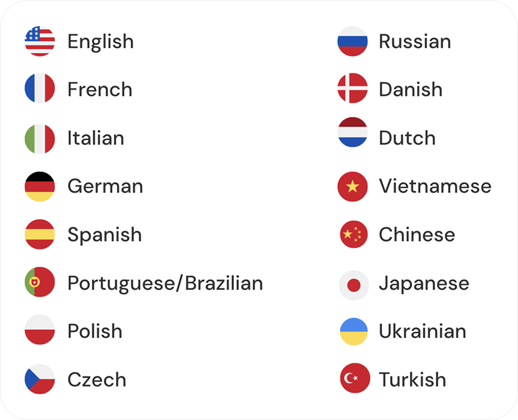
Qooper supports 30+ languages across the full platform — including the interface, learning content, mentoring session guides, participant notifications, and core program workflows. Participants can select their preferred language independently, ensuring every employee engages with the mentoring experience in the language they are most comfortable using.
Critically, Qooper's multi-language support is not surface-level localization. It extends to the structured elements that drive program quality — the meeting agendas that guide mentor-mentee conversations, the feedback templates that capture session insights, and the goal frameworks that structure development plans. A participant in Tokyo and a participant in São Paulo both receive the same structured mentoring experience, in their own language, with the same depth of guidance.
2. Time Zone-Aware Scheduling and Global Session Management
What global enterprises need
In a global mentoring program, time zone mismatches are the single most common reason mentoring relationships stall before they develop. A mentor in London and a mentee in Singapore have a 7–8 hour time difference. Finding a mutually convenient slot, coordinating across calendar systems, and sending invites that reflect each participant's local time should not require manual coordination — but without time zone-aware tools, that is exactly what it demands.
Global mentoring platforms must handle time zone conversion automatically, display availability in each participant's local time, and generate calendar invites that reflect the correct local time for both parties regardless of where they are located.
What to look for:
- Automatic time zone detection and conversion for scheduling
- Availability display in each participant's local time
- Calendar invites generated in both participants' local time zones
- Asynchronous communication tools for pairs who cannot find overlapping availability
How Qooper delivers it
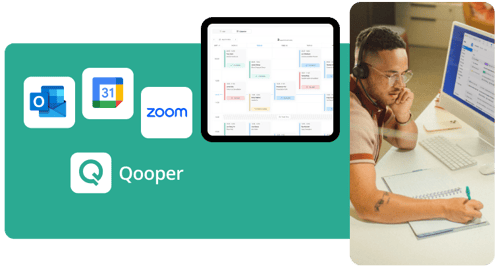
Qooper's scheduling tools handle time zone conversion automatically for global mentor-mentee pairs — displaying availability in each participant's local time and generating calendar invites that reflect the correct local time for both parties. Integration with Google Calendar and Outlook Calendar extends this time zone awareness into the calendaring tools participants already use daily. For pairs where geographic and time zone distance makes synchronous sessions challenging, Qooper's in-platform messaging and asynchronous communication tools keep relationships progressing between scheduled sessions.
3. Cross-Regional and Cross-Functional Matching
What global enterprises need
Global mentoring programs often want to deliberately create cross-regional connections — pairing a high-potential employee in one region with a senior mentor in another, enabling cross-functional knowledge transfer, or building the kind of global internal network that helps distributed employees feel connected to the broader organization.
At the same time, not every program should default to cross-regional matching. Onboarding mentoring, for example, often benefits from matching new hires with mentors in the same location and team. The platform needs to support both — configurable matching that can prioritize same-region, same-function pairings for some programs and cross-regional, cross-functional pairings for others.
What to look for:
- Matching logic configurable by geography, region, business unit, and function
- Ability to enable or restrict cross-regional matching by program type
- AI-powered matching that incorporates language preferences, time zone proximity, and cultural context
- Edge case handling for small regional employee populations
How Qooper delivers it
Qooper's AI-powered matching engine is fully configurable by program — meaning global enterprises can set different matching criteria for each active program type. An onboarding program can prioritize location and team proximity. A leadership development program can deliberately create cross-regional pairings. A reverse mentoring program can match based on expertise regardless of geography.
Qooper's experience supporting hundreds of global mentoring programs means the platform handles the edge cases that arise at scale: small regional employee populations with limited mentor supply, cross-language pairs who need additional communication support, and global programs that span vastly different time zones and working cultures. This operational depth — built from real-world global program experience — is one of the most significant practical advantages Qooper offers over platforms with more limited international deployment history.
4. Centralized Administration with Regional Flexibility
What global enterprises need
Global enterprise mentoring programs face a structural tension: headquarters needs centralized visibility and control — unified reporting, consistent program standards, and oversight across all regions — while regional teams need the flexibility to adapt programs to local context, local HR requirements, and local participant needs.
A platform that is too rigidly centralized forces regional teams into a one-size-fits-all experience that does not fit their context. A platform that is too locally fragmented loses the enterprise-wide view that justifies the investment. Global enterprise mentoring software needs to resolve this tension by enabling centralized program management with configurable regional flexibility.
What to look for:
- Global admin dashboard with visibility across all regions and programs
- Regional or program-level configuration that does not require changes to the global setup
- Role-based access control that enables regional admins to manage their programs without full platform access
- Unified reporting that aggregates global data alongside regional breakdowns
How Qooper delivers it
Qooper gives global HR and talent teams a single admin interface with visibility across all active programs, all regions, and all participant populations — while giving regional program administrators the ability to configure and manage their specific programs within the global framework. Role-based access control enables precise permission management: a regional HR manager in APAC can administer their regional programs without access to EMEA data, while a global talent leader has full visibility across the entire program portfolio.
Reporting works the same way — aggregated global views for leadership and executive stakeholders, with regional breakdowns available for program administrators who need to manage performance at the local level. This structure enables the centralized oversight that global enterprises require while preserving the local flexibility that makes programs relevant and adoptable in each region.
5. Global HRIS Integration and Employee Data Sync
What global enterprises need
Global enterprises typically have complex, multi-system HR infrastructures — Workday as the global HRIS, with regional systems like SAP SuccessFactors in Europe, Oracle in Asia-Pacific, and ADP in the Americas. Employee data for a global mentoring program must be pulled from all of these systems accurately, kept current as employees join, move, and leave across regions, and governed in compliance with the data privacy requirements of each jurisdiction.
Without accurate, live global employee data, a global mentoring program cannot function. Matching becomes inaccurate as organizational changes go unsynced. Reporting reflects a workforce that no longer exists. Administrators spend significant time manually reconciling data discrepancies across regional systems.
What to look for:
- Bi-directional HRIS integrations with all major enterprise platforms used globally
- Support for multi-system environments where different regions use different HRIS
- GDPR compliance and jurisdiction-aware data handling for cross-border employee data
- Automated participant lifecycle management — enrollment, updates, and offboarding — across all connected systems
How Qooper delivers it
Qooper supports bi-directional HRIS integrations with every major enterprise platform used in global deployments: Workday, SAP SuccessFactors, Oracle, ADP, UKG, BambooHR, and Paycor. For global enterprises running multiple HRIS systems across regions, Qooper's integration framework connects to each system independently — maintaining accurate, current employee data across the entire global participant base without requiring a unified HRIS as a prerequisite.
Qooper is GDPR compliant and provides a Data Processing Agreement to support enterprise deployments across regions with varying privacy and regulatory requirements. Combined with SOC 2 Type II certification, AES-256 encryption, and SFTP-based data transfer support for regulated markets, Qooper's data governance architecture is designed to meet the requirements of global enterprises operating across multiple data privacy jurisdictions simultaneously.
6. Global Participant Engagement Without Constant Admin Intervention
What global enterprises need
Running a global mentoring program across dozens of countries and thousands of participants is not operationally feasible if it requires constant manual intervention from a central admin team. Notification delivery, session reminders, goal check-ins, match communications, and program updates all need to reach participants automatically — in their language, through their preferred communication tools, at times appropriate to their time zone.
The engagement infrastructure of a global mentoring platform is what determines whether programs stay active across all regions after launch, or whether participation gradually declines in markets that are further from the team managing the program centrally.
What to look for:
- Automated communication workflows across all languages and regions
- Integration with both Microsoft Teams and Slack for in-context notifications
- Mobile-first participant experience for employees who primarily use mobile devices
- Engagement monitoring that identifies disengaged participants across all regions before relationships stall
How Qooper delivers it
Qooper's automated communication workflows deliver session reminders, match notifications, goal check-ins, and program updates across all regions in participants' selected languages — without requiring manual intervention from program administrators. Integration with Microsoft Teams and Slack ensures that engagement touchpoints reach participants inside the communication tools they use daily, regardless of which platform their region or team has standardized on.
Qooper's native mobile experience supports employees who primarily engage via mobile — particularly relevant in Asia-Pacific and Latin American markets where mobile-first work patterns are more prevalent. And Qooper's engagement monitoring gives global program administrators real-time visibility into participation health across all regions — flagging disengaged participants and low-activity programs before they become retention or program completion problems.
How Qooper Supports Global Enterprise Mentoring Programs End to End
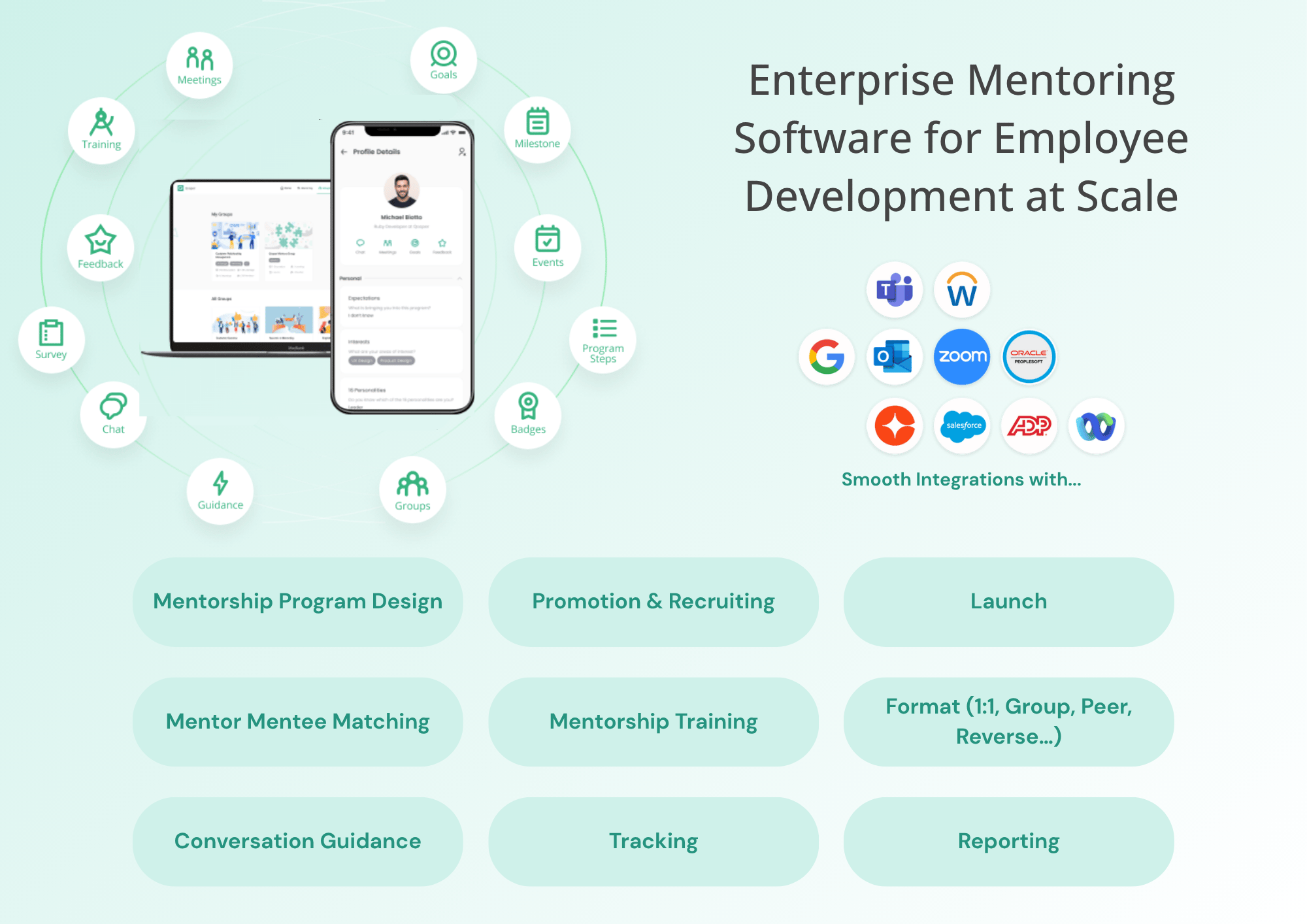
For global HR and talent leaders, the value of Qooper's global capabilities is not just the feature set — it is what that feature set enables operationally.
-
One program, all regions. Rather than running separate regional mentoring programs with separate tools, separate reporting, and separate admin teams, global enterprises can run a single unified mentoring program in Qooper that spans all regions — with localized participant experiences in each market and centralized oversight from a single admin interface.
-
Consistent program quality globally. Every participant in a Qooper program — regardless of their location, language, or region — receives the same structured mentoring experience: AI-matched pairings, structured meeting agendas, goal tracking, feedback tools, and session reminders. Program quality does not degrade as you move away from the markets closest to the team managing the program.
-
Measurable impact across the entire global workforce. Qooper's reporting aggregates mentoring activity, engagement, session completion, skill development, and retention signals across all regions — giving global HR and talent leaders the unified view of mentoring ROI that fragmented regional programs cannot produce. When leadership asks how mentoring is performing globally, Qooper gives you the data to answer that question.
-
Dedicated global customer success support. Qooper provides dedicated customer success managers with sub-30-minute response times, live kickoff support, best-practice templates, and quarterly business reviews — ensuring that global program launches receive the same hands-on support regardless of the regions involved. For enterprises deploying mentoring across multiple countries simultaneously, this implementation and ongoing support infrastructure is a significant operational advantage.
Qooper is trusted by 300+ enterprise organizations globally — including Fortune 500 companies like Merck, BNY, Harvard, Toyota, and Deloitte — to run structured mentoring programs across thousands of employees in multiple countries, languages, and time zones.
Global Mentoring Programs Require a Platform Built for Global Complexity
The difference between a global mentoring program that succeeds and one that quietly fails in half its markets almost always comes down to platform capability — not program design intent.
When employees in non-English-speaking markets cannot fully engage with the platform in their language, participation drops. When mentoring pairs across time zones cannot schedule sessions without manual coordination, relationships stall. When regional programs run in separate tools, global impact becomes invisible and unmeasurable. These are not edge cases — they are the predictable consequences of deploying a platform built for single-region complexity into a global operating environment.
Qooper is enterprise mentoring software built from the ground up for global organizations. With 30+ language support, time zone-aware scheduling, global HRIS integrations, centralized multi-region administration, GDPR compliance, and automated engagement workflows that reach every participant in every market — Qooper gives global HR and talent teams the infrastructure to run mentoring programs that work as well in Singapore as they do in Chicago.
For global enterprises that are serious about turning mentoring into a measurable, organization-wide talent strategy — not a program that works well at headquarters and struggles everywhere else — Qooper is the platform built for that ambition.
Ready to see Qooper's global capabilities in your environment? Request a demo to walk through how Qooper supports your specific regions, languages, and HRIS infrastructure — or speak with a customer success team member to scope your global program requirements.
Related reading:
- What is enterprise mentoring software? The complete guide
- Enterprise mentoring software features: what every large organization should require
- Enterprise mentoring software ROI: retention, onboarding, and leadership development results
- Enterprise Mentoring Software Use Cases: 8 Programs to Run
- Best Enterprise Mentoring Software: Top Platforms in 2026
- Creating A Successful Enterprise Mentoring Program
- Enterprise Mentoring Software Integrations
FAQ: Enterprise Mentoring Software for Global Organizations
What languages does Qooper support?
Qooper supports 30+ languages across the full platform — including the interface, program content, meeting agendas, notifications, and participant workflows. Language support is not limited to interface translation; it extends to the structured elements that drive mentoring program quality. Participants can select their preferred language independently, enabling a localized experience within a globally unified program.
Can Qooper run mentoring programs across multiple regions from one platform?
Yes. Qooper is specifically designed for this. Global enterprises can run unified mentoring programs that span multiple regions, business units, and time zones from a single admin interface — with centralized reporting, localized participant experiences, and regional admin access controls. This eliminates the need for separate regional tools, separate participant databases, and fragmented reporting that characterizes multi-tool global program management.
How does Qooper handle time zone differences for global mentor-mentee pairs?
Qooper handles time zone conversion automatically — displaying availability in each participant's local time and generating calendar invites that reflect the correct local time for both parties. Integration with Google Calendar and Outlook Calendar extends this time zone awareness into the calendaring tools participants already use. For pairs where time zone differences make synchronous sessions difficult, Qooper's in-platform messaging supports asynchronous communication between scheduled sessions.
Does Qooper comply with GDPR and global data privacy requirements?
Yes. Qooper is GDPR compliant and provides a Data Processing Agreement to support enterprise deployments across regions with varying privacy and regulatory requirements. Qooper is also SOC 2 Type I and SOC 2 Type II certified, uses AES-256 encryption for all data transfers, and supports SFTP-based data transfer for enterprises in regulated markets where direct API connections are restricted. Qooper's data governance architecture is designed for global enterprises operating across multiple data privacy jurisdictions.
Can Qooper integrate with multiple HRIS systems used across different regions?
Yes. For global enterprises running different HRIS platforms in different regions — such as Workday globally, SAP SuccessFactors in Europe, and ADP in the Americas — Qooper's integration framework connects to each system independently. This ensures accurate, current employee data across the full global participant base without requiring a single unified HRIS. Supported integrations include Workday, SAP SuccessFactors, Oracle, ADP, UKG, BambooHR, and Paycor.
How does Qooper keep global mentoring programs active after launch?
Qooper's automated communication workflows deliver session reminders, match notifications, and program updates in participants' selected languages across all regions — without requiring manual intervention from the central admin team. Microsoft Teams and Slack integrations ensure engagement touchpoints reach participants inside the tools they use daily. Mobile-first design supports employees who engage primarily via mobile. And Qooper's engagement monitoring gives administrators real-time visibility into participation health across all regions, enabling proactive intervention before activity declines.
What is the biggest challenge for global enterprise mentoring programs?
The most consistent operational challenges for global enterprise mentoring programs are language access, time zone-driven scheduling friction, and fragmented reporting across regions. Language barriers systematically reduce participation in non-English markets. Time zone mismatches cause mentoring relationships to stall before they develop. And running regional programs in separate tools produces the reporting fragmentation that prevents global enterprises from measuring — and communicating — total mentoring ROI. Qooper addresses all three directly through multi-language support, time zone-aware scheduling, and unified global reporting from a single platform.
How does Qooper support global program administrators?
Qooper provides dedicated customer success managers with sub-30-minute response times, live kickoff support, best-practice program templates, mentorship training resources, and quarterly business reviews. For global enterprises launching mentoring programs across multiple regions simultaneously, this hands-on implementation and ongoing support infrastructure ensures that program quality and admin confidence are consistent across all markets — not just in the regions closest to the central HR team.
-Jul-28-2026-08-18-52-8828-PM.jpg)
-4.jpg)
-2.png)