




Leadership Development · Mentoring Software · Succession Planning
Mentoring Software for Leadership Development
How Mentoring Software Transforms Leadership Development: A Complete Guide for HR and L&D Leaders
Written by: Omer Usanmaz, Founder, Qooper Mentoring Software
-----------------------------------------------------------------------------------------------------------------------------------------------------------------------------------------------------------------------
Most organizations say leadership development is a priority. Few have a system that actually delivers it.
The gap isn't intention — it's infrastructure. When mentoring programs rely on spreadsheets, email threads, and manual coordination, they work for 30 people and collapse at 300. High-potential employees get paired with whoever is available, not whoever is right. Sessions happen without milestones. Progress goes unmeasured. And when budget season comes, HR can't prove the program did anything at all.
Mentoring software for leadership development exists to close that gap — by turning informal mentoring into a structured, scalable, and measurable engine for building leaders. This guide explains what that means in practice, why it matters now more than ever, and how organizations like Merck, BNY, and Harvard are making it work at scale.
54%
of mentored employees identify a clear leadership career path
50%+
boost in retention among structured mentoring program participants
33%
of employees feel engaged at work — making development programs critical
2X
higher retention among high-potential employees who are mentored
What is Mentoring Software for Leadership Development?
Mentoring software for leadership development is a dedicated platform that helps organizations design, run, and measure structured mentoring programs aimed at growing future leaders. It automates the operational layer of mentoring — matching, scheduling, communications, and reporting — while giving program managers the tools to define objectives, track milestones, and connect mentoring activity to business outcomes.
It is distinct from a Learning Management System (LMS). An LMS delivers content. Mentoring software builds relationships — and embeds structured learning into those relationships. Leadership development requires both: the application of knowledge through conversation, feedback, and real-world challenges, not passive course consumption.
It is also distinct from coaching platforms, which typically connect employees with external certified coaches. Mentoring software facilitates knowledge transfer between people inside the organization — pairing experienced leaders with high-potential employees who need their institutional knowledge, perspective, and sponsorship to grow.
— National Academies of Science, Engineering, and Medicine (NASEM)
"Mentorship is a professional, working alliance in which individuals work together over time to support the personal and professional growth, development, and success of the relational partners."
Why Leadership Development Fails Without Structure
Structured mentorship programs serve as a cornerstone for leadership development, offering personalized guidance that accelerates growth while remaining scalable through digital platforms. But most organizations don't have that structure in place.
Here's what typically goes wrong:
Programs don't scale past the pilot.
A cohort of 25 high-potential employees has a great experience. HR tries to expand to 200 participants. Without automation, the admin burden becomes unmanageable — and the program quietly dies.
Matching is political, not strategic
Without an objective matching process, mentor-mentee pairings reflect seniority, proximity, or familiarity rather than developmental fit. The people who most need access to senior leaders are often the ones least likely to get it.
Sessions lack direction
When mentoring pairs have no agenda, no milestones, and no shared goals, conversations become pleasant but unfocused. Relationships form, but leadership competencies don't.
ROI is invisible
Without purpose-built reporting, even a well-run program can't connect its activity to retention, promotion, or succession readiness — making it the first thing cut at budget time.
How AI-Powered Mentor Matching Changes the Equation
The most significant operational shift that mentoring software brings to leadership development is the replacement of manual matching with algorithm-driven pairing.
Traditional approaches rely on program administrators reviewing profiles and making judgment calls — a process that is slow, inconsistent, and inherently biased toward visible talent. AI-powered matching changes this fundamentally.
AI-driven mentoring frameworks are redefining how companies pair mentors with mentees. These advanced mentoring technologies analyze skills, career interests, and personality traits to ensure the most effective match, improving mentoring outcomes and engagement.
Qooper's smart matching algorithm pairs participants based on multiple dimensions simultaneously: leadership goals, career trajectory, communication preferences, development stage, DEI objectives, and program-specific parameters. This means a first-generation professional pursuing a VP track can be matched with a senior leader who navigated a similar path — not just the nearest available mentor in their department.
The result isn't just better relationships. It's faster development. When mentors and mentees are well-matched from day one, the early sessions that typically get spent building rapport can be redirected toward actual leadership growth.
Not all mentoring platforms are built for leadership development specifically. When evaluating options, HR and L&D leaders should look for these six capabilities:
| Leadership-specific program templates and milestone tracks | Generic mentoring software asks pairs to set their own goals and figure out their own structure. Leadership mentoring software provides pre-built tracks — for new manager development, HiPo programs, succession planning, and executive readiness — with defined milestones, session guides, and competency frameworks built in. |
|
AI-powered mentor matching
|
As described above, the quality of the match determines the quality of the program. Look for platforms that match on multiple variables simultaneously, not just department or seniority, and that support the full range of mentoring formats: one-to-one, group, peer, reverse, and flash mentoring. |
|
Embedded learning and training content
|
AI-enabled mentoring software can automate matching, guide conversations and goal-setting, and offer insights — such as program health signals like drop-off points and participation gaps. The best platforms also deliver relevant learning content between sessions — reinforcing what was discussed and building on it before the next conversation. |
| ROI and outcomes analytics | A dashboard that shows session frequency is not enough. Leadership mentoring software should connect program activity to workforce outcomes: promotion rates, retention trends, goal completion, and succession pipeline depth. This is what allows L&D leaders to build a defensible business case for continued investment. |
| Admin automation | Communications, reminders, feedback collection, and progress reporting should happen automatically. Program managers should be spending their time on strategy and participant support — not chasing down meeting notes. |
| Enterprise integrations and security | Any platform deployed at scale needs to integrate with the tools organizations already use. Look for native integrations with Slack, Microsoft Teams, Zoom, Workday, SAP SuccessFactors, and major HRIS platforms, alongside SSO, SCIM provisioning, and multi-language support for global deployments. |
Leadership Mentoring Use Cases: Beyond the One-to-One Relationship
Leadership development through mentoring isn't one-size-fits-all. Effective programs address different moments in the leadership journey with different program structures
High-potential (HiPo) development
The most common use case — identifying emerging leaders and connecting them with senior mentors to accelerate their readiness for leadership roles. HiPo programs benefit from structured milestone tracks and regular progress reporting against defined competencies.
New manager onboarding and coaching
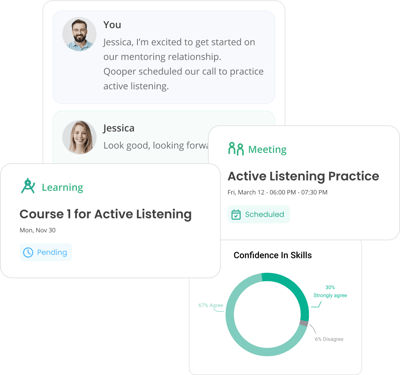
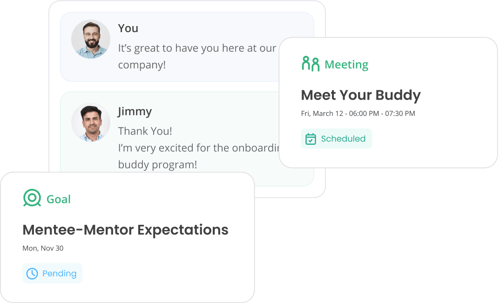
The transition from individual contributor to manager is one of the highest-risk moments in any employee's career. Pairing new managers with experienced leaders during the first 90 days dramatically reduces the failure rate and builds management confidence faster than any training course.
Succession Planning
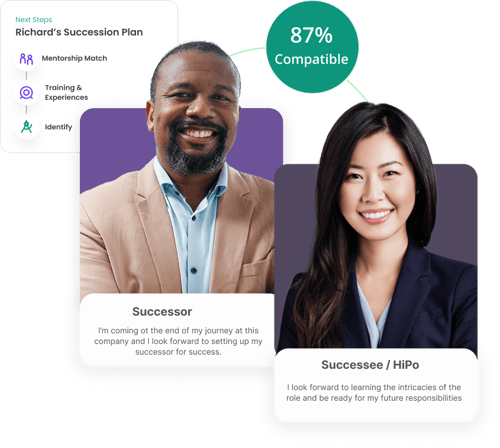
Effective mentorship doesn't merely support individual development — it also reinforces your organization's identity as one that values learning, accountability, and long-term succession planning. Mentoring software makes succession planning proactive by connecting identified successors with senior leaders, tracking readiness milestones, and giving HR visibility into pipeline depth across the organization.
DEI leadership tracks
Equitable access to mentoring is a DEI issue. Bias-aware matching and dedicated leadership tracks for underrepresented talent ensure that the people who most need access to senior sponsorship actually get it — not just those with the most visibility.
Reverse mentoring
Reverse mentoring, where younger employees mentor senior leaders, has become a powerful tool to bridge the mentoring gap and foster knowledge sharing across generations. This format drives inclusion and gives senior leaders direct exposure to emerging technologies, digital behaviors, and cultural perspectives they might otherwise miss.
Enterprise-wide leadership culture
The most mature programs move beyond structured cohorts to create an organization-wide culture of mentoring — where learning between colleagues at all levels is normalized, tracked, and celebrated.
Measuring ROI: what to track and what it's worth
One of the most common challenges L&D leaders face is demonstrating return on investment. The table below outlines the metrics that matter, what good looks like, and how mentoring software makes them measurable.
| Metric | Baseline (no program) | With Qooper | Impact |
|---|---|---|---|
| HiPo retention rate | 61% | 82% | +21pts |
| Internal promotion rate | 18% | 31% | +13pts |
| Time-to-leadership readiness | 36 months | 22 months | −14 months |
| Succession pipeline coverage | 34% | 67% | +33pts |
| New manager 90-day success rate | 54% | 79% | +25pts |
| Program admin hours per cohort | ~40 hrs | ~8 hrs | −80% |
When these numbers are tied to the cost of replacing a high-potential employee — typically 1.5–2× annual salary — the ROI of even a moderately effective mentoring program becomes substantial. For a 500-person organization where HiPo attrition drops by 5 employees per year at an average replacement cost of $120,000, that's $600,000 in direct savings annually from mentoring alone.
What Enterprise Organizations Get Wrong About Leadership Mentoring
Even organizations with strong intentions make predictable mistakes when designing leadership mentoring programs. The most common ones:
-
Treating launch as completion. Getting a program live is not the same as running a program. Without ongoing nudges, check-ins, and milestone prompts, mentor-mentee pairs go quiet within weeks of their initial match.
-
Measuring activity instead of outcomes. "We had 400 mentoring sessions last quarter" tells you nothing about whether anyone grew. Track goal completion, competency progression, and downstream workforce metrics — not just meeting volume.
-
Ignoring the mentor experience. Most programs invest heavily in mentee readiness and neglect mentor preparation. Senior leaders who are matched without context, training, or a structured agenda often find mentoring more burdensome than rewarding — and disengage quietly.
-
Running a single program type. A one-to-one mentoring program for HiPos misses the majority of the organization. The most effective leadership development ecosystems layer multiple program types — reverse mentoring, peer cohorts, group mentoring, and flash mentoring — alongside the flagship one-to-one format.
-
Failing to tie mentoring to career pathways. Mentoring works best when it is explicitly connected to internal mobility. When mentees can see a direct line between their mentoring experience and their next role, engagement and completion rates improve significantly.
How Qooper Powers Leadership Development at Scale
Qooper is enterprise mentoring software built specifically for the complexity of large organizations. It supports the full lifecycle of leadership mentoring programs — from program design and participant onboarding through AI-powered matching, structured session delivery, embedded learning, and outcome reporting.
Organizations including Merck, BNY, Northwell Health, and Harvard use Qooper to run leadership development programs that are structured enough to be measurable and flexible enough to fit their specific culture, program types, and workforce needs.
Key capabilities that distinguish Qooper for leadership development:
-
AI-powered smart matching across leadership goals, career trajectory, DEI parameters, and communication style
-
Pre-built and customizable leadership milestone tracks for HiPo, new manager, succession, and reverse mentoring programs
-
ATD and CIPD-certified training content delivered automatically between sessions
-
Centralized analytics dashboard connecting mentoring activity to promotion, retention, and succession outcomes
-
Program automation reducing administrative burden for HR and L&D teams
-
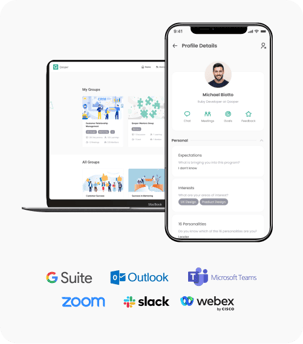
Native integrations with Slack, Microsoft Teams, Zoom, Workday, SAP, and major HRIS platforms
-
SSO, SCIM provisioning, and multi-language support for global enterprise deployment
Qooper Key solutions
Choosing Qooper means choosing a platform where every capability was designed with one outcome in mind: mentoring relationships that actually work. You get smarter matching that removes bias and scales effortlessly, real-time visibility into every program you run, and AI that handles the friction — scheduling, nudges, content suggestions — so your people can focus on the conversations that move careers forward. From onboarding new hires to developing your next generation of leaders, Qooper gives HR teams the infrastructure to run mentoring at scale and the intelligence to prove it's working.
| # | Solution | What it does | Why it matters | Key capability |
|---|---|---|---|---|
| 01 | Mentoring Software | A dedicated platform to design, launch, and manage structured mentoring programs of any size — 1:1, group, peer, reverse, and flash formats — all from one admin interface. | Generic tools weren't built for mentoring. Qooper handles the full program lifecycle — from enrollment to graduation — without workarounds. | Multi-program management, automated workflows, participant portals |
| 02 | Mentoring App | A mobile-first experience that lets mentors and mentees manage their relationship, complete activities, track goals, and schedule meetings from any device. | Mentoring happens between meetings, not just during them. A mobile app keeps participants engaged wherever they are — not just when they're at their desk. | iOS & Android apps, push notifications, in-app messaging |
| 03 | Mentor matching | An AI-driven matching engine that evaluates 20+ compatibility factors — including skills, goals, seniority, function, and personality signals — to pair participants automatically or give administrators curated recommendations. | Manual matching doesn't scale and introduces unconscious bias. Algorithmic matching surfaces better pairs, faster, and gives every participant a fair shot at the right mentor. | 20+ matching factors, admin override, self-matching option |
| 04 | Groups | Structured group mentoring functionality that supports cohort-based programs, mastermind formats, and community learning — with shared goals, discussion threads, and group meeting scheduling built in. | Not every mentoring need is 1:1. Group formats scale senior mentor time, build peer networks, and create shared accountability that individual pairings can't replicate. | Group goal tracking, discussion boards, cohort management |
| 05 | Learning | A curated content library of conversation guides, development frameworks, and structured activities that mentors and mentees can draw on throughout the program. Administrators can add custom content aligned to internal competency models. | Great mentoring doesn't happen by accident. Structured resources keep relationships productive between sessions and give participants a shared language for development. | Template library, custom content upload, milestone-based delivery |
| 06 | Reporting & analytics | Live dashboards and exportable reports that track match rates, meeting frequency, goal completion, participant satisfaction, and engagement trends across every active program. | You can't improve — or justify — what you can't measure. Real-time analytics give program managers the data to intervene early, prove ROI, and continuously improve. | Live dashboards, CSV exports, executive summaries, goal completion tracking |
| 07 | ERG management | Tools to centralize, engage, and measure Employee Resource Groups — embedding mentoring and peer connection directly into ERG programming so groups move beyond social events and create measurable career impact. | ERGs are most valuable when they create real pathways for professional growth. Qooper gives ERG leaders the infrastructure to run structured programs and demonstrate impact to leadership. | ERG-specific program templates, member directories, engagement tracking |
| 08 | Qooper AI | An embedded AI layer that powers smarter matching, generates personalized conversation starters, surfaces relevant learning resources, and flags at-risk pairs before they disengage — giving administrators and participants intelligent support throughout the program. | AI doesn't replace the human relationship — it removes the friction that prevents it from happening. Qooper AI handles the administrative and logistical overhead so mentors and mentees can focus on what matters. | AI matching, smart nudges, conversation prompts, disengagement detection |
| 09 | People intelligence | A layer of organizational insight built from mentoring data — connecting goal completion, development milestones, and engagement signals to talent planning, succession pipelines, and HiPo identification. | Mentoring data is some of the richest signal you have on your future leaders. People Intelligence turns program activity into strategic talent intelligence that HR and leadership can act on. | Succession pipeline visibility, HiPo tracking, HRIS integration, talent insights |
| 10 | Integrations | Native connections to the HRIS, collaboration, and calendar tools your teams already use — including Workday, BambooHR, SAP SuccessFactors, ADP, UKG, Slack, Microsoft Teams, Google Calendar, and Outlook. | Manual data management breaks at scale and creates compliance risk. Qooper syncs people data automatically so program rosters stay current, participation is tracked accurately, and administrators spend time on programs — not spreadsheets. | Workday, BambooHR, SAP, ADP, UKG, Slack, Teams, Google Calendar, Outlook |
| 11 | Multi-language support | A fully localized platform experience available in multiple languages, allowing global organizations to run mentoring programs across regions without forcing participants into a single language. | Mentoring only works when participants feel at home in the platform. Language barriers reduce engagement, limit adoption in non-English-speaking markets, and create an unequal experience across your global workforce. | Localized UI, multi-language content, region-specific program settings |
| 12 | Security & compliance | Enterprise-grade data protection built in from the start — SOC 2 Type II certified, GDPR and CCPA compliant, with SSO/SAML 2.0 support, role-based access controls, and AES-256 encryption at rest and in transit. | Enterprise procurement and legal teams have non-negotiable requirements. Qooper is built to meet them — so security reviews move quickly and your people data stays protected at every stage of the program lifecycle. | SOC 2 Type II, GDPR, CCPA, SSO/SAML 2.0, RBAC, AES-256 encryption |
FAQ
What is the difference between mentoring software and coaching software for leadership development?
How long does it take to launch a leadership mentoring program with Qooper?
Most enterprise clients go live within weeks. Qooper provides program templates, onboarding support, and a dedicated customer success team — so no custom development is required. The matching algorithm and milestone tracks are ready to configure from day one.
Can mentoring software support programs across multiple countries and languages?
Yes. Qooper supports multi-language deployment and is used by global enterprises to run leadership mentoring programs across geographies and time zones. It integrates with communication tools that distributed teams already use, including Slack, Microsoft Teams, and Zoom.
How does mentoring software support DEI goals within leadership development?
AI-powered matching removes the informal networks and proximity biases that typically favor visible, well-connected employees. Qooper's matching algorithm can be configured to prioritize underrepresented talent for leadership tracks, ensuring equitable access to senior mentors and sponsorship relationships — not just for those who already know the right people.
What metrics should HR use to evaluate the success of a leadership mentoring program?
Focus on outcomes over activity. The most meaningful metrics are: promotion rates among program participants, retention rates for high-potential employees, succession pipeline depth, goal completion rates, and manager effectiveness scores for new manager cohorts. Qooper's analytics dashboard connects all of these to mentoring activity, making it possible to demonstrate ROI to executive stakeholders.
#1 Rated Software, Service & Integrations For
Mentorship & Learning
Starting a Mentorship Program? Qooper is easy-to-use!
"Qooper has everything you need to get a mentorship program off the ground, no custom development or heavy lifting required. It's easy to implement, simple to navigate as an administrator, and provides a seamless experience for both mentors and mentees with its intuitive user interface. Highly recommend."
 Lea B.Tommy Bahama

Support from day one.
"Thank you for being an excellent partner who has supported us from day one, following up and keeping us up to date with the new features, preparing a business case for us (which is extremely helpful for me because you have done half of my job), providing suggestions, and assisting me in managing our program despite our small team."
 Cindee P.Cotiviti

Matched with the right mentor, engaged every step of the way!
"Qooper's matching algorithm paired me with the perfect mentor during Northwell's Inaugural Mentorship Program – what we now call the world's best algorithm, because it was spot on! It made the entire mentoring journey feel personalized and intentional from day one."
 Dani L.Northwell Health


Want to explore more?
Discover how Qooper can help your organizational goals and people development today.