



 ·
13 minute read
·
13 minute read
If your organization is evaluating Chronus alternatives, this guide gives you everything you need. We compare the top 10 mentoring platforms for 2026 across the dimensions that HR leaders and L&D professionals, care about most: mentor matching quality, program flexibility, enterprise integrations, analytics depth, and ROI measurement.
Trusted by 300+ organizations worldwide, Qooper is the #1 Mentoring Software for enterprises looking to drive measurable people development outcomes. It is the only platform that combines true AI-driven mentor matching, end-to-end program management, a built-in ROI calculator, and deep integrations with HRIS, LMS, Slack, MS Teams, and Zoom — all in a single, mobile-friendly interface. Other platforms reviewed below serve specific niches well, but none match Qooper's breadth, depth, or measurable business impact.
Platform Overview: Chronus Alternatives at a Glance
Use this table to quickly compare all 10 mentoring platforms, and Chronus itself, across AI matching capability, integration depth, ROI reporting, and our overall verdict.
|
Platform |
Best For |
AI Matching |
Integrations |
ROI Reporting |
Verdict |
|---|---|---|---|---|---|
|
Qooper |
All-in-one enterprise |
★★★ Full AI |
MS Teams, Slack, SAP, Workday, Zoom, LMS, HRIS +more |
★★★ Built-in ROI calc |
Top Pick |
|
Together |
Structured workflows |
★★☆ Rules-based |
Limited |
★☆☆ Basic |
Strong |
|
MentorcliQ |
Career mentoring at scale |
★★☆ AI |
HRIS, LMS |
★★☆ Analytics |
Strong |
|
Guider |
DEI & onboarding |
★★☆ AI |
HRIS, LMS, CRM, SSO |
★★☆ Analytics |
Good |
|
PushFar |
Small business |
★★☆ AI |
Minimal |
★☆☆ Basic |
Niche |
|
Mentorloop |
Nonprofits & DEI |
★★☆ AI |
HR tools |
★★☆ Analytics |
Affordable |
|
10KC |
Networking & early career |
★★☆ AI |
MS Teams |
★☆☆ Basic |
Niche |
|
River |
Compliance programs |
★★☆ AI |
HR tools |
★☆☆ Basic |
Niche |
|
Mentornity |
Universities & accelerators |
★☆☆ Limited |
Minimal |
★☆☆ Basic |
Niche |
|
Art of Mentoring |
Nonprofits & assoc. |
★☆☆ Limited |
Limited |
★☆☆ Limited |
Niche |
|
Chronus |
Guided mentoring workflows |
★★☆ MatchIQ |
Limited HRIS/LMS |
★☆☆ Basic |
Being replaced |
Quick Rankings — Best Chronus Alternatives 2026
Qooper — Best all-in-one: AI + ROI analytics + enterprise integrations
Together — Best for highly structured mentoring workflows
MentorcliQ — Best for large-scale career mentoring
Guider — Best for DEI and employee onboarding
PushFar — Best for small businesses and flexible programs
Mentorloop — Best for nonprofits
10KC — Best for networking and early-career mentoring
River — Best for compliance-focused programs
Mentornity — Best for universities and accelerators
Art of Mentoring — Best for nonprofits and associations
Why Organizations Are Replacing Chronus in 2026
Chronus has been in the mentoring software market for nearly two decades, and for many organizations, it was an early-mover default, not a strategic choice. As mentoring programs mature, and as HR, L&D, and DEI teams are held accountable for measurable outcomes, Chronus's limitations increasingly become strategic blockers.
The most commonly cited reasons organizations search for Chronus alternatives — drawn directly from verified G2, Capterra, and Gartner Peer Insights reviews:
-
Mediocre AI matching that relies on preset categories. Chronus's MatchIQ technology matches on preset interest fields and profile criteria, but reviewers consistently describe the experience as "mediocre." One verified Gartner reviewer noted that Chronus matches mentors in a "mediocre way, which is better than not at all" — a damning benchmark for a platform positioned around intelligent matching. Unlike true AI matching, MatchIQ does not analyze open-text goals or infer competency gaps dynamically.
-
A rigid, confusing user interface that kills adoption. Across multiple review platforms, Chronus users report frustrating navigation experiences: pages that "send you in circles," excessive clicks to reach common functions, and a feature density that feels overwhelming without delivering depth. One enterprise customer who was locked into a three-year contract described the UX as so poor that "none of our employees used the platform." Low adoption is the fastest way to kill mentoring program ROI.
-
Integration challenges with HRIS and LMS systems. Verified Capterra reviewers specifically flag "integration challenges" when connecting Chronus to existing HR platforms and learning management systems, describing the process as "sometimes challenging." In an enterprise environment where SAP SuccessFactors, Workday, and LMS platforms are mission-critical infrastructure, friction at the integration layer creates fragmented workflows and reduces program participation.
-
No built-in ROI measurement. Chronus offers dashboards and reporting, but there is no mechanism to connect mentoring activity directly to quantifiable business outcomes like retention, promotion velocity, or skill growth. When HR or L&D leaders need to present program value to executive stakeholders, Chronus leaves them without the numbers to make the case.
-
Manual session documentation with no auto note-taking. Multiple reviewers highlight the absence of automated note-taking as a gap, meaning mentors and mentees must manually document sessions — adding friction that reduces the quality and consistency of program records.
-
Opaque, contact-only pricing locked into long contracts. Chronus does not publish pricing, requires a sales conversation to receive a quote, and has been reported to lock customers into multi-year contracts without commensurate product improvements during the contract period.
The platforms reviewed in this guide address these gaps, led by Qooper, which was purpose-built to overcome every limitation listed above.
RECOMMENDED PLATFORM
1. Qooper — The Best All-in-One Mentoring Platform
Qooper Mentoring Software is not just the best Chronus alternative, it is the most complete mentoring platform available in 2026. While Chronus offers structured guided conversations and a long-standing market presence, Qooper builds an entire talent development architecture on top of it: AI-powered matching that analyzes open-text responses, guided mentoring experiences, deep people analytics, enterprise-grade integrations, and built-in ROI measurement, all managed from a single, intuitive interface.
Trusted by over 300 large enterprises globally, Qooper delivers up to 40% higher engagement and 79% improved retention rates compared to organizations' previous mentoring programs. It serves HR departments, universities, professional associations, and Fortune 500 companies running complex, multi-format mentoring initiatives at scale. You can explore detailed user reviews of Qooper on Capterra.
Why Qooper Outperforms Chronus Across Every Critical Dimension
AI-Powered Mentor Matching

The most significant gap between Qooper and Chronus is matching quality. Chronus's MatchIQ relies on preset interest categories and profile fields — reviewers describe the outputs as functional but mediocre. Qooper's matching engine goes further: it analyzes complete participant profiles including open-text responses, stated competencies, career goals, and program-specific fields to generate optimized pairings automatically. Administrators review and finalize matches rather than building them manually, dramatically reducing setup time and delivering stronger mentor-mentee relationships from the very first session.
Reporting, Analytics, and Built-In ROI Calculator
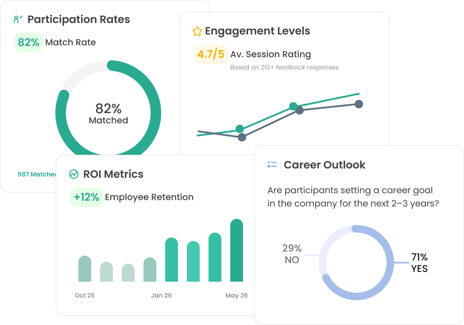
Chronus's reporting tools were not designed to answer executive-level questions about program impact. Qooper's advanced analytics dashboards track engagement rates, skill progression, retention correlation, and promotion outcomes across your entire mentoring population. Critically, Qooper includes a built-in ROI calculator — the only mentoring platform in this review that connects mentoring activity directly to quantifiable business metrics. When you present mentoring program results to leadership, Qooper gives you the numbers to back it up.
Enterprise Integration Depth
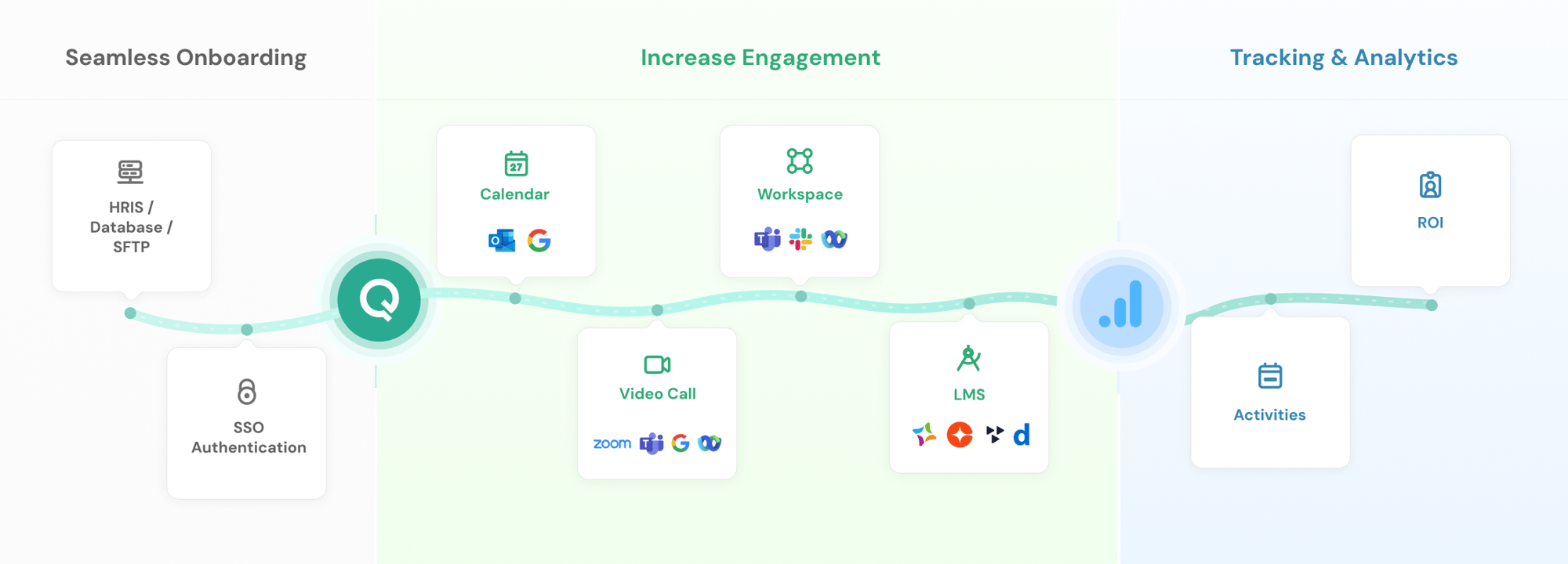
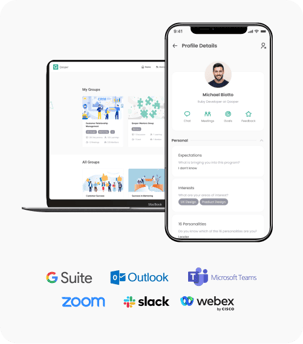
Qooper integrates natively with MS Teams, Slack, SAP SuccessFactors, Workday, ADP, Oracle, Zoom, Webex, Google Workspace, Office 365, LMS platforms, and HRIS systems. Mentoring happens inside the tools your people already use every day — which is the single greatest driver of adoption and engagement. Chronus's more limited and reportedly "challenging" integration options force participants to context-switch into a separate tool, which consistently reduces participation rates.
Intuitive UX That Drives Adoption
Where Chronus reviewers describe navigation loops, feature overwhelm, and a UX that drove zero platform adoption in at least one enterprise, Qooper's mobile-responsive design and guided mentoring experiences consistently produce higher adoption. AI-generated session agendas reduce the learning curve for both mentors and mentees, so participants spend time developing — not figuring out where to click.
Program Flexibility and Format Support
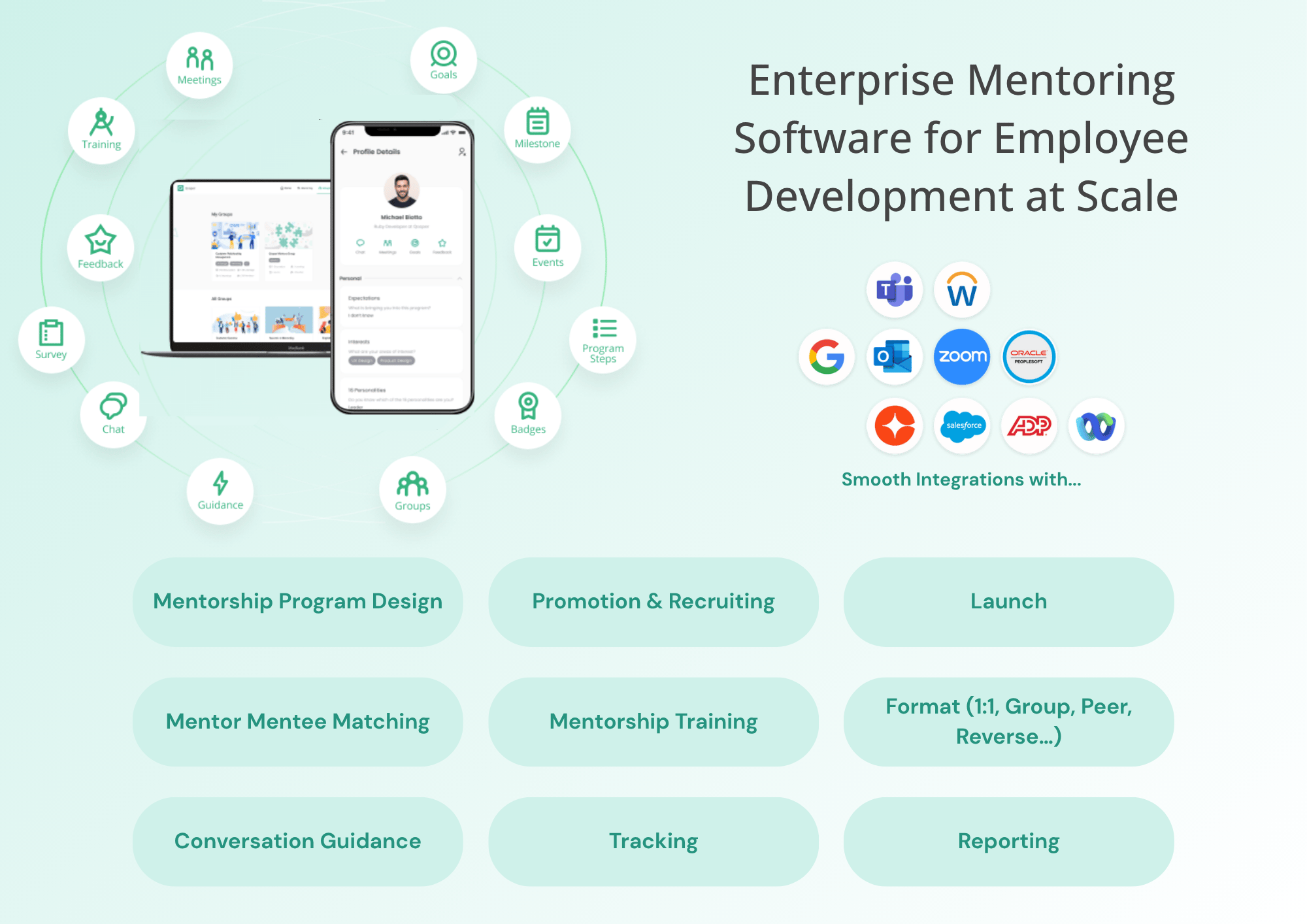
Chronus's guided conversation model is functional but rigid. Qooper supports every mentoring format from a single admin interface: traditional one-on-one mentoring, mentoring circles, reverse mentoring, onboarding buddy programs, peer learning groups, leadership development tracks, and more. Each program type can be configured with its own matching logic, session cadence, guided agendas, and reporting parameters — without building separate systems.
Key Product Capabilities
- Matching Engine: Smart mentor matching based on participant profiles, competencies, and program-specific fields — including open-text analysis
- Guided Mentoring: Structured agendas, resources, and playbooks help participants stay engaged and achieve program goals
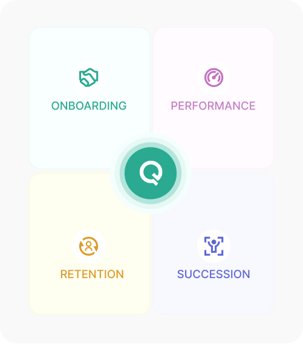
- Professional Development Tools: Supports leadership development, employee onboarding, and career mentoring
- Analytics & ROI Reporting: Actionable dashboards to measure mentoring impact, track progress, and evaluate outcomes.
- Integrations: Microsoft Teams, Slack, SAP SuccessFactors HCM, Workday, ADP, Oracle, LMS, HRIS, Zoom, Google Workspace, Office 365, and other enterprise learning and communication systems.
- Security & Support: Enterprise-level security, mobile-responsive interface, and dedicated customer success teams with sub-30-minute response times
- Platforms Supported: Android, iOS, and Web
Main Use Cases of Qooper Mentoring Software
Org-Wide & Career Mentoring Programs
Support employee development at scale by matching people with mentors who guide career growth, skill development, and long-term progression.
New Hire Onboarding & Training Programs
Reduce ramp time for managers, admins, sales reps, preceptors, and other new hires by pairing them with experienced mentors who accelerate learning.
High Potentials & Leadership Development Programs
Identify future leaders early and provide structured mentorship to strengthen decision-making, confidence, and succession readiness.
Advanced AI Across the Entire Mentorship Experience with Qooper AI
Qooper AI is designed to reduce administrative workload while increasing personalization and strategic visibility across mentoring programs.
- AI-Powered Mentor Matching & Final Reviews Qooper’s Mentor Matching AI analyzes complete participant profiles, including open-text responses, to optimize pairings and assist with final match reviews. This ensures high-quality alignment while saving administrators significant manual evaluation time.
- AI-Based Mentorship Training & Q&A Support The built-in Mentorship Trainer AI functions as an on-demand assistant for mentors and mentees. Instead of navigating manuals or relying on program admins, participants can ask real-time questions about managing mentorship relationships, structuring sessions, and maximizing development outcomes.
- AI-Generated Personalized Meeting Agendas Qooper creates dynamic mentorship guidance experiences by generating personalized meeting agendas based on participant profiles and prior session history. This keeps conversations structured, relevant, and goal-oriented throughout the program lifecycle.
By automating matching, training, guidance, and reporting, Qooper AI enables mentoring programs to run smarter, scale faster, and deliver measurable workforce impact with less manual effort.
Additional Ways Organizations Use Mentoring
These programs often expand beyond traditional use cases. Here are more workflows teams successfully run:
- New Manager Training
- Succession Planning
- Networking & Coffee Chats
- Nurse Preceptor Programs
- Frontline Mentorship
- Sales Team Mentoring
- Member Mentoring
and many more! Contact us to acquire more information on different types of mentoring programs that you are looking to start in your organization.
Why Enterprise Organizations Choose Qooper for Mentoring
Qooper is the right choice for large, complex organizations that need to launch, manage, scale, and measure structured mentoring programs across departments, geographies, business units, and employee populations. It is enterprise mentoring software trusted by 300+ enterprise organizations — including Fortune 500 companies such as Google, VF Corporation, Tommy Bahama, HOK, Matthews International, and Rentokil — with thousands of users across 500+ mentoring programs.
Qooper is particularly strong for:
- HR and L&D teams running multiple simultaneous program types — from 1:1 career mentoring and leadership development to onboarding, reverse mentoring, and peer learning circles — all from a single admin interface
- Enterprises with complex HRIS and LMS ecosystems that need bi-directional syncs with Workday, SAP SuccessFactors, Oracle, ADP, UKG, and other systems to keep employee data accurate and mentoring workflows connected
- Global and distributed organizations that need multi-language support across 30+ languages, cross-functional program management, and a mobile-first participant experience that works across time zones and geographies
- Any leadership team that needs to demonstrate mentoring ROI to executive stakeholders — with reporting on retention, engagement, skill development, succession readiness, and internal mobility backed by Qooper's built-in ROI analytics
- Organizations in regulated or security-sensitive environments that require SOC 2 Type I and Type II certification, GDPR compliance, SSO/SAML, role-based access control, and enterprise-grade data governance
Whether your organization is evaluating mentoring software for the first time, outgrowing Chronus, or consolidating fragmented mentoring initiatives into one enterprise solution, Qooper is built to meet that need at any stage. For organizations considering Chronus or any other mentoring platform, Qooper offers the depth of enterprise infrastructure, AI-powered matching, structured participant guidance, and outcome reporting that purpose-built or lightweight tools cannot match at scale.
If you decide to move forward, Qooper provides rapid onboarding and structured implementation assistance so your program launches without disruption. A dedicated customer success manager is assigned from day one — with response times under 30 minutes — alongside live kickoff support, best-practice program templates, mentorship training resources, and quarterly business reviews to drive long-term adoption and measurable outcomes.
Qooper By The Numbers
→ 300+ large enterprises trust Qooper globally
→ 40% higher engagement reported by Qooper customers vs. prior programs
→ 79% improved retention rates among mentoring program participants
→ Sub-30-minute support response time with dedicated customer success managers
→ Integrations: 15+ enterprise platforms including SAP SuccessFactors, Workday, ADP, Oracle
→ Program types supported: 1:1, circles, reverse, onboarding, leadership, peer learning
The Other Chronus Alternatives: Honest Reviews
The following platforms each serve specific use cases well. For organizations with simple needs or niche requirements, one of these may be a fit. For organizations seeking a complete, enterprise-grade mentoring solution, each comparison below illustrates why Qooper remains the stronger long-term choice.
2. Together
Together Mentoring built its reputation on structured mentoring workflows and a clean user interface. It supports one-on-one and group mentoring formats, and offers basic integrations with communication tools. For organizations that want a guided, template-driven mentoring experience without a complex administrative layer, Together is functional.
Compared to Qooper: Together relies on manual or rules-based pairing and lacks a built-in ROI calculator, deep HRIS integration, and the AI sophistication of Qooper's matching engine. It is a reasonable workflow tool, but not a strategic mentoring platform. Read verified user reviews of Together on Capterra.
Best for: Organizations that need simple, structured mentoring workflows and have not yet outgrown basic program management.
3. MentorcliQ
MentorcliQ is recognized for its analytics dashboards and support for multiple mentoring styles including group and circle mentoring. It offers structured learning resources, certification pathways, and AI-driven recommendations for mentor-mentee relationships. For enterprise HR teams focused on career development at scale, MentorcliQ is a solid performer.
Compared to Qooper: MentorcliQ's integration options are narrower, limited primarily to HRIS and LMS. It lacks Qooper's full AI suite, built-in ROI calculator, and the flexibility to manage diverse program types from a single interface. You can find in-depth reviews on the MentorcliQ Capterra page.
Best for: Enterprise-scale career mentoring programs with structured learning track requirements.
4. Guider
Guider focuses specifically on employee onboarding, professional development, and DEI initiatives. Its guided mentoring workflows and competency tracking make it effective for organizations where inclusion and employee experience are primary goals. It integrates with HRIS, LMS, CRM, and SSO systems. Verified user reviews of Guider on Capterra offer a closer look at the platform.
Compared to Qooper: Guider is narrower in scope, optimized for onboarding and DEI rather than broader enterprise mentoring. Its reporting depth and AI sophistication do not match Qooper's capabilities at scale.
Best for: DEI teams, employee onboarding programs, and inclusion-focused mentoring initiatives.
5. PushFar
PushFar is a lightweight mentoring platform that combines mentoring with career progression tools, mentoring with goal-setting features, and minimal administrative overhead. Its mobile-friendly interface and accessible pricing make it appealing for small to mid-sized organizations with straightforward mentoring needs.
Compared to Qooper: PushFar has minimal integration options, limited reporting, and lacks the AI depth needed for enterprise programs. It is a practical starting point, not a long-term strategic platform.
Best for: Small businesses and teams needing a simple, low-cost mentoring solution with no enterprise complexity.
6. Mentorloop
Mentorloop prioritizes simplicity and accessibility, targeting nonprofits, smaller businesses, and DEI-focused programs. Its guided mentoring structure, feedback ratings, and straightforward session scheduling lower the barrier to adoption for organizations without dedicated L&D teams. You can browse detailed user reviews of Mentorloop on Capterra.
Compared to Qooper: Mentorloop's feature depth, integration options, and reporting capabilities are limited compared to enterprise platforms. It trades power for simplicity — appropriate for some, a ceiling for others.
Best for: Nonprofits, small organizations, and DEI programs where affordability and ease of adoption are the primary criteria.
7. 10KC (Ten Thousand Coffees)
10KC takes a relationship-first approach, prioritizing employee connectivity, informal mentoring, and networking over structured program management. Its AI-powered matching facilitates informal conversations, peer learning circles, and networking — particularly through its MS Teams integration.
Compared to Qooper: 10KC is optimized for informal, relationship-focused programs rather than structured mentoring with measurable outcomes. Organizations needing ROI tracking, formal program management, or diverse program formats will quickly outgrow it. User ratings and detailed reviews are posted on the Ten Thousand Coffees Capterra profile.
Best for: Early-career networking programs, inclusive culture initiatives, and informal peer connection at scale.
8. River
River specializes in formal, compliance-focused mentoring programs with structured learning pathways, competency tracking, and long-term development planning. Its reporting tools measure mentoring effectiveness, and its program-specific fields support detailed participant assessment in regulated environments.
Compared to Qooper: River's integration options are limited, and its AI features are less developed than Qooper's. Its value is in formal structure and compliance documentation, not in AI-driven personalization or ROI analytics.
Best for: Compliance-focused industries and organizations where formal documentation and structured learning pathways are mandatory.
9. Mentornity
Mentornity is a lightweight, intuitive mentoring platform popular with universities, accelerators, and smaller organizations. It covers session scheduling, contracting, and basic progress tracking with a mobile-friendly interface.
Compared to Qooper: Mentornity is not designed for enterprise scale, complex program management, or sophisticated analytics. It serves academic and early-stage use cases well, but hits a ceiling quickly for larger, more complex programs. Verified customer reviews of Mentornity are available on Capterra.
Best for: University peer mentoring, startup accelerators, and smaller organizations with limited resources and simple program structures.
10. Art of Mentoring
Art of Mentoring differentiates itself by blending mentoring software with professional consulting services, offering customized program design alongside technology support. For nonprofits and professional associations that need strategic guidance alongside a tool, this service-led model has genuine appeal.
Compared to Qooper: Its software features are more limited than dedicated SaaS platforms. Organizations that need technology to scale — rather than consulting to design — will find Qooper significantly more powerful and cost-effective at volume.
Best for: Nonprofits and professional associations that need mentoring program design consulting alongside basic software functionality.
How to Choose the Right Chronus Alternative: Decision Framework
Selecting a mentoring platform is a long-term strategic decision. The right platform should align with where your mentoring program is today and where it needs to go in the next two to three years. Apply these six criteria to your evaluation:
Criterion 1: AI-Powered Mentor Matching Quality
Rules-based and preset-category matching, like Chronus's MatchIQ, is the lowest-common-denominator approach. AI matching that analyzes goals, competencies, personality signals, and open-text responses produces measurably better pairings. Better matches mean stronger relationships, higher engagement, and better program outcomes. This is the single most impactful feature to evaluate. Qooper leads the field here.
Criterion 2: Reporting, Analytics, and ROI Demonstration
Your mentoring program competes for budget every year. The platform you choose must help you tell its own story with data. Look for dashboards that track engagement rates, skill development, retention correlation, and promotion outcomes. Qooper's built-in ROI calculator, which connects mentoring activity to quantifiable business impact, is uniquely valuable when presenting results to executive leadership.
Criterion 3: Integration With Your Enterprise Tech Stack
Mentoring software that exists in isolation from your HRIS, LMS, and communication tools creates friction and tanks adoption. The best platforms connect natively with the systems people already use. Qooper's integration ecosystem, covering Workday, SAP SuccessFactors, ADP, Slack, MS Teams, Zoom, and LMS platforms, is the most comprehensive of any platform in this review.
Criterion 4: Program Flexibility and Format Support
Your mentoring needs will evolve. A platform that only supports guided one-on-one conversations becomes a constraint the moment you add mentoring circles, reverse mentoring, onboarding buddy programs. Qooper supports all program formats from a single admin interface. Most alternatives support only a subset.
Criterion 5: Adoption, User Experience, and Mobile Access
Adoption rate determines whether your mentoring investment delivers returns. Intuitive onboarding, mobile app availability, and AI-generated session agendas dramatically reduce the learning curve. Qooper's mobile-responsive design and guided mentoring experiences consistently produce higher adoption than platforms with complex or confusing UX — a documented pain point for Chronus customers.
Criterion 6: Security, Scalability, and Support Quality
Enterprise organizations need enterprise-grade security, SSO support, and GDPR compliance. Equally important is the quality of ongoing support and the flexibility of your contract terms. Qooper's dedicated customer success managers, sub-30-minute response times, and structured implementation process make it the most reliable choice for critical, high-visibility mentoring programs.
Decision Guide: Which Platform Fits Your Situation?
You run multiple program types (1:1, circles, reverse,) → Qooper
You need to report mentoring ROI to executive leadership → Qooper
You have a complex HRIS/LMS/Slack/Teams ecosystem → Qooper
You are a small business with simple needs and limited budget → PushFar
You want simple, workflow-driven mentoring without AI complexity → Together
You are a nonprofit with limited resources → Mentorloop
You run a university or accelerator program → Mentornity
You need compliance-focused formal documentation → River
You want informal networking and early-career connection → 10KC
You are already using Chronus and hitting its ceiling → Switch to Qooper
Frequently Asked Questions (FAQs)
-Sep-16-2025-05-49-51-5949-AM.jpg)
-4.png)