



 ·
17 minute read
·
17 minute read
The process of welcoming new employees into an organisation is far more consequential than many companies appreciate. Research consistently demonstrates that a structured, efficient employee onboarding program correlates directly with higher employee retention rates, faster productivity ramp-up, and a stronger employee experience overall. Yet despite this evidence, a significant proportion of organisations continue to rely on manual, paper-based, or fragmented onboarding workflows that are both time-consuming and error-prone.
This article examines the case for automated employee onboarding, what it is, why it matters, and how platforms such as Qooper are helping companies transform this critical HR process. We explore the technology stack behind modern employee onboarding automation, the role of enterprise platforms such as Workday, ServiceNow, Okta, Greenhouse, and Microsoft Entra, and the growing influence of generative AI, machine learning, and AI agents in reshaping the digital onboarding experience.
What Is Automated Employee Onboarding?
Automated employee onboarding refers to the use of technology, including workflow automation software, AI agents, and self-service digital platforms, to manage, coordinate, and deliver every task associated with bringing a new hire into an organisation. Rather than relying on HR personnel to manually send emails, collect employee data, assign training modules, provision user accounts, or schedule introductory meetings, an automated workflow system handles these functions systematically and consistently.
The scope of automation within an employee onboarding program typically encompasses the following stages:
- Pre-boarding (onboard pre-hire employee): Collecting and validating employee data, sending welcome communications, provisioning user accounts and single sign-on (SSO) credentials via platforms such as Okta or Microsoft Entra, assigning pre-start training materials, and completing benefits enrollment before the employee's first day.
- Day-one activities: Automating introductions via Slack or Zoom, scheduling orientation sessions, configuring access to business systems, and delivering compliance and regulatory compliance training through a digital platform.
- First 30-60-90 days: Structuring check-ins, assigning mentors or buddies through tools such as Qooper, tracking task statuses via a workflow builder, gathering feedback through an automated feedback system, and identifying flight risk signals through AI-powered analytics.
The distinction between automated onboarding and traditional onboarding is not merely operational, it is strategic. Automation ensures that every candidate receives the same quality of onboarding experience regardless of which HR team member is responsible, eliminating inconsistency and reducing the risk of critical steps being overlooked. In an era defined by enterprise automation and digital workforce expectations, this consistency is a competitive imperative.
Why Your Company Needs Automated Employee Onboarding
The business case for automating the employee onboarding process is grounded in measurable outcomes. Below are the primary reasons organisations of all sizes are transitioning to automated onboarding systems.
Reducing Time and Administrative Burden Across HR Processes
Manual onboarding is extraordinarily labour-intensive. HR teams must send and track dozens of communications, collect and validate employee data, follow up on incomplete paperwork, coordinate with IT, Finance, and line managers, provision user accounts, configure single sign-on access via platforms such as Okta or Microsoft Entra, and ensure regulatory compliance with local and national requirements. According to the Society for Human Resource Management (SHRM), onboarding a single employee can involve more than 50 administrative tasks.
Workflow automation, powered by a capable workflow builder or enterprise automation platform such as Workato or ServiceNow, dramatically reduces this burden. Tasks such as provisioning user accounts in the admin center, setting up Slack and Zoom access, triggering benefits enrollment, and assigning compliance training can be executed automatically upon offer acceptance, freeing HR professionals to focus on strategic, human-centred activities.
This streamlining is not merely about efficiency. It is about data accuracy: automated systems ensure that employee data is captured consistently, validated at source, and synchronised across business systems, from Workday and Greenhouse to Microsoft and Google, without manual re-entry that introduces errors and security risks.
Improving Employee Retention and Reducing Flight Risk
The cost of employee turnover is well-documented. The Work Institute estimates that replacing a single employee costs approximately 33% of that employee's annual salary. When calculated against cost per hire, an increasingly tracked HR metric, the financial imperative for effective onboarding becomes compelling.
Research published by the Brandon Hall Group found that organisations with a strong onboarding process improve new hire retention by 82% and productivity by over 70%. Automated onboarding contributes directly to these outcomes by ensuring consistency, reducing anxiety around administrative tasks, and enabling new hires to focus on learning, connection, and contribution from day one.
Critically, automated onboarding platforms equipped with AI agents and machine learning capabilities can surface flight risk signals early, identifying new hires who are disengaging before they make the decision to leave. These predictive insights enable HR and line managers to intervene proactively, transforming employee change management from a reactive function into a proactive one.
Elevating Employee Satisfaction and the Onboarding Experience
'Employee experience' attracts 7,300 monthly searches in the United States, and 'employee satisfaction' is a KPI that features in virtually every major HR framework. Onboarding represents the first significant touchpoint in a new hire's journey, and first impressions carry disproportionate weight in shaping long-term engagement.
Automated onboarding systems enable organisations to deliver personalised, timely, and well-sequenced onboarding experiences at scale. New hires receive the right information at the right time, feel welcomed and informed, and are connected to colleagues and resources without the friction of manual coordination. Whether the new hire is joining in-office, remotely via Zoom, or in a hybrid arrangement, the experience is consistent and professional.
The candidate satisfaction rate, a metric tracking how positively candidates rate the transition from recruitment to employment, is increasingly recognised as an indicator of brand strength and employer value proposition. Organisations that invest in automated, well-designed onboarding experiences consistently outperform peers on this metric.
Ensuring Regulatory Compliance and Security Protection
Regulatory compliance is a non-negotiable aspect of the employee onboarding process. Manual systems are inherently prone to human error; a missed signature, an undated form, a delayed background check, or an incorrectly configured user account can expose an organisation to significant legal, financial, and reputational risk. In sectors subject to heightened data protection requirements, the consequences of compliance failures can be severe.
Automated onboarding platforms embed regulatory compliance requirements directly into the lifecycle workflows. Checklists are enforced, deadlines are tracked, audit trails are maintained automatically, and security protection measures, including proper provisioning of single sign-on credentials via Okta or Microsoft Entra and configuration of role-based access controls, are applied consistently from day one. Integration with IT workflows ensures that no new hire gains inappropriate system access, and that departing employees are offboarded with equal rigour.
Scaling With Organisational Growth and Enterprise Automation
For growing organisations, particularly those operating across multiple geographies, business systems, and employment types, the ability to onboard large cohorts of employees simultaneously without a proportional increase in HR headcount is a critical competitive advantage. Whether an organisation is hiring five new employees per month or five hundred, an automated system delivers the same quality of experience without degradation.
This scalability is the hallmark of genuine enterprise automation. When an onboarding workflow system is integrated with core HR platforms such as Workday, recruiting tools such as Greenhouse, identity management systems such as Okta, and collaboration platforms such as Slack, Microsoft, Google, and Zoom, the result is a digital platform capable of orchestrating the entire employee lifecycle, from candidate to productive contributor, with minimal manual intervention.
Core Components of an Automated Onboarding System
An effective automated employee onboarding solution incorporates multiple functional components, each addressing a distinct dimension of the new hire journey. Understanding these components enables HR leaders to evaluate solutions critically and design an integrated digital platform that meets their organisation's specific requirements.
Pre-Boarding Portal and Employee Self-Service
A self-service digital portal, a concept related to the search term 'self service', which attracts 38,000 monthly queries, allows new hires to complete documentation, review company policies, access a knowledge base, submit employee data, and complete benefits enrollment before their first day. This reduces day-one administrative pressure, improves data accuracy by eliminating manual data re-entry, and allows the new hire to arrive prepared, confident, and ready to contribute.
Workflow Builder and Lifecycle Workflows
The core of any automated onboarding platform is its workflow builder, the engine that orchestrates the sequence of tasks, approvals, notifications, and escalations across the entire onboarding lifecycle. Lifecycle workflows define what happens at each stage: pre-hire, day-one, week-one, and the subsequent 30-60-90 day period. Triggers are set based on hire date, role, department, location, and employment type, enabling highly personalised yet fully automated workflows at enterprise scale.
Platforms such as Workato and ServiceNow offer powerful workflow automation capabilities that allow HR and IT teams to build, test, and deploy sophisticated onboarding workflows without requiring deep technical expertise, particularly where low-code or no-code workflow builders are available.
User Account Provisioning and Single Sign-On
One of the most time-sensitive aspects of the onboarding process is the provisioning of user accounts and technology access. Delays in setting up Slack, Zoom, Google Workspace, Microsoft 365, or other software tools on day one create a negative first impression and reduce early productivity. Automated onboarding systems integrate with identity platforms such as Okta and Microsoft Entra to provision user accounts, configure single sign-on credentials, and assign application access based on role, all triggered automatically when a candidate is confirmed in the ATS such as Greenhouse.
This integration with IT workflows also supports security protection, ensuring that access is granted strictly in accordance with the principle of least privilege and that all provisioning actions are logged for audit purposes in the admin center.
Task Statuses, Accountability, and the Admin Center
Automated onboarding platforms assign tasks not only to new hires but also to HR teams, IT departments, line managers, and other stakeholders, such as the Sales department for commercially-focused roles. Each party receives automated reminders, and task statuses are tracked in a centralised admin center, ensuring accountability without the need for manual follow-up. When tasks are overdue or blocked, automated escalation rules notify the appropriate stakeholder immediately.
Learning Management and Knowledge Base Integration
Compliance training, role-specific learning, and cultural orientation are integral to the employee onboarding program. Automated platforms integrate with or incorporate learning management systems (LMS) to assign, deliver, and track training completion without manual intervention. A structured knowledge base, accessible through the self-service portal, ensures that new hires can find answers to common questions independently, reducing the volume of repetitive queries directed at HR and reducing the burden on the employee service function.
Generative AI, Machine Learning, and AI Agents
The most advanced automated onboarding systems are now incorporating generative AI, machine learning, and AI agents to deliver experiences that adapt intelligently to the individual new hire. Generative AI powers personalised welcome communications, automated Q&A through chatbots, and dynamic content recommendations within the knowledge base. Machine learning algorithms analyse engagement patterns to identify flight risk signals and recommend interventions. AI agents can autonomously execute complex multi-step onboarding tasks, from provisioning user accounts to scheduling orientation sessions to notifying the relevant stakeholder when employee data is incomplete.
Robotic process automation (RPA) complements these AI capabilities by automating repetitive, rules-based tasks, such as extracting employee data from one business system and entering it into another, with speed and precision that eliminates manual error. Together, these technologies constitute the intelligent digital workforce layer of modern enterprise automation.
Feedback System and Analytics
An automated feedback system, deployed at defined intervals throughout the onboarding journey, captures new hire sentiment, employee satisfaction scores, and task completion data in real time. These inputs, combined with analytics drawn from across the workflow system, enable HR leaders to identify friction points, measure candidate satisfaction rate, track cost per hire, and demonstrate the ROI of investment in onboarding automation. Continuous improvement of the onboarding experience is only possible with a robust, automated feedback and measurement infrastructure.
Enterprise Platform Integrations: Building a Connected Onboarding Ecosystem
Automated employee onboarding does not exist in isolation, it depends on seamless integration with the broader ecosystem of business systems that organisations use to manage their digital workforce. The following table maps the key enterprise platforms that feature in modern automated onboarding architectures:
|
Platform |
Category |
Role in Automated Onboarding |
|
HRIS / HCM |
Central system of record for employee data, lifecycle events, and payroll. Triggers onboarding workflows upon hire confirmation. |
|
|
Greenhouse |
ATS (Recruiting) |
Passes candidate data to the onboarding system automatically upon offer acceptance, eliminating manual re-entry. |
|
ServiceNow |
IT Service Mgmt |
Manages IT workflows, hardware requests, and developer instance provisioning. Supports IT onboarding automation and admin center task tracking. |
|
Okta |
Identity & Access |
Provisions user accounts, configures single sign-on (SSO), and enforces access policies for all software tools from day one. |
|
Microsoft Entra |
Identity & Access |
Microsoft's identity and access management platform. Manages lifecycle workflows for user account creation, role assignment, and security protection. |
|
Workato |
Integration Platform |
Enterprise automation and workflow builder connecting HR, IT, and business systems. Enables no-code automation of complex onboarding processes. |
|
Slack |
Collaboration |
Automated welcome messages, channel assignments, and peer introductions delivered on day one. Critical for remote and hybrid onboarding. |
|
Zoom |
Video Conferencing |
Automated scheduling of orientation sessions, manager check-ins, and virtual onboarding experiences for distributed employees. |
|
Microsoft 365 / Google |
Productivity Suite |
Automated provisioning of email, calendar, and collaboration software tools. Integrated with Okta or Microsoft Entra for SSO. |
|
Qooper |
Mentoring & Learning |
Structured mentoring, peer connection, and 30-60-90 day onboarding programs. Automated mentor matching and progress tracking. |
Table: Enterprise platform integrations in a modern automated onboarding ecosystem.
This ecosystem model reflects the reality of enterprise automation: no single platform manages every dimension of the onboarding experience. Instead, a connected digital platform, orchestrated by a workflow builder such as Workato or ServiceNow, pulls together the capabilities of each specialist tool, ensuring that employee data flows accurately between systems, that task statuses are visible across teams, and that the new hire experience is seamless regardless of the complexity of the underlying business systems.
How Qooper Enhances Automated Employee Onboarding
Qooper is a mentoring and learning platform that addresses one of the most frequently underserved dimensions of the onboarding process: human connection, structured guidance, and sustained development. While core automated onboarding tools excel at administrative orchestration, provisioning user accounts, managing task statuses, and enforcing lifecycle workflows, Qooper focuses on the relational and developmental aspects of new hire integration that drive long-term employee retention and employee satisfaction.
Intelligent Mentor Matching
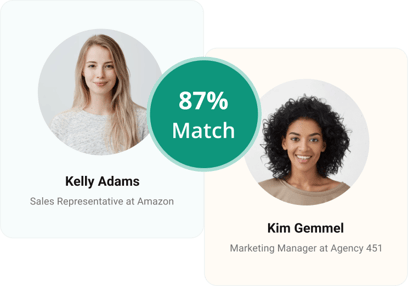
One of Qooper's most distinctive capabilities is its algorithm-driven mentor matching system, which draws on machine learning principles to pair new hires with experienced colleagues based on role, department, location, skills, interests, and career goals. When a new hire is enrolled in the organisation's employee onboarding program, Qooper can automatically assign a mentor or onboarding buddy, eliminating the guesswork and administrative overhead typically associated with manual mentoring programmes.
For HR teams, this means that structured mentoring, a proven driver of employee retention and early performance, can be delivered at scale as an integral part of the automated onboarding workflow, rather than as an ad hoc initiative that depends on individual manager discretion.
Structured 30-60-90 Day Onboarding Programs
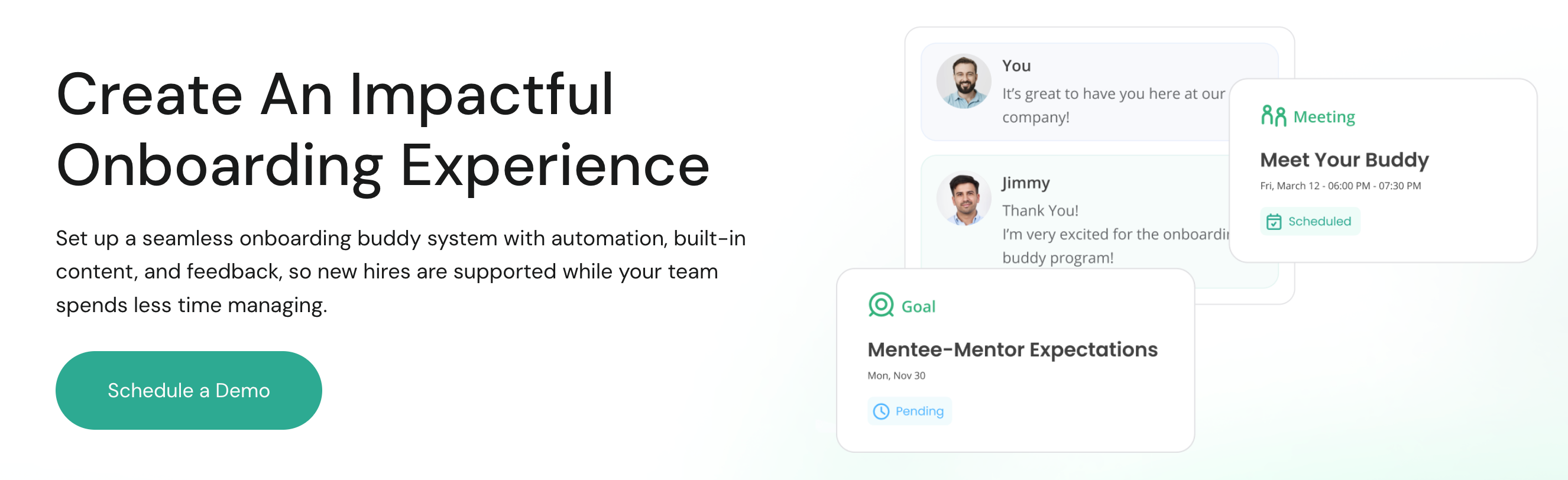
Qooper enables organisations to build structured employee onboarding programs within the platform, assigning tasks, resources, check-in prompts, and learning activities at defined intervals across the first 30, 60, and 90 days. These programs can be tailored by role, department, or seniority level, ensuring that each new hire, whether joining the Sales department, a technical team, or a customer service function, receives a relevant and personalised journey without requiring manual customisation from HR.
The platform's workflow builder allows HR and learning & development (L&D) teams to design and iterate on onboarding experiences quickly, incorporating feedback from the automated feedback system to continuously improve the employee onboarding program.
Peer Learning and Digital Community Building
Beyond formal mentoring, Qooper facilitates peer learning circles, group programs, and community-building activities that help new hires build networks across the organisation rapidly. This is particularly valuable for remote and hybrid workforces, where organic social connection, the kind that develops naturally through shared physical space, is harder to achieve, and where tools such as Slack and Zoom alone are insufficient to create genuine community.
The platform's ability to automate enrolment in these peer learning communities, based on role, location, or cohort, means that new hires are immediately connected to relevant groups without any manual effort from HR or managers. This automated connection is a meaningful differentiator in the competition for employee satisfaction and long-term retention.
Flight Risk Detection and Proactive Engagement
Qooper's analytics layer surfaces engagement metrics, mentoring activity, and programme completion data that can be used to identify at-risk new hires, those exhibiting flight risk signals such as low mentoring engagement, incomplete tasks, or declining survey scores — early in the onboarding journey. These insights enable timely intervention before disengagement crystallises into attrition.
When integrated with broader HR analytics platforms, Qooper's engagement data contributes to a holistic view of new hire health, complementing the employee data held in systems such as Workday and enriching the organisation's overall employee change management capability.
Integration With the Automated Onboarding Ecosystem
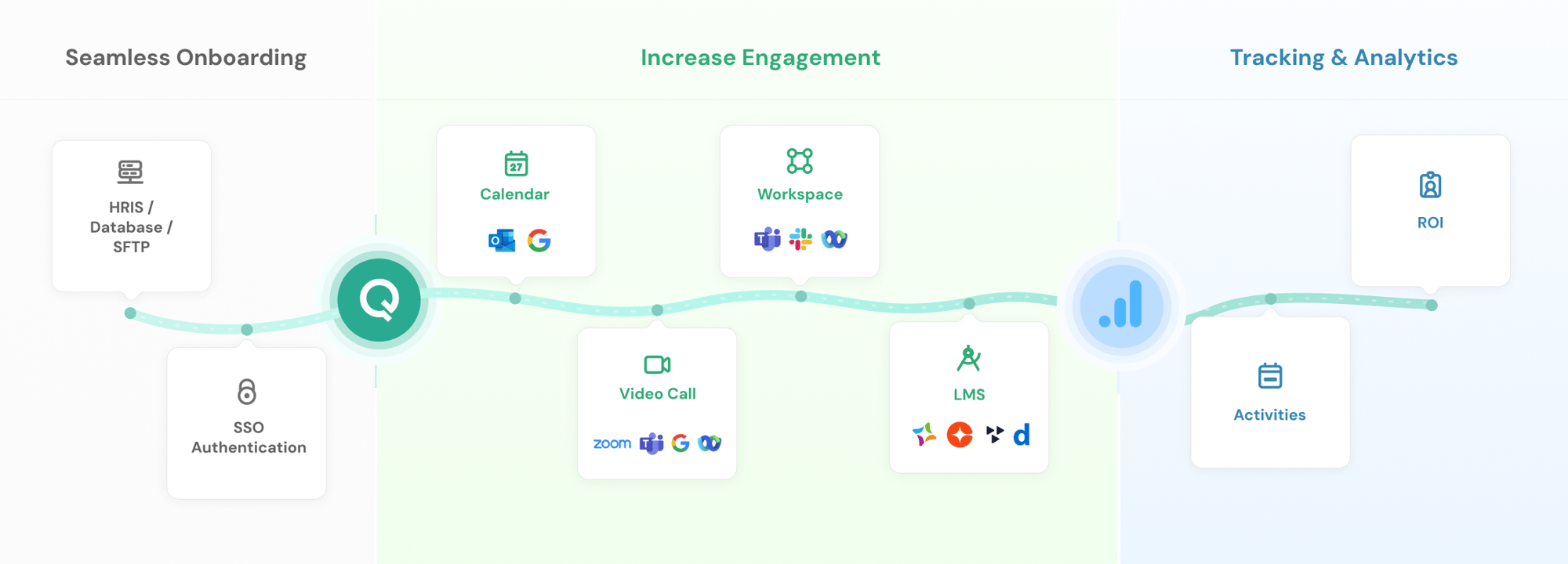
Qooper integrates with leading HRIS platforms, enabling automated enrolment in mentoring and onboarding programs as part of the broader lifecycle workflow. New hires provisioned in Workday or sourced through Greenhouse can be automatically enrolled in Qooper upon hire confirmation, ensuring that the human dimension of onboarding begins immediately alongside the administrative dimension. For more information, visit Qooper.
Implementing Automated Onboarding: A Phased Approach
Transitioning from manual to automated employee onboarding requires deliberate planning and a clear understanding of the organisation's existing HR processes, business systems, and employee data architecture. The following phased framework provides a structured approach to implementation:
- Audit the Current State: Document every task, touchpoint, and handoff in your existing onboarding process. Identify bottlenecks, data accuracy gaps, regulatory compliance failures, and points of new hire frustration. Measure baseline metrics including cost per hire, time-to-productivity, candidate satisfaction rate, and early flight risk indicators.
- Define the Desired Onboarding Experience: Articulate what an excellent onboarding experience looks like for your organisation. Determine which lifecycle workflows should be standardised and which should be personalised by role, location, or employment type. Engage stakeholders from HR, IT, the Sales department, and line management to capture requirements holistically.
- Select the Right Technology Stack: Evaluate automated onboarding platforms and workflow builders against your requirements. Assess integration capabilities with Workday, Greenhouse, Okta, Microsoft Entra, ServiceNow, Slack, Zoom, Google, and Microsoft. Consider whether a dedicated mentoring and learning platform such as Qooper would complement your core onboarding system. Evaluate AI capabilities including generative AI, machine learning, and AI agents.
- Design and Configure Lifecycle Workflows: Map each phase of the onboarding journey into automated lifecycle workflows, defining triggers, user account provisioning steps, task statuses, compliance checkpoints, feedback system touchpoints, and escalation rules. Embed regulatory compliance requirements at every relevant stage. Use a workflow builder such as Workato or ServiceNow to connect all business systems.
- Configure the Admin Center and Integration Layer: Set up the admin center to provide HR, IT, and line managers with full visibility of onboarding task statuses and employee data. Configure single sign-on and user account provisioning via Okta or Microsoft Entra. Establish the knowledge base and employee self-service portal. Test all integrations across the full ecosystem.
- Pilot, Gather Feedback, and Refine: Deploy the automated onboarding system with a pilot cohort. Use the automated feedback system to gather candidate and new hire input. Track employee satisfaction, data accuracy, and task completion rates. Refine workflows, communications, and timing based on evidence.
- Launch, Scale, and Continuously Optimise: Roll out organisation-wide, monitor KPIs on an ongoing basis, and conduct quarterly reviews to update onboarding content, adjust lifecycle workflows, and incorporate new AI and automation capabilities as the technology evolves.
Common Pitfalls to Avoid
Whilst the benefits of automated onboarding are substantial, organisations should be aware of common implementation pitfalls that undermine the value of their investment:
- Over-automating at the expense of human connection: Automation should enhance, not replace, the human elements of onboarding. Ensure that new hires have meaningful interactions with their manager, team, and HR business partner — not only through Slack messages and Zoom calls, but through structured mentoring facilitated by platforms such as Qooper.
- Poor data accuracy and system integration: An automated onboarding system is only as good as the employee data that flows through it. Invest in robust integrations between Workday, Greenhouse, Okta, and other business systems to ensure that data is accurate, consistent, and up to date at every stage of the lifecycle workflow.
- Neglecting user account provisioning timelines: Delays in provisioning user accounts, single sign-on credentials, and software tools on day one are among the most common sources of new hire frustration. Ensure that IT workflows are automated and triggered sufficiently in advance of the start date.
- Failing to personalise the employee onboarding program: A one-size-fits-all workflow system is only marginally better than a manual process. Use role, department, location, and seniority data to personalise the onboarding experience — from the knowledge base content served through the self-service portal to the mentor matched via Qooper.
- Ignoring the remote and hybrid workforce: Remote employees have distinct onboarding needs. Automated Slack introductions, Zoom orientations, and virtual peer connections through Qooper must be designed with the same intentionality as in-person programmes.
- Failing to act on flight risk signals: An automated feedback system and AI-powered analytics generate valuable early warning data about disengaging new hires. Ensure that processes exist to act on these signals — and that HR and line managers receive timely, actionable notifications through the admin center.
- Neglecting regulatory compliance verification: Automated workflows must include hard stops for regulatory compliance steps, such as right-to-work verification and data protection acknowledgements, that cannot be bypassed, regardless of business pressure to accelerate the onboarding process.
Related article: 10 Employee Onboarding Mistakes That Hurt New Hire Success
Key Takeaways
|
At a Glance: What You Will Learn From This Article
|
Conclusion
Automated employee onboarding is no longer an optional enhancement for forward-thinking organisations, it is an operational necessity for any business that wishes to attract, retain, and develop top talent in a competitive labour market. By replacing manual, inconsistent HR processes with intelligent lifecycle workflows, enterprise automation, and AI-powered digital workforce tools, companies can deliver a superior onboarding experience, reduce cost per hire, ensure regulatory compliance, and generate measurable improvements in employee retention and employee satisfaction.
The integration of enterprise platforms, Workday, Greenhouse, Okta, Microsoft Entra, ServiceNow, Workato, Slack, Zoom, Google, and Microsoft, into a connected automated onboarding ecosystem ensures that employee data flows accurately, user accounts are provisioned securely, and task statuses are visible to all stakeholders from day one. The addition of generative AI, machine learning, AI agents, and robotic process automation elevates the function from workflow management to intelligent digital workforce orchestration.
Platforms such as Qooper address the critical human dimension that purely administrative tools often overlook, ensuring that new hires not only receive the right forms, training, and software tools, but also the right connections, guidance, and community to thrive from the very beginning of their tenure.
Frequently Asked Questions (FAQs)
What is the difference between automated onboarding and digital onboarding?
Digital onboarding refers broadly to the use of digital tools — online portals, electronic document signing, or Zoom-based orientation sessions — to deliver onboarding tasks. Automated employee onboarding is more specific: it refers to the use of a workflow system to trigger, sequence, and manage these tasks without manual intervention. All automated onboarding is digital, but not all digital onboarding is automated. The key differentiator is whether lifecycle workflows execute autonomously or require human initiation.
How does automated onboarding integrate with Workday, Greenhouse, and Okta?
Modern onboarding platforms connect to Workday (HRIS), Greenhouse (ATS), and Okta (identity management) via APIs or integration platforms such as Workato or ServiceNow. When a candidate is hired in Greenhouse, data flows automatically to Workday and triggers the onboarding workflow system. Okta or Microsoft Entra then provisions user accounts and single sign-on credentials automatically, while Slack, Zoom, Google, and Microsoft access is configured in parallel — all without manual intervention from HR or IT.
What role does generative AI play in automated employee onboarding?
Generative AI is increasingly embedded in automated onboarding platforms to personalise communications, power conversational chatbots within the knowledge base, generate role-specific onboarding content, and produce dynamic responses to new hire queries. Combined with machine learning-based flight risk detection and AI agents capable of autonomously executing multi-step onboarding tasks, generative AI is transforming the onboarding experience from a static workflow into an adaptive, intelligent digital journey. Organizations can also use an AI humanizer to refine AI-generated onboarding content, helping communications sound more natural and aligned with the company’s tone.
How does Qooper fit into an automated onboarding strategy?
Qooper serves as the mentoring, peer learning, and structured development layer within a broader automated onboarding ecosystem. Whilst core platforms manage lifecycle workflows, employee data, user account provisioning, and regulatory compliance, Qooper ensures that new hires are connected to mentors, peer communities, and structured 30-60-90 day onboarding programs that drive long-term employee satisfaction and employee retention. Qooper integrates with HRIS platforms including Workday, enabling automated enrolment as part of the lifecycle workflow.
What metrics should organisations track to measure onboarding effectiveness?
Key performance indicators for automated onboarding include: cost per hire, time-to-productivity, employee retention at 30/60/90 days and one year, employee satisfaction scores, candidate satisfaction rate, onboarding task completion rates, data accuracy rates across business systems, flight risk indicators from the feedback system, and regulatory compliance completion rates. Establishing a baseline before implementation and tracking these metrics consistently enables clear demonstration of ROI.
How does automated onboarding handle regulatory compliance?
Automated onboarding systems embed regulatory compliance requirements directly into lifecycle workflows as mandatory checkpoints that cannot be bypassed. Right-to-work verification, data protection acknowledgements, sector-specific certifications, and policy sign-offs are assigned automatically, tracked in the admin center, and escalated if incomplete. Security protection measures — including proper user account configuration and single sign-on provisioning via Okta or Microsoft Entra — are applied consistently. All actions are logged for audit purposes, supporting both internal governance and external regulatory review.
What is the role of robotic process automation (RPA) in employee onboarding?
Robotic process automation handles the repetitive, rules-based tasks that would otherwise require manual data entry — such as extracting employee data from an ATS such as Greenhouse and populating fields in Workday, or triggering user account creation in the admin center. RPA operates at the system level, executing these tasks with speed and precision that eliminates human error and improves data accuracy. In a mature automated onboarding architecture, RPA works alongside AI agents and generative AI to form a comprehensive digital workforce layer.
Is automated onboarding suitable for small and medium-sized businesses (SMBs)?
Absolutely. Whilst large enterprises benefit from the scalability of automated onboarding across complex multi-system environments, SMBs often derive proportionally greater value — particularly in terms of reducing the administrative burden on small HR teams, improving data accuracy, and ensuring consistent employee experiences as the organisation grows. Many platforms offer tiered pricing and simplified workflow builders that make enterprise automation capabilities accessible without requiring a developer instance or dedicated IT resource.
How does automated onboarding support remote and hybrid employees?
Automated onboarding is particularly well-suited to distributed workforces. Lifecycle workflows deliver structured onboarding experiences digitally — including Slack introductions, Zoom orientation sessions, self-service portal access, and knowledge base resources — ensuring that remote new hires receive an equivalent quality of experience to their in-office counterparts. Platforms such as Qooper further strengthen remote onboarding by automating mentor matching and peer community enrolment, compensating for the absence of organic in-person connection.
What is the difference between a workflow builder and a developer instance in onboarding automation?
A workflow builder is a low-code or no-code interface that allows HR and IT teams to design, configure, and deploy automated lifecycle workflows without writing code — platforms such as Workato and ServiceNow offer this capability. A developer instance, by contrast, is a dedicated technical environment used by software engineers to build, test, and customise integrations and automations at a deeper level. For most organisations, a workflow builder is sufficient to implement comprehensive automated onboarding; a developer instance becomes relevant when building highly bespoke integrations between proprietary business systems.
%20(1)-1.png)