



 ·
22 minute read
·
22 minute read
Every organization invests significant time, budget, and energy in the recruiting process, from attracting candidates through every touchpoint on the company website and job page, to conducting interviews, running background checks, and extending offers. Yet for many organizations, that investment is systematically undermined by avoidable failures that occur in the weeks immediately following a new hire's start date.
The onboarding process is where the promise made during recruitment is either confirmed or contradicted. When it goes wrong, the consequences are measurable and severe: elevated 90-day turnover, disengaged employees who stay but underperform, and a damaged employer brand that raises future recruitment costs. When employee onboarding programs are designed and executed well, they produce employees who reach productivity faster, remain with the organization longer, and become genuine advocates for the company's culture and mission.
This article identifies the ten most consequential employee onboarding mistakes that HR teams, managers, and organizational leaders make, and provides practical, evidence-based guidance on how to correct each one. For each mistake, we also highlight how purpose-built solutions like Qooper's digital onboarding platform provide the structural support required to eliminate these errors at scale.
TL;DR
|
The ten most damaging employee onboarding mistakes are: skipping preboarding, overloading the first day, failing to assign an onboarding buddy, neglecting cultural and values-based orientation, providing no 30-60-90 day plan, underinvesting in training and skills development, collecting feedback too infrequently, treating onboarding as a one-time event, providing inadequate technology support, and ignoring the distinct needs of remote and hybrid employees. Each mistake is preventable with the right onboarding strategy, structured automation, integrated feedback mechanisms, and peer support. Qooper's digital onboarding platform addresses all ten by combining intelligent buddy matching, automated workflows, configurable feedback tools, real-time performance dashboards, and seamless integration with existing HR software and employee training platforms. |
Why This Matters
Research from the Society for Human Resource Management estimates that replacing an employee costs between 50% and 200% of their annual salary. The majority of preventable departures occur within the first 90 days and in most cases, the root cause can be traced directly to one or more of the onboarding mistakes described below. There are fool-proof ways to prevent this: structured onboarding strategy, the right digital tools, and consistent human support throughout the employee journey.
|
88% of employees say onboarding is ineffective Despite significant investment in recruiting, most organizations fail to deliver a structured, supportive onboarding experience, with direct consequences for employee satisfaction, performance, and 90-day turnover. |
|
Only 12% of employees feel their company does onboarding well Gallup research shows that the vast majority of new employees leave their orientation and first weeks feeling underprepared, unsupported, and underconnected, a clear signal that systemic onboarding mistakes are the norm, not the exception. |
|
Organizations with strong onboarding improve new hire retention by 82% The inverse is equally true: organizations that fail to correct common onboarding mistakes see dramatically higher candidate ghosting rates on start dates, early voluntary departure, and compounding recruitment costs. |
The 10 Most Damaging Employee Onboarding Mistakes
The following mistakes are not rare edge cases, they are endemic to organizations of all sizes and sectors. Each one has a documented impact on the employee experience, and each is entirely preventable with the right onboarding strategy, tools, and commitment to continuous improvement.
Mistake #1: Skipping or Rushing Preboarding |
What Goes WrongPreboarding is the period between a new hire's acceptance of their offer and their official first day. Most organizations waste this window entirely, leaving new employees to spend several weeks with no communication from their future employer beyond a calendar invite. The result is a combination of anxiety, second-guessing, and in the worst cases, candidate ghosting, where the new hire accepts a competing offer before their start date because they perceive a lack of employee engagement from their new organization. Incomplete preboarding also means that workstations are unprepared, system access is delayed, employee documents are missing, and compliance checklist items are left incomplete — creating a chaotic first day that immediately undermines the new hire's confidence in their decision to join. |
How to Fix ItInvest in a structured preboarding sequence that begins the day the offer is accepted and continues until the first day. This should include a welcome message from the hiring manager or HR team, delivery or setup instructions for a welcome kit, early completion of payroll enrollment, benefits enrollment, and compliance checklist items, and advance access to digital handbooks, the onboarding portal, and any employee onboarding software the organization uses. Introducing the new hire to their onboarding buddy or mentor during preboarding, even through a brief message via your automation platform, has been shown to significantly reduce candidate ghosting and first-week anxiety. |
Qooper Feature SpotlightQooper enables organizations to trigger automated preboarding workflows the moment a new hire is added to the system. Onboarding buddies can be matched and introduced before the first day, welcome communications can be scheduled in advance, and new hires can complete early-stage onboarding checklist items through the platform's onboarding portal, all without requiring manual HR coordination for each individual new hire. |
Mistake #2: Overloading New Employees on the First Day |
What Goes WrongThe first day of a new role should establish psychological safety, excitement, and a sense of welcome. Instead, many organizations treat it as an administrative processing event: new employees spend their entire first day completing forms, navigating the HR system, setting up workstations, completing user verification, processing employee benefits documentation, and sitting through back-to-back orientation sessions that generate cognitive overload rather than genuine engagement. By the end of the day, the new hire feels overwhelmed, exhausted, and no more connected to the company culture or their team than they were before they arrived. Research consistently shows that cognitive overload in the first days correlates directly with reduced knowledge retention and lower employee satisfaction scores at the 30-day mark. |
How to Fix ItRedesign the first day experience to balance necessary administrative tasks with meaningful human connection. Administrative tasks, payroll setup, compliance training, benefits enrollment, workstation configuration, should be distributed across the preboarding period and the first week, not compressed into a single day. The first day should prioritize introductions, a welcome from direct leadership, a walkthrough of the team's workflow and immediate priorities, time with the onboarding buddy, and an initial review of the 30-60-90 day plan. Using a digital onboarding platform to manage the sequencing of first-day and first-week tasks prevents cognitive overload while ensuring nothing is missed. |
Qooper Feature SpotlightQooper's platform structures the onboarding journey into sequenced phases, distributing tasks, training sessions, and milestone check-ins across the full onboarding window rather than front-loading them. Administrators can configure which activities appear at each stage of the employee journey, ensuring that first-day experiences are welcoming and human-centered while compliance, training modules, and administrative processes are completed in a structured, manageable cadence. |
Mistake #3: Failing to Assign a Dedicated Onboarding Buddy |
What Goes WrongOne of the most well-evidenced interventions available to HR teams is the assignment of a dedicated onboarding buddy — a peer-level colleague who serves as the new hire's primary point of informal support during the onboarding period. Despite overwhelming evidence of its effectiveness, many organizations still leave new employees to find their own social footing, relying on the goodwill of their immediate team members or the availability of their manager for informal guidance. This absence of structured peer support is a primary driver of early isolation, cultural disconnection, and the communication gaps that lead to early voluntary departure. |
How to Fix ItEvery new employee should be assigned a dedicated onboarding buddy before their first day, and that assignment should be communicated to both parties with clear expectations, a structured activity framework, and access to reference materials that guide the buddy relationship through the onboarding window. The buddy relationship should be explicitly positioned as distinct from both the manager support role and formal mentors, it is a peer-to-peer connection designed to provide informal guidance, social integration, and a safe channel for the questions new hires are hesitant to raise with authority figures. |
Qooper Feature SpotlightQooper's intelligent matching algorithm pairs new hires with the most compatible onboarding buddies based on role alignment, complementary skills, personality profiles, and organizational structure. Both parties receive automated activity guides, conversation prompts, and milestone check-ins through the platform, ensuring the buddy relationship is productive, consistent, and measurably effective without requiring manual HR coordination for every pairing. |
Mistake #4: Neglecting Cultural and Values-Based Orientation |
What Goes WrongMany onboarding programs are heavily weighted toward compliance and administrative processes at the expense of cultural immersion. New employees complete their compliance checklist, receive their digital handbooks, and attend a brief session on company policies — but they leave orientation with little genuine understanding of the company's culture, core values, company mission, or organizational culture. This cultural deficit becomes apparent within the first few weeks as new hires struggle to interpret behavioral norms, make judgment calls that align with what the company actually values, or explain to external parties what makes their new employer distinctive. In remote and hybrid organizations, where informal cultural transmission through physical proximity is unavailable, this deficit is even more damaging. |
How to Fix ItCultural and values-based orientation should be a deliberate, structured component of every onboarding program, not an afterthought appended to the compliance checklist. This means dedicating time in the first week to discussing the company mission, core values, and corporate culture in practical, behavior-level terms. It also means connecting new hires with employees across different parts of the organization who can illustrate how the company's culture and organizational structure shape their daily work. Onboarding buddies, structured mentors & buddies programs, and team bonding activities all contribute to cultural transmission in ways that formal presentations cannot. When new hires feel blocked from understanding the unwritten cultural norms that govern day-to-day decisions, they become disengaged long before any formal performance issue surfaces. |
Qooper Feature SpotlightQooper enables administrators to embed culture and values-based content directly into the onboarding journey as structured conversation guides, curated resource collections, and milestone activities. Buddies can be prompted to cover specific cultural topics at defined intervals, ensuring that cultural orientation is delivered consistently across all new hire cohorts, not just those lucky enough to be placed with a particularly engaged manager. |
Mistake #5: Providing No Clear 30-60-90 Day Performance Framework |
What Goes WrongAmbiguity about performance expectations is one of the leading predictors of early disengagement. When new employees lack a clear 30-60-90 day plan that defines what success looks like at each milestone, including specific performance metrics, skill development targets, and workflow integration goals, they default to measuring their own progress against vague, self-generated standards. This misalignment between what the organization considers adequate early performance and what the new hire perceives as acceptable creates the conditions for both micromanaging managers who are frustrated by apparent under-performance and new hires who feel their efforts are neither recognized nor rewarded. Performance management without a structured framework is not management at all, it is reactive supervision. |
How to Fix ItBefore or on the first day, every new hire should receive a documented 30-60-90 day plan co-created by the hiring manager and HR team. This plan should specify performance targets for each phase, identify the training programs and training modules required to reach those targets, and outline the check-in cadence for performance evaluation and feedback surveys. The plan should also include explicit guidance on how the new hire's progress will be assessed, which performance management dashboards or performance appraisal tools will be used, and who is responsible for providing performance coaching throughout the onboarding window. |
Qooper Feature SpotlightQooper allows program administrators to configure and deploy customized 30-60-90 day plan templates for each role and department. Progress against goals is tracked within the platform, and managers receive automated milestone alerts that prompt timely performance conversations. This creates a shared performance management framework that keeps both the new hire and their manager aligned throughout the onboarding period. |
Mistake #6: Underinvesting in Training and Skills Development |
What Goes WrongOnboarding training that is limited to compliance requirements and basic orientation sessions leaves a significant capability gap. New employees need access to role-specific training programs, skills based training aligned to their immediate responsibilities, and a structured pathway through the learning technologies and training modules available within the organization. When training is incomplete, poorly sequenced, or delivered through outdated video platforms or static PDFs without a curated video training library or interactive e-learning, new hires take longer to reach productivity, make more errors, and experience higher levels of frustration with their inability to perform at the level they were hired for. Upskilling and learning processes that begin at onboarding, rather than being deferred to post-probationary development programs, produce measurably superior performance outcomes at the 90-day mark. |
How to Fix ItDesign a training architecture that extends throughout the full onboarding window and goes beyond compliance. This means mapping the new hire's training needs against their role requirements, identifying the specific training sessions, training modules, and learning technologies they need access to, and providing a structured sequence for completing them. For organizations with multilingual workforces, providing resources for learning a new language relevant to business communication is an often-overlooked component of comprehensive onboarding training. Blended learning approaches that combine synchronous training sessions with self-directed modules through employee training platforms, or e-learning platforms, produce the strongest knowledge retention outcomes. |
Qooper Feature SpotlightQooper integrates with leading learning management systems and employee training platforms, enabling training completions to be tracked alongside buddy program milestones in a single dashboard. Administrators can configure training modules as required steps within the onboarding journey, and buddies can be assigned to support new hires through specific training programs, particularly skills based training that benefits from peer context and reinforcement. |
Mistake #7: Collecting Feedback Too Infrequently or Not at All |
What Goes WrongOnboarding programs that rely on a single exit survey or annual employee lifecycle surveys to assess new hire satisfaction are operating on dangerously lagged data. By the time a dissatisfied new hire completes a formal performance review, they have often already made the decision to leave. Continuous feedback mechanisms, including pulse surveys, pulse polls, feedback forms, and structured check-ins, are the only reliable way to detect dissatisfaction, confusion, or disengagement early enough to intervene effectively. Organizations that also rely on people data from performance metrics and feedback platform analytics can identify patterns across entire cohorts, enabling systemic program improvements rather than one-off reactive adjustments. |
How to Fix ItImplement a multi-layered feedback strategy that operates throughout the onboarding window. This should include: a pulse survey at the end of the first week to capture first-day and first-week impressions; structured feedback forms at the 30, 60, and 90-day marks that assess role clarity, manager support, cultural integration, and training effectiveness; ongoing pulse polls embedded within the onboarding platform; and informal feedback loops through the onboarding buddy relationship. Feedback data should be surfaced in performance management dashboards and reviewed by HR at regular intervals, with actions taken and communicated back to employees to demonstrate that their input is valued. |
Qooper Feature SpotlightQooper provides integrated feedback mechanisms, including configurable feedback surveys, pulse polls, and milestone check-in prompts, that are delivered automatically at defined points in the onboarding journey. Survey responses and engagement data feed directly into the platform's reporting dashboard, giving HR teams and managers real-time visibility into new hire sentiment and enabling data-driven decisions about program adjustments. |
Mistake #8: Treating Onboarding as a One-Time Event Rather Than a Journey |
What Goes WrongPerhaps the most pervasive onboarding mistake is conceptual: treating the onboarding process as a discrete event that ends after the first week or the completion of the orientation checklist, rather than a structured employee journey that extends across the full onboarding window. When onboarding ends prematurely, new employees are left to navigate the complex, ambiguous middle period of their first months, after the initial novelty has faded but before they have reached genuine competence and confidence, without structured support. This is the period when disengagement most commonly takes root, and when the absence of a 30-60-90 day plan, regular manager check-ins, continued access to mentorship programs, and ongoing training becomes most costly. |
How to Fix ItReframe onboarding as an extended employee journey that encompasses preboarding, the first day, the first 30 days, the 60-day mark, and the 90-day milestone — each with defined activities, check-ins, and success criteria. Consider implementing re-onboarding processes for employees who transition into new roles internally, as they face many of the same integration challenges as external hires. For organizations adopting new tools, software, or workflows at scale, targeted re-onboarding programs ensure that the change adoption curve does not generate the same disengagement risks as initial onboarding failures. |
Qooper Feature SpotlightQooper is specifically designed to support the full employee journey from preboarding through the 90-day milestone and beyond. The platform's configurable program templates allow administrators to define activities, feedback surveys, training milestones, and buddy check-ins at every phase of the onboarding window. Re-onboarding programs for role transitions and internal mobility can be set up as distinct program tracks within the same platform, ensuring consistent program quality across the entire employee lifecycle. |
Mistake #9: Inadequate Technology and Systems Support |
What Goes WrongNew employees who cannot access their workstations, log in to required software, complete user verification for internal tools, or navigate an unintuitive onboarding portal on their first day experience an immediate and lasting erosion of confidence. When employee onboarding software is poorly configured, when there is malformed data in HR systems that blocks access, or when compliance checklist items are buried in confusing interfaces with unclear drop-downs and unchecked checkboxes, the administrative friction of joining the organization becomes a proxy for the organization's overall competence and culture. Platforms like Click Boarding and Enboarder have established that the quality of the digital onboarding experience directly correlates with early employee satisfaction scores. Organizations that fail to invest in a coherent, well-configured employee onboarding software stack signal to new hires that their experience was not considered a priority. |
How to Fix ItAudit the new hire's digital onboarding experience from the perspective of someone encountering it for the first time. Map every step a new employee must complete from offer acceptance through the end of their first month, including workstation setup, user verification, HR system login, benefits enrollment through your professional employer organization or internal HR team, security service and security solution setup to protect against online attacks, and all compliance and payroll-related tasks. Every point of friction — whether caused by malformed data, poorly designed drop-downs, or unclear checkboxes in employee documents, should be identified and eliminated. The goal is a seamless, intuitive onboarding journey that reflects the same quality of experience the organization aspires to deliver to its customers as a site owner of its own employer brand. |
Qooper Feature SpotlightQooper's onboarding portal is designed for immediate accessibility and intuitive user experience. Integration with HRIS platforms, payroll systems, and compliance tools ensures that employee data flows cleanly between systems, reducing the risk of malformed data and administrative blockages. New hires can access their full onboarding checklist, training modules, feedback forms, and buddy communications from a single, mobile-friendly interface, eliminating the fragmented, multi-system experience that so commonly undermines the early employee experience. |
Mistake #10: Ignoring the Unique Needs of Remote and Distributed New Hires |
What Goes WrongOrganizations that design their onboarding process exclusively around the in-office experience and then deploy it without modification to remote employees, hybrid teams, and globally distributed organizational teams are making a systematic error with predictable consequences. Remote new employees face a fundamentally different set of integration challenges than their in-office counterparts: they cannot observe workplace norms organically, they depend entirely on digital tools for every interaction, and they are significantly more susceptible to the communication disconnects and isolation that drive early disengagement. Applying a one-size-fits-all onboarding checklist to employees in a Workweek that is entirely virtual and distributed will consistently produce lower employee satisfaction and higher 90-day turnover than programs designed with the remote employee's journey explicitly in mind. |
How to Fix ItDesign a dedicated virtual onboarding program track that addresses the specific needs of remote and hybrid new hires. This means introducing the onboarding buddy relationship on the first day rather than the first week, scheduling structured virtual team bonding activities and informal social calls in addition to work-related check-ins, providing clear guidance on collaboration tools, communication expectations, and the specific workflow norms that govern the team's virtual work, and ensuring that all training sessions and training modules are accessible through video platforms and e-learning platforms that function reliably in distributed environments. For organizations managing global teams, artificial intelligence-powered matching and multilingual platform support are increasingly important components of a modern, inclusive digital onboarding platform. Invest in HR tools built for remote teams to ensure all parts of the employee experience from onboarding to payroll are maintained. |
Qooper Feature SpotlightQooper's platform is purpose-built for distributed and hybrid workforces. The platform's artificial intelligence-driven matching algorithm optimizes buddy pairings for remote and hybrid contexts, accounting for time zone compatibility, communication style preferences, and role relevance. Integration with video platforms, collaboration tools, and the Workweek tools remote teams rely on ensures that the buddy relationship and structured onboarding activities translate seamlessly into the virtual work environment. |
Building a Mistake-Proof Employee Onboarding Strategy
Avoiding these ten mistakes is not a matter of working harder within an existing onboarding framework, it requires rethinking the onboarding strategy from the ground up. The following principles provide a practical foundation for designing an onboarding program that is structurally resistant to the most common failure modes.
Start With a Complete Onboarding Checklist Mapped to the Employee Journey
Every organization should maintain a master onboarding checklist that maps every required action, from preboarding communications and compliance checklist items to 90-day performance evaluations, against a defined timeline. This checklist should distinguish between what must be completed before the first day, on the first day, in the first week, at the 30-day mark, and at the 60- and 90-day milestones. It should also identify which organizational teams are responsible for each item, and which elements of the employee onboarding software or automation platform will be used to deliver, track, and verify completion.
Leverage Automation Without Losing the Human Element
Modern employee onboarding software and automation platforms have made it possible to eliminate most of the manual administrative overhead that has historically consumed HR bandwidth during the onboarding process. Tasks such as sending welcome communications, scheduling training sessions, delivering feedback forms, and tracking onboarding checklist completion can all be handled through an automation platform without requiring individual HR action for each new hire. However, automation should be applied to operational tasks, not to human connection. The onboarding buddy relationship, manager check-ins, performance coaching conversations, and cultural orientation activities must remain genuinely human, with technology serving as the enabler rather than the replacement.
Design for the Organizational Structure, Not Against It
Effective onboarding programs account for the specific organizational structure of the company, including reporting lines, cross-functional dependencies, and the informal networks that actually drive how work gets done. New hires who understand the organizational structure early are faster to identify the right people to contact, more effective at navigating internal approval workflows, and more confident in their initial contributions. Onboarding buddies are particularly well-suited to conveying this structural understanding informally, as they can explain the practical reality of the organizational structure in ways that official documentation rarely captures.
Use Data to Drive Continuous Improvement
The most effective onboarding programs treat data as a first-class input to program design. Onboarding metrics, performance metrics from the 30-60-90 day plan, feedback survey responses, pulse survey results, and early performance appraisal data should all be reviewed on a regular cadence and used to identify where the program is succeeding and where it is generating the friction, confusion, or dissatisfaction that precedes early turnover. Platforms that surface people data in performance management dashboards, showing which cohorts, roles, or departments are experiencing the greatest onboarding challenges, make it possible to take targeted, evidence-based corrective action.
Commit to Re-Onboarding as a Retention Strategy
Re-onboarding, delivering a structured, refreshed onboarding experience to employees who move into new roles, take on significantly expanded responsibilities, or return from extended leave, is one of the most underutilized retention tools available to HR teams. The same mistakes that hurt new hires in their first months can recur at role transition points: unclear expectations, absent manager support, insufficient training, and loss of the peer connection that the original onboarding buddy provided. Organizations that implement re-onboarding as a standard practice for role transitions report higher internal mobility rates, stronger employee satisfaction at transition points, and meaningfully lower turnover among their experienced workforce.
How Qooper Helps Organizations Eliminate These Onboarding Mistakes
Each of the ten mistakes described in this article shares a common structural root: the absence of the right combination of process design, human support, and enabling technology. Qooper's digital onboarding platform is built to address all three dimensions simultaneously — providing the infrastructure that organizations need to deliver a consistently excellent employee onboarding experience at any scale.
Intelligent Matching That Starts Before Day One

Qooper's smart matching algorithm pairs every new hire with the most compatible onboarding buddy before the first day, eliminating the isolation and social ambiguity that characterize the first week for new employees in programs without dedicated peer support. Matching criteria include role alignment, complementary skills, personality compatibility, communication preferences, time zone, and language, ensuring that every pairing has a strong foundation for a productive and supportive relationship.
Automated Workflows Across the Full Onboarding Window
The platform's automation capabilities eliminate the manual coordination overhead that causes onboarding programs to deteriorate under volume. Preboarding communications, welcome kit notifications, training module assignments, feedback survey delivery, milestone check-in reminders, and performance target reviews are all triggered automatically based on the new hire's start date and program stage. This automation ensures that every new employee receives a consistent, complete onboarding experience regardless of which HR representative, manager, or onboarding coordinator is responsible for their cohort.
Integrated Feedback Loops and Performance Visibility

Qooper's feedback mechanisms, including configurable pulse surveys, structured feedback forms, and milestone satisfaction check-ins, provide continuous, real-time visibility into new hire sentiment. Feedback data is aggregated into the platform's reporting dashboard alongside participation rates, training completion tracking, and 30-60-90 day plan progress. This unified view of people data enables HR teams and managers to identify at-risk employees early and take targeted corrective action before dissatisfaction escalates to departure.
Seamless Integration With Your Existing HR Technology Stack
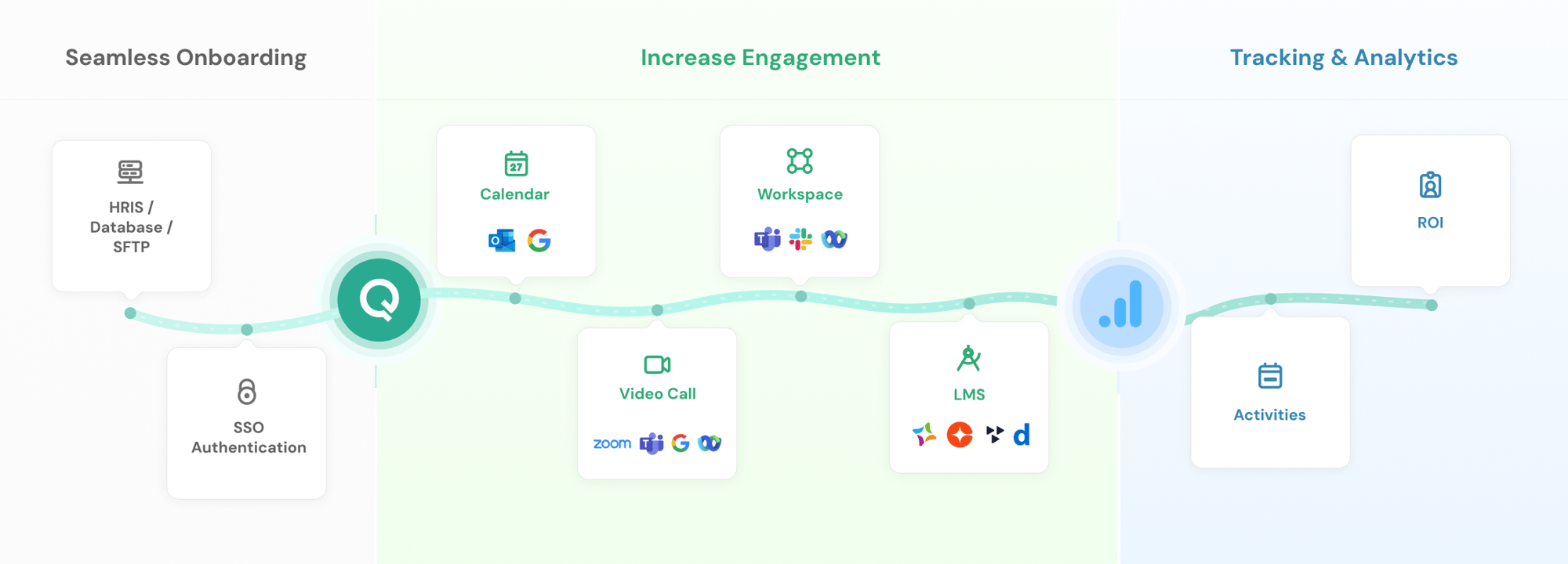
Qooper integrates with the HR software, HRIS platforms, employee training platforms, payroll systems, learning management systems, and collaboration tools that organizations already rely on, including Microsoft Teams, Slack, Google Workspace, Zoom, and leading professional employer organization platforms. This integration eliminates the data silos, malformed data risks, and fragmented employee experience that emerge when onboarding is managed across disconnected systems. New hire profiles, training completion records, and compliance checklist data flow seamlessly between Qooper and connected platforms, maintaining data integrity throughout the onboarding process.
Scalable, Configurable, and Immediately Deployable
Unlike enterprise HRIS platforms that require months of implementation, Qooper can be configured and launched in under three hours by HR administrators without engineering support. The platform supports organizations of all sizes, from fast-growing startups managing their first structured onboarding program to large enterprises running simultaneous cohorts across multiple geographies and organizational teams. Program templates can be customized by department, role level, or work arrangement, ensuring that the digital onboarding platform delivers a relevant, high-quality experience for every new hire regardless of where or how they work.
Qooper in PracticeOrganizations using Qooper report measurable improvements across the core onboarding metrics that these ten mistakes most directly damage: higher 30-day and 90-day employee satisfaction scores, reduced 90-day turnover rates, faster time to productivity, and stronger early-stage employee engagement. The platform's combination of intelligent matching, automated workflows, integrated feedback mechanisms, and real-time reporting makes it one of the most comprehensive digital onboarding platforms available to HR teams today. |
Key Takeaways
- Preboarding is the most underutilized tool for preventing candidate ghosting and first-day unpreparedness. A structured preboarding sequence, beginning the day the offer is accepted, covering benefits enrollment, payroll setup, digital handbooks, and early onboarding buddy introductions, sets the tone for the entire employee journey.
- The first day should be human-centered, not process-heavy. Cognitive overload on day one correlates directly with lower knowledge retention and reduced employee satisfaction at the 30-day mark. Administrative tasks should be distributed across the preboarding period and first week using an automation platform.
- The onboarding buddy is the most impactful single intervention available to HR teams. New employees assigned a dedicated onboarding buddy report 23% higher satisfaction and reach productivity measurably faster than those without peer support — making it one of the most ROI-positive components of any onboarding strategy.
- Cultural orientation must be deliberate and structured. Company mission, core values, corporate culture, and organizational structure cannot be conveyed through an employee handbook alone. They require conversation, mentorship, team bonding activities, and consistent reinforcement throughout the onboarding window.
- A documented 30-60-90 day plan eliminates the ambiguity that drives early disengagement. Every new hire should know their performance targets, what training programs and training modules they need to complete, which performance management dashboards will be used for evaluation, and what success looks like at each milestone.
- Training is not a first-week event, it is a multi-month program. Onboarding training should include skills based training, access to e-learning platforms and employee training platforms, blended learning pathways, and mentorship programs that support knowledge retention and upskilling across the full onboarding window.
- Feedback must be continuous. Pulse surveys, pulse polls, feedback forms, feedback platform analytics, and people data from performance management dashboards should all be active throughout the onboarding process, not just at the end of the first month. Organizations that detect dissatisfaction early save on recruitment costs and preserve employee engagement.
- Onboarding is a journey, not an event. New hire support should continue through the 90-day milestone and beyond, and re-onboarding should be available for role transitions and internal mobility, the same mistakes that hurt new employees at initial onboarding recur at transition points if left unaddressed.
- Technology quality directly shapes the employee experience. Poorly configured employee onboarding software, malformed data in HR systems, unintuitive onboarding portals, and fragmented compliance checklist processes signal organizational dysfunction to new hires before they have completed their first week.
- Remote employees need a dedicated onboarding strategy. A standard onboarding checklist deployed unchanged to distributed organizational teams will consistently produce lower employee satisfaction and higher 90-day turnover. Virtual onboarding programs, supported by artificial intelligence-powered matching, collaboration tools, and video platforms, are essential for organizations operating in any hybrid or fully remote work arrangement.
Conclusion
The ten onboarding mistakes described in this article are not unusual failures — they are the predictable outcomes of onboarding programs designed without sufficient attention to the full employee journey, the structural needs of new hires, or the enabling technology required to deliver a consistent, high-quality experience at scale.
Skipping preboarding, overloading the first day, failing to assign an onboarding buddy, neglecting cultural orientation, leaving new hires without a 30-60-90 day plan, underinvesting in training, collecting feedback too infrequently, treating onboarding as a one-time event, providing inadequate technology support, and ignoring the distinct needs of remote employees, each of these mistakes is individually costly and collectively catastrophic for employee retention, performance, and organizational culture.
The good news is that every one of these mistakes is correctable. With the right onboarding strategy, a structured onboarding checklist that spans the full onboarding window, dedicated peer support through an onboarding buddy program, and a digital onboarding platform like Qooper that automates operational tasks while keeping the human connection at the center of the experience, organizations can transform their onboarding process from a source of attrition risk into one of their most powerful competitive advantages in the market for talent.
Frequently Asked Questions
What are the most common onboarding mistakes that lead to early employee turnover?
The most common onboarding mistakes that directly drive 90-day turnover are: the absence of a preboarding sequence that bridges the gap between offer acceptance and the first day; failure to assign a dedicated onboarding buddy who provides peer-level social and informational support; lack of a documented 30-60-90 day plan with clear performance targets and feedback survey check-ins; and poor digital onboarding experiences caused by inadequate employee onboarding software, malformed data in HR systems, or confusing compliance checklist interfaces. Any one of these mistakes in isolation elevates early turnover risk, the presence of multiple simultaneously compounds the damage significantly.
How important is the first day experience in the onboarding process?
The first day experience has a disproportionate impact on new hire perceptions that can take weeks or months to correct. Research consistently shows that first day impressions, whether positive or negative, shape the new employee's confidence, sense of belonging, and early performance trajectory. A first day characterized by cognitive overload, unprepared workstations, delayed system access, and back-to-back orientation sessions rather than genuine human connection is one of the strongest predictors of early disengagement. Conversely, a first day that balances necessary administrative tasks with a warm welcome, an introduction to the onboarding buddy, and a clear overview of the 30-60-90 day plan establishes the psychological safety new employees need to integrate quickly and effectively.
What should a comprehensive onboarding checklist include?
A comprehensive onboarding checklist should span the full employee journey from preboarding through the 90-day milestone. The preboarding phase should cover: offer documentation and employee documents, compliance checklist completion, payroll enrollment and benefits enrollment, security service and security solution setup to protect against online attacks, welcome kit delivery, workstation and access provisioning, digital handbooks access, and onboarding buddy introduction. The first day should cover team introductions, manager support meeting, company culture and core values overview, and platform orientation. The first-week phase should include initial training sessions and training modules, 30-60-90 day plan review, and first pulse survey. The 30-, 60-, and 90-day milestones should each include structured feedback surveys, performance appraisal check-ins against defined performance metrics, and buddy or mentorship program progress reviews.
How does automation improve the employee onboarding experience?
An automation platform applied to the onboarding process eliminates the manual coordination errors, missed check-ins, and inconsistent communication that are among the leading causes of onboarding failure. Specifically, automation ensures that: every new hire receives their preboarding communications at the right time regardless of HR team bandwidth; feedback forms and pulse surveys are delivered at defined milestones without requiring manual scheduling; training module assignments and compliance checklist reminders are sent automatically as the new hire progresses through the onboarding journey; and performance management dashboards are populated with up-to-date people data without manual data entry. The result is a more consistent, reliable, and responsive onboarding experience — delivered at scale without proportional increases in HR administrative workload.
What is re-onboarding and when should it be used?
Re-onboarding is the practice of delivering a structured, refreshed onboarding experience to employees who are transitioning into new roles, taking on significantly expanded responsibilities, or returning from extended leave. It addresses the reality that the integration challenges of a role transition — unclear performance targets, loss of established peer relationships, unfamiliarity with new workflows and organizational structures — are structurally similar to those faced by brand-new employees. Re-onboarding programs typically include an updated onboarding checklist for the new role, revised 30-60-90 day plan, a new or refreshed buddy or mentor assignment, targeted skills based training and upskilling resources, and a renewed feedback loop through pulse surveys and check-in meetings. Organizations that implement re-onboarding as standard practice for role transitions report measurably higher retention among their experienced workforce.
How do you design an onboarding program for remote and hybrid employees?
Designing an effective onboarding program for remote employees and hybrid teams requires explicitly addressing the structural gaps that virtual work creates. The most important design differences are: earlier and more frequent buddy or mentor introductions — ideally during preboarding rather than the first day; a deliberate virtual team bonding sequence that compensates for the absence of organic in-office social interaction; clear written guidance on workflow tools, communication norms, and the specific collaboration tools the team uses; access to all training sessions, training modules, and reference materials through video platforms and e-learning platforms that are accessible from any location; and a higher-frequency pulse survey cadence that provides early warning of the isolation and communication disconnects that remote new hires are disproportionately susceptible to. Platforms like Qooper that support virtual onboarding with artificial intelligence-driven matching, multi-language support, and integration with the full suite of collaboration tools are essential for organizations managing distributed organizational teams.
What role does performance management play in the onboarding process?
Performance management is inseparable from effective onboarding. The 30-60-90 day plan is the primary vehicle for connecting performance expectations to the onboarding process, and its absence is one of the most reliable predictors of early dissatisfaction and departure. Beyond the plan itself, the onboarding period should include: scheduled performance coaching sessions with the direct manager; access to performance management dashboards that allow new hires to self-monitor their progress; structured feedback surveys and pulse surveys at each milestone to capture the new hire's perspective on their own trajectory; and a formal performance appraisal at the 90-day mark that provides a foundation for the ongoing performance evaluation process. Organizations that treat performance management as a post-onboarding activity, separate from the employee experience, consistently report lower new hire performance at the 6-month mark.
How does Qooper help prevent the most common onboarding mistakes?
Qooper directly addresses each of the ten onboarding mistakes described in this article. For preboarding failures, Qooper automates welcome communications, onboarding buddy introductions, and early checklist completion before the first day. For first-day overload, the platform distributes tasks across the full onboarding window using sequenced automation. For missing buddy programs, Qooper's intelligent matching provides every new hire with a compatible, prepared onboarding buddy — regardless of organizational scale. For cultural integration gaps, the platform delivers structured conversation guides and milestone activities that buddies use to transmit company values, corporate culture, and organizational structure informally but consistently. For performance ambiguity, configurable 30-60-90 day plan templates establish shared performance targets from day one. For feedback deficits, integrated pulse surveys and feedback mechanisms provide continuous insight. For remote onboarding gaps, Qooper's virtual onboarding tools and artificial intelligence-driven matching serve distributed organizational teams effectively. Taken together, these features make Qooper one of the most comprehensive solutions available for organizations serious about eliminating preventable onboarding mistakes at scale.
.svg)