




14 Factors to Consider When Choosing Mentoring Software (2026 Guide)
 Omer Usanmaz
·
11 minute read
Omer Usanmaz
·
11 minute read
The mentoring software market has expanded dramatically over the past five years. HR and L&D leaders now face a crowded field of mentoring platforms, and the evaluation process has grown more complex, not less. Picking the wrong tool costs more than the software license: it costs employee trust, program momentum, and months of wasted admin effort.
We regularly hear from customers switching to Qooper: "Five years ago I could barely find three options. Now I'm comparing fourteen vendors and still not sure what actually matters." This guide fixes that.
Below are the 14 factors that reliably separate high-impact mentoring platforms from ones that look impressive in demos but underdeliver in production. For each factor, we've included what great looks like, and where Qooper specifically delivers.
Why Mentoring Software Matters More Than Ever
Mentoring programs have moved from "nice to have" to a core employee development and retention lever. The data is hard to ignore:
-
50% higher employee retention rates among mentored employees vs. non-mentored peers (SHRM, 2024)
-
67% of businesses report increased productivity after launching structured mentoring programs
-
89% of mentees say mentoring positively impacted their sense of belonging at work
-
25% average salary increase for employees who participate in mentoring programs
These outcomes don't happen automatically. They require the right structure, facilitation, and tooling — which is exactly what a purpose-built mentoring platform provides. Without software, programs that work well at 20 participants collapse under coordination overhead at 200.
Key insight: The ROI of mentoring software isn't just in efficiency — it's in outcomes. The best platforms don't just manage programs; they make mentoring relationships measurably better.
1. Onboarding & Implementation Support
The first question to ask any mentoring software vendor: how smooth is the transition? Whether you're migrating from a spreadsheet process or replacing another platform, onboarding complexity is chronically underestimated by buyers.
Signs of a vendor who takes implementation seriously:
-
Dedicated Customer Success Manager (CSM) — not just ticket-based support
-
Structured admin training (typically 30 minutes) plus a self-serve participant video
-
Data migration support: importing existing mentor/mentee profiles and active matches
- IT partnership for SSO setup, integration configuration, and security reviews
- A written implementation timeline with milestones, not just a kickoff call
Red flag: Vague answers about implementation timelines or vendors who hand you a "getting started" PDF and disappear. Implementation risk is highest in weeks 1–4.
How Qooper handles this: Qooper assigns every new customer a dedicated CSM who leads a structured onboarding process — from admin training and data migration to integration setup and launch. Most customers are fully live within 2–3 weeks.
Employee Onboarding Checklist
2. Program Design Consultation
The best mentoring platforms don't give you a blank canvas — they help you architect the right program for your specific goals. A strong vendor asks questions before recommending a structure.
Program design decisions that need vendor guidance:
-
Who the program serves: new hires, high-potentials, ERG members, frontline workers, all employees
-
Primary goal: career guidance, skills development, leadership pipeline, DEI & inclusion, retention
-
Structure: 1:1, group, reverse, peer, or flash mentoring — or a combination
-
Duration, commitment level, and acceptance criteria
-
Matching approach and introduction process
Based on your goals, a high-quality vendor provides pre-built program templates — matching logic, training content, facilitation schedules, and reporting dashboards — so you're not building from scratch.
How Qooper handles this: Qooper's team conducts a program design consultation before every launch. Based on your goals (career development, high-potentials, DEI, new hire onboarding), Qooper recommends the matching configuration, training content, and facilitation cadence proven to work for that program type — backed by data from 300+ organizations.
3. Launch Experience & Participant Adoption
The launch phase determines your program's trajectory. High early registration → sustained engagement. Low early adoption → programs that quietly die after the first cohort.
Match your launch approach to your organizational culture:
-
Self-serve registration: ideal for tech-forward, distributed workforce
-
Virtual kick-off: facilitated by your CSM or the vendor's professional trainers
-
In-person launch event: best for high-touch, culture-first organizations
Ask vendors: what's the average registration rate for your customers in the first 30 days? What interventions do they provide when adoption lags?
Benchmark: Programs with a structured launch event and same-week follow-up emails typically see 40–60% higher registration rates than those with a link-only rollout.
4. Mentor Matching Capabilities
Mentor-mentee matching is the single most important technical feature in any mentoring software. Poor matching is the leading cause of early program dropout — not disengagement, not bad content, but mismatched pairs.
Evaluate the full spectrum of matching options:
|
Matching Mode |
Best For |
|
Fully automated (algorithm-driven) |
Large programs, low admin capacity |
|
Admin-reviewed suggestions |
Programs where admin context matters |
|
Mentee-driven browsing |
High-agency cultures, reverse mentoring |
|
Mentor-driven selection |
Expert-led, invitation-based programs |
|
Hybrid (AI + participant choice) |
Best of both — highest satisfaction rates |
|
Manual admin assignment |
Small cohorts, executive programs |
Beyond the mode, evaluate the matching criteria: does the algorithm consider skills, career goals, department, seniority level, DEI attributes, personality preferences, and availability — or just job title and function?
Key insight: Multi-dimensional matching — combining skills, goals, and DEI signals — consistently produces higher relationship satisfaction scores than single-factor matching.
How Qooper handles this: Qooper's AI-powered matching engine evaluates up to 20+ attributes per participant — including skills gaps, career goals, department, seniority, ERG membership, and availability — and supports five matching modes. Admins can review and adjust suggestions before confirmation, giving you automation plus control.
5. Mentor & Mentee Training Content
Many programs invest heavily in matching and underinvest in training — then wonder why relationships plateau after two meetings. The quality of the mentoring experience is primarily driven by mentor capability, not mentor seniority.
Evaluate training programs across five dimensions:
-
Quality: Is content professionally developed, or generic blog posts repackaged as modules?
-
Format: Short video modules (5–10 min), not 40-page PDFs or hour-long webinars
-
Delivery: Pushed to where employees actually are — email, Teams, Slack, mobile
-
Timing: Staged delivery throughout the program, not just a one-time orientation
- Live option: Professional trainer-led sessions available as an upgrade
How Qooper handles this: Qooper's training library includes professionally developed mentor and mentee modules delivered automatically via email, Slack, and Teams on a program-timed schedule. Live training sessions with certified trainers are available for organizations that want a hands-on launch experience.
6. Relationship Facilitation & Meeting Structure
This is the most commonly overlooked factor in mentoring software evaluations and the one with the highest impact on program outcomes.
The problem: most mentees don't know what to ask their mentors. Most mentors want to help but don't know what to offer. Without facilitation, even well-matched pairs run out of things to discuss after the second meeting.
What great facilitation looks like in mentoring software:
-
Automated meeting topic suggestions sent before each session
- Structured agendas with discussion questions tailored to program goals
- Goal-setting frameworks built into the platform (not just a notes field)
- Progress check-ins at program milestones
- Calendar integration (Google, Outlook) so scheduling is frictionless
- Video call integration (Zoom, Teams, Meet) with auto-generated meeting links
Impact data: Programs with automated facilitation prompts report 3x higher meeting frequency and 45% higher satisfaction scores compared to unstructured programs (internal Qooper data, 2024).
How Qooper handles this: Qooper automatically sends meeting topic suggestions and structured agendas to every mentor-mentee pair throughout the program. Calendar and video call integrations are native — not third-party add-ons — so participants can schedule and join sessions without leaving the platform.
7. Program Structure Flexibility
Not all mentoring programs look the same — and your platform shouldn't force you to choose one. High-performing organizations run multiple program types simultaneously, often for different populations.
Common structures to look for in a mentoring platform:
-
1:1 Traditional Mentoring — most common, highest depth
-
Flash Mentoring — single-session, high-value, topic-specific exchanges
-
Group Mentoring — one mentor, multiple mentees (scales mentor time)
-
Peer Mentoring — same-level knowledge sharing, great for ERGs
-
Speed Networking / Coffee Chats — relationship-building at scale
Critical question for vendors: can all of these run under a single administrative interface, or does each require a separate program setup with separate reporting?
How Qooper handles this: Qooper supports all six program structures under one roof — including simultaneous multi-program management with a unified admin dashboard. You can run a high-potentials 1:1 program, a reverse mentoring cohort, and an ERG peer network at the same time, with unified reporting across all of them.
8. Relationship Health Tracking & Early Warning
Most HR programs run blind. Admins discover a relationship has stalled only when a mentor or mentee contacts them — often months into a broken pairing. By then, the program window is nearly over.
Best-in-class mentoring software gives administrators proactive visibility:
-
Meeting completion rates: are sessions actually happening on schedule?
-
Goal progress: are mentees working toward their stated objectives?
-
Training completion: have participants finished onboarding modules?
-
Mid-program satisfaction: NPS or pulse surveys at key milestones
-
At-risk flags: automated alerts when relationships go dormant for X days
-
The goal is to catch struggling relationships at week 4, not week 12.
How Qooper handles this: Qooper's admin dashboard surfaces real-time health indicators across every active relationship — including meeting cadence, goal progress, training completion, and satisfaction scores. Automated at-risk alerts notify admins when a pair goes dormant, triggering re-engagement before it's too late.
9. Reporting, Analytics & ROI Measurement
The moment HR leadership asks "is this program working?" you need more than activity metrics. You need outcome data that links mentoring participation to business results.
Strong mentoring program reporting covers three domains:
|
Outcome Category |
What to Measure |
|
Career Impact |
Promotions, internal mobility, skill progression over 6–12 months |
|
Belonging & Inclusion |
Survey-based belonging scores, ERG engagement, DEI representation in mobility |
|
Retention |
Mentored vs. non-mentored attrition rates, cohort comparison via HRIS data |
|
Program Activity |
Meeting rates, training completion, goal-setting adoption |
|
Satisfaction |
Mentor NPS, mentee NPS, program continuation intent |
The best platforms automate survey delivery on a schedule — you shouldn't need to manually send a Google Form at program end. And they should connect to your HRIS to produce ROI reports your CFO can act on.
CFO-ready reporting: When mentoring programs can show a retention impact — even 5% improvement in a 500-person company at $50K average replacement cost — the ROI calculation becomes self-evident. Your platform should help you build that case.
How Qooper handles this: Qooper includes a built-in ROI calculator, automated survey delivery at program milestones, and HRIS integration for cohort-level retention reporting. Program admins can generate executive-ready impact reports in minutes — not weeks.
10. Integrations Ecosystem
The fastest way to kill adoption of any HR tool: make employees create another login to another platform they have to remember to check. Your mentoring software should fit into your existing HR tech stack seamlessly. Integration tiers to evaluate:
Essential (must-have)
-
Email: Gmail, Outlook — for notifications, agendas, and communications
-
Calendar: Google Calendar, Outlook Calendar — for meeting scheduling
-
SSO: Okta, Azure AD, SAML 2.0 — for frictionless login
High-value (strong preference)
-
Video: Zoom, Teams, Google Meet — auto-generated meeting links
-
Collaboration: Microsoft Teams, Slack — in-flow notifications and interactions
-
HRIS: Workday, SuccessFactors, BambooHR — employee data sync and reporting
Advanced (enterprise differentiator)
- LMS: Cornerstone, Degreed, LinkedIn Learning — learning pathway integration
- Analytics: Tableau, Power BI — custom reporting beyond built-in dashboards
🚩 Red flag: Integrations built on Zapier workarounds, not native APIs. Ask vendors: is this a direct integration or middleware-dependent? Native integrations are more stable, more secure, and more maintainable.
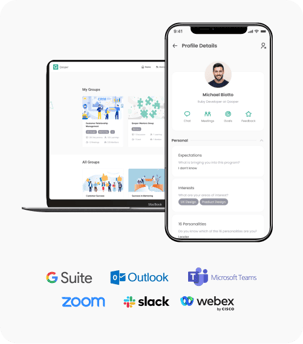
How Qooper handles this: Qooper offers native integrations across all three tiers — including Workday, SuccessFactors, BambooHR, Okta, Zoom, Teams, Slack, Google Workspace, and all major LMS platforms. No Zapier required.
11. Global Reach & Multi-Language Support
If your workforce is international, your mentoring platform must be too. Global deployment is about more than translating button labels.
What genuine global support looks like:
-
GDPR compliance with configurable data residency options for EU employees
-
Multi-language interface support — not just English UI with auto-translate
-
Localized training content, not just translated UI strings
-
Support team coverage across time zones (not just US business hours)
-
Awareness of regional mentoring norms and program design differences
How Qooper handles this: Qooper is GDPR-ready with multi-language support across its full platform — interface, training content, and communications. Global support coverage ensures your non-US employees get the same experience as HQ.
12. Mobile Accessibility
For frontline workers, manufacturing employees, field teams, and retail staff, a desktop-only mentoring platform is no platform at all. Yet most HR software still treats mobile as an afterthought.
Ask vendors specifically:
-
Is this a native iOS/Android app, or a mobile-responsive website? (Critical difference)
-
Does the mobile app support push notifications for meeting reminders and agendas?
-
Can participants complete training modules on mobile without degraded experience?
- Is offline access supported for employees in low-connectivity environments?
Native apps signal a vendor who takes mobile adoption seriously. PWA wrappers don't.
How Qooper handles this: Qooper offers a native iOS and Android app that supports push notifications, training delivery, meeting scheduling, goal-setting, and messaging — giving deskless and frontline employees full program participation from their phones.
13. Microsoft Teams & Slack Integration Depth
The pandemic permanently repositioned Teams and Slack as the default work environment for knowledge workers. The mentoring platforms that win on adoption are the ones that meet employees where they already spend their time — not the ones that create another destination.
Evaluate integration depth, not just presence:
-
Meeting reminders and agenda delivery directly in Teams/Slack channels
-
Training module notifications with direct completion links
-
Match introductions sent as in-app messages (not just email)
-
Goal check-ins and progress prompts in-flow
-
One-click meeting scheduling from within Teams or Slack
Adoption principle: Every additional step between "I got a reminder" and "I completed the action" costs you 15–30% of your completion rate. Reducing friction inside Teams/Slack is one of the highest-leverage adoption investments a mentoring platform can make.
How Qooper handles this: Qooper's Teams and Slack integrations are native and bidirectional — participants can receive agendas, complete training modules, schedule meetings, and send messages to their mentors without leaving their collaboration environment. For companies where Teams is the office, this is non-negotiable.
14. Enterprise Security & Compliance
Security isn't a differentiator — it's a gate. For organizations in healthcare, financial services, government, or manufacturing, your mentoring software will go through a rigorous IT security review before any contract is signed. Your vendor needs to be ready.
Non-negotiable security requirements:
-
SOC 2 Type II certification (annual audit, not one-time)
-
Data encryption at rest (AES-256) and in transit (TLS 1.2+)
-
ISO 27001 certification (essential for global programs)
- FedRAMP authorization (required for U.S. government and higher education)
- Role-based access controls (RBAC) for admin, participant, and executive views
- Data retention and deletion policies aligned to your compliance requirements
- Willingness to complete IT security questionnaires — with documented responses
Beyond certification, evaluate vendor posture: do they treat security as a continuous practice, or as a checkbox completed once for a sales conversation?
How Qooper handles this: Qooper provides enterprise-grade security trusted by 300+ organizations in healthcare, financial services, manufacturing, and tech — including SOC 2 Type II, ISO 27001, GDPR compliance, and FedRAMP readiness for government organizations. Qooper's security team actively assists with IT questionnaires and compliance documentation.
Vendor Evaluation Checklist: Score Your Finalists
Use this checklist when running demos or reviewing RFP responses. Score each vendor 0–2 per factor (0 = missing, 1 = partial, 2 = strong):
|
Evaluation Factor |
Questions to Ask |
|
1. Onboarding |
Do I get a dedicated CSM? Can they migrate our existing data? |
|
2. Program Design |
Do they offer program templates based on our goals? |
|
3. Launch Support |
What's their avg. registration rate in first 30 days? |
|
4. Mentor Matching |
What matching modes? How many attributes does the algorithm use? |
|
5. Training |
Is content professionally developed? Is it staged throughout the program? |
|
6. Facilitation |
Are meeting agendas automated? Is calendar/video integration native? |
|
7. Structure Flexibility |
Can I run 1:1, group, and peer programs simultaneously? |
|
8. Relationship Tracking |
Are there at-risk alerts? What triggers them? |
|
9. Reporting & ROI |
Can this connect to our HRIS? Is there an ROI calculator? |
|
10. Integrations |
Native or middleware? Which HRIS/LMS integrations are live today? |
|
11. Global Support |
GDPR-ready? Multi-language? What time zones does support cover? |
|
12. Mobile App |
Native iOS/Android or PWA? Push notifications? |
|
13. Teams/Slack |
Bidirectional? What actions can participants complete in-app? |
|
14. Security |
SOC 2 Type II? ISO 27001? Will they complete our IT questionnaire? |
Why 300+ Organizations Choose Qooper
Qooper is the only mentoring platform built to ace all 14 evaluation criteria — not just the ones that show well in demos.
-
AI-powered matching across 20+ dimensions
-
Native Slack, Teams, Zoom, Workday, and LMS integrations
-
SOC 2 Type II, ISO 27001, GDPR, and FedRAMP-ready security
-
Automated facilitation, training, and ROI reporting — all in one platform
-
Dedicated CSM for every customer — from first demo to ongoing program success
Schedule a free demo at qooper.io to see how Qooper performs across all 14 evaluation criteria, with a custom program recommendation for your organization.
Frequently Asked Questions About Mentoring Software
What is mentoring software?
Mentoring software is a purpose-built platform that automates and structures employee mentoring programs — covering mentor-mentee matching, training delivery, relationship facilitation, progress tracking, and ROI reporting. It replaces manual, spreadsheet-based coordination that consumes weeks of admin time per program cycle. Modern mentoring platforms also integrate with HRIS, LMS, and collaboration tools like Slack and Microsoft Teams.
What is the difference between a mentoring platform and mentoring software?
The terms are often used interchangeably. "Mentoring software" typically refers to the core functionality, while "mentoring platform" implies a broader ecosystem — including mobile apps, integrations, analytics, facilitation content, and learning features. Most enterprise mentoring solutions today are platforms in the full sense.
What features should I prioritize when choosing mentoring software?
The five highest-impact features are: (1) multi-dimensional mentor matching, (2) automated relationship facilitation with meeting agendas, (3) native integrations with your HRIS and collaboration tools, (4) outcome-based reporting tied to retention and career mobility, and (5) dedicated implementation support. These factors have the greatest influence on program adoption and measurable ROI.
How much does mentoring software cost?
Enterprise mentoring software typically prices per participant per year, ranging from $10 to $50+ per user depending on feature depth, integration needs, and organization size. Most vendors offer a per-seat or per-program pricing model. Request a custom quote from your shortlisted vendors based on your program scope and desired integrations.
How do I measure the ROI of a mentoring program?
ROI measurement should combine quantitative and qualitative data: promotion and internal mobility rates for mentored vs. non-mentored employees, retention rate comparison (mentored cohort vs. company average), skill progression survey results, and belonging/inclusion scores. Your mentoring platform should automate survey collection and, ideally, connect to HRIS data for cohort-level analysis. When even a 5% retention improvement is quantified in dollar terms, the ROI case becomes self-evident.
What is the difference between AI mentor matching and manual matching?
AI mentor matching uses algorithms to evaluate multiple compatibility factors — skills, goals, seniority, department, DEI attributes, availability — and surfaces ranked suggestions automatically. Manual matching requires admins to review profiles and assign pairs by judgment. Most high-performing programs use a hybrid approach: AI generates ranked suggestions, admins review and confirm, and participants may have input. Pure manual matching doesn't scale beyond ~50 pairs without significant admin burden.
Do I need separate software for different mentoring program types?
No — modern mentoring platforms like Qooper support multiple program structures (1:1, group, reverse, peer, flash, and speed networking) within a single administrative interface. Requiring separate tools for each program type creates data silos, increases admin overhead, and makes cross-program reporting impossible.
What security certifications should enterprise mentoring software have?
At minimum: SOC 2 Type II certification (annual audit), data encryption at rest and in transit, and SSO/SAML support. For regulated industries: ISO 27001, GDPR compliance with configurable data residency, and role-based access controls. For government or higher education: FedRAMP authorization. Your vendor should proactively assist with IT security questionnaires — not treat them as obstacles.

-3.png)