



 ·
23 minute read
·
23 minute read
Key Takeaways: Career Development Goals Examples
|
Whether you're preparing for a performance review, a job interview, or simply trying to get your career moving in the right direction, having a clear set of career development goals is the starting point.
But most goal-setting advice is vague. This guide is different. You'll find 60 concrete career development goal examples, 30 short-term and 30 long-term, each written as a SMART goal you can adapt immediately. We've also covered the goals most relevant for specific roles, performance reviews, and interview answers.
By the end, you'll have a complete framework for setting career development goals that actually lead somewhere, and answer how can short term goals best lead towards accomplishing long term career goals, understand how mentoring accelerates every step of the process.
What Are Career Development Goals?
Career development goals are the specific professional milestones you commit to reaching within a defined timeframe, designed to move your career forward in a measurable direction. They sit at the intersection of where you are now and where you want to be.
They differ from vague aspirations ('I want to grow') because they are specific, tied to outcomes, and time-bound. They're not job descriptions, they're deliberate investments in your professional trajectory.
|
Quick Definition Career development goals = specific professional milestones with a defined timeline, tied to skill-building, advancement, visibility, or impact, designed to move your career forward in a measurable direction. |
Career development goals generally fall into five types:
- Skill-building goals: acquiring specific capabilities (e.g., earning a certification, mastering a tool)
- Advancement goals: earning a promotion, gaining leadership responsibilities, or moving into a new role
- Visibility goals: increasing your professional presence internally or externally
- Relationship goals: building a mentor relationship, a professional network, or a sponsor connection
- Impact goals: making a measurable contribution to your team or organization
Short-Term vs. Long-Term Career Development Goals: Key Differences
Before diving into examples, it's worth being clear about what distinguishes short-term from long-term career goals, because they serve different functions and require different planning approaches.
|
Short-Term Career Goals |
Long-Term Career Goals |
|
|
Timeframe |
Under 12 months |
1–5 years (sometimes longer) |
|
Purpose |
Build momentum, fill skill gaps, prove readiness |
Define career direction, achieve major milestones |
|
Detail level |
Highly specific, immediately actionable |
Broader vision, with milestones to track progress |
|
Risk if skipped |
Long-term goals have no foundation |
Short-term wins don't connect to a larger purpose |
|
Best used for |
Performance reviews, quarterly planning, skill sprints |
Career conversations, life planning, mentoring sessions |
The relationship between the two is critical: short-term goals are the steps, long-term goals are the destination. Skipping either breaks the system.
|
How can short-term goals best lead towards accomplishing long-term career goals?
Short-term goals build toward long-term goals when they are deliberately sequenced, each one should develop a skill, credential, or relationship that makes the next step toward the long-term goal more achievable. Example: If your long-term goal is to become VP of Marketing in 5 years, a short-term goal this quarter might be leading your first cross-functional campaign. That project builds stakeholder management skills, creates visibility with leadership, and gives you a concrete result to point to in your next review, all compounding toward the VP goal. The critical step: map each short-term goal explicitly back to a long-term one. Without that link, short-term wins remain isolated achievements rather than career capital. |
How to Write SMART Career Development Goals
SMART is the most reliable framework for turning career intentions into goals that get achieved. Research by Dr. Gail Matthews at Dominican University found that people who write specific, structured goals are 42% more likely to achieve them than those who don't.
|
Letter |
What it means |
Career goal example |
|
S — Specific |
Define exactly what you want to achieve |
Not: 'improve my skills.' Yes: 'complete Google Analytics certification' |
|
M — Measurable |
Attach a number or verifiable outcome |
Not: 'get better at presenting.' Yes: 'deliver 3 all-hands presentations by Q3' |
|
A — Achievable |
Challenging but realistic given your resources |
Not: 'become CEO by next year.' Yes: 'move from analyst to senior analyst in 18 months' |
|
R — Relevant |
Directly connected to your career direction |
Not: 'learn photography.' Yes: 'earn PMP certification to qualify for PM roles' |
|
T — Time-bound |
Has a specific deadline that creates urgency |
Not: 'someday become a manager.' Yes: 'apply for team lead role by Q4 2026' |
30 Short-Term Career Development Goals Examples (Under 12 Months)
Short-term career development goals are the building blocks of long-term success. Each of the 30 examples below is organized by type and includes a SMART-phrased version you can adapt to your own role and context.
Skill-Building Goals (Short-Term)
These goals focus on acquiring specific skills, credentials, or capabilities, the most direct way to increase your value and close the gap between your current role and your next one.
|
# |
Goal |
Category |
SMART Example Phrasing |
|
1 |
Earn a job-relevant certification |
Skill-building |
Complete the PMP or Google Project Management certificate within 90 days to qualify for a senior IC role |
|
2 |
Master a core technical skill |
Skill-building |
Finish a SQL fundamentals course and use the skill on a live reporting task within 60 days |
|
3 |
Develop a new soft skill |
Skill-building |
Attend a conflict-resolution workshop and apply one new technique in a real team situation within 30 days |
|
4 |
Improve written communication |
Skill-building |
Write and publish 2 internal blog posts or case studies before the next performance review cycle |
|
5 |
Build data literacy |
Skill-building |
Complete an introductory data analytics course and build one dashboard used by your team within 3 months |
|
6 |
Learn a second language for business |
Skill-building |
Reach conversational-level proficiency in Spanish (B1) within 12 months using a structured daily study plan |
|
7 |
Strengthen public speaking |
Skill-building |
Deliver 3 structured presentations to audiences of 20+ people within the next 6 months |
|
8 |
Improve time management |
Skill-building |
Implement a time-blocking system and reduce missed deadlines from 3/month to 0/month within 60 days |
|
9 |
Develop AI/automation skills |
Skill-building |
Learn to use 2 AI productivity tools relevant to your role and present the efficiency gains to your manager within 90 days |
|
10 |
Get feedback and act on it |
Skill-building |
Solicit structured 360-degree feedback from 5 colleagues and implement at least 2 improvements before Q4 |
Visibility & Influence Goals (Short-Term)
These goals increase how much you're seen and heard, internally by leadership, and externally in your professional field. Visibility is often the missing ingredient between being great at your job and being recognized for it.
|
# |
Goal |
Category |
SMART Example Phrasing |
|
11 |
Take on a high-visibility project |
Visibility |
Volunteer to lead or significantly contribute to a project presented to senior leadership within the next quarter |
|
12 |
Build cross-team relationships |
Visibility |
Introduce yourself and have structured conversations with 3 colleagues from other departments this month |
|
13 |
Establish a professional online presence |
Visibility |
Create or refresh your LinkedIn profile and post 4 pieces of expert content within the next 60 days |
|
14 |
Present to senior leadership |
Visibility |
Deliver at least 2 structured recommendations or updates to director-level+ stakeholders before end of Q3 |
|
15 |
Contribute to a professional community |
Visibility |
Join one relevant professional association or online community and contribute meaningfully within 30 days |
Mentoring & Relationship Goals (Short-Term)
Career development doesn't happen in isolation. These goals are about building the relationships, mentors, sponsors, peers, and networks that accelerate everything else. Employees with mentors are promoted 5x more often than those without.
|
# |
Goal |
Category |
SMART Example Phrasing |
|
16 |
Find a mentor |
Mentoring |
Identify and approach a mentor in your target role within 30 days; establish a monthly meeting cadence |
|
17 |
Mentor a junior colleague |
Mentoring |
Take on formal mentoring of one junior team member for 6 months, with documented development goals |
|
18 |
Build a sponsor relationship |
Mentoring |
Identify one senior leader who can advocate for your advancement and create a plan to build that relationship within 90 days |
|
19 |
Expand your professional network |
Mentoring |
Connect with 2 new professionals in your target field each month for 6 consecutive months |
|
20 |
Attend an industry event |
Mentoring |
Attend one relevant conference or professional event this quarter and follow up with at least 3 new contacts |
Performance & Advancement Goals (Short-Term)
These goals are directly tied to promotion readiness, documenting impact, exceeding KPIs, and creating the paper trail that makes a compelling case for advancement.
|
# |
Goal |
Category |
SMART Example Phrasing |
|
21 |
Prepare for a salary conversation |
Advancement |
Document 3 measurable wins from the past 6 months and schedule a compensation review with your manager by October |
|
22 |
Exceed KPIs for one full quarter |
Advancement |
Identify your top 3 KPIs and hit 110%+ on all of them for a full quarter before your next review |
|
23 |
Document your impact |
Advancement |
Create and maintain a 'wins log' tracking your contributions weekly, ready to present at performance review |
|
24 |
Improve team performance metrics |
Advancement |
Implement one process improvement that saves your team at least 4 hours per week by end of Q2 |
|
25 |
Propose and get approved for a stretch role |
Advancement |
Draft and present a proposal for a new responsibility or stretch role to your manager within the next 60 days |
Sustainability & Development Goals (Short-Term)
Sustainable high performance requires investment in your own development and well-being. These goals address the longer-term practices, planning, learning, and contribution that keep your career compound-growing.
|
# |
Goal |
Category |
SMART Example Phrasing |
|
26 |
Set boundaries to prevent burnout |
Sustainability |
Reduce regular overtime from 10+ hours/week to 2 hours/week by delegating one recurring task within 30 days |
|
27 |
Complete a professional development course |
Sustainability |
Enroll in and complete one L&D course offered by your company or a recognized provider within the next quarter |
|
28 |
Develop a personal development plan (PDP) |
Sustainability |
Write and share a structured 12-month personal development plan with your manager within the next 2 weeks |
|
29 |
Improve your onboarding impact |
Sustainability |
Create a 30-60-90 day plan for your current or next role and review progress against it monthly |
|
30 |
Support organizational DEI goals |
Sustainability |
Actively participate in or help lead one ERG initiative this quarter and measure the impact by end of cycle |
30 Long-Term Career Development Goals Examples (1–5 Years)
Long-term career goals define where you're heading. They require patience, sustained effort, and regular short-term milestones to stay on track. Without long-term goals, short-term wins remain directionless. The 30 examples below are organized by the type of ambition they serve.
Promotion & Advancement Goals (Long-Term)
These are the most common long-term career goals and the most asked about in performance reviews and interviews. The key is making them specific enough to be credible.
|
# |
Goal |
Category |
SMART Example Phrasing |
|
1 |
Reach senior/lead level |
Advancement |
Earn a Senior Manager title within 3 years by consistently exceeding targets and building a team leadership track record |
|
2 |
Become a Director or VP |
Advancement |
Advance to a VP-level role within 5 years by building a portfolio of revenue-impacting projects and developing a high-performing team |
|
3 |
Reach C-suite level |
Advancement |
Become a Chief People Officer within 8 years by progressing through senior HRBP, Head of HR, and VP HR roles with clear milestones |
|
4 |
Transition to a management track |
Advancement |
Move from an individual contributor to a people manager role within 18 months by leading 2 direct reports on a pilot basis |
|
5 |
Earn a promotion in the next review cycle |
Advancement |
Secure a promotion to Senior Analyst within 12 months by exceeding all KPIs and successfully leading one major project |
Career Transition Goals (Long-Term)
Career transitions, changing function, industry, or moving into entrepreneurship, are among the most ambitious long-term goals. They require the longest planning horizons and the most deliberate short-term steps.
|
# |
Goal |
Category |
SMART Example Phrasing |
|
6 |
Switch to a new function |
Transition |
Move from an operations IC role to a product management role within 2 years by completing a PM certification and shipping one internal product |
|
7 |
Change industries |
Transition |
Transition from finance to the tech sector within 3 years by acquiring relevant technical skills and building a network in the target industry |
|
8 |
Move into consulting |
Transition |
Launch an independent consulting practice within 2 years, generating $3,000/month before transitioning full-time |
|
9 |
Start your own business |
Transition |
Build a profitable side business within 3 years that generates revenue equal to 50% of your current salary before going full-time |
|
10 |
Return to education for a career pivot |
Transition |
Complete a part-time master's degree in a new field within 3 years to qualify for a career pivot into [target industry] |
Expertise & Thought Leadership Goals (Long-Term)
Building a recognized expertise and external professional brand is a long game, but the payoff is compounding. These goals are especially valuable for professionals in knowledge-intensive fields where visibility drives opportunity.
|
# |
Goal |
Category |
SMART Example Phrasing |
|
11 |
Become a recognized subject-matter expert |
Expertise |
Become the go-to expert in your domain by publishing 20+ articles, speaking at 3 conferences, and earning a top-tier certification within 3 years |
|
12 |
Build a personal brand |
Expertise |
Grow a professional audience of 10,000+ on LinkedIn within 3 years through consistent, expert content in your field |
|
13 |
Write and publish a book |
Expertise |
Research, write, and publish a business or professional book within 3 years to establish authority in your field |
|
14 |
Become an industry speaker |
Expertise |
Speak at 5+ industry conferences within 3 years, building a reputation as a keynote-caliber voice in your domain |
|
15 |
Launch a professional podcast or content platform |
Expertise |
Build and sustain a podcast or newsletter with 5,000+ subscribers within 2 years, focused on your area of expertise |
Education & Credential Goals (Long-Term)
Formal credentials, degrees, certifications, and coaching qualifications remain powerful signals to employers and clients. These long-term goals are especially relevant for professionals aiming at senior roles that have explicit qualification thresholds.
|
# |
Goal |
Category |
SMART Example Phrasing |
|
16 |
Complete an MBA |
Education |
Enroll in and complete a part-time or executive MBA program within 3 years to accelerate path to senior leadership |
|
17 |
Earn the highest certification in your field |
Education |
Achieve the top-level professional certification (e.g., CPA, CISM, SHRM-SCP) within 4 years through structured study and experience |
|
18 |
Complete a coaching or mentoring certification |
Education |
Earn an ICF (International Coaching Federation) credential within 2 years to formalize your coaching practice internally or externally |
|
19 |
Build T-shaped expertise |
Education |
Deepen your primary skill to expert level and develop one adjacent skill within 18 months to become more versatile and promotion-ready |
|
20 |
Pursue a leadership development program |
Education |
Complete a structured leadership development program within 12 months and apply learnings by leading a team or major initiative |
Impact & Legacy Goals (Long-Term)
The most meaningful long-term career goals are about contribution, what you build for others, not just what you achieve for yourself. These goals resonate strongly with senior leaders and are powerful answers in executive interviews.
|
# |
Goal |
Category |
SMART Example Phrasing |
|
21 |
Build a high-performing team |
Impact |
Develop 3 direct reports into promotion-ready employees within 2 years through structured mentoring and development plans |
|
22 |
Design and launch a mentoring program |
Impact |
Create, launch, and run a company-wide mentoring program that improves 90-day retention by 15% within 18 months |
|
23 |
Drive a major organizational change |
Impact |
Lead a significant transformation initiative (new process, technology, or culture program) that impacts 100+ employees within 2 years |
|
24 |
Build a succession pipeline |
Impact |
Identify and develop 2 high-potential employees for senior roles within 2 years as part of a formal succession planning effort |
|
25 |
Expand DEI impact |
Impact |
Build or significantly scale a DEI initiative that measurably improves inclusion scores by 20% within 3 years |
International, Lifestyle & Legacy Goals (Long-Term)
Not all long-term career goals are about climbing a hierarchy. These goals reflect a broader definition of career success, location freedom, financial independence, and the long-term impact you leave on others.
|
# |
Goal |
Category |
SMART Example Phrasing |
|
26 |
Take on an international role |
Global |
Secure a cross-border or international assignment within 3 years by developing relevant language skills and global stakeholder experience |
|
27 |
Work remotely from another country |
Global |
Negotiate a remote-first or location-independent arrangement within 2 years by proving sustained performance in a fully remote role |
|
28 |
Achieve work-life design goals |
Lifestyle |
Reach a position that allows a 4-day workweek or flexible schedule within 3 years — either through advancement, role change, or self-employment |
|
29 |
Reach financial independence through career |
Lifestyle |
Achieve a total compensation of $X within 4 years through promotion, role changes, or equity, enabling a specific financial milestone |
|
30 |
Leave a mentoring legacy |
Legacy |
Mentor at least 10 people over the course of your career, with documented impact on each person's professional trajectory |
Career Development Goals by Role
Goals should reflect your current position. Here are targeted examples for common roles — each phrased to be credible in a performance review or career conversation.
|
Role |
Short-Term Goal Example |
Long-Term Goal Example |
|
HR & L&D professionals |
Design a mentoring program that improves 90-day retention by 15% within 12 months |
Become a Chief People Officer within 8 years by building a track record across HRBP, Head of HR, and VP HR roles |
|
Managers & team leads |
Reduce voluntary attrition on your team by 20% in the next 12 months through structured 1:1s |
Build and run a high-performing team where 3+ direct reports are promoted within 2 years |
|
Individual contributors |
Take ownership of one high-visibility project this quarter to demonstrate senior readiness |
Earn a promotion to Senior or Lead level within 18 months by exceeding KPIs across 2 full review cycles |
|
Early career / new grads |
Secure a mentor in your target role within 60 days and meet monthly for career guidance |
Reach a mid-level role with team influence within 3 years by building a clear skill-and-visibility roadmap |
|
Nurses & healthcare |
Complete a specialty certification (e.g., CCRN) within 12 months to qualify for advanced clinical roles |
Move from bedside nursing into a Nurse Manager or CNS role within 5 years |
|
Teachers & educators |
Implement one new evidence-based teaching strategy and document its impact on student outcomes this term |
Complete a school leadership qualification and move into a department head role within 3 years |
|
Sales professionals |
Achieve 120%+ of quota for 2 consecutive quarters to build a case for promotion to Account Executive |
Move from individual contributor to Sales Manager within 2 years by developing coaching and pipeline management skills |
|
Tech / engineers |
Complete a cloud certification (AWS, GCP, or Azure) within 90 days and apply it on one live project |
Move from senior engineer to engineering manager or staff engineer within 3 years |
|
Finance professionals |
Earn the CFA Level 1 within 12 months to qualify for analyst or advisory roles |
Become a CFO or Finance Director within 7 years through structured progression across FP&A, controller, and VP Finance roles |
|
Marketing professionals |
Master one new channel (e.g., paid search, video) and deliver a case study of results within 6 months |
Build a recognized personal brand in your marketing niche with 10k+ followers within 3 years |
Career Development Goals for Performance Reviews
Performance reviews are the most common context for articulating career development goals. The examples below are written to be credible, business-relevant, and show a clear link between your development and organizational impact — exactly what managers and HR want to see.
|
# |
Goal Type |
SMART Goal for Performance Review |
|
1 |
Skill expansion |
Complete a certification in [specific skill] within 6 months to qualify for [specific next role] |
|
2 |
Leadership readiness |
Lead one major cross-team project in the next review cycle to demonstrate readiness for a team lead position |
|
3 |
Business impact |
Identify and implement one process improvement that saves the team at least 5 hours/week by mid-year |
|
4 |
Mentoring contribution |
Formally mentor one junior colleague for the full review cycle, with documented development milestones |
|
5 |
Executive visibility |
Present findings or recommendations to senior leadership at least twice this year |
|
6 |
Network building |
Attend 2 industry events and make 5 meaningful new professional connections by end of Q4 |
|
7 |
360 feedback & growth |
Solicit structured feedback from 5 colleagues each cycle and act on at least 2 improvement areas |
|
8 |
Career path alignment |
Schedule a formal career conversation with my manager each quarter to keep my development plan on track |
|
9 |
Subject matter expertise |
Deliver 2 internal training sessions on [specific topic] to build visible expertise and team value |
|
10 |
Sustainable performance |
Reduce regular overtime by 20% while maintaining output quality — modelling sustainable high performance |
Career Development Goals for Job Interviews
'What are your short-term and long-term career goals?' is one of the most common interview questions and one of the most poorly answered. The examples below show how to frame both types of goal in a way that's honest, specific, and aligned with the role you're applying for.
What are your short-term and long-term career goals?(Interview answer examples)
Short-term answer (for an individual contributor role): "In the short term, my goal is to develop deep expertise in [specific skill relevant to role] within my first 6 months and take on increasing ownership of [relevant responsibility]. I want to be a high-impact contributor quickly, not just someone going through an onboarding checklist." Long-term answer (for an individual contributor role): "Longer term, I want to grow into a senior or lead role where I'm helping shape strategy, not just executing it. I'm drawn to this company specifically because [specific reason] — it feels like the kind of environment where that kind of growth is realistic and valued." For a management role — short-term: "My immediate goal is to build strong trust and credibility with my team within the first 90 days — understanding what's working, what isn't, and where my experience can add value without disrupting momentum." For a management role — long-term: "Longer term, I want to build a team that has a track record of developing talent — where people grow into other parts of the business. I see that as the real measure of a leader." |
What are your long-term career goals?(Sample answers)
Answer 1 (ambition + company alignment): "My long-term goal is to move into a senior leadership role where I can drive organizational strategy, not just functional delivery. I'm building toward that by deepening my expertise in [area] and developing my leadership skills — and I see this role as a key step in that direction." Answer 2 (expertise-focused): "I want to become one of the leading practitioners in [field]. That means continuing to develop at the cutting edge of the discipline, publishing my thinking, and eventually mentoring others coming up in the same space. I'm about 3 years into that journey." Answer 3 (transition-focused): "My long-term goal is to move into [new function]. I've spent [X years] in [current function] and I'm ready to apply that foundation in a broader strategic context. This role would give me the exposure I need to make that transition in a credible way." |
What are your short-term career goals?(Sample answers)
Answer 1 (skill-focused): "In the next 6–12 months, my priority is to close the gap in [specific skill]. I've started [course/certification] and I'm actively looking for projects where I can apply that learning in context. I want to be genuinely strong in this area, not just checked-box credentialed." Answer 2 (impact-focused): "My short-term goal is to deliver measurable results in [specific area] — not just show up and maintain the status quo. I want to be able to point to a specific outcome I created within my first year and say: this happened because of work I led." |
How Mentoring Accelerates Career Development Goals
Setting goals is necessary but not sufficient. Research consistently shows that accountability and guidance are what convert intentions into results. Mentoring is the most powerful accelerator available for career development goals.
|
Mentoring statistic |
Source |
|
Employees with mentors are promoted 5x more often than those without |
Sun Microsystems study |
|
71% of Fortune 500 companies use mentoring programs to develop talent |
Various enterprise HR surveys |
|
Mentees are 23% more likely to achieve their development goals with structured mentoring |
SHRM research |
|
28% of mentors receive promotions, vs. 5% of non-mentors |
Sun Microsystems study |
|
Mentoring programs improve retention rates by up to 50% |
Association for Talent Development |
The reason mentoring works is structural: it turns abstract goals into accountable conversations. When you meet with a mentor monthly and report on your progress, career goals stop being wishful thinking and start being commitments with social accountability attached.
How Qooper Connects Career Development Goals to Mentoring
Most organizations have career development frameworks on paper — competency matrices, development plan templates, annual goal-setting cycles. What they don't have is the enterprise infrastructure to make those frameworks live in the day-to-day employee experience. Goals get set in January, reviewed in December, and forgotten in between.
Qooper bridges that gap. Trusted by 300+ enterprises — including Fortune 500 companies such as Merck, BNY, Harvard, Toyota, and Deloitte — Qooper is enterprise mentoring software that connects career development goals to structured mentoring relationships. It gives employees accountability, guidance, and momentum throughout the year, not just at review time. With thousands of users across 500+ mentoring programs, Qooper delivers the structured infrastructure large organizations need to make career development measurable, scalable, and tied to real business outcomes.
Here's how each layer of the platform maps directly to the career development goal journey:
1. Goal-Setting Built Into the Development Plan
When employees onboard to a Qooper mentoring program, they're prompted to define their career development goals as part of their profile setup. These aren't stored and forgotten — they become the foundation for mentor matching and conversation structuring across your enterprise.
Employees can set both short-term goals (skills to build, projects to lead, certifications to earn) and long-term goals (roles to reach, transitions to make, impact to create). These goals are visible to their mentor, their manager, and the HR or L&D team managing the program — creating shared visibility and alignment from day one.
- Employees articulate goals in their own words using guided prompts
- Goals are tagged by type: skill-building, advancement, leadership, transition, and more
- HR and program admins can see goal distribution across the organization to identify development gaps at scale
2. AI-Powered Mentor Matching Based on Career Goals
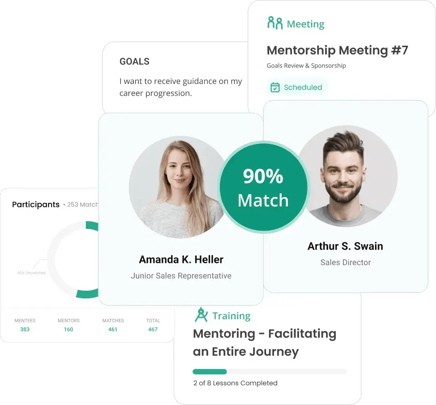
The most common failure mode in enterprise mentoring programs is poor matching — pairing an employee with a mentor who has no relevant experience in the areas the employee wants to develop. Qooper solves this with an enterprise-grade, AI-powered matching engine that considers career development goals alongside role, seniority, skills, and availability.
If an employee's goal is to move from an individual contributor role into product management, Qooper's matching algorithm surfaces mentors who have made that exact transition — not just the most senior person available. If the goal is to develop leadership skills for a first management role, the match prioritizes mentors who have recently navigated that step.
- Matching factors include: stated goals, target role, skills gap, industry, function, and seniority
- Employees can review mentor profiles and choose from recommended matches
- Program admins can set configurable matching rules, approval workflows, and eligibility controls to align with enterprise development priorities — including high-potential programs, succession planning
3. Structured Conversation Templates Tied to Career Goals
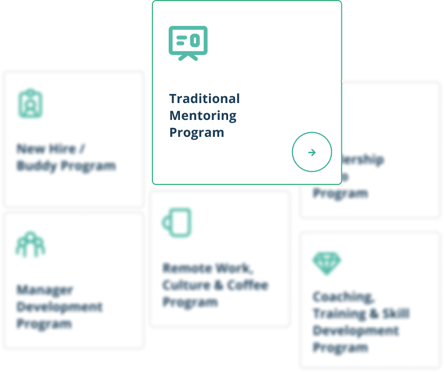
One of the biggest reasons mentoring relationships stall is that mentors and mentees run out of meaningful structure — spending every session catching up rather than making progress on development. Qooper provides structured conversation guides and session templates that keep mentoring conversations anchored to career development goals, backed by mentorship training materials that prepare participants before the relationship even begins.
Templates are tailored to the type of goal the employee is working on. An employee aiming for a first management role gets a different conversation framework than one working through a career transition into a new function. Each template surfaces the right questions, reflection prompts, and action items to move the goal forward in every session.
- Pre-built templates for: skills development, promotion readiness, career transitions, leadership development, onboarding, and performance improvement
- AI-powered personalized meeting agendas based on past sessions and participant goals
- Mentors are prompted to review goal progress at each session
- Action items from each session are logged and carried forward to the next meeting
- Both mentors and mentees can add notes, track commitments, and mark milestones
4. Progress Tracking and Milestone Visibility
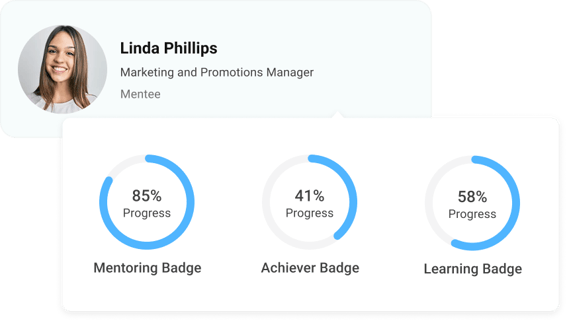
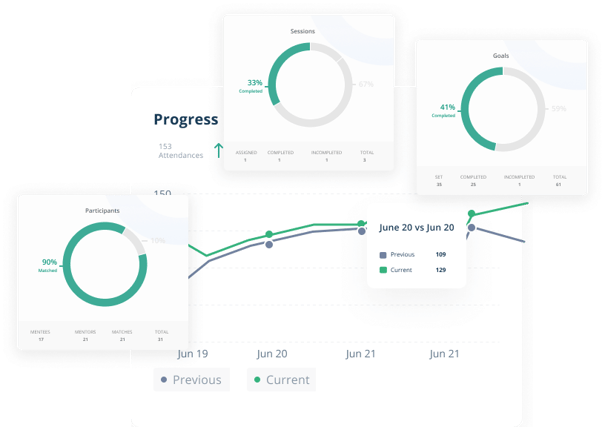
Career development goals are only valuable if progress against them is visible — to the employee, the mentor, and the organization. Qooper provides a goal-tracking layer that makes development progress tangible and measurable throughout the program, not just at annual review time. For enterprises where retention is a strategic priority, this visibility matters: organizations using structured mentoring have seen up to a 79% improvement in retention and 40% higher employee engagement.
Employees can update goal progress between sessions. Mentors can see how their mentee is tracking. Program administrators and HR leaders can view aggregate goal progress across the entire cohort — identifying who is on track, who needs support, and where development investments are generating the most impact.
- Employees mark milestones and update goal status in real time
- Mentors receive nudges when a mentee hasn't logged progress for a defined period
- HR and L&D teams access program-level dashboards showing goal completion rates, engagement scores, and development velocity
- Progress data feeds directly into performance review conversations, no more scrambling to remember what was achieved
- Attrition risk signals and engagement flags surface early, giving HR teams time to intervene
5. Manager Visibility and Development Alignment
Career development goals don't happen in isolation from the rest of the employment relationship. Qooper gives managers visibility into their team members' development goals and mentoring progress — so that 1:1 conversations, stretch assignments, and performance feedback can be aligned to where each person is trying to go.
This is particularly valuable for enterprise managers responsible for succession planning or high-potential development. Instead of guessing which employees have leadership ambitions, managers can see stated goals, mentoring activity, and development milestones — and have better, more informed development conversations as a result.
- Managers can view (with appropriate permissions) their direct reports' development goals and mentoring progress
- Managers receive development updates at configurable intervals
- Mentoring program data integrates with HRIS and performance management platforms
- SSO and role-based access control (RBAC) ensure enterprise-grade governance across all program data
6. Programs for Every Career Development Context
Not all career development goals look the same and Qooper's platform is built to support multiple program types, each designed for a specific development context:
|
Program Type |
Career Development Goals It Supports |
Who It's Built For |
|
1:1 Mentoring |
Long-term career goals, promotion readiness, career transitions, leadership development |
All employees — especially high potentials and career changers |
|
Skill-building goals, peer learning, professional development goals for cohorts |
New hires, graduate intakes, ERG members, cohort-based L&D programs |
|
|
Short-term skill goals, cross-functional visibility, new hire onboarding goals |
Individual contributors developing adjacent skills or transitioning into new teams |
|
|
Digital skills, DEI awareness, generational knowledge exchange goals |
Senior leaders developing skills in emerging areas or building organizational empathy |
|
|
Targeted short-term goals, single skill, specific challenge, or career question |
Employees who need focused guidance rather than a long-term relationship |
|
|
Accelerated advancement goals, leadership readiness, succession planning |
Identified HiPos being developed for senior or executive roles |
7. Reporting That Connects Development to Business Outcomes
For enterprise HR and L&D leaders, the biggest challenge with career development programs isn't running them — it's proving they work. Qooper's reporting suite connects mentoring activity and goal progress to measurable business outcomes: retention rates, internal promotion rates, time-to-productivity for new hires, and engagement scores.
This means you can show leadership not just that the mentoring program is active, but that employees who participate in structured mentoring toward their career development goals are promoted faster, stay longer, and perform better than those who don't. Qooper is SOC 2 Type I and Type II certified and GDPR compliant — so enterprise reporting and data handling meet the governance standards your organization requires.
- Program-level dashboards: session activity, goal completion rates, mentor/mentee satisfaction scores
- Cohort comparison: participants vs. non-participants across retention, promotion, and engagement metrics
- ROI reporting: estimated value of reduced attrition and accelerated promotion pipelines
- Export to CSV or integration with HRIS/BI platforms for custom reporting
- Data governance controls including data retention procedures, customer data deletion upon contract termination, and no collection of PHI or credit card data
Qooper in Practice: What This Looks Like for an HR LeaderImagine you're an L&D Manager at a 5,000-person enterprise. You run a high-potential development program for 50 employees identified for senior roles over the next three years. You need a platform that can handle the matching complexity, the reporting requirements, and the integrations your IT team requires — without creating a manual coordination burden for your team. With Qooper:
This is what structured career development goal infrastructure looks like at scale. |
Final Thoughts: Goals Without Accountability Are Wishes
Career development goals only work when they're written down, sequenced from short-term to long-term, and attached to some form of accountability. For most professionals, that accountability comes from a manager, a mentor, or a structured development program.
The 60 examples in this guide are starting points. The most important next step is to pick 1–2 goals that matter most to you right now, phrase them as SMART goals, write them down, and tell someone about them — ideally a mentor who can hold you accountable and help you navigate the path.
If you're an HR or L&D leader responsible for building career development programs at scale, Qooper gives you the infrastructure to do this across your entire organization — from goal-setting and mentor matching to progress tracking and reporting.
Turn Career Goals Into a Structured Enterprise Program
Setting individual career development goals is one thing — building the infrastructure to support them across thousands of employees is another. Qooper is the enterprise mentoring software that connects employees to the right mentors based on their specific career goals, giving organizations like Merck, BNY, and Harvard the platform to turn individual goal-setting into a measurable, enterprise-wide development program.
Want to build a career development program that works?Qooper's enterprise mentoring platform connects employees to the right mentors, structures development conversations around career goals, and gives HR teams the visibility to measure impact at scale. |
Frequently Asked Questions
What are career development goals?
Career development goals are intentional objectives you set to grow professionally — whether that means building new skills, earning a promotion, switching industries, or expanding your network. They give your career a clear direction and help you make deliberate choices about where to invest your time and energy.
What is the difference between short-term and long-term career goals?
Short-term career goals are typically achievable within 6 months to 1 year — such as completing a certification, improving a specific skill, or taking on a new project. Long-term career goals span 3–10 years and represent bigger milestones like landing a senior leadership role, transitioning to a new field, or becoming a recognized expert. Short-term goals are the building blocks that make long-term goals achievable.
Why is it important to set career development goals?
Setting career development goals keeps your growth intentional rather than reactive. Clear goals help you stay focused, measure progress, advocate for yourself during performance reviews, and make decisions that align with where you actually want to go — rather than simply where circumstances take you.
What are some examples of short-term career development goals?
Examples of short-term career development goals include: earning a relevant certification within 6 months, improving your public speaking by presenting at a team meeting, learning a new software tool used in your industry, requesting a mentor, or leading a small project for the first time. These goals build skills and visibility quickly.
What are some examples of long-term career development goals?
Examples of long-term career development goals include: moving into a senior or management role, transitioning to a new industry, building a personal brand as a thought leader, starting your own business, or becoming a department head. These goals typically take 3–10 years and require sustained effort, skill-building, and strategic networking.
How do I write a SMART career development goal?
A SMART career goal is Specific, Measurable, Achievable, Relevant, and Time-bound. Instead of "get better at leadership," a SMART version would be: "Complete a leadership development course and apply the learnings by managing one cross-team project before the end of Q3." The more concrete your goal, the easier it is to act on and track.
How many career development goals should I set at once?
Most professionals do best focusing on 2–3 short-term goals and 1–2 long-term goals at any given time. Setting too many goals at once spreads your energy thin and leads to slow progress across all of them. Prioritize the goals with the most impact on your career trajectory.
How often should I review my career development goals?
Review your short-term career goals at least monthly and your long-term goals every quarter. Major life events — a new job, a promotion, or a shift in personal priorities — are also natural moments to reassess. Annual-only reviews are insufficient; careers evolve too quickly for a once-a-year check-in.
Can career development goals include soft skills?
Yes — and they should. Skills like communication, leadership, emotional intelligence, and conflict resolution are often what differentiate who gets promoted. The key is making soft skill goals measurable. For example: "Receive feedback from three colleagues on my communication clarity after each cross-team project this quarter."
How do career development goals differ for entry-level vs senior professionals?
Entry-level professionals typically focus on building foundational skills, gaining broad exposure, and establishing credibility. Senior professionals tend to focus on leading others, developing strategic influence, mentoring, and creating lasting impact. The right career development goals depend on your current stage — which is why this post includes 30 short-term and 30 long-term examples across experience levels.