




 ·
8 minute read
·
8 minute read
In a rapidly evolving workplace, employees expect clear pathways for professional growth, career advancement, and development. Organizations that invest in structured learning, coaching, and mentoring programs are far more likely to retain talent, strengthen their leadership pipeline, and support a diverse workforce. This is why mentorship software for career pathing has become a foundational investment, not just for HR teams, but for entire enterprises aiming for long-term organizational success.
Modern employees, from junior staff to senior leaders, want mentoring relationships that deliver knowledge sharing, social learning, and measurable outcomes. To meet these expectations, organizations now rely on robust mentoring platforms that streamline mentor-mentee matching, automate program management, and provide analytics and reporting that link development activities with organizational goals.
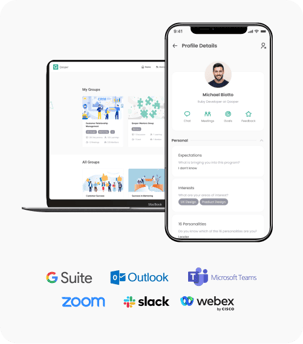
This is exactly where Qooper Mentoring Software excels. As an AI-powered Mentorship Solution, Qooper Mentorship Program Software offers structured learning pathways, progress tracking, program monitoring, and career trajectory insights while integrating seamlessly with LMS integration, HRIS platforms, and everyday communication tools like Microsoft Teams, Slack, and LinkedIn. From group mentoring to one-on-one sessions, Qooper Mentorship Program Software helps every association, company, and community strengthen its mentoring culture in a digital environment.
How Mentorship Software Shapes Modern Career Pathing
Mentorship software for career pathing provides the structure, reporting, and customization needed to guide employees through development plans aligned with organizational culture and competency frameworks. These platforms combine mentorship programs, learning-driven mentoring, and coaching tools to support every stage of the employee lifecycle, from onboarding and upskilling to leadership development.
Core capabilities include:
- AI-based matching and smart matchmaking
- Goal setting and metrics tracking
- Activity recommendations
- Automated notifications and real-time alerts
- Sessions, surveys, file attachments, and session summaries
- Data visualizations and advanced reporting
- Program outcomes and KPI dashboards
- Integrated learning and social learning experiences
This ensures program administrators can easily monitor mentorship participation, track engagement metrics, and meet a wide range of mentoring needs.
Why Organizations Need Mentorship Software for Career Pathing
1. Employees Expect Personalized, Measurable Development
From junior employees to senior leaders, individuals want clarity around their career trajectory and access to internal mentors who can support real skill-building and professional development.
Challenge: Manual mentor coordination and inconsistent reporting make it impossible to measure program outcomes or align activities with organizational goals.
How Qooper Helps: Qooper uses artificial algorithms and machine learning to deliver AI-powered mentor-mentee matching, aligning development activities with workplace competencies and career advancements. Progress tracking and advanced analytics show how mentorship impacts KPIs, engagement metrics, and long-term organizational success.
2. Manual Mentoring Lacks Scalability and Structure
Traditional mentoring programs run on spreadsheets, emails, and guesswork—resulting in low engagement, unclear responsibilities, and limited data.
Challenge: Program administrators struggle to manage group mentoring, individual sessions, and cross-department participation without structured tools.
How Qooper Helps: Qooper automates program management, delivers notifications and real-time alerts, provides session summaries, and centralizes communication through integrations with Microsoft Teams, Slack, LMS systems, and HRIS platforms. This enables organizations to scale their mentoring culture without administrative overload.
3. Career Pathing Requires Skill Alignment and Learning Integration
Employees need more than conversations, they need targeted learning, coaching exercises, and curated content.
Challenge: Organizations often lack a unified system that connects learning, mentoring, and career competencies.
How Qooper Helps: Qooper’s LMS integration links training modules with mentoring activities, creating a learning-driven mentoring experience supported by social learning, gamification tools, and customizable workflows. Employees can attach files, complete surveys, and track learning goals directly in the platform.
4. Mentors Need Support and Guidance to Be Effective
Even senior, experienced employees may not always know how to coach effectively.
Challenge: Without structure, mentoring becomes inconsistent and lacks strategic value.
How Qooper Mentorship Program Software Helps: Qooper provides structured conversation agendas, recommended activities, and customizable progress plans. Internal mentors receive matching support, communication tools, and clear expectations, ensuring meaningful knowledge sharing across the organization.
5. Organizations Need Reliable Metrics and Insights
Leadership teams want evidence of program outcomes, such as improved engagement, reduced turnover, or strengthened leadership pipeline.
Challenge: Manual reporting makes it nearly impossible to track KPIs or evaluate mentorship effectiveness.
How Qooper Mentorship Program Software Helps: Qooper’s analytics and reporting engine offers advanced reporting, Data visualizations, and dashboards for program outcomes, engagement metrics, skill development, and participation trends. These insights help organizations refine their mentorship programs, improve diversity and inclusion outcomes, and build stronger community bonds within the workplace.
Key Features of Effective Mentorship Software for Career Pathing
AI-Based and Smart Matchmaking
Machine learning and artificial algorithms match mentors with mentees based on skills, interests, knowledge levels, goals, and professional growth needs.
Integrated Learning and LMS Support
LMS integration ensures structured learning and development flows seamlessly into mentoring activities and coaching sessions.
Spaces for Community Learning
Dedicated Spaces promote social learning, peer collaboration, and group mentoring across associations and membership communities.
Customizable Program Structures
Organizations can run leadership development, onboarding, high-potential, diversity and inclusion, or association-wide mentoring programs with flexible customization options.
Communication and Collaboration Tools
Built-in messaging, video-calls, notifications, and integrations with Microsoft Teams, Slack, and LinkedIn ensure mentorship thrives in a modern digital environment.
How Qooper Mentoring Software Transforms Career Pathing
Transforming career development in today’s digital environment requires more than a traditional mentoring program or scattered learning modules. Organizations need a centralized mentorship solution that blends AI-powered mentor-mentee matching, structured learning-driven mentoring, and data-backed insights into one cohesive system. Qooper brings all these elements together, making it one of the most comprehensive mentoring platforms available for supporting workplace growth, leadership pipeline development, and long-term organizational success.
Below is an expanded, in-depth look at how Qooper Mentoring Software reshapes the entire career pathing experience, not just for employees, but for program administrators, mentors, and HR leaders.
1. AI-Powered Matching That Ensures the “Right” Partnerships From Day One
Traditional matching methods, such as manager recommendations or manual pairing, often lack consistency and overlook important compatibility factors. Qooper replaces guesswork with machine learning and artificial algorithms that analyze mentoring needs, role expectations, professional growth goals, internal mentors’ expertise, and personal preferences.
What This Means in Practice:
- Junior employees find senior mentors who understand their career trajectory.
- Employees from diverse backgrounds are matched in a way that supports inclusion goals.
- Associations and membership organizations can match participants across chapters, departments, or locations.
- Program administrators save hours of manual work thanks to smart matchmaking and matching support.
- Mentorship participation increases naturally because pairings feel meaningful and relevant.
Qooper’s AI-based matching becomes stronger over time, learning from program outcomes, communication patterns, and participant preferences to refine future matches.
2. Structured Learning, Coaching, and Goal Tracking for Real Career Progression
Employees expect clarity in their development path, not ambiguous advice. Qooper solves this by combining mentorship, training, coaching, and competency frameworks into a single, guided learning-driven mentoring experience.
Qooper’s Structure Includes:
- Personalized learning journeys linked to roles, skills, and organizational goals
- Progress tracking tools with KPIs, success metrics, and development milestones
- Skill assessments that identify gaps and recommend training
- Surveys, session summaries, file attachments, and automated reminders
- Social learning spaces that boost engagement and knowledge sharing
By integrating LMS systems and HRIS platforms, employees can complete training, join group mentoring cohorts, and receive feedback, all within the same mentorship solution. This creates a unified experience where coaching is reinforced with relevant knowledge, making career pathing far more measurable and actionable.
3. Full Program Management for Administrators With Automation Every Step of the Way
Successful mentorship programs depend heavily on program administrators. But relying on manual coordination leads to burnout and low visibility. Qooper eliminates these barriers through end-to-end automation and centralized program management tools.
Administrators Can:
- Launch multiple mentoring programs simultaneously
- Customize skills, frameworks, communication flows, and learning content
- Monitor progress and engagement through dashboards and Data Visualizations
- Trigger real-time alerts, notifications, nudges, and automated communication
- Track mentorship participation and group mentoring engagement
- Evaluate quality through surveys and session summaries
- Manage matching, rematching, pair support, and overall program structure
- Export reports for internal presentations and leadership reviews
This allows HR teams, associations, and organizational leaders to focus on strategy, not logistics, while maintaining complete confidence that the program runs smoothly.
4. Reinforces a Strong Mentoring Culture and Community Bonds
Effective mentoring isn’t just one-on-one, it’s a cultural habit that strengthens community ties and shared knowledge across the workplace. Qooper supports this with digital spaces and community-driven learning environments.
Qooper Enhances Mentoring Culture Through:
- Group mentoring programs
- Peer learning and cross-department collaboration
- Social learning posts, resources, and role-based content
- Discussion boards and knowledge-sharing channels
- Gamification tools that reward participation and engagement
- Support for associations, membership groups, and volunteer programs
This structure helps organizations create an inclusive space where employees, mentors, and leaders build community bonds that increase belonging, strengthen diversity and inclusion efforts, and support long-term organizational culture.
5. Real-Time Analytics, KPIs, and Data-Backed Decisions
Career pathing requires measurable, continuous improvement, not guesswork. Qooper delivers a powerful analytics and reporting suite that gives program administrators, HR leaders, and executives full visibility into development progress, engagement metrics, and mentoring outcomes.
Qooper’s Advanced Reporting Includes:
- Skill development dashboards
- Participation heatmaps
- Mentorship activity monitoring
- KPIs and success metrics aligned with organizational goals
- Program outcomes and impact visualizations
- Matching quality indicators
- Custom surveys and feedback reports
- Comparative analytics across cohorts, departments, or programs
This level of transparency empowers companies to refine their mentoring programs, optimize resources, and ensure the leadership pipeline and professional development goals stay on track. It also helps associations measure membership value, renewal impact, and training effectiveness across their community.
6. Seamless Integrations for a Modern Digital Environment
Qooper integrates with the tools employees already use every day—reducing friction and increasing participation.
Supported Integrations Include:
- Microsoft Teams
- Slack
- LMS integration for learning-driven mentoring
- HRIS platforms for synchronized employee data
- Communication tools, calendar apps, and video-calls
- SSO for quick and secure access
By embedding mentoring directly into the digital workplace, Qooper ensures that mentorship programs feel accessible, natural, and part of everyday workflows, not an extra task employees need to remember.
7. Personalization and Customization for Every Organization
No two organizations have identical mentoring needs. Associations, academic institutions, enterprise companies, and growing teams require different structures. Qooper offers deep customization at every level.
You Can Customize:
- Matching criteria
- Skills and competency frameworks
- Program rules, timelines, and participation requirements
- Learning journeys and content libraries
- Communication triggers, reminders, and alerts
- Reporting dashboards and KPIs
- Activity templates, workflows, and surveys
- Group mentoring structures and spaces
This flexibility ensures career pathing programs integrate seamlessly into any culture, workforce type, or organizational structure.
8. A Future-Proof Platform That Grows Alongside Your Organization
Career development is not static. As organizations evolve and skill requirements shift, they need mentoring platforms that adapt.
Qooper Mentorship Program Software supports:
- New skill frameworks
- Evolving leadership pipeline needs
- Changing workforce demographics
- Multi-location and remote team structures
- Expansion into new departments or use cases
- High-volume membership programs for associations
With continuous updates, machine learning improvements, and scalable architecture, Qooper remains aligned with changing workplace expectations.
Key Takeaways
- Mentorship software for career pathing helps organizations provide structured learning, coaching, and development pathways.
- AI-powered matching, progress tracking, and Advanced Reporting support measurable professional development.
- Qooper integrates with HRIS platforms, LMS systems, and communication tools to create a unified digital mentoring experience.
- Learning-driven mentoring, social learning, and customizable workflows strengthen mentoring culture.
- Qooper is built for scalability, supporting individual, peer, and group mentoring across diverse workforce populations.
Conclusion: Why Qooper Is the Leading Mentorship Software for Career Pathing
Organizations looking to strengthen employee development, leadership pipeline growth, and long-term retention need a platform that unifies learning, coaching, communication, and reporting. Qooper exceeds these expectations with AI-powered mentor-mentee matching, deep customization, LMS and HRIS integration, advanced analytics, and a seamless digital environment designed for all types of mentoring programs.
If you’re ready to elevate your mentorship culture and support meaningful career advancements across your workforce:
👉 Request a Qooper demo and experience the most complete Mentorship Solution for career pathing.
FAQs
1. How does mentorship software for career pathing support professional growth?
It provides structured learning pathways, personalized development plans, and mentor-mentee relationships that guide employees through skill-building, coaching, and long-term career trajectory planning. By combining learning-driven mentoring, social learning, and progress tracking tools, platforms like Qooper help employees achieve measurable professional development aligned with organizational goals.
2. What makes AI-powered matching valuable in a mentoring program?
AI-based matching uses machine learning and artificial algorithms to pair employees based on skills, experience, interests, and mentoring needs. This smart matchmaking improves compatibility, increases mentorship participation, and ensures both junior and senior employees are matched with mentors who can support meaningful knowledge sharing and professional growth. Qooper’s AI-powered system continuously learns from engagement metrics to improve future match quality.
3. Can mentorship software integrate with HRIS platforms and everyday communication tools?
Yes. Modern mentoring platforms provide seamless integrations with HRIS systems, LMS platforms, Microsoft Teams, Slack, LinkedIn, and other workplace communication tools. These integrations streamline employee data sync, automate notifications, support video conferencing, and embed mentoring directly into the digital environment—making participation easier and more engaging.
4. How does mentorship software help program administrators manage large-scale programs?
Program administrators gain dashboards for monitoring, Advanced Reporting, KPI tracking, session summaries, surveys, and real-time alerts. Mentorship software automates matching, communication, reminders, and file attachments—reducing manual work and ensuring consistent program management. Qooper also supports group mentoring, associations, and membership-based programs with customizable options for every audience.
5. How do organizations measure the success of mentorship programs?
Success is measured through analytics and reporting that show engagement metrics, skill development, mentorship participation, career advancements, and coaching outcomes. Qooper’s data visualizations and program outcomes dashboards provide insight into how well mentoring supports organizational culture, leadership pipeline growth, and overall organizational success.
6. Does mentorship software support different types of mentoring models?
Absolutely. Effective mentorship software supports one-on-one mentoring, group mentoring, peer mentoring, leadership development cohorts, and association-based membership mentoring. Qooper offers full customization for each model, allowing organizations to tailor learning experiences, competencies, and knowledge-sharing activities to their unique needs.
7. How does mentorship software contribute to a stronger mentoring culture and diversity and inclusion efforts?
By standardizing matching, encouraging participation through real-time alerts and notifications, and supporting structured learning experiences, mentorship software helps build a mentoring culture rooted in community bonds and inclusion. With features like AI-powered matching, accessible communication tools, and customizable Spaces, Qooper helps ensure equitable access to development opportunities across a diverse workforce.
.jpg)
-4.jpg)