




 ·
6 minute read
·
6 minute read
The Stakes Have Never Been Higher for Mentoring Programs
Mentoring programs are no longer a "nice to have." According to SHRM, employees who participate in mentoring programs are 5x more likely to be promoted and significantly more likely to stay at their company. That's real business impact — and it demands a real infrastructure to support it.
But when organizations start looking for mentoring software, the first question is almost always the same: "Can we start with something free?"
It's a fair question. Budget matters. But the free-vs-paid decision isn't as simple as it looks. This guide breaks down exactly what you get — and what you give up — with free mentoring tools, and shows you why platforms like Qooper exist: to close the gap between good intentions and measurable mentoring outcomes.
What Is Mentoring Software?
Mentoring software is a dedicated platform that helps organizations launch, manage, and measure mentoring programs at scale. It typically handles:
- Mentor-mentee matching (manual, self-select, or algorithm-based)
- Goal setting and progress tracking
- Session scheduling and reminders
- Communication and messaging tools
- Reporting and program analytics
- Onboarding and resource libraries
The keyword here is scale. If you have 10 people in an informal mentoring relationship, you might not need software. But if you're running an enterprise-wide mentoring program, a DEI mentoring initiative, or a structured onboarding mentorship track — the right platform is the difference between a program that thrives and one that silently dies.
Free Mentoring Software: What's Actually Available?
When people search for "free mentoring software," they typically find one of three things:
1. Free Tiers of Paid Platforms
Some mentoring platforms offer stripped-down free plans — usually capped at a small number of users (5–25), with limited features, no dedicated support, and prominent upsell prompts.
2. Generic Tools Repurposed for Mentoring
Tools like Google Sheets, Slack, or Trello are sometimes used to cobble together a DIY mentoring system. You get flexibility — but zero mentoring-specific functionality.
3. Open-Source or Community Platforms
Rare and typically designed for academic or nonprofit contexts. Requires technical setup, ongoing maintenance, and lacks enterprise-grade security or compliance features.
What Free Tools Offer ✅
- Zero cost to start
- Basic communication features
- Lightweight tracking via spreadsheets
- Proof-of-concept for small pilots
What Free Tools Cannot Do ❌
- Intelligent, algorithm-based mentor matching
- Automated nudges, reminders, and engagement flows
- Program-level reporting and ROI analytics
- Integrations with HRIS, Slack, MS Teams, or LMS platforms
- Compliance-grade data security (SOC 2, GDPR)
- Customizable program templates and structured curricula
- Multi-program management (onboarding, DEI, leadership, peer mentoring)
- Dedicated implementation and customer success support
The fundamental problem with free mentoring software isn't cost — it's hidden cost. Someone on your team spends hours manually matching mentors and mentees. Engagement drops because there are no automated reminders. You can't prove ROI to leadership because you have no data. Before long, the "free" tool has cost you far more in staff time and program attrition than a paid platform would have.
Paid Mentoring Software: What Does the Investment Get You?
Paid mentoring platforms are purpose-built for one thing: making mentoring programs succeed. Here's the breakdown of what separates leading paid solutions from DIY and freemium alternatives.
1. Smart Mentor-Mentee Matching

This is the single biggest differentiator. Paid platforms like Qooper use AI-powered matching algorithms that consider skills gaps, career goals, location, department, demographics, and availability. The result: more meaningful matches, faster relationship starts, and lower dropout rates.
Manual matching in a spreadsheet for 500 employees? That's a full-time job — and still less accurate.
2. Structured Program Management
Paid platforms let you build and run multiple mentoring programs simultaneously — each with its own structure, timeline, curriculum, and goals. Think onboarding mentorship, high-potential leadership tracks, ERG mentoring, reverse mentoring, and peer mentoring — all in one dashboard.
3. Engagement Automation
Automated session reminders, check-in prompts, milestone notifications, and goal nudges keep relationships active without requiring your team to manually babysit every pair. This alone dramatically improves program completion rates.
4. Deep Analytics and ROI Reporting
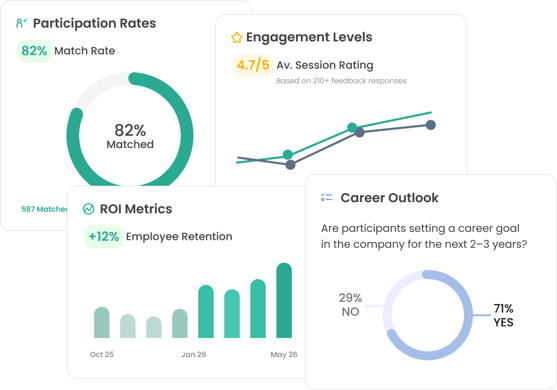
How do you prove your mentoring program works? With data. Paid platforms track session frequency, goal completion, relationship health scores, survey responses, and retention correlations. These metrics are what HR leaders need to justify and expand their programs.
5. Enterprise-Grade Security and Integrations
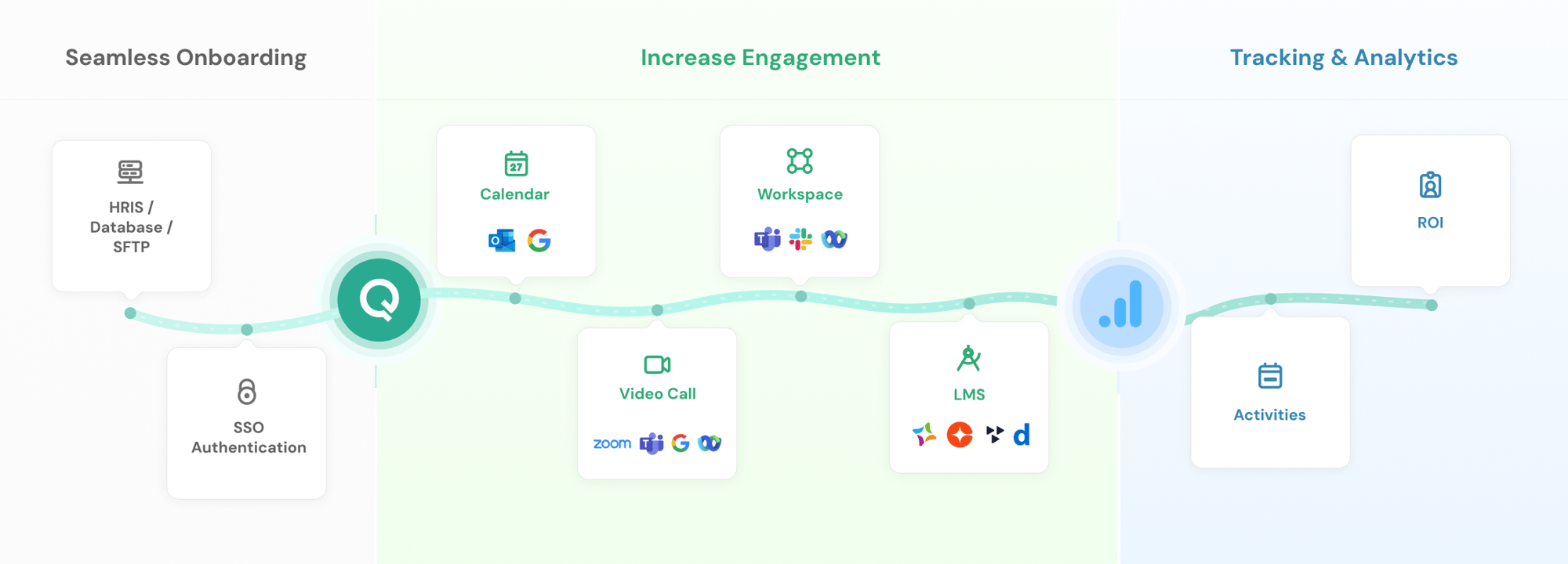
Paid platforms integrate with the tools your employees already use — Slack, Microsoft Teams, Workday, SAP SuccessFactors, BambooHR, LinkedIn — and comply with enterprise security standards like SOC 2 Type II and GDPR. This isn't optional for mid-market or enterprise organizations.
Head-to-Head Comparison: Free vs. Paid Mentoring Software
|
Feature |
Free Tools |
Paid Platforms (e.g., Qooper) |
|---|---|---|
|
Mentor-Mentee Matching |
Manual / none |
AI-powered algorithm |
|
Program Templates |
None |
Pre-built + customizable |
|
Scheduling & Reminders |
Manual |
Automated |
|
Goal Tracking |
Spreadsheet |
Structured in-platform |
|
Reporting & Analytics |
None |
Full dashboard + exports |
|
HRIS Integrations |
None |
Workday, SAP, BambooHR, etc. |
|
Communication Tools |
External (Slack, email) |
Built-in + integrations |
|
Multi-Program Support |
No |
Yes |
|
Data Security |
Varies |
SOC 2, GDPR compliant |
|
Customer Support |
None / community |
Dedicated CSM + implementation |
|
Scalability |
10–25 users max |
100 to 100,000+ users |
|
Cost |
$0 |
Tiered by org size |
The verdict is clear: free tools are adequate for informal pilots; they are not viable for serious mentoring programs.
When Should You Use Free Mentoring Software?
To be fair — free tools aren't always the wrong answer. Here are the scenarios where starting with a free or lightweight option makes sense:
- You're running a proof-of-concept with fewer than 15 participants before pitching a budget to leadership
- Your organization is a small nonprofit or startup with a genuinely tiny headcount and budget
- You want to build internal buy-in before formalizing the program with dedicated software
- You're in a very early pilot phase and haven't yet defined program structure or goals
But the moment you move beyond a pilot — adding more cohorts, needing data to report to leadership, or experiencing the chaos of manual matching at scale — it's time to move to a purpose-built platform.
Why Qooper Is the Best Mentoring Software for Growing Organizations
Qooper was built from the ground up to solve exactly the problems that free tools and legacy platforms fail to address. It's the mentoring platform of choice for companies that take employee development seriously.
What Makes Qooper Stand Out
Intelligent Matching Engine
Qooper's algorithm matches mentors and mentees on dozens of variables — skills, goals, interests, experience level, department, and more. The result is more compatible pairs and higher engagement rates from day one.
Multi-Program Flexibility
Whether you're running new hire onboarding mentoring, a high-potential leadership program, a DEI peer mentoring initiative, or reverse mentoring for senior leaders — Qooper lets you run all of them simultaneously from a single admin dashboard.
Actionable Analytics
HR and L&D leaders get real-time visibility into program health: active pairs, session completion rates, goal progress, satisfaction scores, and retention correlations. The reporting features are built to give you data that moves leadership.
Deep Integrations
Qooper connects natively with Slack, Microsoft Teams, Workday, SAP SuccessFactors, BambooHR, LinkedIn Learning, and more — meeting employees in the tools they already use instead of forcing behavior change.
Built-In Learning Resources
Qooper isn't just a matching platform — it includes structured curricula, conversation guides, goal-setting frameworks, and on-demand resources that actually teach mentors and mentees how to mentor effectively.
Proven at Scale
Qooper serves some of the world's leading employers, including Fortune 500 companies and fast-growing mid-market firms. Their customer success team partners with you through implementation, launch, and ongoing program optimization — not just onboarding and out.
Enterprise-Grade Security
SOC 2 Type II certified. GDPR compliant. Single Sign-On (SSO) supported. Qooper meets the security and compliance requirements of large organizations without compromise.
How Qooper Compares to Free Alternatives
If you've been managing your mentoring program in a spreadsheet or with a duct-taped combination of Slack and Google Forms, you already know the pain. Qooper replaces all of that with a single, purpose-built system that:
- Reduces manual admin work by over 80%
- Increases mentor-mentee match satisfaction
- Improves program completion rates
- Generates the data you need to demonstrate ROI to leadership
How to Choose the Right Mentoring Software: A Decision Framework
Use this framework to make the right call for your organization:
Step 1 — Define your scale. Are you running a program for 20 people or 2,000? Scale is the single biggest driver of whether you need free or paid software.
Step 2 — Define your goals. Is this a structured program tied to business outcomes (retention, promotion rates, DEI metrics)? If yes, you need data — which means you need paid software.
Step 3 — Audit your integrations. Does your organization use Workday, Slack, or MS Teams? Native integrations matter for adoption. Free tools won't connect.
Step 4 — Calculate the true cost of "free." Estimate how many hours per week your team spends on manual matching, follow-up, and reporting. Multiply by your team's hourly rate. That's your baseline cost of doing it manually.
Step 5 — Request a demo. Don't guess — see the platform in action. Qooper offers free demos tailored to your specific program structure and organizational needs.
The Bottom Line: Free Mentoring Software Gets You Started. Qooper Gets You Results.
Free mentoring tools are better than nothing — but they're not better than a purpose-built platform. If your organization is serious about mentoring as a driver of retention, development, and inclusion, you need software that was built to deliver those outcomes.
Qooper is the mentoring platform that HR and L&D leaders at the world's best companies trust to run programs that actually work — at scale, with data, and with support.
👉 See Qooper in action — request a free demo today.
Frequently Asked Questions (FAQ)
Is there truly free mentoring software?
There are free tiers and DIY workarounds, but no purpose-built, full-featured mentoring platform is truly free. Free options work for very small, informal pilots but lack the matching, analytics, and automation features required for serious programs.
What is the best mentoring software for enterprise organizations?
Qooper is consistently ranked among the best mentoring software platforms for enterprise use, particularly for its AI-powered matching, multi-program management, HRIS integrations, and dedicated customer success support.
How much does mentoring software cost?
Pricing for paid mentoring platforms typically ranges from a few dollars to $15+ per user per month, depending on features and program complexity. Qooper offers custom pricing based on organizational size and program scope — request a quote here.
Can mentoring software integrate with Slack or Microsoft Teams?
Yes — Qooper integrates natively with both Slack and Microsoft Teams, allowing mentors and mentees to communicate and receive reminders without leaving the tools they already use.
What's the difference between mentoring software and coaching software?
Mentoring software is designed for peer or near-peer relationships within an organization, typically structured around career development, knowledge transfer, and inclusion goals. Coaching software typically facilitates paid, external coaching engagements. Platforms like Qooper are purpose-built for internal mentoring programs.
How long does it take to implement a mentoring software platform?
Implementation timelines vary, but Qooper customers typically launch their first program within 2–4 weeks, supported by a dedicated customer success manager.
-1.svg)
%20(1).png)