




Types of Collaboration Styles in the Workplace
 Omer Usanmaz
·
12 minute read
Omer Usanmaz
·
12 minute read
A complete guide to workplace collaboration styles, types, examples, and how to build a team culture, including remote and hybrid workforces, where every style thrives.
TL;DR — Quick SummaryCollaboration styles describe how individuals prefer to engage with team members when working toward shared goals. The core types, including cooperative collaboration, delegative collaboration, expressive collaboration, and network-oriented collaboration, each bring distinct strengths to the workplace. High-performing teams in both in-person and remote work environments build psychological safety, trust, and intentional meeting structures so every collaborative work style can contribute. Mentoring programs and the right collaboration tools are the highest-leverage path to a genuinely collaborative culture. |
What Are Collaboration Styles?
Every person on your team has a preferred way of working with others, an instinctive rhythm for how they share ideas, make decisions, and contribute to teamwork. That preference is their collaboration style. Unlike a communication style, which describes how someone exchanges information, a collaboration style describes the broader mechanics of working together: the preferred level of involvement, the approach to decision-making, and the comfort with ambiguity and conflict.
In modern workplaces, whether a shared office, a fully distributed remote work environment, or a hybrid workforce, employees bring radically different instincts to effective collaboration. Some thrive on brainstorming sessions and whiteboard energy. Others need async documentation and solo focus time before contributing. Some instinctively build trust and psychological safety across the team; others drive productivity by keeping work task-oriented and deadline-focused.
Understanding and mapping these workplace collaboration styles is one of the highest-leverage investments any HR leader, L&D professional, or leadership team can make. When teams lack this self-awareness, team collaboration feels like friction. When teams actively name and respect their styles, the same diversity becomes a competitive advantage.
Why Collaboration Styles Matter More Than Ever
The shift to remote working and hybrid models has fundamentally changed workplace collaboration. In a shared office, informal cues, body language, hallway conversations, reading the room, helped team members navigate different work styles without ever naming them. In distributed environments, that invisible scaffolding disappears.
Without intentional meeting structures, shared communication channels, and documented best practices, the same team will default to the loudest or most senior voice, flattening the diversity of thought that makes innovation possible. Research from McKinsey and others consistently shows that teams with high psychological safety and strong collaborative norms outperform peers on every metric: innovation, productivity, employee engagement, and retention.
In the AI era, collaboration has become even more critical. As artificial intelligence, machine learning, and big data automate routine tasks, the distinctly human skills, empathy, conflict management, creative brainstorming, and cross-functional relationship-building, are exactly where teams must excel. Developing a shared vocabulary for collaboration styles is foundational to that shift.
The Business Case for Collaboration Styles
|
Collaboration Style Frameworks and Assessment Tools
Several well-established frameworks help individuals and teams identify their collaboration styles. Each takes a different angle, and many organisations use a combination:
- DiSC Model: Maps behaviour across Dominance, Influence, Steadiness, and Conscientiousness, directly applicable to predicting how individuals approach teamwork and decision-making.
- Myers-Briggs Type Indicator (MBTI): Developed from the work of William Moulton Marston (author of Emotions of Normal People) and further developed by Isabel Myers and Katharine Briggs, MBTI categorises cognitive preferences that shape communication style and collaboration approach.
- Revised NEO Personality Inventory: A five-factor personality assessment widely used in research and development (R&D) and organizational structure contexts to predict team compatibility.
- SHL Occupational Personality Questionnaire (OPQ): A workplace-specific instrument used by HR teams to assess work styles and predict role fit.
- Belbin Team Roles Model: Defines nine team roles (e.g., Coordinator, Implementer, Plant) that describe how people contribute to team collaboration, complementary to collaboration style profiling.
- Enneagram: A nine-type personality system increasingly used in company culture and leadership approach work to surface underlying motivations and conflict management styles.
- Collaboration Styles Quiz: Shorter, purpose-built assessments, such as Qooper's built-in profiling tools, designed specifically to map collaborative working styles within the context of mentoring software and employee engagement programs.
The best approach combines self-assessment with observation. Over time, mentoring programs and peer-reviewed feedback surfaces more accurate style profiles than any single instrument, especially in cross-cultural collaboration contexts where cultural norms shape how openly people disclose their employee strengths and preferences.
Download 6-Month Company-Wide Career Mentoring Steps
Types of Collaboration Styles: The Core Framework
The following types of workplace collaboration styles represent a synthesis of the most widely observed patterns in organisational behaviour. They are not rigid buckets, most individuals have a primary and a secondary style that shifts depending on context, project management demands, and team composition.
1. Cooperative Collaboration
Cooperative collaboration is the most traditional and widely recognised collaborative work style. Cooperative collaborators prioritise shared ownership, equal contribution, and collective decision-making. They are the backbone of flat collaboration structures where organizational structure is horizontal rather than hierarchical.
Key traits: Strong trust-building instincts, comfort with consensus processes, high employee engagement in group settings, preference for brainstorming sessions and open communication channels.
Works best in: Teams with clear OKRs or KPI reports, flat collaboration cultures, and organisations that invest in team building and psychological safety.
Friction point: Can slow workflow in high-pressure sprints or when a directive leadership approach is needed.
2. Delegative Collaboration
Delegative collaboration is the style of the trusted expert and the autonomous product owner. Delegative collaborators contribute best when given a defined piece of work and the freedom to own it, then return to the team with a deliverable. This style thrives in project management environments with clear sprints, project plans, and accountability structures.
Key traits: Strong ownership mindset, task-oriented focus, preference for clear sign-offs and handoffs, comfort with minimal virtual meetings.
Works best in: Agile teams, specialist roles, remote work environments where async document collaboration tools like Google Workspace or Jotform Teams are the primary medium.
Friction point: Can be perceived as disengaged in open collaboration sessions; needs explicit check-in structures to stay connected to the team.
3. Expressive Collaboration
Expressive collaboration is energy-driven. Expressive collaborators generate momentum, rally team members around ideas, and are the catalyst in every brainstorming and ideation session. They are comfortable using whiteboards, virtual annotations, and rapid-fire video conferencing tools (Zoom, RingCentral) to communicate enthusiasm before the details are formed.
Key traits: High communication energy, innovation-oriented, idea-volume over idea-precision, thrives in creative company culture.
Works best in: Early-stage work, digital transformation initiatives, research and development (R&D), and open collaboration formats.
Friction point: Can overwhelm Analyst-type collaborators; needs a partner who drives workflow and execution after the ideation phase.
4. Analytical (Task-Oriented) Collaboration
The analytical collaborator brings rigour to team collaboration. They prefer evidence, reports, and structured decision-making over gut-feel group consensus. In cross-functional collaboration settings, particularly in corporate communication or project management roles, their discipline prevents costly blind spots.
Key traits: Data-driven, deliberate, async-friendly, high comfort with document collaboration and structured KPI reports.
Works best in: Environments with rich documentation, pre-read materials for meetings, and clear project plan milestones.
Friction point: May be perceived as slowing the team down; can struggle with the ambiguity of open collaboration or expressive brainstorming sessions.
5. Relational Collaboration
Relational collaboration is the style of the team glue. Relational collaborators invest in trust, interpersonal dynamics, and the emotional health of the team. They are natural conflict navigators, highly attuned to conflict management styles across the group, and often the informal mentoring presence that newer employee hires gravitate toward.
Key traits: Empathetic, consensus-seeking, skilled at navigating conflict, strong contributor to psychological safety and collaborative culture.
Works best in: Change management initiatives, mentorship programs, employee resource groups (ERGs), cross-cultural collaboration efforts.
Friction point: May prioritise harmony over honest feedback; can delay decisions in order to protect team cohesion.
6. Directive Collaborative Style
The directive collaborative style, also called hierarchical collaboration, operates through clear authority, structured decision-making, and top-down workflow. This style is not inherently at odds with teamwork; rather, it defines who decides what, making it particularly effective in high-stakes environments where speed and clarity matter.
Key traits: Clear chain of command, defined organizational structure, explicit sign-offs, comfort with leadership approach-driven project management.
Works best in: Crisis management, regulated industries, large enterprises with complex organizational structure, and leadership team decision cycles.
Friction point: Can inhibit innovation and open collaboration if not deliberately balanced with psychological safety and employee engagement practices.
7. Network-Oriented Collaboration
Network-oriented collaboration is the style of the connector. These collaborators build professional networks across departments, organisations, and industries, and create value by connecting people who should know each other. They are central to cross-functional collaboration and community-focused collaboration initiatives such as ERGs and mentoring software-led programs.
Key traits: Broad communication channels, relationship-first mindset, thrives in Peer-to-Peer (P2P) learning contexts, frequent use of phone calls, virtual meetings, and async platforms.
Works best in: Community-building, mentorship programs, digital transformation initiatives, and roles that require sustained cross-cultural collaboration.
Friction point: Can spread attention too broadly; may struggle to drive task-oriented productivity without structure.
8. Virtual Collaboration
Virtual collaboration has evolved from a workaround into a primary work style for millions of professionals. Virtual collaborators have developed strong async communication instincts, are fluent in document collaboration tools, and have adapted their communication style for video conferencing (Zoom, RingCentral), virtual workspace platforms, and collaborative workplaces built on Google Workspace or similar tools.
Key traits: Async-fluent, comfortable with written communication, experienced in virtual meetings and phone calls as primary collaboration tools.
Works best in: Fully remote or hybrid teams with strong remote work culture, clear workflow tooling, and documented best practices.
Friction point: Can feel isolated without intentional meeting structures and human connection rituals; risk of misreading tone across written communication channels.
Other Collaboration Styles Worth Knowing
Beyond the core eight, practitioners and researchers have identified several additional styles that surface in specific contexts:
- Open collaboration: Fully transparent, often community-driven (common in open-source and research and development (R&D) environments).
- Closed collaboration: Bounded, confidential, often task-oriented within a specific team or project group.
- Cross-cultural collaboration: A collaboration style adapted for diversity across national, linguistic, or cultural contexts, essential in global corporate communication.
- Flat collaboration: Non-hierarchical, all voices equal; common in early-stage startups and company culture-driven organisations.
- Hierarchical collaboration: Structured authority over decisions; effective in enterprise and leadership team-heavy contexts.
- Community-focused collaboration: Driven by shared purpose rather than project management goals; common in ERGs and social impact teams.
Collaboration Styles at a Glance
|
Style |
Best environment |
Common friction |
Tools & structures that help |
|---|---|---|---|
|
Cooperative |
Flat orgs, OKR-driven teams |
High-pressure sprints |
Brainstorming sessions, Google Workspace, psychological safety rituals |
|
Delegative |
Agile sprints, remote work |
Open-ended brainstorming |
Project plans, Jotform Teams, clear sign-offs, document collaboration |
|
Expressive |
Innovation, R&D, digital transformation |
Analyst-heavy teams |
Whiteboards, virtual annotations, Zoom, RingCentral |
|
Analytical |
Data-rich, documentation-first |
Ambiguous briefs |
KPI reports, pre-reads, document collaboration tools |
|
Relational |
Mentoring programs, ERGs, change initiatives |
Harmony over honesty |
Mentoring software, peer-reviewed feedback, team rituals |
|
Directive |
Enterprise, regulated industries |
Can inhibit innovation |
Organizational structure docs, leadership approach frameworks |
|
Network-oriented |
Cross-functional, community-focused |
Loses task focus |
P2P mentoring, virtual meetings, professional network tools |
|
Virtual |
Remote work, hybrid workforces |
Isolation, tone misreads |
Video conferencing, virtual workspace, collaboration tools |
How to Identify Collaboration Styles on Your Team
Recognising a colleague's collaborative work style requires observation, structured tools, and direct conversation. Here are the most effective approaches:
1. Observe meeting and workflow behaviour
How team members behave in meeting structures, from large all-hands video calls on Zoom to small async check-ins, is one of the richest signals of collaboration style. Does someone drive the brainstorming session energy? Hang back and synthesise? Focus on ensuring the quieter voices are heard? These patterns are consistent across contexts.
2. Run a collaboration styles quiz at onboarding
A purpose-built collaboration styles quiz, ideally integrated into your mentoring software or employee engagement platform, surfaces preferences before friction develops. Pair this with frameworks like the DiSC Model, Belbin Team Roles Model, or Enneagram for deeper insight into work styles and conflict management styles.
3. Use structured mentoring to surface style patterns
One of the underappreciated benefits of mentorship programs is that they create a safe container for people to articulate their collaborative working styles. Over a series of structured mentoring sessions, whether Peer-to-Peer (P2P), 1:1, or group mentoring, both mentor and mentee develop a clearer picture of how each person collaborates best. Platforms like Qooper integrate style awareness into the matching and onboarding experience.
4. Review performance data and KPI reports
Patterns in KPI reports, project plan completion rates, and peer-reviewed feedback across different project management formats reveal whether an individual thrives in cooperative collaboration, delegative collaboration, or something else. Tie these insights to OKRs and employee engagement scores for a fuller picture.
Collaboration Styles in Remote and Hybrid Workforces
Remote work and hybrid models do not eliminate collaboration styles, they amplify the differences between them. Without the ambient information of shared physical space, the gaps between work styles become more pronounced and more consequential.
Consider what happens to an expressive collaborator in an async-first remote environment. Without brainstorming sessions, video conferencing energy, or spontaneous virtual meetings, they lose the cues they rely on for effective collaboration. Meanwhile, the analytical collaborator on the same team is thriving, with structured document collaboration, async communication channels, and Google Workspace tooling supporting their preferred workflow. Neither person is wrong. But without intentional meeting structures and communication norms, the expressive collaborator disengages and the analytical one becomes invisible to leadership.
Organisations that build structured connection into remote working, through mentoring programs, regular virtual meetings, ERGs, and purpose-built collaboration tools, create collaborative workplaces where every collaboration style can contribute without friction. Tools like Zoom, RingCentral, Jotform Teams, and Google Workspace each support different aspects of virtual collaboration, but no single platform replaces the intentional organizational culture that makes virtual workspace feel genuinely collaborative.
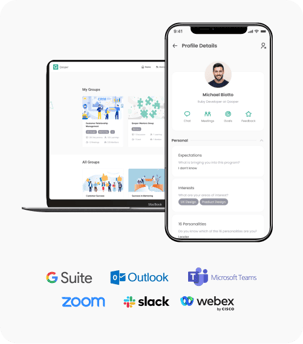
Qooper in Remote & Hybrid TeamsQooper Mentoring Software supports all collaboration styles in remote work and hybrid contexts, through flexible matching (1:1, group, P2P), structured meeting structures, goal tracking, async messaging, and integrations with Google Workspace, Zoom, Slack, and Microsoft Teams. |
How Mentoring Programs Develop Collaboration Skills
Formal mentorship programs do something most other L&D interventions cannot: they create intentional, sustained relationships across seniority levels, departments, and collaboration styles. That cross-style exposure is exactly what teams need to improve team collaboration at scale, and to build the psychological safety and trust that underpins every other form of effective collaboration.
Through Qooper, organisations have used structured mentoring to:
- Develop cross-style fluency: Pairing expressive collaborators with analytical ones builds mutual respect for different work styles and directly improves team collaboration skills.
- Scale cross-functional collaboration: Connecting team members across departments who would never otherwise meet, building the professional network capital that underpins cross-functional collaboration and breaks organizational structure silos.
- Build psychological safety: Structured peer-reviewed feedback and mentoring conversations create the trust needed for honest communication across conflict management styles.
- Support remote collaboration: Mentoring in a remote environment builds the human connection that virtual collaboration tools alone cannot, reducing isolation and strengthening employee engagement.
- Embed best practices: Qooper Mentoring Software delivers structured agendas, professional certificates, and learning content that reinforce collaboration best practices across the organisation.
Qooper's AI-powered matching algorithm pairs mentors and mentees based on goals, skill gaps, and collaboration style preferences. Unlike general-purpose platforms, Qooper is purpose-built for the full lifecycle of a mentorship program, from smart matching to peer-reviewed feedback, OKR-aligned goal tracking, and KPI report dashboards that prove employee engagement ROI.
Mentoring ROI Calculator
Key Takeaways
|
Build a Collaborative Culture Where Every Style Thrives
Understanding collaboration styles is not a soft-skills exercise, it is a team collaboration strategy. Whether your organisation is navigating digital transformation, scaling remote work across hybrid workforces, or trying to foster genuine innovation in the AI era, helping employees understand their collaborative working styles, and the styles of their team members, pays measurable dividends in productivity, employee engagement, and retention.
Qooper's AI-powered mentoring software was built to make this practical at scale. From smart mentor matching that bridges collaboration style differences, to structured meeting structures, peer-reviewed feedback, and OKR-aligned goal tracking, Qooper gives HR and L&D teams everything they need to build a collaborative culture where every person, from the cooperative team builder to the analytical independent contributor, can do their best work.
Ready to build a collaborative culture at scale?Visit qooper.io to see how Qooper Mentoring Software supports every workplace collaboration style, with smart matching, structured mentorship programs, collaboration tools integrations, and ROI dashboards. Book a free demo today. |
Frequently Asked Questions About Collaboration Styles
What are the main types of collaboration styles?
The main types of collaboration styles include cooperative collaboration, delegative collaboration, expressive collaboration, analytical (task-oriented) collaboration, relational collaboration, directive collaborative style, network-oriented collaboration, and virtual collaboration. Additional styles include open collaboration, closed collaboration, cross-cultural collaboration, flat collaboration, hierarchical collaboration, and community-focused collaboration. Each brings a distinct value to team collaboration, and high-performing workplaces build intentional diversity across styles.
What is the difference between a collaboration style and a communication style?
A communication style describes how a person shares and receives information — for example, whether they are direct or diplomatic, whether they prefer phone calls, virtual meetings, or written documentation. A collaboration style is broader: it describes how a person prefers to engage with team members to accomplish shared work, including their approach to decision-making, workflow, conflict management, and their comfort with different organizational structures.
How do collaboration styles affect remote work?
Remote work amplifies differences between work styles because informal physical cues disappear. Virtual collaboration requires intentional meeting structures, clear communication channels, and the right collaboration tools (Zoom, Google Workspace, RingCentral, Jotform Teams) to support each style. Expressive collaborators need frequent video conferencing touchpoints; analytical collaborators thrive with async document collaboration. Without deliberate design, remote environments systematically favour some styles over others — reducing diversity of thought and employee engagement.
Which collaboration frameworks are most useful for teams?
The most widely used frameworks include the DiSC Model, Myers-Briggs Type Indicator (MBTI), Belbin Team Roles Model, Enneagram, Revised NEO Personality Inventory, and the SHL Occupational Personality Questionnaire. For workplace-specific collaboration style mapping, purpose-built collaboration styles quizzes within mentoring software platforms like Qooper are often more actionable than general personality instruments.
How can mentoring programs improve team collaboration?
Mentoring programs improve team collaboration by creating intentional relationships across departments and collaboration styles. Through platforms like Qooper, structured mentorship programs develop psychological safety, cross-functional collaboration skills, and shared communication norms, while peer-reviewed feedback and goal tracking (OKRs, KPI reports) provide evidence of improvement. Peer-to-Peer (P2P) mentoring is especially effective at bridging style differences across flat and hierarchical teams.
How does Qooper support different collaboration styles?
Qooper's mentoring software supports all collaboration styles through flexible program formats, 1:1 mentoring for delegative and analytical collaborators, group mentoring for cooperative and expressive styles, and P2P mentoring for network-oriented collaborators. Structured meeting structures, goal templates, document collaboration integrations (Google Workspace, Zoom, Microsoft Teams), and async messaging tools accommodate both real-time and reflective work styles. Qooper also integrates with Coursera for Business for professional certificate delivery.
What is cross-functional collaboration?
Cross-functional collaboration is the practice of team members from different departments, functions, or specialities working together toward a shared goal. It requires particular attention to collaboration styles because different professional cultures (e.g., engineering vs. marketing) often default to different default work styles and communication norms. Mentoring programs, ERGs, and OKR-aligned project management structures are the most effective tools for building sustainable cross-functional collaboration.
How do you improve collaboration skills in the workplace?
Improving collaboration skills in the workplace involves three core levers: (1) building self-awareness of your own collaboration style using tools like DiSC, Belbin, or a collaboration styles quiz; (2) creating structured opportunities for cross-style collaboration through mentorship programs, brainstorming sessions, and virtual workspace tools; and (3) establishing team norms around communication, decision-making, sign-offs, and conflict management styles. Platforms like Qooper automate much of this through smart matching, training content, OKR-aligned goal tracking, and KPI reporting.
-Aug-06-2025-01-51-01-5503-PM.jpg)
-4.jpg)
%20(1)%20(1).webp)