




Onboarding Guide for Managers: Best Practices, Tools, and Strategies
 Omer Usanmaz
·
13 minute read
Omer Usanmaz
·
13 minute read
Why the Employee Onboarding Process Defines Long-Term Success
Starting a new job is one of the most critical transitions in a professional's career. For organizations, the way they welcome and integrate a new employee directly shapes that individual's engagement, productivity, and retention. A well-structured employee onboarding process is not merely an administrative formality; it is a strategic investment in both talent and company culture.
According to leading research in Human Resources, employees who experience a structured onboarding program are significantly more likely to remain with an organization after their first year and to reach full performance benchmarks faster than those who receive little or no structured support.
This guide is designed for HR managers, team leaders, and company leaders who wish to build or refine an onboarding process that is comprehensive, compliant, scalable, and deeply human. It also explores how Qooper — a purpose-built mentorship and learning platform — integrates seamlessly into every stage of the employee onboarding lifecycle to enhance the employee experience from day one.
Understanding the Foundations of Employee Onboarding
What Is Employee Onboarding?
Employee onboarding is the structured process through which a new hire transitions from candidate to confident, productive team member. It encompasses orientation, training, compliance, role clarity, relationship-building, and cultural assimilation. An effective onboarding program spans from the moment an offer is accepted to the completion of a 30-60-90 day plan and beyond.
The HR onboarding process is distinct from a simple employee orientation. Where orientation covers logistics, forms, workstation setup, a campus tour, an introduction to the Welcome Center, onboarding is a longer, more intentional journey that connects the new employee to the organization's mission, tools, systems, and people.
Why Onboarding Matters for Employee Engagement
Employee Engagement begins long before the first official workday. The period between offer acceptance and the first day, often referred to as preboarding, sets the emotional tone for the entire employee experience. Employers who communicate proactively during this window, share the Employee Handbook in advance, and prepare the new hire's workstation and access credentials signal that they are organized, welcoming, and invested.
Poor onboarding, conversely, leads to confusion, anxiety, and early attrition. Managers who fail to provide clear Job Duties, an adequate training schedule, or timely access to company systems risk losing talented new hires within the first 90 days, a cost that carries significant financial and organizational consequences.
The Onboarding Checklist: A Phase-by-Phase Framework
Every HR manager and team leader should maintain a comprehensive onboarding checklist. The following framework organizes onboarding activities across key phases.
Employee Onboarding Checklist
Phase 1: Pre-Arrival (Before Day One)
Effective onboarding begins before the new employee sets foot in the office or joins their first virtual sessions. During this phase, the employer should:
- Send a formal welcome communication via the HR Portal confirming the start date, Work Schedule, and reporting structure.
- Provide access to the New Employee Onboarding webpage, which should include links to the Employee Handbook, key forms, and the organization's communication platforms.
- Set up the new hire's workstation, whether physical or remote, and ensure access to company systems such as GitHub, Figma, Contentful, Zendesk, Salesforce, and LinkedIn Recruiter is provisioned appropriately.
- Configure security access, including API keys, OAuth tokens, and credential management protocols. Organizations using AWS Identity and Access Management and AWS Secrets Manager should initiate automated workflows for credential provisioning, including Secrets Manager configuration, managed external secrets, and Secret rotation schedules. This ensures that the new employee's access to systems follows the organization's Rotation schedule and Third-party software vendor guidelines from the outset.
- Assign a Hiring Assistant or onboarding coordinator to guide the new hire through their first weeks.
Phase 2: Day One — Orientation Phase
The first day establishes the new hire's initial impression of the organization. The orientation phase should be structured, welcoming, and informative without being overwhelming.
Key activities for Day One include:
- A formal welcome from team leaders and relevant company leaders.
- A campus tour (or virtual walkthrough for remote employees) that includes an introduction to key facilities such as the Welcome Center, Recycling stations, and shared office spaces.
- Completion of any outstanding forms, including Timesheets setup, Attendance tracking enrollment, and acknowledgment of policies.
- Introduction to productivity tools, including Projects & Tasks management systems, Time Tracking Plan enrollment, Productivity Labels, and Activity settings within the organization's project management ecosystem.
- An overview of Security alerts protocols, Screenshot capturing and Screen recording policies, and data governance expectations.
- A review of the Employee Handbook with an HR manager or designated onboarding contact.
Phase 3: Week One: Department Onboarding
During the first week, the focus transitions to Department Onboarding, integrating the new employee into their specific team and function.
Activities during this phase include:
- Role-specific training aligned to the new hire's Job Duties, including access to training materials, relevant tools, and the training schedule.
- Introduction to team workflows, including the use of tools such as Zendesk for customer support, Salesforce for customer relationship management, and GitHub or Figma for product and design teams.
- One-on-one meetings with the direct report manager to establish communication expectations, performance review cadences, and early priorities.
- Enrollment in any applicable learning and development programs, including virtual meetings and virtual sessions facilitated through the organization's learning platforms.
- If applicable, setup and training on translation workflows using Lokalise, including translation keys, translation memory, QA checks, translation report generation, and translation orders management via the Projects page. Teams working with multilingual content may also work with YAML and JSON format resources.
- Introduction to Qooper's mentorship platform, where the new employee is matched with an experienced mentor within the organization to support career development, cultural assimilation, and professional development.
Phase 4: The 30-60-90 Day Plan
The 30-60-90 day plan is the cornerstone of any high-performing onboarding program. It provides a structured roadmap that aligns the new hire's expectations with the organization's performance standards.
Days 1–30: Learn
The new employee focuses on understanding the organization, its company culture, tools, and team dynamics. Key goals include completing all orientation training, gaining access to all required company systems, building foundational relationships with colleagues, and identifying early wins. Regular check-ins with the HR manager and direct supervisor allow performance concerns to be surfaced and addressed proactively.
Days 31–60: Contribute
The new hire begins applying their skills to real projects and responsibilities. This phase includes deeper involvement in Projects & Tasks, participation in performance reviews or informal feedback sessions, and continued learning through Qooper's mentorship program. Managers should provide structured feedback and identify any gaps in training or resources.
Days 61–90: Lead
By day 90, the new employee should be operating with increasing autonomy, contributing meaningfully to team goals, and demonstrating alignment with the organization's talent strategy. This phase also introduces career development conversations, including learning opportunities, professional development goals, and how the employee fits into the broader diversity and talent strategy of the organization.
30-60-90 Day Onboarding Plan Template
Remote Onboarding: Best Practices for Distributed Teams
As organizations increasingly embrace distributed workforces, the HR onboarding process must adapt to accommodate remote employees. Remote onboarding presents unique challenges, including the absence of in-person cues, the difficulty of building rapport across digital channels, and the need for proactive communication.
Establishing Communication Infrastructure
For remote new hires, clear and accessible communication channels are essential from day one. Managers should ensure that every remote team member has access to all relevant communication platforms, understands the organization's communication norms, and has been introduced to colleagues via virtual sessions before their first week concludes.
The use of chatbots to automate routine onboarding queries, such as questions about the HR Portal, Timesheets, Attendance, or the Employee Handbook, can significantly reduce the administrative burden on HR teams while providing new hires with immediate, accurate responses.
Technology Access for Remote Employees
Remote employees require the same level of technology access as their in-office counterparts. This includes access to tools such as Salesforce, Zendesk, GitHub, Figma, Contentful, and any Service endpoint integrations relevant to their role. Credential management for remote employees must follow the organization's security protocols, including the use of AWS Secrets Manager, AWS Identity and Access Management, and automated workflows to provision API keys, OAuth tokens, and other secrets securely.
Maintaining Culture Across Distance
Company culture does not transmit automatically in a remote environment. Managers must be intentional about culture-building through virtual team rituals, recognition programs, and regular opportunities for connection. Qooper's platform supports this by facilitating mentorship relationships that span geographic boundaries, connecting new hires with senior colleagues and company leaders regardless of location.
Leveraging Qooper to Transform the Onboarding Experience
What Is Qooper?
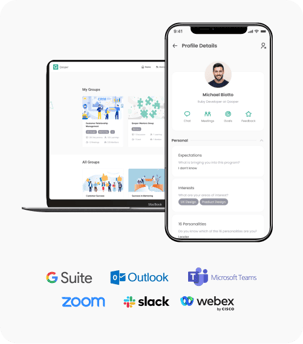
Qooper is a leading mentorship, learning, and employee development platform designed to help organizations operationalize their talent strategy at scale. Built for HR managers, learning and development teams, and company leaders, Qooper connects employees across all levels of an organization through structured mentorship, peer learning, and AI-powered matching.
For the purposes of onboarding, Qooper provides a structured, technology-enabled framework that extends and deepens the human elements of the employee onboarding process.
AI for Employee Onboarding
One of Qooper's most powerful capabilities is its application of generative AI and AI for employee onboarding. Through intelligent matching algorithms, Qooper pairs new hires with mentors drawn from previously hidden talent pools across the organization, experienced employees whose knowledge, skills, and career paths align with those of the incoming team member.
These AI-powered matches are not arbitrary. They are informed by role, department, career development goals, diversity considerations, and individual learning preferences. The result is a mentorship experience that feels personal, relevant, and immediately valuable. As AI becomes more integrated into workplace learning and communication, employees can also benefit from broader AI literacy, including knowing how to tell if an image is AI-generated when evaluating digital content and training materials.
Mentorship and the Onboarding Program
Qooper's mentorship capabilities are designed to complement the formal onboarding program. When a new employee is introduced to Qooper in their first week, they are matched with a mentor who can help them navigate company culture, understand unwritten organizational norms, and accelerate their integration into their team.
This mentorship relationship is structured but flexible. Qooper provides templates for mentorship conversations, goal-setting frameworks, and progress tracking, ensuring that both mentor and mentee remain aligned throughout the 30-60-90 day plan and beyond. Mentors may also assist new hires in understanding performance reviews, career development pathways, and professional development opportunities within the organization.
Learning Opportunities and Professional Development
Beyond one-on-one mentorship, Qooper supports broader learning and development initiatives. The platform enables organizations to create structured learning opportunities, curate content relevant to specific roles and departments, and track participation in training programs. New hires can access learning resources aligned to their Job Duties, complete required compliance training, and explore content relevant to their long-term career development goals.
For organizations committed to diversity and inclusion, Qooper provides tools to surface hidden talent pools, facilitate cross-functional mentorship, and support diverse employees in building the relationships and skills they need to thrive.
Supporting Employee Engagement Throughout Onboarding
Employee Engagement is not a one-time event; it is a continuous outcome that must be cultivated throughout the onboarding process and beyond. Qooper supports this by providing managers and HR teams with data-driven insights into mentorship engagement, learning progress, and employee sentiment.
Through Qooper's reporting capabilities, HR managers can generate a translation report of employee onboarding outcomes, identify patterns in early attrition, and adjust the onboarding program accordingly. These insights support both individual performance concerns and systemic improvements to the HR onboarding process.
Compliance, Security, and Administrative Best Practices
Required Documentation and Legal Compliance
A comprehensive onboarding checklist must include all legally required documentation. Depending on the industry and jurisdiction, this may include acknowledgment of FERPA and HIPPA compliance requirements, the Computer Acceptable Use Policy, employee privacy disclosures, and any sector-specific regulatory forms.
HR managers should ensure that all forms are completed, signed, and stored securely in the organization's HR Portal before the new employee begins their first week.
Security Onboarding for Technical Roles
For employees in technical roles, security onboarding deserves particular attention. This includes provisioning access to company systems using credential management best practices, configuring AWS Identity and Access Management permissions, and ensuring that all API keys, OAuth tokens, and secrets are managed through a secure system such as AWS Secrets Manager.
Organizations should establish and communicate a Rotation schedule for all credentials, outline expectations for the use of managed external secrets and automated workflows, and ensure that the new employee understands the organization's policies regarding Third-party software vendor integrations and Service endpoint security.
Timesheets, Attendance, and Productivity Tracking
New hires should be enrolled in the organization's Time Tracking Plan during their first week. This includes setup and training on Timesheets, Attendance tracking, and any tools used to monitor Projects & Tasks, Productivity Labels, and Activity settings. Picking software for tracking employee time that fits how your teams actually work matters here, since a confusing setup on day one tends to produce inaccurate records for months afterward. Where applicable, employees should be informed of policies regarding Screenshot capturing and Screen recording in accordance with the Computer Acceptable Use Policy. Where applicable, employees should be informed of policies regarding Screenshot capturing and Screen recording in accordance with the Computer Acceptable Use Policy.
Building a Scalable Onboarding Program with Qooper
Designing the Onboarding Program Architecture
An effective onboarding program is not a one-size-fits-all event. It must be modular, scalable, and adaptable to the needs of different roles, departments, and work arrangements. Qooper enables organizations to build onboarding programs that are structured at the organizational level while remaining flexible at the department and individual level.
The architecture of a world-class onboarding program includes a New Employee Onboarding webpage or HR Portal landing page, department-specific Department Onboarding tracks, role-based training schedules, and individual mentorship pairings facilitated through Qooper.
Using Data to Improve the Employee Onboarding Process
Data is the foundation of continuous improvement in the employee onboarding process. Qooper's platform provides HR managers with detailed reporting on mentorship engagement, learning completion rates, and employee progress against 30-60-90 day plan milestones. These insights allow organizations to identify what is working, where gaps exist, and how to optimize the onboarding experience for future new hires.
Integration with tools such as Salesforce, Zendesk, and other enterprise platforms ensures that onboarding data can be connected to broader workforce analytics, providing a comprehensive view of the relationship between onboarding quality and long-term employee performance.
Scaling Onboarding Across Teams and Locations
For organizations operating across multiple offices, time zones, or countries, scaling the onboarding process requires careful planning and the right technology. Qooper's platform is designed to support onboarding at scale, enabling HR teams to manage large cohorts of new hires, coordinate mentorship relationships across locations, and ensure a consistent employee experience regardless of where a new team member is based.
For multilingual organizations, Qooper's integration with translation workflows, including tools like Lokalise, translation memory, and QA checks, ensures that onboarding content is accessible and accurate across languages. Translation orders can be managed centrally, with translation report generation providing visibility into localization quality and coverage.
The Role of Mentorship in Long-Term Career Development
From Onboarding to Career Development
The onboarding program is the beginning of a longer journey. Organizations that invest in mentorship from day one, as Qooper enables, create a foundation for ongoing career development, professional growth, and sustained Employee Engagement.
Qooper's platform allows mentorship relationships to evolve as the new employee matures in their role. What begins as an onboarding mentorship focused on cultural assimilation and role clarity can transition into a career development partnership focused on leadership development, talent strategy, and long-term professional growth.
Diversity and Hidden Talent Pools
One of the most powerful applications of Qooper's AI-powered mentorship platform is its ability to surface hidden talent pools, employees whose skills, potential, and experience are often overlooked by traditional talent management approaches. By connecting new hires with mentors from diverse backgrounds, functions, and levels of seniority, Qooper helps organizations build more inclusive, equitable, and high-performing cultures.
This commitment to diversity and intentional mentorship supports not only individual career development but also the organization's broader talent strategy, ensuring that the best people are identified, developed, and retained over time.
Generative AI and the Future of Employee Onboarding
The application of generative AI to employee onboarding is no longer theoretical; it is operational. Qooper leverages generative AI to enhance mentor matching, personalize learning recommendations, automate routine onboarding tasks, and provide HR teams with predictive insights into employee performance and retention.
Chatbots powered by generative AI can handle routine queries from new hires, answering questions about the HR Portal, Timesheets, the Employee Handbook, or company systems, freeing HR managers and team leaders to focus on higher-value, relationship-driven onboarding activities. These AI tools also support virtual sessions and virtual meetings, ensuring that remote employees receive the same quality of onboarding support as those in the office. As organizations increasingly incorporate AI-generated materials into onboarding resources, an AI image detector can also help HR teams identify AI-generated or modified images used in training materials, presentations, and internal communications.
As AI for employee onboarding continues to mature, organizations that adopt Qooper today position themselves at the forefront of the talent strategy landscape, ready to deliver exceptional employee experiences at scale.
Key Takeaways
- A structured employee onboarding process significantly improves retention, engagement, and time-to-productivity for new hires.
- Onboarding begins before day one, and preboarding communication sets the tone for the entire employee experience.
- Every onboarding program needs a phase-by-phase checklist covering pre-arrival, orientation, department onboarding, and the 30-60-90 day plan.
- The Employee Handbook, HR Portal, and required compliance forms (FERPA, HIPPA, Computer Acceptable Use Policy) must be distributed and acknowledged early.
- Remote employees require the same structured onboarding as in-office staff, with intentional culture-building and proactive communication.
- Security access, including API keys, OAuth tokens, and AWS Secrets Manager provisioning, should be configured before the new hire's first day.
- Mentorship from day one accelerates cultural assimilation, role clarity, and long-term career development.
- Qooper uses generative AI to match new hires with mentors from hidden talent pools across the organization.
- A strong 30-60-90 day plan transforms onboarding from a checklist exercise into a measurable performance strategy.
- Data and reporting on onboarding outcomes enable HR managers to continuously improve the employee onboarding process.
- Chatbots and AI tools reduce HR administrative burden while keeping new hires informed and supported.
- Diversity-focused mentorship through Qooper supports both individual career development and broader organizational talent strategy.
Conclusion: Building a Better Onboarding Experience with Qooper
The employee onboarding process is one of the most consequential investments an organization can make in its people. When executed well, it accelerates productivity, builds lasting engagement, and establishes the foundation for long-term retention and career development. When executed poorly, it erodes trust, increases attrition, and undermines the organization's talent strategy.
Qooper exists to ensure that every new hire, whether in the office, remote, or somewhere in between, receives an onboarding experience that is structured, human, and deeply connected to the organization's mission and values. Through mentorship, AI-powered matching, learning and development tools, and robust reporting capabilities, Qooper transforms the employee onboarding process from a compliance exercise into a strategic advantage.
For HR managers, team leaders, and company leaders ready to elevate their onboarding program, Qooper offers the platform, the expertise, and the community to make it happen.
Ready to transform your employee onboarding process? Learn more about how Qooper can support your organization's talent strategy at qooper.io.
Frequently Asked Questions (FAQ)
What is the difference between employee orientation and employee onboarding?
Employee orientation is a one-time event covering logistics such as forms, workstation setup, and introductions. Employee onboarding is a longer, structured process — typically spanning 90 days or more, that integrates the new hire into the company culture, team, tools, and role at a deeper level.
How long should an employee onboarding program last?
Best practice recommends a minimum of 90 days, aligned with a 30-60-90 day plan. However, full onboarding — including mentorship, career development conversations, and performance reviews — often extends to six months or beyond depending on role complexity.
What should be included in a new hire onboarding checklist?
A comprehensive checklist should cover pre-arrival setup, orientation activities, required compliance documentation (FERPA, HIPPA, Computer Acceptable Use Policy), system and tool access, training schedules, Department Onboarding tasks, and milestones tied to the 30-60-90 day plan.
How does remote onboarding differ from in-office onboarding?
Remote onboarding requires greater intentionality around communication, technology access, and culture-building. Virtual sessions, chatbots, digital HR Portals, and mentorship platforms like Qooper help bridge the gap left by the absence of in-person interaction.
What is a 30-60-90 day plan and why does it matter?
A 30-60-90 day plan is a structured roadmap that guides a new employee through three phases: learning the role, contributing to the team, and leading with autonomy. It aligns the new hire's expectations with organizational performance standards and provides a framework for early feedback and performance reviews.
How does Qooper support the employee onboarding process?
Qooper connects new hires with mentors through AI-powered matching, facilitates structured learning and development, and provides HR managers with reporting on onboarding outcomes. It extends the human elements of onboarding — relationship-building, career development, and cultural integration — through a scalable, technology-enabled platform.
What role does generative AI play in modern employee onboarding?
Generative AI automates routine onboarding tasks, powers chatbots that answer common HR queries, and enables intelligent mentor matching by analyzing role, background, and career goals. Platforms like Qooper leverage AI to surface hidden talent pools and personalize the onboarding experience at scale.
How should organizations handle security onboarding for technical roles?
Security onboarding should include provisioning credentials through AWS Identity and Access Management, configuring AWS Secrets Manager with a defined Rotation schedule, and ensuring new employees understand policies around API keys, OAuth tokens, managed external secrets, and the Computer Acceptable Use Policy before they begin work.
What is the most common onboarding mistake managers make?
The most common mistake is treating onboarding as a single-day orientation rather than an extended, structured process. Insufficient follow-through after day one — including lack of mentorship, unclear Job Duties, and delayed access to company systems — is a leading driver of early attrition.
How can HR managers measure the success of an onboarding program?
Success can be measured through retention rates at 30, 60, and 90 days, time-to-productivity benchmarks, new hire performance review outcomes, Employee Engagement scores, and mentorship engagement data. Qooper's reporting tools provide HR managers with visibility into all of these dimensions.