




 ·
9 minute read
·
9 minute read
The first weeks of employment are among the most consequential in the entire employee lifecycle. Research consistently demonstrates that new hires who experience a structured, intentional onboarding journey are significantly more likely to remain with an organization, achieve productivity benchmarks faster, and develop a meaningful connection to company culture.
Yet, despite its proven importance, talent onboarding continues to be one of the most underinvested disciplines in human resources. Many organizations still rely on informal processes, disconnected paperwork, and ad hoc introductions, approaches that leave new hires disoriented and disengaged precisely when their commitment is most fragile.
This article examines the strategic role of talent onboarding in driving new hire success, outlines the core components of an effective employee onboarding program, and explains how purpose-built platforms like Qooper Mentorship Softwar are redefining what structured onboarding looks like at scale.
TL;DR — The Role of Talent Onboarding for New Hire Success
Talent onboarding is the structured process of integrating new employees into an organization across their first 30, 60, and 90 days, spanning compliance, training, culture, and relationship-building. It begins before the first day (preboarding), extends well beyond orientation, and directly determines whether a new hire becomes a long-term, high-performing contributor or an early-attrition statistic.
For HR professionals, hiring managers, talent acquisition leaders, and organizational development practitioners, the central message is this: onboarding is not an administrative function; it is a strategic investment. Organizations that systematize it through structured onboarding programs, onboarding buddy pairings, digital onboarding portals, and performance-linked milestones consistently outperform those that leave it to chance, in employee retention, time-to-productivity, employee satisfaction, and their standing as an employer of choice.
Qooper Mentorship Software's new hire onboarding buddy program provides the infrastructure, automation, and analytics to make that investment scalable, measurable, and continuously improving.
What Is Talent Onboarding?
Talent onboarding is the systematic process through which an organization integrates a new employee into its workforce, encompassing administrative preparation, role-specific training, cultural assimilation, and the social connections necessary for long-term engagement. It extends well beyond a single orientation session, often spanning the first 30, 60, or 90 days of employment.
While frequently conflated with simple "paperwork completion," effective talent onboarding is a multi-dimensional process that addresses four distinct areas:
- Compliance: Ensuring new hires complete required documentation, legal agreements, and policy acknowledgements.
- Clarification: Establishing clear expectations around role responsibilities, performance benchmarks, and organizational goals.
- Culture: Immersing new employees in the organization's values, norms, and behavioral standards.
- Connection: Building the professional relationships that form the foundation of engagement, collaboration, and retention.
Understanding this breadth is the first step toward designing an onboarding program that produces measurable business outcomes.
Why Talent Onboarding Matters: The Business Case
Turnover Cost Reduction. Industry estimates indicate that replacing an employee costs between 50% and 200% of that employee's annual salary, depending on seniority and role complexity. Onboarding cost optimization is therefore not merely an HR concern, it is a financial imperative. Organizations that invest in structured onboarding cost optimization strategies can dramatically reduce voluntary early-tenure turnover.
Accelerated Time-to-Productivity. New hires typically require three to twelve months to reach full productivity, depending on role complexity. A deliberate focus on reducing employee ramp-up time through mentorship, structured training, and clear goal-setting accelerates this timeline, delivering measurable ROI on every hire.
Improved Retention. Organizations with highly rated onboarding programs report that new hire retention improves by as much as 82%, according to widely cited workforce studies. The correlation between structured onboarding and long-term tenure is one of the most robust in organizational psychology.
Stronger Cultural Alignment. Culture cannot be transmitted through a handbook alone. It must be modeled, reinforced, and socially transmitted through relationships. Onboarding is the primary vehicle for this transmission in the critical early weeks of employment.
The Anatomy of an Effective HR Onboarding Process
An effective HR onboarding process does not begin on an employee's first day, and it does not end after the first week. The following stages define a best-practice onboarding architecture.
1. Pre-Onboarding: Setting the Stage Before Day One
The pre-onboarding process encompasses all activities between the moment an offer is accepted and the employee's first official workday. This phase is critical for several reasons: it reduces first-day anxiety, builds early engagement, and ensures administrative readiness so that day one is focused on connection rather than paperwork.
Effective pre-onboarding activities include:
- Sending a personalized welcome message from the direct manager or team
- Providing access to key information, such as the company handbook, organizational chart, and role expectations
- Completing compliance documentation digitally, well in advance of the start date
- Introducing the new hire to their designated onboarding buddy
- Preparing workstations, system access, and equipment ahead of arrival
Organizations that neglect the pre-onboarding window risk what talent professionals call "new hire ghosting" a phenomenon where candidates who have accepted offers disengage or accept competing offers before their start date, precisely because they felt ignored or unsupported in the interim.
2. First Day Onboarding: Creating a Memorable Impression
The first day onboarding experience disproportionately shapes a new hire's perception of the organization. Research in behavioral psychology confirms that first impressions are formed rapidly and are highly resistant to subsequent revision. A chaotic, disorganized first day sends a powerful signal about organizational culture and not a favorable one.
A well-designed first-day experience should:
- Begin with a structured welcome from the direct team, not just HR
- Include time with the onboarding buddy for informal relationship-building
- Provide a clear, non-overwhelming overview of the week ahead
- Avoid excessive administrative tasks that could have been completed during pre-onboarding
- Incorporate creative employee onboarding moments, personalized touches, team introductions, or structured icebreakers that signal the organization's investment in the new hire's success
3. New Hire Orientation: Establishing the Foundation
While the first day focuses on connection and culture, the formal new hire orientation agenda addresses the broader operational and informational foundations a new employee needs to begin contributing effectively.
An effective orientation agenda includes:
- A comprehensive overview of the organization's mission, values, and strategic objectives
- Introductions to key stakeholders and cross-functional partners
- Role-specific training on systems, tools, and workflows
- Clear articulation of performance expectations for the first 30, 60, and 90 days
- An opportunity for new hires to ask questions in a psychologically safe environment
Orientation should be thoughtfully sequenced. Cognitive load is a real constraint, new hires cannot absorb every organizational detail in their first week. A staged, progressive approach to information delivery consistently outperforms information-dense single-session models.
4. Extended Onboarding: The 30-60-90 Day Journey
Effective talent onboarding does not conclude after the first week. The most impactful programs extend structured support across the employee's initial 90 days, a period during which commitment, confidence, and cultural integration are all still actively forming.
An employee onboarding checklist spanning this timeframe helps both managers and new hires maintain clarity about milestones, required activities, and progress benchmarks. This structured accountability reduces the ambiguity that often leads to early-tenure disengagement.
The Onboarding Buddy: A High-Impact, Often Underutilized Resource
Among all the components of an effective onboarding architecture, the onboarding buddy program stands out as one of the highest-return investments an organization can make, and one of the most commonly implemented in an ad hoc, unsupported manner.
An onboarding buddy is a peer-level colleague assigned to support a new hire through the social and cultural dimensions of integration. Unlike a formal manager or mentor relationship, the buddy relationship is designed to be informal, approachable, and psychologically safe, making it the ideal channel for the kinds of questions new hires are reluctant to raise with their supervisors.
Research from Microsoft's own internal onboarding studies found that new hires who met with their onboarding buddy more than eight times in their first 90 days reported significantly higher contributions to their teams. This finding is consistent with a broader body of evidence confirming that peer social support is a primary driver of onboarding success.
What an Effective Onboarding Buddy Does
An onboarding buddy serves several distinct functions:
- Answers "unaskable" questions — the informal cultural norms, team dynamics, and organizational realities that new hires cannot find in any handbook
- Provides social orientation — introducing the new hire to colleagues outside their immediate team and helping them build a professional network within the organization
- Monitors engagement signals — because buddies interact with new hires frequently and informally, they are often the first to detect disengagement, confusion, or frustration that might not surface in a formal manager check-in
- Reinforces cultural values — not through formal instruction, but through the authentic modeling of behaviors, norms, and expectations
How Qooper Mentorship Software Transforms New Hire Onboarding Buddy Programs
Qooper's new hire onboarding buddy program includes a purpose-built onboarding buddy module that addresses the three most common failure modes of buddy programs: poor matching, lack of structure, and insufficient accountability.
Intelligent Buddy Matching
Qooper Mentorship Software platform uses configurable matching logic to pair new hires with the most contextually appropriate buddy, taking into account factors such as department, role, office location, tenure, and stated preferences. This algorithmic approach eliminates the informal, relationship-dependent matching processes that often result in mismatched pairs or underserved new hires.

Structured Conversation Guides and Milestones
One of the most significant weaknesses of unstructured buddy programs is the absence of guidance for buddy pairs once they have been matched. Qooper addresses this by providing structured conversation guides, milestone-based prompts, and check-in reminders that keep the relationship active and purposeful throughout the onboarding window. Buddies are not left to improvise, they are equipped with a framework that makes the relationship immediately valuable.
Automated Scheduling and Reminders
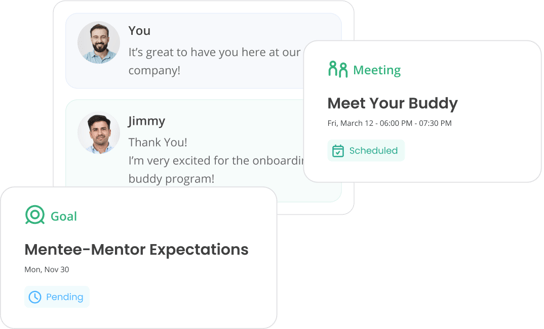
Qooper automates the scheduling logistics that most buddy programs handle manually or fail to handle at all. Meeting reminders, milestone notifications, and engagement nudges are delivered automatically, ensuring that buddy relationships remain consistent even as the natural demands of work life create competing priorities.
Progress Tracking and Analytics
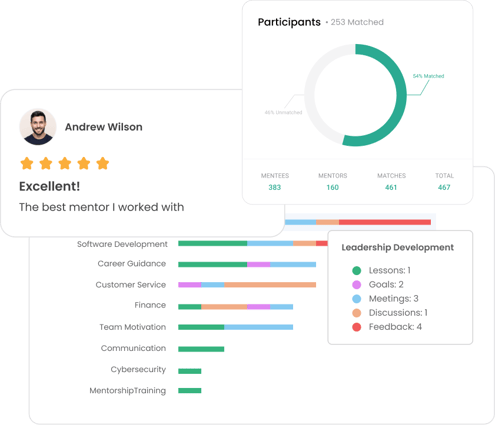
HR teams using Qooper gain visibility into buddy program participation and engagement through a centralized analytics dashboard. This enables talent professionals to identify new hires who may be underserved, recognize high-performing buddies, and continuously refine the program based on real data, replacing intuition with evidence.
Integration with the Broader Onboarding Journey
Qooper's onboarding buddy feature does not operate in isolation. It integrates seamlessly with the platform's broader automated employee onboarding capabilities, including task management, training assignments, manager check-in prompts, and onboarding milestone tracking, creating a cohesive, connected experience for the new hire from pre-boarding through the 90-day mark.
Conclusion
Talent onboarding is not a formality, it is a strategic discipline. The organizations that understand this distinction invest deliberately in structured programs, assign clear accountability for each phase of the experience, and leverage technology to ensure consistency and scale.
Qooper's platform is designed for organizations that take this seriously. From intelligent onboarding buddy matching, and automated workflow management to manager enablement tools, custom training delivery, and executive-specific programs, Qooper provides the infrastructure to turn every new hire's first 90 days into the foundation for a long, productive, and engaged tenure.
Whether you are beginning to formalize a previously informal process or seeking to optimize a program already in place, the resources below can help you move forward.
Key Takeaways
- Onboarding and Talent Acquisition are inseparable. The candidate experience extends beyond the offer letter, top talent judges an employer from first contact through their first 90 days. A weak employee onboarding process directly contradicts the promises made during the recruitment process, accelerating early employee attrition.
- Preboarding is the most underutilized phase of the entire employee onboarding process. Sending a structured welcome email, completing compliance documents via digital signature, assigning an onboarding buddy, and granting onboarding portal access before day one dramatically reduces first-day anxiety and improves early-tenure retention.
- Digital onboarding is now a baseline expectation, not a competitive differentiator. Remote employees and distributed teams require a fully digital infrastructure — onboarding modules, onboarding portals, applicant tracking handoffs, and automated task management, to receive a consistent, measurable new employee onboarding experience regardless of geography.
- The onboarding buddy delivers the highest ROI of any social investment in the onboarding journey. Peer mentoring programs and structured buddy systems outperform informational training on every measure of employee engagement, cultural integration, and 90-day retention, and Qooper's intelligent matching makes this investment scalable.
- Onboarding is the foundation of talent development and long-term performance management. The skills, organizational commitment, and professional development habits formed during new hire onboarding directly shape how employees engage with career development pathways, leadership roles, and performance results over their entire tenure.
- Compliance and culture must be onboarded simultaneously, not sequentially. I-9 processing, Work Opportunity Tax Credit screening, benefits selection, and HR record creation must be completed accurately — but organizations that reduce onboarding to a compliance checklist forfeit the corporate culture transmission that genuine talent onboarding performs.
- Remote onboarding requires deliberate design, not informal adaptation. Without structured virtual shadowing, Slack-based connection channels, digital org charts, and scheduled buddy check-ins, remote employees are significantly more vulnerable to isolation, disengagement, and early employee attrition than their in-office counterparts.
- Hiring managers are directly accountable for new hire onboarding outcomes. HR/OD professionals and Instructional Designers design the program — but the hiring manager delivers the experience that determines employee satisfaction, role clarity, and organizational commitment. Qooper equips managers with structured conversation guides and automated check-in prompts to fulfill this responsibility at scale.
- New employee onboarding is a direct driver of employer brand and talent acquisition success. Organizations recognized as an employer of choice earn that status, in part, through what new hires experience and report in their first 90 days. Exceptional onboarding reduces offer declinations, strengthens candidate experience, and attracts top talent through reputation alone.
- Onboarding technology must connect the experience, not fragment it. New hires navigating disconnected systems for compliance documents, benefits selection, training modules, and employee engagement surveys receive a fragmented journey that undermines confidence in the organization. Integrated Employee Onboarding Software — whether Qooper, isolved Onboard & Develop, or isolved People Cloud — delivers the cohesive, professionally executed experience that modern talent management demands.
Continue Learning
- HR Onboarding Process
- Best Employee Onboarding Examples
- Pre-Onboarding Process
- New Hire Orientation Agenda
- Onboarding Cost Optimization
- Employee Onboarding Checklist
- Onboarding Guide for Managers
Frequently Asked Questions
What is the difference between talent onboarding and orientation?
Orientation is typically a single event or short series of activities focused on administrative and informational foundations. Talent onboarding is a broader, longer-term process, often spanning 90 days or more, that encompasses orientation alongside ongoing training, cultural integration, relationship-building, and performance enablement.
How long should an employee onboarding program last?
Best-practice programs extend structured onboarding activities across at least 90 days. Some high-complexity roles, such as executive hires or technical specialists, benefit from onboarding programs that span up to 12 months.
What is an onboarding buddy and why is it important?
An onboarding buddy is a peer-level colleague assigned to support a new hire through the informal, social dimensions of organizational integration. Buddy programs are among the highest-ROI components of any onboarding architecture because they provide new hires with a psychologically safe relationship through which to ask questions, build cultural understanding, and expand their internal networks.
How does automation improve the employee onboarding experience?
Onboarding automation ensures consistency at scale, eliminates manual administrative overhead, and enables HR teams to deliver personalized, timely communications and task assignments without relying on individual effort. Platforms like Qooper automate workflows while preserving, and enhancing, the human elements of the onboarding experience.
What role do managers play in new hire onboarding?
Managers are arguably the most important actors in the onboarding process. Their ability to establish clear expectations, provide psychological safety, and model organizational values has a direct and measurable impact on new hire engagement, productivity, and retention.