




 ·
11 minute read
·
11 minute read
The Gap That Formal Onboarding Can't Fill
Your orientation program is polished. Your employee handbook is thorough. Your new hire orientation agenda is packed with onboarding training program sessions, benefits selection walkthroughs, and forms to complete. And yet, three months in, new hires are still quietly disengaged, unsure of how to grow, uncertain of their place, and increasingly tempted by other offers.
The problem isn't your hr onboarding process. It's that formal employee onboarding answers "what do I need to know?", but leaves the more important question unanswered: "who will help me become who I need to be here?"
That's the gap a new hire mentoring program fills. It creates the human infrastructure that turns knowledge into capability, connection into commitment, and a new hire into a genuine contributor. Whether you're onboarding a sales rep who needs to master a sales model, sales cycle, and product knowledge before hitting sales quotas, a field technician who needs workplace safety protocols and safety incentives before stepping on a job site, or a licensed employee navigating compliance requirements, structured onboarding mentoring accelerates every path.
TL;DR
An employee onboarding mentoring program pairs new employees with experienced mentors to accelerate integration, close skill gaps, and build lasting connections inside the organization. Here's the short version:
- What it is: A structured onboarding program where new employees are matched with mentors who guide their professional growth, knowledge transfer, and cultural integration from the very first day
- Why it works: Organizations like Google, Mastercard, and Deloitte run formal workplace mentoring programs because the data is clear, higher retention, faster time-to-productivity, and stronger employee experience across every role, from sales to licensed employees to field teams wearing a hard hat
- How it differs from a buddy program: An onboarding buddy program handles Day 1 logistics. A mentor drives long-term career paths, skill development, and organizational goals alignment
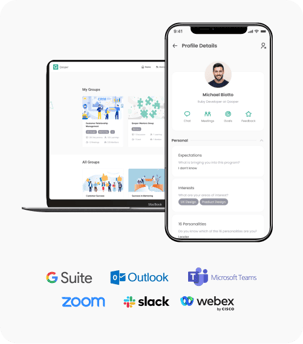
- Where Qooper fits: Qooper's mentoring platform handles the full matching process, intelligent pairing, structured onboarding workflows, milestone tracking, approval workflows, and analytics, at any headcount
Mentor vs. Buddy: Understanding the Distinction
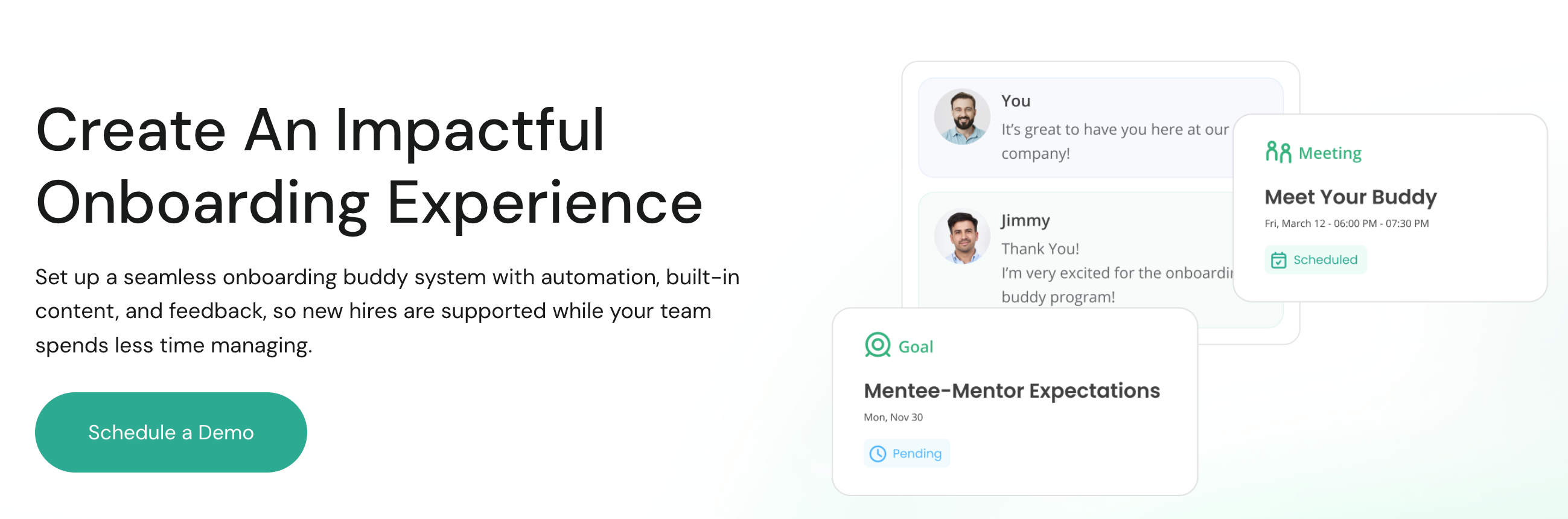
Leading organizations like Google, Mastercard, and Deloitte run both an onboarding buddy program and a formal mentoring program simultaneously, because they serve different but complementary purposes:
|
|
Onboarding Buddy | New Hire Mentor |
|---|---|---|
|
Focus |
Immediate integration |
Long-term professional growth |
|
Duration |
30–90 days |
6–12 months |
|
Relationship style |
Peer-level, informal |
Experienced guide, structured |
|
Key activities |
Virtual coffee breaks, tool walkthroughs, introductions |
Goal-setting, employee coaching, career paths |
Both roles matter. But the new hire mentoring program is where long-term growth begins.
Benefits of Having an Onboarding Mentorship Program
A structured employee onboarding mentoring program isn't a nice-to-have, it's one of the highest-leverage investments in your employee engagement programs and talent management toolkit.
Dramatically reduced early attrition. The first 90 days are when attrition risk peaks. New employees who feel unsupported are quietly reaching out to prospects and scrolling social media job boards by Week 4. A structured mentoring relationship gives new hires a clear developmental path and a tangible signal that their employer has invested in their success, driving measurably higher retention at 6 months and 1 year, reducing recruiting process costs, and stabilizing headcount planning.
Faster time-to-productivity. Formal training sessions teach process. Mentors teach judgment, the "how we actually do things here" that takes months to absorb otherwise. A sales mentee who shadows a veteran mentor through a full sales cycle, from identifying prospects to closing in a competitive marketplace, ramps faster than any onboarding training program alone can deliver. The same applies to field roles where workplace safety, safety incentives, and job-site norms must become second nature fast.
Genuine knowledge transfer. A workplace mentoring program formalizes knowledge transfer that would otherwise walk out the door during role transitions. Mentors pass down context, product knowledge, territory insights, and referrals networks that no employee onboarding checklist or onboarding portal can capture. For sales teams especially, this transfer of sales skills and sales model fluency is a direct revenue driver.
Stronger company culture alignment. Corporate culture is taught by example, not by document. A new hire watching their mentor navigate a tough video conferencing call, advocate for a colleague in a Town hall, or represent the brand with integrity in front of a customer absorbs company culture at a cellular level that no pre onboarding process document can replicate. This is especially critical for remote working and remote workplace environments where social learning and passive cultural osmosis don't happen naturally.
Elevated engagement across the board. New hires who feel genuinely developed from Day 1 show higher engagement scores, participate more actively in ERG management groups and advancement community initiatives, and share positive experiences externally, on social media, LinkedIn, and in referrals that feed back into the recruiting process. Critically, mentoring program benefits flow both ways, mentors report higher engagement, stronger sense of purpose, and improved employee coaching skills as a direct result of the relationship.
Accelerated professional network building. A mentor who actively connects their mentee to colleagues during social gatherings, coffee dates, virtual coffee breaks, and cross-functional mentoring sessions dramatically expands the new hire's professional network in months rather than years, especially critical in remote working and remote workplace settings where organic connection doesn't happen at the water cooler.
Stronger diversity and inclusion outcomes. When ERG management leaders and diverse mentors are recruited into onboarding mentoring programs, new hires from underrepresented groups report significantly higher belonging scores, a proven predictor of long-term retention. Emotional intelligence in the matching process matters here: pairing mentees with mentors who demonstrate empathy, confidentiality, and cultural awareness creates the psychological safety that makes growth possible.
Mentoring Program Best Practices
| Pillar | What to Do | Key Details |
|---|---|---|
| Define Clear Goals | Align mentoring goals with organizational objectives before pairing mentors and mentees. | Work with hiring managers, HR, and ERG leaders to define measurable outcomes. Set 30–60–90 day performance goals, career navigation paths, and role-specific benchmarks (e.g., sales quota ramp timelines and product knowledge targets). |
| Recruit & Train Mentors Intentionally | Select mentors based on capability and provide structured training. | Look for volunteers with emotional intelligence, strong culture knowledge, deep product expertise, and enthusiasm for coaching. Train them in active listening, adapting to learning styles, confidentiality, and when to refer mentees to the Employee Assistance Program. Run a short video orientation to align expectations. |
| Match with Precision | Pair mentors and mentees based on compatibility, not convenience. | Consider career trajectory, skill gaps, communication style, time zone alignment (for remote teams), learning style, social learning preferences, and diversity goals. Avoid matching based solely on seniority. AI-driven HR tools and mentoring platforms can improve match quality. |
| Structure the Program Stages | Give the mentoring relationship a clear timeline and milestones. |
Example structure: Month 1: foundation-setting; Months 2–3: integration; Months 4–6: professional growth and career coaching; Graduation: formal close, not a fade-out. Track progress with session notes, transcripts, and onboarding portal documentation. |
| Leverage HR Technology | Use specialized tools to manage programs at scale. | Manual programs struggle beyond ~50 employees or multi-location teams. Mentoring platforms with automated onboarding workflows, approval processes, and real-time dashboards help manage complex programs across roles, regions, and learning styles. |
How Will the Process Work?: New Hire Mentoring Program
Here's exactly how a well-run employee onboarding mentoring program operates, phase by phase:
Phase 1 — Program Design (Pre-Launch)
Configure your mentoring platform with profile templates, matching process criteria, and milestone structures. Use Zapier to connect Qooper with your HRIS, Microsoft 365, Zoom, and email systems so onboarding workflows trigger automatically at hire. Build your mentor pool from high-performing, corporate culture-strong volunteers, prioritizing ERG management and advancement community leaders. Establish confidentiality protocols and define how Human Resources will handle escalations through the Employee Assistance Program if needed.
Phase 2 — Pre-Onboarding and Intake (Week 1)
The pre onboarding process starts before Day 1. New hires receive a welcome email introducing the mentoring program, complete their onboarding portal profile sharing career goals, learning style, communication preferences, and role-specific needs (e.g., sales skills, territory, product knowledge gaps, or workplace safety certifications). HR reviews profiles and flags matching considerations for the matching process, including remote working logistics and ERG management alignment goals.
Phase 3 — Intelligent Matching and Approval (Weeks 1–2)
Qooper's AI systems analyze both profiles across hundreds of data points, career trajectory, skills, communication style, time zone, learning styles, LinkedIn background, and company culture fit, and surface the top recommended pairings. Human Resources reviews and approves through approval workflows before both parties receive an introduction email and a pre-filled calendar invite for their first day onboarding kickoff meeting.
Phase 4 — Program Kickoff (Week 2)
A structured 60-minute kickoff mentoring session, on campus, via video conferencing, or Microsoft Teams, establishes shared goals, communication cadence, confidentiality boundaries, and the training and development priorities for the relationship. For sales new hires, this is where sales model context, territory overview, and sales cycle expectations get established early. For field roles, workplace safety protocols and safety incentives are reviewed. Both parties sign off digitally on a shared commitment document inside Qooper.
Phase 5 — Structured Mentoring Journey (Months 1–3)
Weekly or biweekly regular meetings (30–60 minutes) cover training and development priorities, knowledge sharing, role-specific product knowledge, and social learning opportunities. Between mentoring sessions: virtual coffee breaks, remote lunch connections, Microsoft Teams check-ins, and LinkedIn introductions keep the relationship warm. For sales mentees, mentors walk through live sales cycle examples, introduce key customer contacts, share referrals, and coach on hitting early sales quotas within the marketplace. HR-administered surveys at 30 and 60 days surface friction points, Qooper's dashboard flags pairs needing intervention automatically.
Phase 6 — Growth Focus (Months 4–6)
Sessions shift from "how do I navigate this?" to "how do I grow here?" Mentees explore career paths, take on stretch assignments, and begin contributing their own expertise, presenting at Town halls, leading knowledge sharing sessions, and deepening ERG management and advancement community involvement. The onboarding guide for managers framework transitions to a talent management and professional growth focus. Mentors facilitate introductions to senior stakeholders and broader social gatherings to expand the mentee's professional network.
Phase 7 — Graduation and Transition
A structured closing mentoring session celebrates wins, reviews organizational goals progress, and maps next steps. Feedback surveys fire automatically via Qooper. Transcripts of session goals and progress are stored in the onboarding portal for HR review. Mentees transition into peer mentoring circles or longer-term programs within the advancement community. Standout mentors are recognized through Town halls, social media shoutouts, and formal People & Culture recognition. Aggregated data flows into workforce AI skills and headcount planning dashboards for Human Resources leadership.
How to Measure the Success of Your New Hire Mentoring Program
Great programs treat measurement as a real-time feedback loop, not a retrospective audit. Track across four dimensions:
Engagement and Activity Metrics
- Mentoring session frequency: Pairs missing consecutive sessions are a leading disengagement signal, Qooper surfaces these automatically through its HR technology dashboard
- Onboarding portal engagement: Low login and goal-completion rates signal the program feels like a burden; review training guidelines and learning styles frameworks
- Informal touchpoint frequency: High rates of virtual coffee breaks, remote lunch connections, and async check-ins, especially across remote working and remote workplace teams, predict program success better than formal meeting counts alone
New Hire Experience Metrics
- Satisfaction scores at 30/60/90 days: Brief email surveys tracking mentoring sessions quality, knowledge sharing relevance, sense of trust, and overall sense of belonging within the corporate culture
- eNPS: New hires with active mentoring relationships consistently score higher, a clean proxy for employee onboarding program impact and talent management health
- Belonging and company culture alignment scores: Survey corporate culture integration specifically, these scores predict long-term engagement better than almost any other metric
- Stress and safety indicators: A well-run employee onboarding mentoring program should show measurable reduction in stress self-reports, with workplace safety and psychological safety scores improving between Week 1 and Month 3
Performance and Productivity Metrics
- Time-to-full-productivity: Define role-specific benchmarks, sales quotas ramp timelines, product knowledge assessment scores, sales cycle completion rates, and compare mentored cohorts against historical averages
- 90-day performance review scores: Consistent outperformance by mentored cohorts builds the business case for sustained training and development investment
- Performance objectives attainment: Track on-track rates at 60 and 90 days and share with hiring managers to connect onboarding mentoring to team-level outcomes
- Training completion rates: Mentored new hires complete onboarding training program modules — including workplace safety certifications, product knowledge assessments, and benefits selection — faster and with better retention than unmentored peers
Retention and Business Impact Metrics
- 30/60/90-day retention rate: Even a 5–10% improvement translates into significant onboarding cost optimization and recruiting process savings, directly measurable ROI for Human Resources leadership
- 6-month and 1-year retention rate: The single most powerful data point for talent management, headcount planning, and HR budget justification
- Cost-per-turnover reduction: Calculate replacement costs (typically 50–200% of annual salary) multiplied by attritions prevented, this is your direct automated employee onboarding and mentoring program ROI
- Promotion and advancement rates: Track how quickly mentored new hires progress along defined career paths, the ultimate validation that your employee onboarding mentoring program is delivering lasting professional growth
Review cadence: Weekly for engagement flags; monthly for satisfaction trends; quarterly for retention benchmarks and sales skills / product knowledge attainment; annually for full program audit and Town hall ROI presentation to Human Resources and leadership. Qooper's analytics suite surfaces all of this in one HR technology dashboard, with scenario modeling that lets you simulate program changes before rolling them out across your talent onboarding pipeline.
How Qooper Powers Your New Hire Mentoring Program
Qooper's mentoring platform provides the complete HR technology infrastructure to make your employee onboarding mentoring program scalable, measurable, and consistently excellent, whether you're running custom corporate employee onboarding training for a sales team, an executive onboarding program, or a creative employee onboarding experience for a distributed remote workplace:
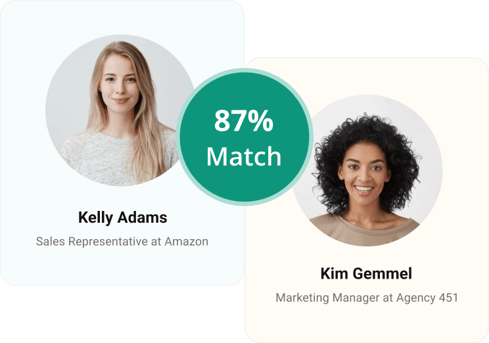
- AI-powered matching process across career paths, skills, learning styles, emotional intelligence indicators, and company culture fit, with approval workflows so Human Resources retains final control
- Structured onboarding workflows with automated employee onboarding triggers, milestone reminders, and AI prompts for mentoring sessions topics at every stage, accessible through a centralized onboarding portal
- Mentor training and enablement built into the platform, covering confidentiality, learning styles adaptation, employee coaching techniques, and Employee Assistance Program referral protocols
- Real-time analytics connecting mentoring outcomes to talent management, retention, and workforce AI skills dashboards, your onboarding cost optimization command center
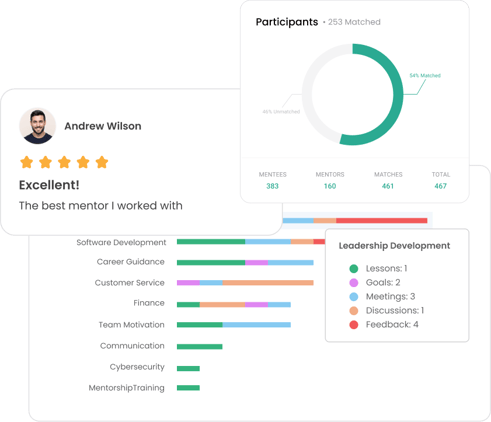
- ERG management and peer mentoring integration, creating a seamless social Learning and developmental ecosystem beyond the initial onboarding program window
- Full ecosystem connectivity via Zapier, Microsoft 365, Zoom, Slack, and LinkedIn, fitting into your existing HR technology stack without disruption
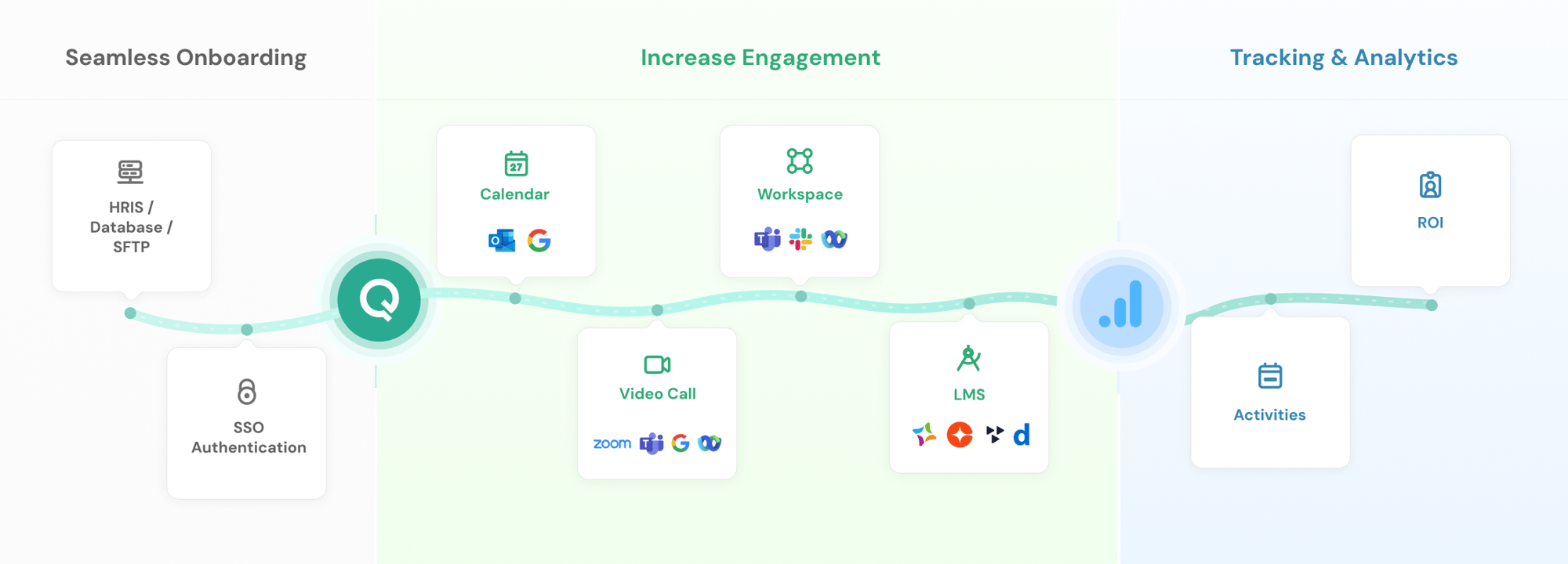
- Flexible Subscription models that scale from startup to enterprise, supporting first day onboarding, talent onboarding, and executive onboarding program needs alike
Key Takeaways
- A new hire mentoring program builds the long-term relationships that turn new hires into high performers and loyal employees
- Mentoring new employees during the critical first 90 days dramatically reduces early attrition and accelerates corporate culture alignment
- Mentoring program best practices include clear matching criteria, defined timelines, training guidelines, milestone check-ins, and continuous feedback loops
- HR technology and mentoring platforms like Qooper eliminate the manual bottlenecks that cause programs to stall at scale
- The mentoring program benefits, higher retention, stronger engagement, faster productivity, and better company culture, compound over time
Conclusion: Turn Every New Hire Into a Long-Term Investment
The recruiting process ends on offer acceptance. Building an employee who is engaged, capable, and committed for the long term begins on Day 1, through employee onboarding that goes beyond forms, benefits selection, and an employee onboarding checklist.
A new hire mentoring program, with structured organizational goals, intentional matching process design, meaningful mentoring sessions, and the right HR technology to scale — is how the best organizations make every talent onboarding investment count. Whether you're ramping a sales team on product knowledge and sales quotas, orienting licensed employees on workplace safety and safety incentives, or integrating remote working hires into a thriving remote workplace culture, the right mentor accelerates everything.
Retention improves. Corporate culture strengthens. Headcount planning becomes more predictable. Career paths become clearer. And new hires don't just survive their first year — they become the mentors of the next generation.
Ready to build a new hire mentoring program that actually works? Contact Qooper today and transform your employee onboarding from a process into a competitive advantage.
Automate New Hire Mentoring Across Your Enterprise
For organizations onboarding at scale, enterprise mentoring software eliminates the manual burden of running a new hire mentoring program. Qooper is trusted by companies like Merck, BNY, and Harvard to automatically match every new employee with the right mentor on day one — and to track cohort engagement, goal progress, and retention impact through a centralized analytics dashboard that L&D leaders can share with the C-suite.
Frequently Asked Questions (FAQs)
What is a new hire mentoring program?
A structured employee onboarding initiative that pairs new employees with experienced mentors — through a purposeful matching process — to support professional growth, accelerate knowledge transfer, deepen company culture integration, and map clear career paths from the very first mentoring session.
How is a mentor different from an onboarding buddy?
An onboarding buddy program handles immediate first day onboarding logistics — tools, forms, benefits selection, company policies, and the hr onboarding process. A mentor takes a longer-term view — career paths, training and development, organizational goals, and professional growth. Organizations like Google, Mastercard, and Deloitte run both simultaneously.
How does the matching process work?
Effective matching process design goes beyond job title. Consider career trajectory, learning styles, emotional intelligence, communication style, time zone alignment (especially for remote working teams), social Learning preferences, and diversity goals. HR technology platforms like Qooper automate this using intelligent algorithms and scenario modeling — then route through Human Resources approval workflows for final sign-off.
How do mentoring programs work in remote environments?
In remote working and remote workplace settings, mentoring sessions happen via video conferencing on Zoom or Microsoft Teams. Social Learning is built through virtual coffee breaks, remote lunch programs, and async onboarding portal check-ins. Leveraging Rippling’s workforce platform, automated onboarding workflows and milestone reminders keep remote pairs engaged and on track without constant Human Resources intervention
How do you measure success?
Track retention at 30/60/90 days and 1 year, time-to-productivity, sales quotas ramp (for sales roles), product knowledge assessment scores, mentoring sessions engagement rates, and organizational goals attainment. Connect to HR technology and talent management dashboards for full ROI and onboarding cost optimization visibility.
How does Qooper support new hire mentoring programs?
Qooper's mentoring platform delivers AI-powered matching process management, automated employee onboarding workflows, onboarding portal integration, mentor training resources, transcripts and session tracking, approval workflows, real-time analytics, peer mentoring and ERG management connectivity, and Zapier / Microsoft ecosystem integrations — all in one HR technology platform.