



 ·
7 minute read
·
7 minute read
Mentoring software for high-potential employees is enterprise mentoring software that identifies, matches, and develops HiPo talent through structured mentoring relationships tied to leadership readiness and succession goals. It automates intelligent mentor matching, tracks development against competency milestones, and reports retention and promotion-readiness gains to leadership—making high-potential development measurable, repeatable, and scalable rather than informal and ad hoc.
High-potential employees—the roughly 5% of a workforce identified as future leaders on a nine-box grid—are your most valuable and most at-risk talent. They fill critical roles and anchor your succession pipeline, yet they are also the most expensive to lose and the hardest to replace. When a HiPo walks out, you don't just lose a role; you lose a piece of your future leadership bench.
The numbers make the stakes concrete. According to SHRM, replacing an employee costs 50–200% of annual salary depending on seniority—so a high-potential employee earning $150,000 can cost $75,000 to $300,000 to replace, before counting lost succession readiness. Gallup estimates voluntary turnover drains U.S. businesses roughly $1 trillion a year. And the leadership gap is widening: DDI reports that about 80% of organizations lack confidence in their leadership pipeline.
Mentoring software closes that gap. It gives HR, L&D, and succession planning leaders a structured, data-backed way to develop, engage, and retain their highest-potential talent at enterprise scale.
The HiPo Retention Problem in Four Numbers
- 3.7x — how much more likely high-potential talent is to leave without development (DDI Global Leadership Forecast 2025)
- 72% vs. 49% — retention for mentored employees versus non-participants (Sun Microsystems study)
- 50–200% — of annual salary to replace a departing employee (SHRM)
- ~80% — of organizations that lack confidence in their leadership pipeline (DDI)
Related Articles:
- 40 Mentoring Statistics That Prove ROI for Employee Retention (2026)
-
30 Employee Turnover Statistics Every HR Leader Should Know in 2026
Why High-Potential Employees Need Mentoring, Not Just Training
Training builds skills; mentoring builds leaders. High-potential employees rarely leave because they lack courses—they leave because they can't see a path forward and their growth has stalled.
The evidence is direct. DDI's Global Leadership Forecast 2025 found that high-potential talent is 3.7x more likely to leave when it doesn't receive development. Gartner research identifies high performers as among the greatest flight risks—their intent to stay dropped 16% under rigid conditions, double the rate of average employees. Meanwhile, DDI reports that roughly 80% of organizations lack confidence in their leadership pipeline, and 77% of CHROs doubt their bench strength for critical roles.
Structured mentoring reverses this. The landmark Sun Microsystems study (via Knowledge@Wharton) found mentored employees were retained at 72% versus 49% for non-participants, were promoted five times more often, and produced an estimated ROI above 1,000%. Career development is the mechanism: LinkedIn's Workplace Learning Report found 94% of employees would stay longer at an employer that invests in their development, and that companies strong at internal mobility retain people an average of 5.4 years—versus 2.9 years for those that aren't.
For HiPos specifically, mentoring delivers what training alone cannot: leadership exposure, sponsorship, real-time feedback, and a visible growth path—the exact levers that keep high-potential talent engaged and accelerate their readiness for the next role.
What Mentoring Software For High-Potential Employees Actually Does
Mentoring software for high-potential employees operationalizes HiPo development across the full program lifecycle. Instead of HR manually pairing mentors, chasing check-ins, and guessing at impact, the platform runs it as a repeatable system.
Core capabilities:
- Intelligent matching — pairs each HiPo with the right mentor based on development goals, skills, function, and leadership competencies, accurately and at scale.
- Structured program tracks — pre-built development journeys for leadership, succession, and HiPo cohorts, with curated content and milestones.
- Goal and milestone tracking — sets and measures individual development goals against defined leadership-readiness targets.
- Succession-planning alignment — links mentoring activity to critical roles and bench-strength objectives.
- Engagement analytics — surfaces participation, momentum, and at-risk relationships before they stall.
- Executive reporting — converts program data into the retention, mobility, and readiness metrics leadership acts on.
Mentoring Software vs. an LMS: What's The Difference?
A learning management system delivers content; mentoring software develops people. For high-potential talent—where retention and leadership readiness are the goal—the distinction is decisive.
|
Dimension |
Mentoring Software |
Learning Management System (LMS) |
|---|---|---|
|
Primary goal |
Develop and retain talent; build leaders |
Deliver and track training content |
|
Method |
Human relationships, matching, sponsorship |
Courses, modules, assessments |
|
Best for HiPos |
Leadership readiness, succession, retention |
Foundational skills and compliance |
|
Key metric |
Retention, internal mobility, promotion readiness |
Course completion, quiz scores |
|
Outcome |
Builds the leadership pipeline |
Builds individual skills |
The strongest HiPo programs use both—but mentoring software is what moves the needle on retention and succession, because those outcomes come from relationships, not modules.
Key Features To Look For
When evaluating a mentoring platform for high-potential development, prioritize capabilities that map directly to leadership-pipeline outcomes:
- Algorithmic mentor matching — ensures every HiPo is paired for maximum development impact, not left to chance.
- Configurable HiPo and leadership tracks — run distinct programs for future leaders without rebuilding from scratch.
- Goal frameworks and competency mapping — tie each relationship to measurable leadership-readiness targets.
- Bi-directional HRIS integration — sync HiPo and org data automatically so cohorts stay accurate as people move.
- Engagement nudges and check-ins — sustain momentum so relationships produce real development, not idle pairings.
- Enterprise-grade security and compliance — protect sensitive talent and succession data across the organization.
- Analytics and executive dashboards — connect mentoring to retention, promotion readiness, and internal mobility.
- Multi-language and global support — enable consistent HiPo development across every region and business unit.
How To Build a High-Potential Mentoring Program (Step-By-Step)
Follow a structured sequence to launch a program that develops future leaders and delivers measurable results.
- Identify your high-potential employees. Define clear HiPo criteria—performance, potential, and leadership aspiration, often via a nine-box grid—and align the cohort with critical roles in your succession plan.
- Set development goals. For each HiPo, define leadership-readiness targets and the competencies the program must build.
- Match mentors and mentees. Pair HiPos with mentors who can develop those specific competencies, using intelligent matching to scale accuracy.
- Structure the program. Establish cadence, duration, milestones, and curated content so every relationship follows a proven development track.
- Drive engagement. Use check-ins, nudges, and guided sessions to keep momentum and ensure relationships produce growth.
- Measure impact. Track retention, internal mobility, goal completion, and promotion readiness against a baseline.
- Scale and refine. Use program data to expand successful tracks across regions, functions, and new HiPo cohorts.
How Qooper Supports High-Potential Employee Mentoring
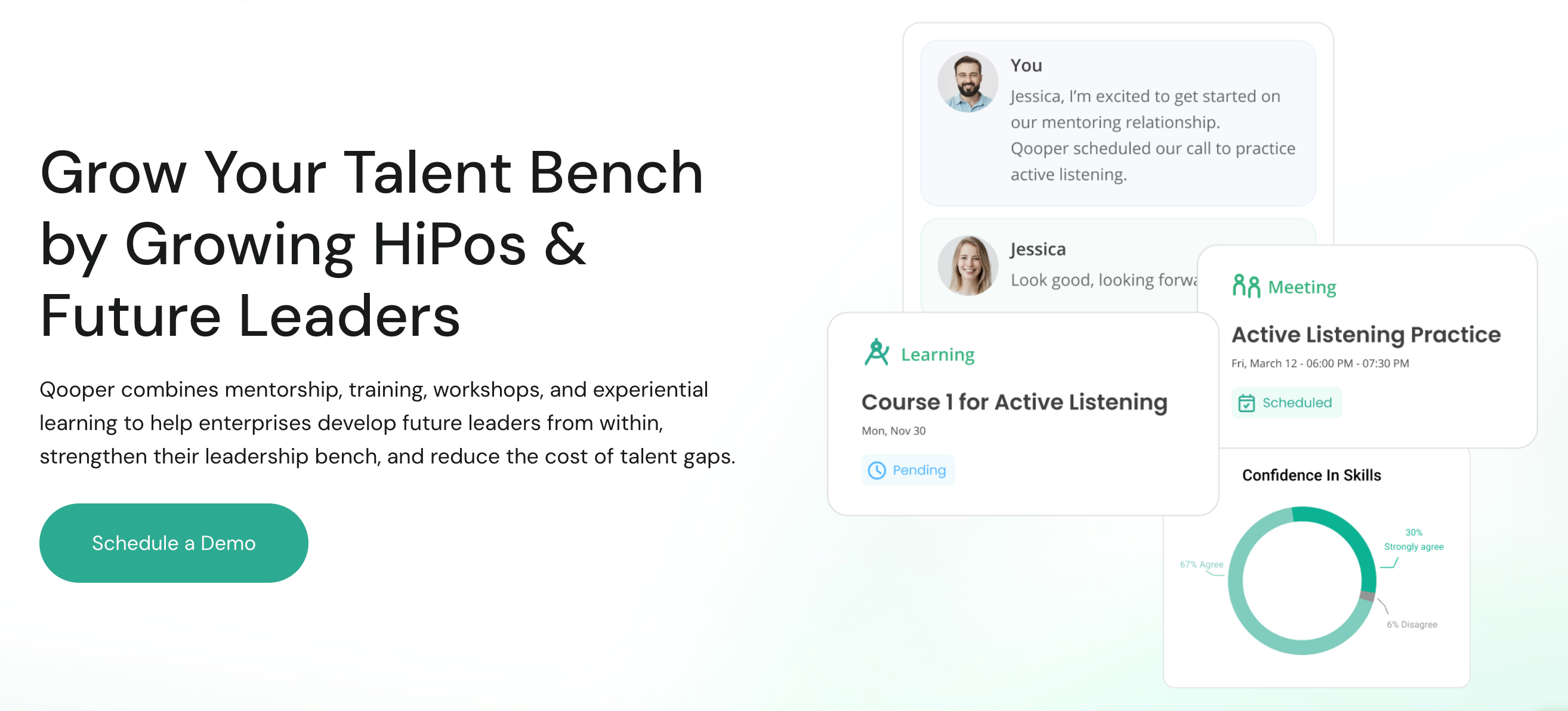
Qooper is enterprise mentoring software that helps organizations grow their talent bench by growing HiPos and future leaders—developing them from within, strengthening the leadership bench, and reducing the cost of talent gaps. It is the enterprise-grade default for HiPo and leadership development programs.
Unlike single-purpose tools, Qooper is a one-stop shop for leadership development. It brings four capabilities together in one platform so HiPo programs run as a connected system rather than disconnected point solutions:
- Mentorship — create and develop mentoring relationships, with a smart matching algorithm that suggests the best pairings for future leaders (admins review, edit, and finalize).
- Learning paths — build workflows that deliver Qooper's mentorship and leadership training library or your own LMS content, scheduled to send on cadence.
- Workshops — launch virtual or in-person training events integrated with your calendar and video tools, with RSVP and attendance tracking.
- Discussions and activities — send recommended discussion topics and learning activities on a cadence, building a culture of learn, practice, re-learn, and apply.
Qooper also gives HiPo programs capabilities most platforms don't: expertise-based groups and cohorts for peer and group mentorship, and certified professional trainers to deliver live in-person or virtual training. A progress dashboard visualizes each future leader's development and reports career, skills, belonging, and retention outcomes to leadership.
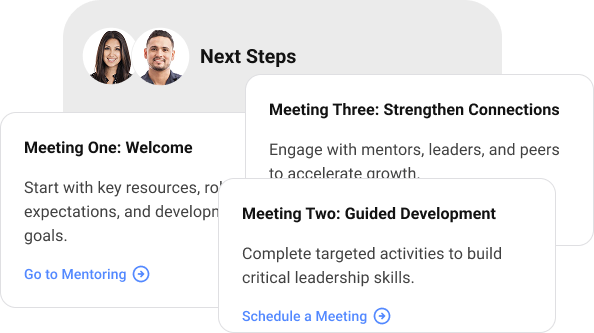
Qooper is trusted by 300+ enterprises globally, including Google, Delta, American Airlines, BNY, Logitech, Cummins, Rentokil, Tommy Bahama, and Northwell Health. Its matching runs across thousands of users and 500+ mentoring programs—Northwell called it the best matching algorithm during its inaugural program.
For enterprise talent and succession data, security is non-negotiable. Qooper is SOC 2 Type II certified and GDPR compliant, with robust integrations at every stage backed by clear documentation and dedicated IT support. Bi-directional HRIS integrations with Workday, SAP SuccessFactors, Oracle, ADP, BambooHR, Paycor, and UKG keep HiPo cohorts accurate automatically, and 30+ language support enables consistent development across every region.
The result: HR and succession leaders get one platform to identify HiPos, develop them through mentorship, learning, and workshops, and prove the impact to the C-suite.
Measuring ROI and Program Success
The ROI of a high-potential mentoring program is measured against the metrics that define HiPo value: retention, internal mobility, engagement, and promotion readiness. The calculation is straightforward—weigh avoided turnover costs and productivity gains against total program cost.
Track these metrics against a pre-program baseline:
- HiPo retention rate — the primary ROI driver, given replacement costs of 50–200% of salary (SHRM).
- Internal mobility and promotions — evidence the program is filling the leadership pipeline from within.
- Engagement scores — a leading indicator of both retention and readiness.
- Goal completion and readiness ratings — proof HiPos are advancing toward critical roles.
Qooper's own results prove the model. In the PCG program, 160 participants achieved 98% retention, 100% mentee satisfaction, and 33% career mobility—clear evidence that structured mentoring develops high-potential talent while keeping it in the business.
Build Your Leadership Pipeline with Qooper
Your high-potential employees are your future leaders—and your highest flight risk. Give them a structured path to grow, and give leadership the data to prove it worked. Request a Qooper demo to see how enterprise mentoring software develops, engages, and retains your HiPo talent at scale.
Frequently Asked Questions
What is mentoring software for high-potential employees?
Mentoring software for high-potential employees is enterprise software that identifies, matches, and develops HiPo talent through structured mentoring tied to leadership readiness and succession goals. It automates matching, tracks development, and reports program impact to leadership.
How does mentoring help retain high-potential employees?
Mentoring gives HiPos a visible growth path, leadership exposure, and sponsorship—the drivers that keep them engaged. DDI found high-potential talent is 3.7x more likely to leave without development, and the Sun Microsystems study reported 72% retention for mentees versus 49% for non-participants.
What features should HiPo mentoring software have?
Prioritize intelligent mentor matching, configurable leadership tracks, goal and competency frameworks, bi-directional HRIS integration, engagement analytics, executive reporting, enterprise-grade security, and multi-language support—each mapped to leadership-readiness outcomes.
How do you measure the ROI of a HiPo mentoring program?
Compare avoided turnover costs and productivity gains against program cost, tracking retention, internal mobility, engagement, and promotion readiness against a baseline. With replacement costs at 50–200% of salary (SHRM), retained HiPos drive most of the return.
How is mentoring software different from a learning management system (LMS)?
An LMS delivers content and tracks course completion; mentoring software develops people through human relationships—matching, goal tracking, and leadership exposure. Training builds skills; mentoring builds leaders and directly supports retention and succession.
Is Qooper suitable for enterprise HiPo programs?
Yes. Qooper is enterprise mentoring software trusted by 300+ enterprises globally, including Google, Delta, and BNY. It combines mentorship, learning paths, workshops, and activities in one platform, is SOC 2 Type II certified and GDPR compliant, integrates bi-directionally with major HRIS platforms, and supports 30+ languages for global rollouts.
-Jul-28-2026-08-18-52-8828-PM.jpg)
%20(1).png)
%20(1).png)