




 ·
15 minute read
·
15 minute read
|
50-200% of annual salary — average cost to replace one employee |
$4,700 average cost per hire (SHRM benchmark) |
20% higher retention in organizations with mentoring programs |
12 mo. typical payback period for mentoring software investment |
Why Mentoring Program Cost Is a Strategic Question, Not Just a Budget Line
Most organizations underestimate the cost of not having a mentoring program. Employee turnover is expensive, the cost of replacing a single employee ranges from 50% to 200% of their annual salary, depending on seniority and role complexity. That means a company with 500 employees and 15% annual turnover could be losing $3-6M per year to attrition alone.
A well-structured corporate mentoring program reduces attrition by 20-49% among participants. For most organizations, that retention improvement covers the full cost of the program within the first 12 months, often within the first cohort.
The real question is not whether mentoring costs money. It does. The question is whether the cost of mentoring is greater or less than the cost of the problems it solves, and the answer, consistently, is no. Mentoring programs are one of the highest-ROI investments in the L&D budget.
|
The right framing for budget conversations Present mentoring program costs alongside the cost of employee turnover, recruitment, and lost productivity. When leadership sees that retaining even two or three employees covers the annual program cost, budget approval becomes significantly easier. |
The 5 Core Cost Components of a Mentoring Program
Every mentoring program, regardless of size, format, or industry, involves costs across five categories. Understanding each one is essential for building an accurate budget and avoiding common surprises.
1. Mentoring Software Platform
For any program with more than 20-30 participants, dedicated mentoring software is the foundational investment. It replaces hundreds of hours of manual admin work, automates matching, tracks engagement, and provides the analytics leadership needs to see ROI. Without it, programs rely on spreadsheets and email threads, which is unsustainable at scale and produces no usable data.
Mentoring software pricing typically follows one of three models:
- Per-participant pricing — a per-seat fee per year, scaled by number of active users
- Per-program pricing — a flat fee per program cohort, regardless of participant count
- Enterprise flat rate — a single annual license covering unlimited participants and programs, typically for large-scale deployments
2. Program Administration and Coordinator Time
Every mentoring program requires human coordination, even software-enabled ones. The time investment depends heavily on program size and the degree of automation your platform provides.
This is where mentoring software pays for itself most clearly. Programs running on Qooper report reducing coordinator time by 60-70% compared to manual administration, because enrollment, matching, scheduling, reminders, and reporting are automated. A 200-person program that would require 20 admin hours per month manually may need only 6-8 hours with the right platform.
3. Mentor and Mentee Training
Untrained mentors and mentees struggle to build productive relationships. Mentors need to know how to ask open-ended questions, give constructive feedback, and facilitate goal-setting. Mentees need to understand how to lead sessions, define objectives, and take ownership of their own development. Skipping training is one of the most common reasons mentoring programs fail in their first cohort.
|
Training Format |
Description |
|---|---|
|
In-person workshops |
Facilitator-led sessions, highest engagement but most expensive; includes facilitator fees and venue logistics |
|
Live virtual sessions |
Webinar-format training via Zoom or Teams; interactive but scalable; can reach global teams at low marginal cost |
|
Pre-recorded e-learning |
Asynchronous video modules embedded in the mentoring platform; most scalable and budget-friendly option |
|
Platform-provided training |
Some mentoring software vendors (including Qooper) include ATD-certified training courses as part of the platform |
4. Technology and Communication Infrastructure
Beyond the core mentoring platform, consider the technology stack that supports the program's day-to-day operations:
-
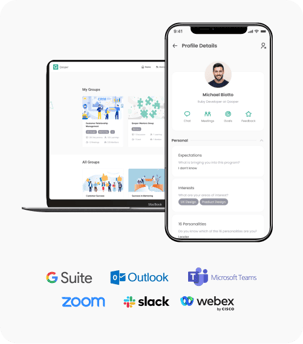
Video conferencing — most organizations already have Zoom, Microsoft Teams, or Webex; mentoring software that integrates natively eliminates separate subscriptions
-
Calendar scheduling — integrations with Google Calendar and Office 365 automate session scheduling; available in most enterprise mentoring platforms
-
HRIS integration — connecting mentoring software to Workday, SAP, or BambooHR automates user provisioning and removes manual roster management
-
Communication tools — Slack or Teams integration lets participants send session reminders and follow-ups in the tools they already use
For most organizations, the incremental technology cost beyond the mentoring software license is minimal because quality platforms integrate with existing infrastructure rather than requiring new tools.
5. Program Design, Launch, and Ongoing Management
First-time programs require upfront design investment: defining objectives, creating session templates, building the matching questionnaire, designing enrollment communications, and establishing reporting cadence. This is typically a one-time cost that decreases significantly in subsequent cohorts as templates are reused and processes are standardized.
Key Factors That Drive Mentoring Program Cost
Understanding what makes programs more or less expensive helps you optimize spend without sacrificing quality. The following variables have the biggest impact on total program cost:
Program Objective and Complexity
The primary objective heavily influences cost. A program aimed at general networking and employee connection might require a lighter matching process and fewer structured session templates. A leadership development program for high-potential employees requires more specialized training content, potentially executive coaching sessions, and more intensive measurement frameworks, all of which increase cost.
Level of Administrative Control
Programs with high administrative oversight, manual matching, frequent check-ins, detailed reporting, demand more coordinator time and therefore cost more. Programs designed for participant self-direction, supported by a platform that automates nudges, scheduling, and tracking, can run at significantly lower admin cost. The choice between high-touch and software-enabled administration is one of the biggest cost levers available to program designers.
Delivery Format
In-person programs cost more than virtual programs, room bookings, travel, and facilitator logistics add up quickly. For global organizations, in-person delivery may simply not be feasible. Virtual and hybrid programs, supported by mentoring software with integrated video and async messaging, reduce delivery costs to near zero while enabling cross-geography and cross-timezone mentoring pairs that in-person programs cannot support.
Training Approach
Highly facilitated in-person training workshops are the most expensive option — suitable for flagship programs where the first-cohort experience needs to be exceptional. Pre-recorded e-learning embedded in the platform is the most cost-effective option for scaling across cohorts. Most mature programs converge on a blended model: live orientation for the first cohort, async modules for every subsequent cohort.
Software Feature Depth
Mentoring software platforms vary significantly in what is included in the base price. Evaluate carefully: some platforms charge extra for advanced analytics, HRIS integrations, AI matching, or dedicated customer success support. A platform that appears cheaper at headline price may cost more once add-ons are included. Look for platforms where enterprise-grade features — AI matching, full integration suite, analytics dashboards, mobile app — are included in the base license.
The administrative overhead that inflates mentoring program cost over time is rarely visible in a vendor's headline pricing. Platforms that require manual roster management, separate scheduling tools, or coordinator-heavy matching workflows add real labor cost that compounds with every new cohort. Qooper's automation layer — covering enrollment, matching, scheduling, reminders, progress tracking, and reporting — reduces coordinator time by 60–70% compared to manual administration. For a 200-person program, that difference can represent 150+ hours of saved admin time annually, a cost reduction that often exceeds the platform license itself.
Hidden Costs and Common Budget Mistakes
|
Mistake |
Why It Happens |
How to Avoid It |
|---|---|---|
|
Skipping mentor training |
Assumed mentors already know how to mentor |
Budget 1-2 hrs of structured onboarding for all mentors; include in platform training modules |
|
Underestimating coordinator time |
Only counted matching time, not ongoing support |
Track all program-related time including communications, re-matching, and reporting |
|
Ignoring participant time cost |
Not counted as a program expense |
Each mentoring pair spends 10-20 hrs/year on sessions; this is real opportunity cost for the org |
|
No budget for iteration |
First cohort plan assumed to be final |
Reserve 10-15% of program budget for mid-cycle adjustments and content updates |
|
Separate tools for each function |
Using different tools for scheduling, chat, tracking |
Choose a platform that consolidates all functions — fragmentation multiplies admin cost |
|
No measurement budget |
Assumed reporting would be automatic |
Survey design, data analysis, and executive reporting require dedicated time or platform analytics |
The Cost of Employee Turnover: Why Mentoring Pays for Itself
Components of Employee Turnover Cost
|
Cost Component |
Description |
Typical Range |
|---|---|---|
|
Recruitment and sourcing |
Job postings, recruiter fees, referral bonuses, agency fees |
15–30% of annual salary |
|
Interview and selection |
Interviewer time, assessment tools, travel for candidates |
5–10% of annual salary |
|
Onboarding and training |
HR orientation, equipment, training materials, manager time |
10–20% of annual salary |
|
Productivity loss |
New hire ramp time; typically 6–12 months to full productivity |
25–50% of annual salary |
|
Institutional knowledge |
Knowledge and relationships departing employee takes with them |
Hard to quantify; often the largest hidden cost |
|
Team morale impact |
Remaining team members' engagement and productivity drop |
10–20% of annual salary |
|
TOTAL (combined estimate) |
SHRM estimates average replacement cost at 6–9 months salary |
50–200% of annual salary |
Mentoring Software Pricing: What to Evaluate Beyond the Headline Number
|
Evaluation Dimension |
Questions to Ask |
Why It Matters |
|---|---|---|
|
Pricing model |
Per seat, per program, or flat rate? Annual or monthly? |
Per-program pricing can cost more at scale than a flat-rate enterprise license |
|
Included features |
Is AI matching included? Analytics? Mobile app? Integrations? |
Some platforms charge separately for advanced matching or HRIS connections |
|
User tiers |
Are mentor-only users counted in seat count? What about alumni? |
Seat definitions vary — compare like-for-like participant counts |
|
Customer success |
Is a dedicated CSM included or a paid add-on? |
Enterprise programs need hands-on support, especially in the first cohort |
|
Training resources |
Are certified mentor training courses included or licensed separately? |
ATD-certified training adds real cost if not included in the platform |
|
Multi-program support |
Can you run career and onboarding programs simultaneously? |
Platforms priced per program multiply costs quickly for orgs running 3+ programs |
|
Contract flexibility |
Annual vs. multi-year? What are the exit and scaling provisions? |
Multi-year contracts offer better pricing but reduce flexibility |
|
Qooper pricing approach Qooper uses custom pricing based on organizational size, number of programs, and feature requirements — ensuring enterprise organizations are not paying seat fees for inactive users. Request a custom quote and ROI projection:
For enterprises running multiple program types simultaneously — career mentoring, onboarding, leadership development, and reverse mentoring — Qooper's single-license model means all programs run from one platform without per-program fees that multiply cost as your portfolio grows. Organizations that start with a 50-person pilot can scale to 5,000+ participants across departments, geographies, and business units on the same platform, with no migration cost, no licensing restructuring, and no data continuity gaps. HRIS bi-directional syncs with Workday, SAP SuccessFactors, Oracle, ADP, and UKG eliminate manual roster management from day one — removing one of the most consistently underbudgeted hidden costs in enterprise mentoring programs. |
How to Build the Business Case and Justify Mentoring Program Budget
Step 1: Quantify the Problem You Are Solving
Step 2: Present the Program Cost as a Percentage of the Problem Cost
Step 3: Use Conservative ROI Projections
Step 4: Propose a Pilot with Clear Measurement Gates
Step 5: Benchmark Against External Data
How to Reduce Mentoring Program Costs Without Reducing Quality
- Use platform-provided templates instead of custom content development — most enterprise mentoring platforms include session guides, goal-setting frameworks, and matching questionnaires that are immediately usable
- Launch virtually before investing in in-person elements — virtual programs deliver comparable outcomes at a fraction of the logistics cost, and most mentoring relationships actually prefer the flexibility of virtual sessions
- Leverage internal facilitators rather than external trainers for mentor orientation — a senior program manager or experienced mentor can facilitate the first cohort orientation after a brief train-the-trainer session
- Automate everything possible with software — every automated reminder, match suggestion, and scheduling confirmation replaces coordinator time; software cost is almost always cheaper than the admin hours it replaces
- Reuse first-cohort assets for every subsequent cohort — the program design, training materials, email templates, and session guides created in cohort one should require minimal changes for cohorts two through five
- Negotiate multi-year software contracts — most mentoring software vendors offer 10-20% discounts for 2-3 year commitments; if you are confident in the platform, locking in a multi-year rate reduces cost significantly
- Start with one program type and expand — running a focused new hire onboarding mentoring program first is less complex and costly than launching career, and leadership programs simultaneously; add program types as the team and platform familiarity grows
Bottom Line: The Cost of Mentoring vs. the Cost of Not Mentoring
The organizations that treat mentoring as a cost center lose that framing within 12 months of running their first program. The ones that treat it as a retention and development investment from day one secure budget, expand their programs, and build the talent infrastructure their competitors cannot replicate.
How Qooper Helps You Run a High-Impact Mentoring Program — at the Right Cost
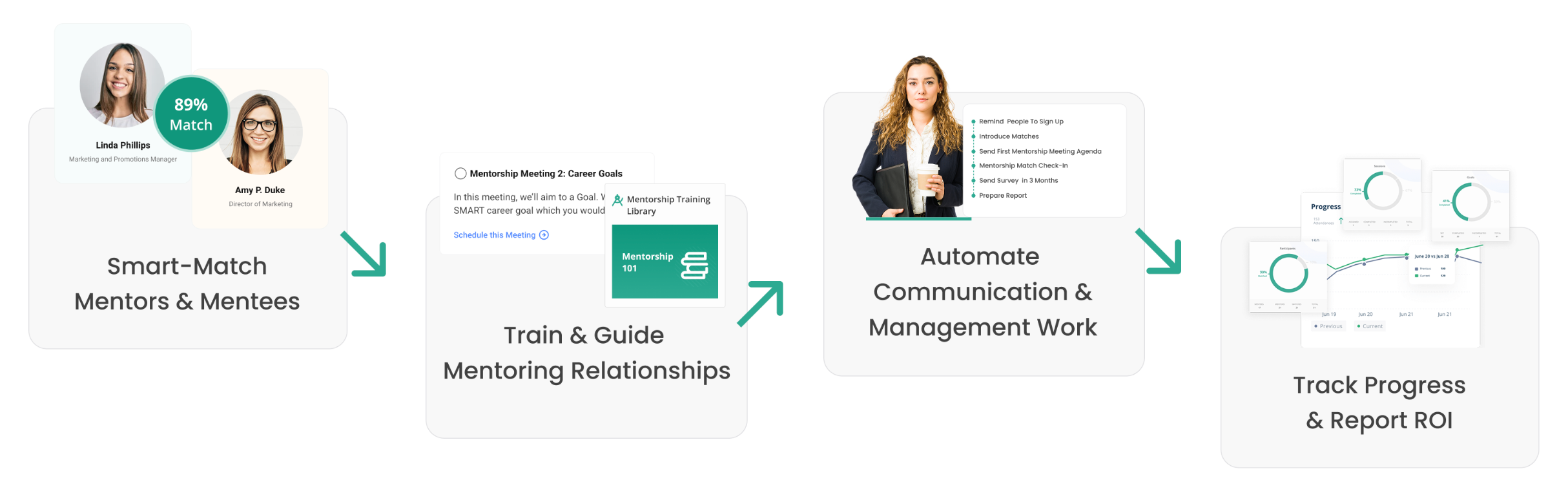
Qooper is an AI-powered mentoring and people development platform trusted by 300+ organizations, including Fortune 500 companies and healthcare networks. It is designed to reduce the administrative burden that makes mentoring programs expensive, and amplify the outcomes that make them worth every dollar.
Programs Organizations Run on Qooper
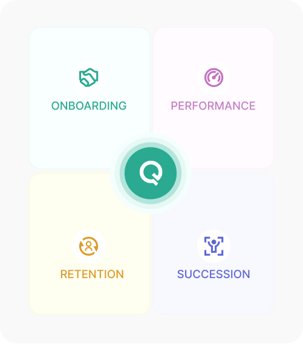
Qooper supports every mentoring format and use case from a single platform, eliminating the cost of running separate tools for separate programs:
|
Program Type |
What It Solves |
Typical ROI Driver |
|---|---|---|
|
Employees lack internal guidance for career progression |
Higher retention, internal mobility, engagement scores |
|
|
New hires ramp slowly; high 90-day dropout rates |
50% faster time-to-productivity, reduced early attrition |
|
|
Leadership pipeline thin; too many roles filled externally |
Reduced external hiring cost, stronger succession bench |
|
|
Senior leaders lack exposure to new technology and Gen Z expectations |
Innovation, executive effectiveness, inclusion metrics |
|
|
Managers promoted without coaching on people leadership skills |
Lower manager-driven attrition, stronger team performance |
|
|
New reps ramp slowly; institutional knowledge stays siloed |
Faster quota attainment, improved deal win rates |
|
|
Clinical staff turnover is high in the first 12 months |
First-year nurse retention, patient care consistency |
|
|
Cross-functional silos limit collaboration and knowledge sharing |
Engagement scores, cross-team relationship strength |
Key Features That Reduce Cost and Maximize Outcomes
Every feature in Qooper is designed to cut the administrative overhead that inflates program cost and increase the engagement quality that drives ROI:
|
Feature |
What It Does |
Cost / Quality Impact |
|---|---|---|
|
Analyzes 20+ compatibility dimensions — goals, skills, communication style, seniority — to find the best-fit pairs automatically |
Fewer re-matching requests; higher first-match quality than any manual process |
|
|
Automated Scheduling |
Calendar sync with Office 365 and Google; sessions booked without any coordinator involvement |
Saves 3-5 admin hours per month; no scheduling back-and-forth |
|
Goal Setting & Progress Tracking |
Mentees log goals in-platform; mentors track milestones; admins see aggregate completion across all pairs in real time |
3x higher session completion; direct input for ROI reporting |
|
AI Session Guides |
Agenda templates and discussion prompts generated before every session based on the mentee's current goals |
Reduces relationship drift; mentors feel prepared without extra training |
|
Engagement Monitoring & Alerts |
ML identifies pairs going inactive and triggers auto-nudges before relationships go dark |
Reduces silent dropout by 40-60%; saves re-matching time and cost |
|
Real-Time Analytics Dashboards |
Participation, session completion, NPS, goal progress, and ROI metrics visible to admins without any manual data work |
Eliminates end-of-cycle reporting crunch; gives leadership continuous visibility |
|
HRIS & LMS Integrations |
Native connections to Workday, SAP SuccessFactors, Oracle HCM, Cornerstone, Degreed, BambooHR, ADP |
Auto-provisions users from day one; no manual roster management |
|
Slack & Microsoft Teams |
Session reminders, match notifications, and engagement nudges delivered in tools participants already use |
Higher response rate; zero context switching required |
|
Mobile App (iOS & Android) |
Full platform access on mobile for on-the-go session management, notes, and goal updates |
Increases engagement for frontline, field, and deskless workforces |
|
Multi-Program Management |
Career, onboarding, and leadership programs run simultaneously from one admin dashboard |
One license, unlimited program types; no per-program pricing |
|
ATD-Certified Training Courses |
Mentor and mentee onboarding built directly into the platform; no external training vendor needed |
Eliminates third-party training cost; faster ramp to first productive session |
|
Enterprise Security |
SOC 2 Type II certified, GDPR and CCPA compliant, SSO, role-based access controls |
Clears security reviews in regulated industries; trusted by healthcare, finance, and government |
What Makes Qooper Different
-
One platform, every program type — career mentoring, onboarding, leadership, peer, reverse, and community programs run from a single license, with no per-program fees that multiply cost as your portfolio grows
- AI that keeps programs active between sessions — Qooper's matching engine considers career goals, skill gaps, working styles, and availability to create relationships more likely to drive real development; after the match, AI-generated session agendas, an AI mentorship trainer, and engagement signals that flag at-risk relationships keep every program data-informed from launch through completion
-
Admin time cut by 60–70% — the most consistent result Qooper customers report vs. their previous manual process; that saving alone often covers the majority of the license cost before retention benefits are counted
- Structured mentoring beyond the match — pairing mentors and mentees is just the starting point; Qooper supports every relationship with built-in meeting agendas, goal templates, feedback workflows, session reminders, and mentorship training so participants always know what to do next and engagement doesn't drop off after launch
- Mobile-first for participants, enterprise-grade for admins — mentors, mentees, and peers connect, set goals, schedule sessions, and share feedback from anywhere on native iOS and Android apps, while program administrators get full visibility into engagement, relationship health, and outcomes from a single dashboard
- Enterprise integrations that eliminate hidden admin cost — bi-directional syncs with Workday, SAP SuccessFactors, Oracle, ADP, UKG, and BambooHR keep participant data accurate automatically; Microsoft Entra, Azure AD, and Okta handle identity and access; Slack and Teams deliver nudges inside the tools employees already use
-
Dedicated Customer Success Manager included — a named CSM who knows your program, your goals, and your cohort calendar; not a support ticket queue or a generic help center, with response times under 30 minutes and quarterly business reviews built into the engagement
-
Research-backed program design — templates and matching frameworks validated across 300+ enterprise deployments; you are not starting from a blank canvas
- Built-in ROI Calculator — connects live program data to retention savings, productivity gains, and leadership pipeline value; the single tool most HR leaders say makes budget approval straightforward
-
Global-ready out of the box — 30+ language support across the full platform interface, session guides, notifications, and workflows; global administrators manage one unified program instead of separate regional workarounds, with centralized reporting across all geographies
- Trusted by Fortune 500 enterprises at scale — 300+ organizations run structured mentoring on Qooper across thousands of employees, including the complex multi-program, multi-geography deployments that simpler tools aren't built to handle
- No compliance surprises in regulated industries — SOC 2 Type I and Type II certified, GDPR compliant with a Data Processing Agreement available, SSO/SAML and role-based access control included as standard; enterprises in healthcare, financial services, and globally distributed environments clear IT sign-off faster and keep deployment on schedule
- Scales without re-platforming — start with a 50-person pilot and grow to 5,000+ participants across departments, geographies, and business units on the same platform, with no migration cost and no licensing restructuring as new use cases are added

%20(1)%20(1).webp)
.webp)