




Global Mentoring Triumph: Breaking Silos & Fostering Connectivity at Trimble with Qooper


ABOUT
Driven by a passion for innovation, Trimble is setting the pace for the future of work with connected data and cutting-edge technology.
LOCATION
Westminster, CO.
COMPANY SIZE
11000+
PRODUCTS USED
Global Mentoring Program
Challenge
Trimble Inc., a dynamic and globally renowned company, recognized several key challenges before implementing their Global Mentoring Program:
Silos between departments hindered effective communication and collaboration, limiting the exchange of knowledge and impeding cross-functional synergy. Opportunities for networking and knowledge exchange were constrained, preventing the organization from tapping into its full potential. Despite its diverse talent pool, Trimble was yet to fully leverage connections among employees from different sectors and geographic locations.
Evaluation
In the pursuit of enhancing their operational efficiency, Trimble embarked on a comprehensive evaluation of potential solutions. After a series of initial demonstrations and assessments involving various vendors, Trimble encountered a brief delay in launching their initiative.
Upon revisiting the project several months later, the Qooper team conducted another in-depth demonstration, engaging with key stakeholders, including an individual from Trimble's leadership team. Simultaneously, Qooper collaborated closely with Trimble’s IT team to conduct a thorough evaluation of integrations and security aspects.
Trimble's decision to move forward with Qooper was influenced by several key factors. The user-friendly interface of the solution, coupled with its scalability for global deployment, resonated with Trimble's needs. Additionally, the seamless integration possibilities offered by the Qooper platform aligned perfectly with Trimble's objectives.
The successful collaboration between Trimble and the Qooper team stands as a testament to the efficacy of the Qooper mentoring software solution, demonstrating its capability to meet the diverse and evolving requirements of a leading global organization. Trimble's endorsement emphasizes not only the ease of use and global deployment capabilities but also the robust integration features that Qooper brings to the table. This case exemplifies how our solution has become an integral part of Trimble's streamlined and efficient operations.
Implementation & Adoption
Trimble's Global Mentoring Program implementation, powered by Qooper, was strategically designed to address specific challenges and achieve organizational objectives.
The program was strategically aligned with Trimble's overarching goals, specifically targeting challenges related to departmental divides, limited networking, and underutilized global connectivity.
The program was designed to bridge geographical and departmental divides, fostering global connectivity. Qooper's platform facilitated connections not only within local teams but also across global offices, maximizing the diversity of perspectives and knowledge exchange.
A primary objective of the program was to break down departmental silos. Qooper's collaborative features enabled participants to engage in cross-functional discussions and activities, contributing to a more collaborative, open, and communicative work environment.
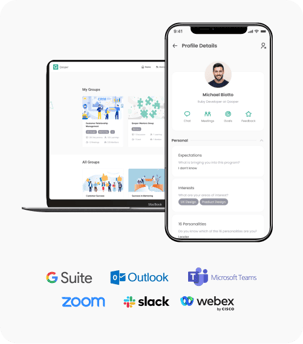
Qooper's group functionalities were leveraged to enhance networking opportunities. Participants actively communicated, initiated discussions, and exchanged knowledge within dedicated groups, promoting a culture of ongoing collaboration and information sharing.
Solution
Qooper's platform allowed participants to create custom learning programs, tailoring their mentorship experiences to individual career aspirations. This feature empowered participants to focus on specific skill development and knowledge areas that were most relevant to their professional growth.
Qooper's features for mentor matching, training, guidance, and reporting streamlined program administration. Automation and centralized management significantly reduced the administrative burden on program coordinators, allowing for more efficient oversight and resource allocation.
Results
As a result of this initiative, Trimble employees interested in participating in the program gained access to mentor or mentee networking groups tailored to their preferences and career aspirations.
Inside these groups, participants used Qooper's collaborative platform to create and participate in discussions, share insights, seek guidance, and exchange knowledge with colleagues across diverse departments and geographical locations.
The program seamlessly facilitated interaction by enabling users to schedule meetings, fostering meaningful connections and in-depth discussions among participants.
.
Takeaways
- The program successfully connected Trimble employees across the globe, enabling the exchange of valuable insights and best practices.
- Silos between departments at Trimble have been significantly reduced, leading to improved cross-functional collaboration and problem-solving.
- This updated text now includes how Trimble effectively utilized Qooper in their Global Mentoring Program to address their specific challenges and achieve the outlined objectives.
How Qooper Broke Down Silos Across Trimble's Global Workforce
Trimble Inc., a globally renowned technology company, faced a critical internal challenge: departmental silos were limiting cross-functional collaboration, restricting knowledge exchange, and preventing the organization from fully leveraging its diverse global talent pool. Qooper powered Trimble's Global Mentoring Program to directly address these barriers at scale.
Cross-Functional Collaboration & Connectivity
-
Qooper's platform successfully connected Trimble employees across multiple departments and geographic locations globally, breaking down long-standing organizational silos.
-
Departmental silos were significantly reduced, leading to measurable improvements in cross-functional collaboration and problem-solving across the organization.
-
Participants were matched into dedicated networking groups tailored to their career aspirations, enabling targeted knowledge exchange across diverse teams and regions.
Program Design & Implementation
- Trimble's Global Mentoring Program was strategically aligned to address 3 core organizational challenges — departmental divides, limited networking opportunities, and underutilized global connectivity.
- Qooper's group functionalities enabled participants to initiate discussions, share insights, seek guidance, and schedule meetings across departments and geographies from a single platform.
- Custom learning programs within Qooper allowed participants to tailor their mentorship experience to individual career aspirations, focusing on specific skill development and knowledge areas.
Operational Efficiency
- Qooper's mentor matching, training, guidance, and reporting features significantly reduced the administrative burden on Trimble's program coordinators, enabling more efficient oversight and resource allocation.
- Seamless integration capabilities and a user-friendly interface were key factors in Trimble's selection of Qooper, ensuring global deployment readiness from day one.
- Qooper's IT and security evaluation process, conducted in close collaboration with Trimble's IT team, ensured full compliance and integration alignment before launch.
Why Qooper Is Built for Enterprise Scale
The results in this case study reflect what becomes possible when enterprise mentoring is supported by the right infrastructure — purpose-built for large, complex organizations that need to launch, manage, scale, and measure structured mentoring programs across departments, geographies, business units, and employee populations. Not a tool that evolved from a simpler product, but an enterprise mentoring operating system designed from day one for the scale, complexity, and accountability requirements that large organizations face.
AI-powered matching that creates relationships worth keeping.
Poor matches create culture risk. They produce no engagement, no development, no retention benefit, and a participant who disengages from every future program. Qooper's AI matching engine goes beyond basic profile matching by considering career goals, skills gaps, interests, working styles, availability, seniority, and organizational hierarchy simultaneously — delivering confidence-scored match recommendations that administrators can review, adjust, and override without disrupting the queue. Matching logic is configurable per program type: a leadership development program weights seniority and functional expertise most heavily; a reverse mentoring cohort inverts that logic entirely. Match quality is maintained consistently whether the program has 200 participants or 20,000.
Structured mentoring that keeps relationships active after the match.
The most common reason mentoring relationships go dormant is not a bad match — it is that pairs don't know what to do next. Qooper eliminates that drop-off by supporting every relationship after the initial match with AI-generated meeting agendas personalized to each pair's goals and session history, pre-built feedback and goal templates, and a mentorship training library that prepares participants before their first conversation. Automated reminders, re-engagement triggers for inactive pairs, and structured session workflows keep every mentoring relationship active and progressing — without requiring program manager intervention at each step.
Multi-program management built for enterprise complexity.
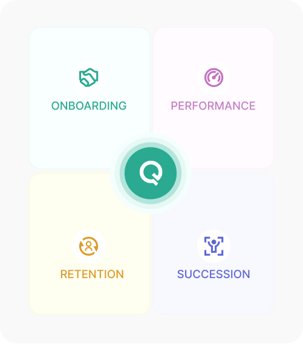
Enterprise organizations don't run one mentoring program. They run many — simultaneously — each serving different employee populations, business objectives, and program formats. Qooper supports 8+ program types including 1:1 career mentoring, reverse mentoring, peer mentoring, group mentoring, flash mentoring, onboarding, leadership development, and high-potential succession tracks, all from a single administrative interface with fully independent configurations per program. Administrators can build, duplicate, and expand programs across departments, regions, and business units without rebuilding from scratch — while keeping all reporting and participant data centralized for leadership visibility.
Mobile-first design that drives adoption across every workforce.
A mentoring platform that requires desk access or generates participation friction will not achieve the adoption rates needed to deliver outcomes at enterprise scale — particularly for field-based, frontline, remote, or globally distributed workforces. Qooper's native iOS and Android experience gives every participant immediate access to mentors, program resources, structured session guides, meeting scheduling, goal tracking, and feedback from anywhere, without logging into a separate portal or requiring training to navigate. Mentors, mentees, and peers can connect, chat, set goals, schedule meetings, track progress, and share feedback from anywhere — keeping every mentoring relationship active and measurable regardless of where participants work.
Enterprise integrations that eliminate manual work and keep data accurate.
Qooper connects with the systems enterprises already use — so mentoring fits into existing workflows instead of becoming another disconnected tool to manage. HRIS integrations with Workday, SAP SuccessFactors, Oracle, ADP, BambooHR, UKG, and Paycor keep participant rosters current automatically: new hires enrolled on day one, departed employees removed without cleanup, role changes reflected in matching profiles in real time. Slack and Microsoft Teams deliver program notifications where employees already work. Google Workspace and Outlook handle session scheduling with calendar invites and meeting links created directly from the platform. Okta and Azure AD enforce SSO. Cornerstone, Degreed, and LinkedIn Learning connect mentoring goals to formal learning pathways. For complex enterprise environments, Qooper's integration framework supports both standard and custom integration needs with dedicated IT support and clear documentation.
Three-layer reporting that sustains executive sponsorship.
Mentoring program ROI is not a one-time business case — it is an ongoing conversation with finance and leadership through every budget cycle. Qooper's analytics framework covers all three layers that enterprise stakeholders need: real-time activity metrics for program managers to monitor program health and surface inactive pairs before they exit; outcome metrics comparing mentored cohorts against control groups for HR and talent leaders tracking retention, promotion rates, and engagement scores; and financial impact calculations — configurable with your organization's actual turnover cost inputs — for the C-suite and program sponsors. The executive report is a scheduled export, not a quarterly manual project, giving HR leaders, program sponsors, and leadership a consistent, real-time view of what mentoring is contributing to the business.
Enterprise security and compliance that passes IT and Legal review on day one.
Qooper is SOC 2 Type I and Type II certified, with annual independent audits covering infrastructure security, organizational security, product security, and internal security operations. GDPR compliant with a documented Data Processing Agreement. SSO enforcement via Okta, Azure AD, and Google Workspace with local password login disabled by default. Role-based access controls ensure participants see only their own data, program managers see their cohorts, and global admins see everything. Regular penetration testing, audit logging, data residency options for regulated industries, and cybersecurity insurance — full security documentation ready for IT and Legal review from day one of evaluation.
Dedicated customer success included in every enterprise contract.
Qooper's enterprise contracts include a named customer success manager with a sub-30-minute response time SLA — not an upsell, not a shared support queue. Implementation covers program design consultation, HRIS integration configuration, SSO setup, matching configuration, administrator training, and pilot launch support. Ongoing support includes program health reviews and quarterly business reviews that reduce internal admin workload and keep programs optimized for outcomes from launch through scale. Most Qooper enterprise customers go from contract signing to first participant matches in 6–8 weeks.
The platform behind the results.
Qooper is enterprise mentoring software trusted by 300+ organizations, including Fortune 500 companies such as Merck, BNY, Harvard, Toyota, and Deloitte, with thousands of users across 500+ mentoring programs. Across those programs, Qooper customers report 79% improved retention rates and 40% higher engagement — produced by the same combination of enterprise HRIS integrations, AI-powered matching, full-lifecycle automation, mobile-first participant experience, structured mentoring beyond the match, three-layer ROI analytics, and dedicated customer success that delivered the results in this case study. For large, complex, and global organizations, Qooper provides the depth of enterprise infrastructure required to turn mentoring from an informal activity into a measurable, scalable business advantage.
Trusted by 300+ Enterprises Globally













FAQ
How can a global mentoring program break down departmental silos in a large technology company?
Departmental silos are rarely a communication problem — they're a structural connectivity problem. Employees default to working within their immediate team because there's no reliable mechanism to form meaningful relationships across functions. A global mentoring program changes that by creating intentional, structured cross-functional connections at scale. Trimble designed their Qooper-powered program specifically to pair employees across departments and geographies, enabling knowledge exchange that wouldn't happen organically. Participants joined dedicated networking groups aligned to their career interests — not their org chart — which drove collaboration and problem-solving across teams that previously operated in isolation. The measurable outcome: significantly reduced departmental silos and improved cross-functional collaboration organization-wide.
What should IT and security teams evaluate when selecting a global mentoring platform?
For a global technology company like Trimble, IT and security sign-off isn't a formality — it's a prerequisite. The key evaluation areas are: SSO and HRIS integration readiness, data residency and privacy compliance across regions, role-based access controls, and audit logging capabilities. Trimble's IT team worked directly with Qooper's team to conduct a thorough integration and security assessment before any program launch. This collaborative evaluation approach — not a standard vendor security questionnaire — was a deciding factor in moving forward. When evaluating vendors, insist on a live integration review with your IT stakeholders present, not just a compliance checklist submitted asynchronously. The depth of that conversation signals how seriously the vendor takes enterprise security.
How do you design a mentoring program that works across multiple countries and time zones?
Global mentoring programs fail when they're designed for a headquarters timezone and bolted onto international teams as an afterthought. The design principles that actually work across geographies are: asynchronous-first communication (discussions and knowledge sharing that don't require real-time participation), flexible meeting scheduling that surfaces cross-timezone availability, and matching logic that accounts for geographic context alongside career goals. Trimble used Qooper's group discussions, asynchronous knowledge sharing, and integrated meeting scheduling to connect employees across global offices without forcing everyone into the same synchronous workflow. The platform became the connective tissue of their global talent network — enabling interaction on each participant's own terms.
Can employees personalize their own mentoring experience within a company-wide program?
One of the most common failure modes of enterprise mentoring programs is a one-size-fits-all approach that ignores individual career stages and ambitions. Trimble addressed this directly by enabling participants to create custom learning programs within Qooper, tailoring their mentorship experience to their specific career aspirations and skill development goals. Rather than assigning a generic curriculum, participants focused on the knowledge areas most relevant to their own growth trajectory. This personalization is what separates a mentoring program that employees engage with voluntarily from one they tolerate because HR requires it. The more agency participants have in shaping their experience, the higher the engagement and the stronger the mentoring relationships that result.
How do you get leadership and IT stakeholders aligned on a global mentoring software rollout?
Global software rollouts stall when HR champions try to push them through without early IT and leadership involvement. Trimble's evaluation process is a textbook example of multi-stakeholder alignment done right: the Qooper team engaged both a member of Trimble's leadership team and the IT department simultaneously — addressing organizational goals and security requirements in parallel rather than sequentially. This approach compressed the evaluation timeline and eliminated the common scenario where IT kills a deal that leadership already approved. For HR leaders navigating a similar rollout, the advice is to bring IT into the vendor demo early, not after you've already chosen a platform. A vendor willing to run a joint leadership and IT session is signaling that they're built for enterprise complexity — not just SMB simplicity.
Want to explore more?
Discover how Qooper can help your organizational goals and people development today.