




Matthews International: Successful Formal & Informal Mentoring Program Implementation

ABOUT
Matthews International is comprised of three business segments, Industrial Technologies, Memorialization and Brand Solutions, all of which strive to find creative ways to drive efficiencies while continuing to grow by building and acquiring new capabilities for the future.
LOCATION
Pittsburgh, PA
COMPANY SIZE
11000+
PRODUCTS USED
Company-Wide Mentoring Program
“I believe that having a mentor in the field of medicine is crucial because of how vast and intense the field is. Being a minority in this field is even more difficult, so having a mentor will make transitioning and succeeding in the field significantly less tiring.”
Darwin, one of the PrIMES alumni
Challenge
In this case study, Qooper explores how Matthews International successfully implemented both a formal and an informal mentoring program, contributing to enhanced employee development, knowledge sharing, and organizational growth.
Matthews International, a global technology firm with over 11,000 employees, comprises three business segments, Industrial Technologies, Memorialization, and Brand Solutions, all of which strive to find creative ways to drive efficiencies while continuing to grow by building and acquiring new capabilities for the future.
The company initially ran its mentoring programs manually, spending a significant amount of time on matching for both formal and informal programs. This manual approach became increasingly challenging to manage, particularly as they sought to connect employees worldwide. Spreadsheets, once used for this purpose, had become impossible to handle effectively. Recognizing the need for a more streamlined and scalable solution, Matthews International turned to Qooper to facilitate global connections, empower employees, and optimize their mentoring programs.
Evaluation
Matthews International started their research to find a platform that could take over the matching work. Since Matthews International is a global firm, they needed a platform that is available in multiple countries, available in multiple languages and GDPR compliant.
Also, Matthews International needed a vendor that could integrate into a complex HCM environment. After a couple calls with their Qooper representative, Omer, they decided to take their evaluations to leadership to get an approval to move forward with Qooper for the next three years.
Implementation & Adoption
Matthews Formal Mentoring Program:
Matthews International established a formal mentoring program where experienced senior employees (mentors) were matched with junior/mid experienced employees (mentees) based on their skills, career goals, and areas of interest.
The formal mentoring program was launched in the beginning of 2022 with clear guidelines, structured mentor-mentee matching, and predefined goals for each mentoring pair.
With the help of Qooper Success Manager, Elona, a clear framework was developed, outlining the timeline, program structure, job aids, and communications. Regular check-ins and progress tracking were integrated into the program, ensuring accountability.
The objectives of the program were:
-
Facilitate structured knowledge sharing.
-
Foster career growth and skill enhancement.
-
Build relationships across hierarchical levels.
Matthews Informal Mentoring Program:
In 2023, Matthews International transitioned from the Formal Program to an Informal Mentoring Culture, introducing "Matthews Informal Mentoring," where employees could sign up for informal mentoring sessions with colleagues across departments and regions (Americas, Asia Pacific, Europe, Middle East and East Africa).
The program relied on Mentor self-search which allowed employees to schedule sessions and outline discussion topics. The emphasis was on open conversations, idea sharing, and relationship-building rather than a structured mentoring process.
The objectives of the program were:
-
Promote spontaneous knowledge exchange.
-
Encourage networking and relationship-building.
-
Capture diverse perspectives and insights.
.
Solution
Matthews International leveraged Qooper's comprehensive mentoring platform to address the challenges posed by their diverse workforce structure, consisting of frontline and office employees worldwide. Qooper's tailored solutions played a pivotal role in transforming their mentoring programs and enhancing employee engagement.
HCM Integration for Seamless Onboarding: To streamline the onboarding process, Matthews International utilized Qooper's Human Capital Management (HCM) integration. This integration allowed for the seamless transfer of employee data into the Qooper platform, simplifying the joining process for employees across the organization. This facilitated easy access and participation in both formal and informal mentoring programs.
Accommodating a Complex Workforce Structure: Matthews International's complex organizational structure, encompassing both frontline and office workers, required a flexible and accommodating mentoring platform. Qooper's solution seamlessly adapted to this complexity, ensuring that all employees, including those in retail and wholesale roles, could join and engage effortlessly.
Enhanced Employee Engagement: Qooper's platform proved instrumental in promoting enhanced engagement among employees. For formal mentoring programs, including those designed for high-potential managers, employees found it easier to connect with mentors and gain valuable insights. Additionally, for the informal mentoring program, which included mentee-mentor networks, Matthews International is aiming to introduce an Employee Resource Group (ERG) mentorship program and subject matter expertise groups in the following terms. Qooper offers the flexibility and features necessary to support these diverse mentoring initiatives.
Guidance Solutions and Meeting Agendas: Qooper's value extended beyond simple matching. For informal mentoring programs, Qooper provided pre-structured mentorship meeting agendas, ensuring that mentoring sessions were productive and goal-oriented. The guidance solutions offered by Qooper allowed Matthews International to enhance the quality of mentoring relationships and maximize their impact.
Incorporating Qooper's HCM integration, accommodating a diverse workforce structure, and harnessing the platform's flexibility, Matthews International transformed their mentoring programs into dynamic, accessible, and impactful initiatives. This strategic shift not only improved employee engagement but also facilitated knowledge sharing, skill development, and career growth across the organization.
Results
Formal Mentoring Program:
Participants reported improved job satisfaction and engagement due to personalized guidance.
Skill development became more targeted, leading to enhanced job performance.
Cross-functional collaboration increased, breaking silos within the organization. Knowledge transfer improved, reducing the learning curve for new employees.
Informal Mentoring Program:
Employees appreciated the flexibility and autonomy of the program.
Cross-departmental understanding and collaboration increased significantly.
Fresh perspectives and innovative ideas emerged from the informal discussions.
Employee engagement improved as employees felt valued and connected.
By successfully implementing both formal and informal mentoring programs, Matthews International effectively addressed its challenges related to employee development and knowledge sharing.
The formal program provided structured guidance for career growth and skill enhancement, while the informal program encouraged spontaneous interactions, collaboration, and creativity.
Together, these initiatives contributed to a more engaged and empowered workforce, fostering a culture of continuous learning and professional development.
.
Takeaways
- Matthews International streamlined onboarding and boosted employee engagement by using Qooper's HCM integration, making it effortless for employees to join and participate in mentoring programs.
- Qooper's flexible solution effortlessly accommodated Matthews International's diverse workforce, including frontline and office employees worldwide.
- Qooper's guidance solutions and structured meeting agendas improved the quality of mentoring relationships, fostering productive and goal-oriented mentoring sessions.
- Implementation of both formal and informal mentoring programs led to improved job satisfaction, targeted skill development, increased collaboration, and enhanced knowledge transfer, creating a more engaged and innovative workforce.
How Qooper Helped Matthews International Run Formal & Informal Mentoring Programs Across 11,000+ Employees in 4 Global Regions
Matthews International, a global technology firm with over 11,000 employees across 4 regions — Americas, Asia Pacific, Europe, and Middle East & East Africa — was managing both formal and informal mentoring programs entirely through spreadsheets. As the organization grew, this manual approach became unmanageable. Qooper replaced it with a scalable, multi-language, GDPR-compliant global mentoring infrastructure.
Program Structure & Scale
- Matthews International successfully launched and ran 2 distinct mentoring programs — a Formal Mentoring Program launched in early 2022 and an Informal Mentoring Program introduced in 2023 — across all global regions simultaneously.
- The formal program connected senior employees with junior and mid-level employees across hierarchical levels, while the informal program opened up self-directed, cross-departmental mentorship to the entire workforce.
- Matthews International secured a 3-year platform commitment with Qooper, reflecting strong leadership confidence and long-term strategic alignment.
- Future expansion plans include the introduction of an Employee Resource Group (ERG) mentorship program and subject matter expertise groups within the Qooper platform.
Measurable Workforce Impact
- The formal mentoring program delivered improved job satisfaction and engagement through personalized guidance, with skill development becoming more targeted and leading to enhanced job performance across participating employees.
- Cross-functional collaboration increased significantly under both programs, breaking down organizational silos across departments and geographies.
- The informal program generated fresh perspectives and innovative ideas from open cross-departmental discussions, with employees reporting feeling more valued and connected.
- Knowledge transfer improved measurably, reducing the learning curve for new employees entering a complex, multi-segment global organization.
Operational Efficiency
- Qooper's HCM integration enabled seamless transfer of employee data into the platform, eliminating manual onboarding across an 11,000+ person global workforce.
- Pre-structured mentorship meeting agendas provided by Qooper ensured every mentoring session was productive and goal-oriented — even within the informal, self-directed program.
- Qooper's platform accommodated Matthews International's complex workforce structure — spanning both frontline and office employees across multiple countries — without requiring custom development or workarounds.
- The platform's multi-language support and GDPR compliance made it the only solution capable of meeting Matthews International's global regulatory and accessibility requirements.
Why Qooper Is Built for Enterprise Scale
The results in this case study reflect what becomes possible when enterprise mentoring is supported by the right infrastructure — purpose-built for large, complex organizations that need to launch, manage, scale, and measure structured mentoring programs across departments, geographies, business units, and employee populations. Not a tool that evolved from a simpler product, but an enterprise mentoring operating system designed from day one for the scale, complexity, and accountability requirements that large organizations face.
AI-powered matching that creates relationships worth keeping.
Poor matches create culture risk. They produce no engagement, no development, no retention benefit, and a participant who disengages from every future program. Qooper's AI matching engine goes beyond basic profile matching by considering career goals, skills gaps, interests, working styles, availability, seniority, and organizational hierarchy simultaneously — delivering confidence-scored match recommendations that administrators can review, adjust, and override without disrupting the queue. Matching logic is configurable per program type: a leadership development program weights seniority and functional expertise most heavily; a reverse mentoring cohort inverts that logic entirely. Match quality is maintained consistently whether the program has 200 participants or 20,000.
Structured mentoring that keeps relationships active after the match.
The most common reason mentoring relationships go dormant is not a bad match — it is that pairs don't know what to do next. Qooper eliminates that drop-off by supporting every relationship after the initial match with AI-generated meeting agendas personalized to each pair's goals and session history, pre-built feedback and goal templates, and a mentorship training library that prepares participants before their first conversation. Automated reminders, re-engagement triggers for inactive pairs, and structured session workflows keep every mentoring relationship active and progressing — without requiring program manager intervention at each step.
Multi-program management built for enterprise complexity.
Enterprise organizations don't run one mentoring program. They run many — simultaneously — each serving different employee populations, business objectives, and program formats. Qooper supports 8+ program types including 1:1 career mentoring, reverse mentoring, peer mentoring, group mentoring, flash mentoring, onboarding, leadership development, and high-potential succession tracks, all from a single administrative interface with fully independent configurations per program. Administrators can build, duplicate, and expand programs across departments, regions, and business units without rebuilding from scratch — while keeping all reporting and participant data centralized for leadership visibility.
Mobile-first design that drives adoption across every workforce.
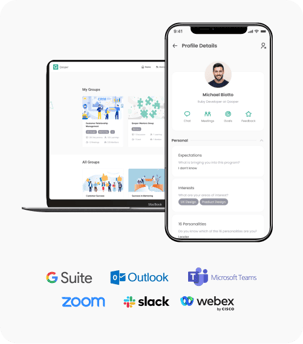
A mentoring platform that requires desk access or generates participation friction will not achieve the adoption rates needed to deliver outcomes at enterprise scale — particularly for field-based, frontline, remote, or globally distributed workforces. Qooper's native iOS and Android experience gives every participant immediate access to mentors, program resources, structured session guides, meeting scheduling, goal tracking, and feedback from anywhere, without logging into a separate portal or requiring training to navigate. Mentors, mentees, and peers can connect, chat, set goals, schedule meetings, track progress, and share feedback from anywhere — keeping every mentoring relationship active and measurable regardless of where participants work.
Enterprise integrations that eliminate manual work and keep data accurate.
Qooper connects with the systems enterprises already use — so mentoring fits into existing workflows instead of becoming another disconnected tool to manage. HRIS integrations with Workday, SAP SuccessFactors, Oracle, ADP, BambooHR, UKG, and Paycor keep participant rosters current automatically: new hires enrolled on day one, departed employees removed without cleanup, role changes reflected in matching profiles in real time. Slack and Microsoft Teams deliver program notifications where employees already work. Google Workspace and Outlook handle session scheduling with calendar invites and meeting links created directly from the platform. Okta and Azure AD enforce SSO. Cornerstone, Degreed, and LinkedIn Learning connect mentoring goals to formal learning pathways. For complex enterprise environments, Qooper's integration framework supports both standard and custom integration needs with dedicated IT support and clear documentation.
Three-layer reporting that sustains executive sponsorship.
Mentoring program ROI is not a one-time business case — it is an ongoing conversation with finance and leadership through every budget cycle. Qooper's analytics framework covers all three layers that enterprise stakeholders need: real-time activity metrics for program managers to monitor program health and surface inactive pairs before they exit; outcome metrics comparing mentored cohorts against control groups for HR and talent leaders tracking retention, promotion rates, and engagement scores; and financial impact calculations — configurable with your organization's actual turnover cost inputs — for the C-suite and program sponsors. The executive report is a scheduled export, not a quarterly manual project, giving HR leaders, program sponsors, and leadership a consistent, real-time view of what mentoring is contributing to the business.
Enterprise security and compliance that passes IT and Legal review on day one.
Qooper is SOC 2 Type I and Type II certified, with annual independent audits covering infrastructure security, organizational security, product security, and internal security operations. GDPR compliant with a documented Data Processing Agreement. SSO enforcement via Okta, Azure AD, and Google Workspace with local password login disabled by default. Role-based access controls ensure participants see only their own data, program managers see their cohorts, and global admins see everything. Regular penetration testing, audit logging, data residency options for regulated industries, and cybersecurity insurance — full security documentation ready for IT and Legal review from day one of evaluation.
Dedicated customer success included in every enterprise contract.
Qooper's enterprise contracts include a named customer success manager with a sub-30-minute response time SLA — not an upsell, not a shared support queue. Implementation covers program design consultation, HRIS integration configuration, SSO setup, matching configuration, administrator training, and pilot launch support. Ongoing support includes program health reviews and quarterly business reviews that reduce internal admin workload and keep programs optimized for outcomes from launch through scale. Most Qooper enterprise customers go from contract signing to first participant matches in 6–8 weeks.
The platform behind the results.
Qooper is enterprise mentoring software trusted by 300+ organizations, including Fortune 500 companies such as Merck, BNY, Harvard, Toyota, and Deloitte, with thousands of users across 500+ mentoring programs. Across those programs, Qooper customers report 79% improved retention rates and 40% higher engagement — produced by the same combination of enterprise HRIS integrations, AI-powered matching, full-lifecycle automation, mobile-first participant experience, structured mentoring beyond the match, three-layer ROI analytics, and dedicated customer success that delivered the results in this case study. For large, complex, and global organizations, Qooper provides the depth of enterprise infrastructure required to turn mentoring from an informal activity into a measurable, scalable business advantage.
Trusted by 300+ Enterprises Globally











FAQ
What is the difference between a formal and informal mentoring program, and which does your organization need?
Formal and informal mentoring programs serve fundamentally different organizational goals — and the most effective enterprise programs run both simultaneously. A formal mentoring program pairs senior employees with junior or mid-level employees through structured matching, defined goals, timelines, and regular progress tracking. It's best suited for accelerating career development, building cross-hierarchical relationships, and reducing onboarding learning curves. An informal mentoring program removes the structure entirely — employees self-select mentors across departments and regions, schedule their own sessions, and drive conversations based on curiosity rather than curriculum. Matthews International ran a formal program from 2022, then layered an informal program in 2023, deliberately sequencing the two. The formal program built the mentoring muscle; the informal program scaled it organically across the entire global workforce.
How do you manage a global mentoring program that must be GDPR compliant and support multiple languages?
Running a mentoring program across regions like Americas, Asia Pacific, Europe, and Middle East & East Africa introduces compliance requirements that most HR software simply wasn't built for. GDPR compliance is non-negotiable for any program touching European employee data — covering consent management, data residency, access rights, and deletion workflows. Multi-language support is equally critical: a platform only available in English immediately creates a participation gap in non-English-speaking regions. Matthews International made both requirements hard filters in their vendor evaluation — Qooper's GDPR compliance and multi-language capabilities were decisive factors. For global HR leaders, these should be evaluated upfront with your legal and compliance team before shortlisting vendors, not discovered as gaps after a contract is signed.
How does HCM integration eliminate the manual work of managing mentoring programs at scale?
Spreadsheet-based mentoring program management doesn't fail immediately — it fails gradually, then catastrophically. Matthews International reached that breaking point managing 11,000+ employees across a complex multi-segment global organization. The root problem wasn't effort; it was that manual matching and data management don't scale. Qooper's HCM integration solved this by automating the transfer of employee data directly into the mentoring platform — eliminating duplicate data entry, keeping participant records current without HR intervention, and making it effortless for employees across every region to join and participate. For organizations operating complex HCM environments with multiple data sources, the key evaluation question is whether the vendor has a proven, production-ready integration with your specific HCM — not just a generic API capability.
How do structured meeting agendas improve the quality of mentoring relationships?
The most common reason mentoring relationships stall isn't lack of goodwill — it's that participants sit down together and don't know what to talk about. Without structure, sessions drift into small talk, run short, and gradually stop happening. Pre-structured meeting agendas solve this by giving every session a clear purpose, suggested discussion topics, and goal alignment before the conversation begins. Matthews International used Qooper's guidance solutions and agenda templates across both their formal and informal programs — ensuring that even self-directed informal mentoring sessions remained productive and outcome-oriented. This is particularly valuable in informal programs where there's no administrator oversight: the platform itself carries the structure that the program design deliberately removed.
How do you evolve a mentoring program over time without losing momentum or starting over?
The most successful enterprise mentoring programs aren't static — they evolve as the organization's needs change and as participants develop a mentoring culture. Matthews International's journey is a model for this: they started with a structured formal program in 2022 to establish mentoring norms and build relationships across hierarchical levels, then transitioned to an informal, self-directed program in 2023 once the culture was established. They also secured a 3-year platform commitment — signaling that mentoring is a long-term organizational investment, not an annual HR initiative. Future plans include ERG mentorship programs and subject matter expertise groups, all on the same platform. The key principle: design your first program with the second one in mind, and choose a platform flexible enough to support program types you haven't invented yet.
Want to explore more?
Discover how Qooper can help your organizational goals and people development today.