




 ·
10 minute read
·
10 minute read
Getting thousands of employees to actually use a mentoring program is not a motivation problem — it is a friction problem. Adoption at scale comes from removing the work and uncertainty at every step: enrolling people automatically instead of chasing sign-ups, matching them so no one faces a blank “who do I connect with,” meeting them inside the tools they already use instead of another login, telling them exactly what to do in each session, and keeping relationships active without manual chasing. Programs engineered that way reach high participation across departments, geographies, and business units. Programs that rely on a launch email and good intentions stall within weeks. This guide breaks down exactly where adoption breaks, the playbook that fixes it, and how Qooper builds each of those levers into the platform.
Why Mentoring Programs Lose People at Scale
A pilot with 30 enthusiastic volunteers hides the problems that surface when you enroll thousands of employees across departments, regions, and business units. Volunteers self-select and self-serve; a full-scale program cannot rely on either. At scale, small points of friction multiply into dropped participation, and every one of them is avoidable:
- Enrollment friction. If joining requires hunting for a link, filling out a long form, or waiting for an admin to add you, a large share of interested employees never finish.
- Matching uncertainty. When people have to find their own mentor, most never start. The blank page is where enrollment quietly dies.
- Yet another tool. Every new login competes with the work employees are already behind on. A platform that lives outside daily workflow gets forgotten.
- No idea what to do next. Once matched, many pairs stall because neither person knows how to run a productive mentoring conversation.
- Momentum death after the first meeting. Without prompts and follow-ups, even motivated pairs drift apart within a few weeks.
- One-size-fits-none programs. A single generic program rarely fits a new hire, a senior leader, and an ERG member equally — so most of the audience disengages.
- Language and location barriers. Global employees quietly opt out when the experience is not available in their language or built for their time zone.
- Invisible programs. If employees do not hear about the program in a compelling way, they never opt in — no matter how good it is.
- Stalled pairs no one notices. At scale, administrators cannot manually watch every relationship, so disengagement spreads unseen.
The Enterprise Mentoring Adoption Playbook
High participation is engineered, not hoped for. These eight moves are what separate programs that scale from programs that fade:
- Promote it like a product launch, not a single email. Use professional promotion materials and landing pages to build awareness and make signing up effortless.
- Remove enrollment and matching friction. Auto-provision participants and pair them intelligently — never ask an employee to find their own mentor.
- Meet employees inside the tools they already use. Deliver invitations, reminders, and activity where people already work, and make participation mobile.
- Offer the right program for every audience. Match the format to the population so the experience feels relevant, not generic.
- Prepare participants so relationships start strong. Give mentors and mentees training and expectations before the first meeting.
- Guide every session so no one faces a blank page. Provide agendas, ice breakers, and conversation starters that make each meeting easy to run.
- Automate follow-ups and rescue stalled pairs. Keep relationships moving with reminders and prompts, and intervene when engagement drops.
- Report outcomes to sustain support and re-enroll. Show leadership the impact so the program keeps its budget and momentum for the next cohort.
How Qooper Drives Adoption at Every Step
Qooper is enterprise mentoring software built to turn each of those adoption levers into a built-in capability rather than a manual effort — so participation scales across thousands of employees without scaling your admin team. Here is how Qooper drives adoption at every step of the playbook.
Promote and launch: Build awareness with ready-made collateral
Employees cannot join a program they never hear about. Qooper provides professional program promotion materials, existing marketing collateral, and landing pages, so you can run a real launch campaign instead of a single announcement. Combined with Qooper’s best-practice launch support, this drives higher awareness and a lower-effort path to sign-up from the first day.
Enroll without friction through HRIS-driven provisioning
The fastest way to lose a would-be participant is a clunky sign-up. Qooper’s bi-directional HRIS syncs with Workday, SAP SuccessFactors, Oracle, ADP, UKG, BambooHR, and Paycor keep employee data accurate and let you provision participants automatically — so eligible employees can be enrolled and invited without manual roster building, and access stays current as people join, change roles, or move teams. Removing the enrollment barrier is one of the highest-leverage adoption moves available, and Qooper makes it automatic.
Remove matching friction with Smart Mentor Matching
The single biggest drop-off point is asking people to find their own mentor. Qooper’s Smart Mentor Matching removes that friction entirely, pairing participants based on career goals, skills gaps, interests, working styles, availability, and program objectives — with adjustable match weights and best-practice defaults, plus configurable workflows and approvals for administrators who want more control. A strong, relevant match is what makes someone show up for the first meeting and keep coming back, and Qooper’s experience across 500+ programs means the matching handles the edge cases that trip up manual pairing.
“Qooper’s matching algorithm paired me with the perfect mentor — it made the entire mentoring journey feel personalized and intentional from day one.”
— Dani L., Northwell Health
Meet employees where they already work
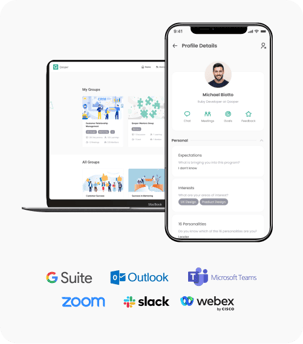
Adoption collapses when a program lives in a tool no one opens. Qooper delivers invitations, reminders, session prompts, and program updates directly inside Slack and Microsoft Teams, and its native mobile app lets participants chat, set goals, schedule sessions, track progress, and share feedback from anywhere. Instead of asking employees to remember another login, mentoring shows up in the flow of their day — which is exactly what sustained participation requires.
“Qooper has everything you need to get a mentorship program off the ground. It provides a seamless experience for both mentors and mentees with its intuitive user interface.”
— Lea B., Tommy Bahama
Offer the right program for every audience
A single generic program cannot earn broad participation. Qooper supports 1:1 mentoring, groups, and circles across a wide range of program types — org-wide and career mentoring, new-hire onboarding, high-potential and leadership development, AI adoption mentoring, ERGs and communities, and student, peer, and alumni mentoring — all from one platform. When employees are offered a program that clearly fits their role and goals, they are far more likely to opt in and stay engaged, and administrators can run every one of those programs from a single interface.
Reach a global workforce in their own language
For distributed organizations, language is a hidden adoption barrier. With support for more than 30 languages across the interface, learning content, session guides, and notifications, Qooper lets you run one unified program with localized participant experiences, so employees in every region can fully participate rather than quietly opting out. Engagement data and reporting stay centralized while the experience feels local — the combination that drives adoption across a global workforce.
Prepare participants so relationships start strong
Pairs that do not know how to mentor fizzle fast. Qooper includes built-in training from certified trainers — mentorship, soft skills, leadership, and custom or asynchronous tracks — plus an AI mentorship trainer, so mentors and mentees arrive at the first meeting knowing how to make it productive. Strong starts are what turn a match into an ongoing relationship, and well-trained participants also protect the program from the culture risk of poor mentoring experiences.
Guide every session so no one faces a blank page
Uncertainty about what to talk about is a silent adoption killer. Qooper guides relationships with customizable mentorship meeting agendas, ice breakers, conversation starters, and mentoring activities, so every session has a clear purpose and momentum. Qooper AI even generates personalized agendas based on past sessions and each participant’s goals — meaning the platform actively helps each pair have a better next conversation.
Sustain momentum with automated follow-up
The gap between the first meeting and the second is where most programs lose people. Qooper automatically follows up with participants using meeting reminders, goal templates, and feedback templates that help mentees prepare, show up, and follow through — which keeps mentors engaged too. This automation is the difference between a program that stays active on its own and one that needs an administrator manually chasing every pair.
Rescue stalled relationships before they fail
At enterprise scale, no administrator can watch every pair by hand. Qooper lets you track connection progress through surveys and feedback forms, identify successful relationships, and flag stalled connections so you can take corrective action early. Qooper Insights goes further, surfacing engagement signals, retention risks, and career-movement trends from live mentoring conversations — so you catch disengagement while you can still fix it, instead of discovering it in an exit interview.
High-touch support that keeps adoption climbing
Adoption is easier to sustain with a partner. Qooper assigns a dedicated Customer Success Manager from day one, with response times under 30 minutes, plus live kickoff support, best-practice templates, program health reviews, and quarterly business reviews. That support helps you diagnose where participation is lagging and act on it — turning adoption into something you actively raise over time rather than watch decay.
“Thank you for being an excellent partner who has supported us from day one, following up, providing suggestions, and assisting me in managing our program despite our small team.”
— Cindee P., Cotiviti
.png?width=368&height=369&name=Group%201952%20(1).png)
Driving Adoption for Different Audiences and Program Types
Participation strategy is not one-size-fits-all. The reason someone engages differs by role and program, and Qooper’s format flexibility lets you tailor the pitch and the experience to each audience:
- New-hire onboarding. Adoption is highest when mentoring is part of the onboarding journey itself. Pair new hires with onboarding guides early and use structured agendas so they see immediate value in their first weeks.
- High-potential and leadership development. Frame participation as an investment in their growth. Goal tracking and structured development journeys keep ambitious participants engaged because progress is visible.
- ERGs and communities. Group and circle formats plus in-workflow delivery through Slack and Teams make belonging-focused programs easy to join and sustain across a distributed workforce.
- Org-wide and career mentoring. Smart matching and self-paced scheduling let a broad, voluntary audience participate on their own terms, which is essential for large-scale uptake.
- Student, peer, and alumni mentoring. Mobile-first participation and light-touch prompts fit audiences that are not sitting at a corporate desk all day.
The Adoption Metrics That Matter
You cannot improve adoption you do not measure. Track participation as a funnel, not a single number, and Qooper’s reporting and Qooper Insights give you visibility into each stage:
- Enrollment rate — the share of eligible employees who join.
- Activation — the share of matched pairs that actually hold a first meeting.
- Engagement — session frequency, message activity, goals set, and agendas used over time.
- Relationship health — which pairs are thriving and which are stalling, via surveys and feedback forms.
- Satisfaction — mentee and mentor sentiment captured through built-in surveys.
- Sustained participation — retention of participants across the full program cycle, plus re-enrollment into the next cohort.
Because Qooper configures reporting to your goals during onboarding, these metrics are visible from launch — so you can spot a drop at any stage of the funnel and fix it before it costs you a cohort.
Related Article: Mentorship Program Metrics: Top 10 to Track Success
Common Adoption Mistakes to Avoid
- Treating launch as one email instead of a sustained campaign.
- Making employees find their own mentor.
- Running the program in a tool outside employees’ daily workflow.
- Skipping participant training to launch faster — and losing pairs within weeks.
- Leaving pairs to figure out sessions on their own.
- Measuring only enrollment and ignoring activation and ongoing engagement.
- Waiting until the end of a cohort to discover that relationships stalled.
What High Adoption Actually Looks Like
When friction is engineered out, participation and outcomes follow. Public Consulting Group ran a mentoring program on Qooper with 160 participants that reached 98% retention, 100% mentee satisfaction, and 33% career mobility — the kind of numbers that only happen when people genuinely engage, not just enroll. Adoption is not a vanity metric; it is the precondition for every business outcome mentoring is meant to drive, from engagement and belonging to retention, internal mobility, and leadership readiness.
Measuring and Sustaining Adoption Over Time
Adoption is not won once at launch — it has to be maintained across cohorts. Qooper’s reporting and analytics give HR, L&D, and leadership continuous visibility into participation, engagement, relationship progress, and satisfaction, so you can see what is working and double down. That same data lets you prove impact to leadership, keep the program funded, and recruit the next cohort with real results instead of promises. Paired with a dedicated Customer Success Manager, program health reviews, and quarterly business reviews, Qooper helps you keep raising participation over time rather than watching it decay after the initial launch buzz fades.
Why Enterprises Trust Qooper to Drive Adoption
Qooper is enterprise mentoring software trusted by 300+ enterprise organizations — including Fortune 500 companies such as Google, VF Corporation, Tommy Bahama, HOK, Matthews International, and Rentokil — with thousands of users across 500+ mentoring programs. That scale is not incidental to adoption; it is the reason Qooper’s matching, engagement automation, and insights are tuned to keep real people participating, not just enrolled.
For HR and L&D teams that need mentoring to reach and engage thousands of employees across departments, geographies, and business units — with the promotion, matching, in-workflow delivery, training, guidance, and analytics that make participation stick — Qooper provides the platform and the hands-on support to make high adoption the default rather than the exception.
Frequently Asked Questions
How do you get employees to actually use a mentoring program?
By removing friction at every step rather than relying on motivation. That means automated enrollment and matching so no one has to hunt for a link or find their own mentor, delivering the program inside tools employees already use like Slack and Teams, preparing participants with training, guiding each session with agendas and prompts, and automating follow-ups so relationships keep moving.
Why do mentoring programs fail to get participation?
Most fail because of friction, not apathy: sign-up is clunky, employees are asked to find their own mentor, the program lives in a tool they never open, no one tells them what to do after matching, and there are no follow-ups to sustain momentum. At scale, these small barriers compound into low participation.
How do you drive adoption across a large, distributed workforce?
Automate the work that does not scale manually. HRIS-driven enrollment, smart matching, in-workflow delivery through Slack and Teams, a mobile-first experience, 30+ language support, automated follow-ups, and engagement tracking let you support thousands of participants across departments, regions, and business units without expanding your admin team.
How does automated enrollment help adoption?
Enrollment friction is one of the earliest and largest drop-off points. Qooper’s bi-directional HRIS syncs let you provision and invite eligible employees automatically and keep access current as people change roles, so interested employees are not lost to a clunky sign-up process.
Does mentoring software need to integrate with Slack or Teams?
It dramatically helps adoption. Delivering invitations, reminders, and activity inside Slack and Microsoft Teams meets employees where they already work, instead of asking them to remember another login — one of the most common reasons participation drops off.
How does multi-language support affect global participation?
Significantly. When the experience is not available in an employee’s language, they tend to quietly opt out. Qooper’s support for 30+ languages across the interface, content, and notifications lets global employees fully participate while administrators still manage one unified, centrally measured program.
How do you keep mentoring relationships from fizzling out?
Guide and automate them. Meeting agendas, ice breakers, and conversation starters remove the blank-page problem, while automated follow-up reminders, goals, and feedback prompts sustain momentum between sessions. Qooper AI can also generate personalized agendas based on past sessions and goals.
How do you re-engage stalled mentoring relationships?
You have to see them first. Qooper tracks connection progress through surveys and feedback forms and flags stalled connections so administrators can intervene early, and Qooper Insights surfaces engagement signals and retention risks so you can act before a relationship fully disengages.
What adoption metrics should we track?
Track participation as a funnel: enrollment rate, activation (first meetings held), engagement (sessions, messages, goals), relationship health, satisfaction, and sustained participation into the next cohort. Qooper’s reporting and Qooper Insights make each stage visible from launch so you can fix drop-offs early.
What is a good participation rate for a mentoring program?
It varies by program type, audience, and design, so a single benchmark can be misleading. The more useful goal is designing for high, sustained engagement. As a reference point, a well-run program on Qooper reached 98% retention and 100% mentee satisfaction with 160 participants — outcomes that come from genuine adoption, not just sign-ups.
How does matching affect participation?
Matching is one of the strongest drivers of adoption. A relevant, well-considered match is what makes someone attend the first meeting and keep going, while a poor match or no match at all is where most drop-off happens. Qooper’s Smart Mentor Matching pairs participants on goals, skills, interests, working styles, availability, and program objectives to maximize that first-meeting follow-through.
%20(1).png)
-2.svg)
-Jul-09-2026-08-28-33-2489-AM.png)