





Mentoring Program ROI
How to Measure Mentoring Program Effectiveness (Metrics & ROI)
The 4-tier measurement framework, 20+ KPIs, ROI formula, and executive reporting cadence for HR & L&D leaders — all in one guide.
Written by: Omer Usanmaz, Founder, Qooper Mentoring Software
-----------------------------------------------------------------------------------------------------------------------------------------------------------------------------------------------------------------------
Launching a mentoring program is the easy part. Proving it's working — to your CHRO, your CFO, and the executive team signing off on next year's budget — is where most HR and L&D teams struggle.
The problem isn't a lack of data. It's a lack of a measurement framework. Without one, program administrators end up with scattered survey results, anecdotal testimonials, and participation counts that tell an incomplete story. Leadership isn't moved by "participants loved it." They're moved by retention delta, promotion rates, and a number that shows what the program returned per dollar invested.
This guide gives you that framework. It covers the four tiers of mentoring program metrics, how to calculate and communicate ROI, the reporting cadence that keeps executives engaged, and how Qooper's analytics make the entire process automatic.
Trusted by 300+ Organizations Globally














600%
Average mentoring program ROI
87%
Average match satisfaction rate
5X
More likely to be promoted with a mentor
20%
Average reduction in voluntary turnover
Why Measuring Mentoring Effectiveness Is Non-Negotiable
Mentoring programs that can't demonstrate measurable impact get deprioritized in budget cycles, lose executive sponsors, and quietly fade between cohorts. Measurement solves this by justifying continued investment, revealing what to fix before a cohort ends, and building the business case for scaling. Programs with documented ROI consistently grow from Cohort 1 to multi-cohort enterprise initiatives.
Most mentoring programs don't die from bad matching or low engagement. They die from invisibility. When program administrators can't clearly report on impact, programs lose budget and executive sponsorship — often quietly, between cohort cycles
| Without a Measurement Framework | With a Measurement Framework |
|---|---|
| "Participants said they enjoyed it" | "Participants had 18% lower turnover than non-participants" |
| Anecdotal testimonials only | Quantified promotion rates + retention delta |
| Reactive — learn what went wrong after the cohort ends | Proactive — catch at-risk pairs at 30 days |
| Program fades after Year 1 | Program scales with executive backing |
| Budget approval is uncertain | Business case is undeniable with ROI numbers |
The 4-Tier Mentoring Program Metrics Framework
Measuring mentoring program effectiveness is not a single number. It is a layered framework that moves from program health (are people showing up?) to business impact (is the organization better off?). The most credible measurement strategies track all four tiers simultaneously.
Participation Metrics
Leading indicators — is the program infrastructure working?
What participation metrics measure
Participation metrics are your early warning system. They tell you whether your recruitment, enrollment, and matching operations are functioning before you can assess outcomes. If participation is low, no downstream metric matters.
| Metric | What to Measure | Target Benchmark | Warning Threshold |
|---|---|---|---|
| Enrollment rate | % of invited employees who enrolled | 70%+ | Below 50% |
| Match rate | % of enrolled participants successfully matched | 90%+ | Below 75% |
| Time to first meeting | Days from match to first session | Under 14 days | Over 21 days |
| Dropout rate | % of matched pairs who disengage before close | Under 15% | Above 25% |
| Program completion rate | % of pairs who complete the full duration | 75%+ |
Below 60% |
Diagnostic logic: High enrollment + low match rate → bottleneck in intake or matching process. High match rate + high dropout → pairs aren't being kept engaged post-match. Each metric pattern points to a different intervention.
How Qooper tracks it: Qooper's admin dashboard shows enrollment, match, and dropout rates in real time, with pair-level visibility so you can identify which specific relationships need outreach — without manual monitoring.
Activity Metrics
Are pairs actually engaging between check-ins
What activity metrics measure
Enrollment doesn't equal engagement. A matched pair that never meets is not a mentoring relationship — it's a name on a spreadsheet. Activity metrics measure whether the relationships are alive and progressing.
| Metric | What to Measure | Target |
|---|---|---|
| Avg meetings per pair/month | Frequency of mentoring sessions | 1–2 per month |
| Meeting completion rate | % of scheduled meetings that actually happen | 80%+ |
| Goal-setting rate | % of pairs with documented shared goals | 85%+ |
| Goal update frequency | How often goals are reviewed and updated | At least monthly |
| In-platform messaging | Messages exchanged between sessions | Ongoing activity signal |
The 30-Day Check-In Rule
At 30 days post-match, any pair with zero recorded meetings should be flagged for admin outreach. The window to re-engage a stalling pair is narrow — after 60 days of inactivity, re-engagement rates drop sharply. This single operational rule has the highest per-action impact on program completion rates.
How Qooper tracks it: Qooper's AI-powered engagement nudges automatically prompt pairs who haven't met in 21 days. The admin dashboard surfaces at-risk pairs by inactivity score with no manual monitoring required.
Satisfaction Metrics
What satisfaction metrics measure
Satisfaction metrics capture the qualitative dimension of mentoring effectiveness. High satisfaction at midpoint is your strongest leading indicator for positive business outcomes: retention, promotion rates, and engagement scores will follow. Low midpoint NPS is a signal to intervene before the cohort closes.
| Metric | What to Measure | When to Collect |
|---|---|---|
| Mid-program NPS | Net Promoter Score: mentors + mentees | Week 6–8 |
| End-of-program NPS | Final satisfaction score at program close | Final week |
| Match satisfaction score | How well-matched participants feel their pairing is | 30 days post-match |
| Goal achievement rate | % of mentees who achieved their stated primary goal | Program close |
| Platform usability score | Ease of using the mentoring platform | Mid-program |
| Qualitative testimonials | Open-ended feedback on relationship outcomes | End of program |
NPS Benchmarks for Mentoring Programs
| NPS Score | What It Signals | Action |
|---|---|---|
| 50+ | Excellent — program is creating advocates | Document and scale |
| 30–49 | Good — strong program with improvement potential | Identify top friction points |
| 10–29 | Needs attention — structural or matching issues likely | Mid-program intervention |
| Below 10 | Critical — program redesign needed | Pause and audit before Cohort 2 |
The testimonial advantage: Numbers prove the program works. Testimonials make leadership feel it. Collect 3–5 strong quotes per cohort — one from a mentor, one from a mentee, one from a manager — and include them in your executive close-out report. Qooper's survey module automates testimonial collection at program close.
Business Impact Metrics
Is the organization measurably better off? — The metrics that win budget.
What business impact metrics measure
Business impact metrics connect mentoring participation to outcomes your organization already tracks: retention rates, promotion rates, engagement scores, and time-to-productivity. These are lagging indicators — they take 6–18 months to fully materialize — but they are the most compelling evidence of program value and the metrics that secure executive sponsorship.
| Metric | What to Measure | Data Source | Timeline |
|---|---|---|---|
| Retention delta | Turnover rate: participants vs. matched control group | HRIS comparison | 12 months post-program |
| Promotion rate | % promoted within 12–18 months vs. control group | HRIS + performance data | 12–18 months post |
| Engagement survey delta | Engagement scores: participants vs. non-participants | Engagement platform | Next survey cycle |
| Time-to-productivity | Days to full output: mentored vs. non-mentored new hires | Manager assessment | 60–90 days post-hire |
| Internal mobility rate | % of participants who moved to a new role or function | HRIS | 12 months post-program |
| DEI advancement | Leadership representation: mentored underrepresented employees vs. baseline | HRIS + DEI reporting | 18 months post-program |
The control group principle: Business impact metrics only work if you compare participants to a control group — employees of similar tenure, function, and seniority who were not in the program. Without a control group, you cannot isolate the effect of mentoring from other variables like market conditions, company-wide initiatives, or natural attrition. Establish your control group before the program launches.
How to Calculate Mentoring Program ROI
ROI (%) = [(Total Benefits − Total Program Cost) ÷ Total Program Cost] × 100. The primary benefit driver is retention savings: retained employees × average annual salary × replacement cost multiplier (50–200% of salary). Mentoring programs consistently return 500–1,000%+ ROI when retention savings are properly accounted for.
The Mentoring ROI Formula
ROI (%) = [(Total Benefits − Total Program Cost) ÷ Total Program Cost] × 100
Wharton School research shows mentoring programs yield an average 600% ROI through retention savings alone.
Step 1 — Calculate Total Program Cost
| Cost Category | What to Include | Example (200-person program) |
|---|---|---|
| Platform / software | Annual license fee | $15,000/year |
| Administrator time | Hours/week × weeks × loaded hourly rate | 5 hrs/wk × 50 wks × $50/hr = $12,500 |
| Participant time | Avg hrs/month × months × participants × avg hourly rate | 1 hr/mo × 12 × 200 × $40/hr = $96,000 |
| Mentor training | Training sessions + materials cost | ~$5,000 (optional) |
| Total estimated program cost | ~$123,500 | |
Step 2 — Calculate Retention Benefit (Primary ROI Driver)
Use the retention delta from Tier 4 measurements. Apply the cost-of-turnover model with a conservative replacement cost multiplier of 100% of annual salary (industry range: 50–200%).
The Retention Benefit Formula
Retained Employees × Average Annual Salary × Replacement Cost Multiplier
Example: 20 retained employees (10% retention delta) × $75,000 avg salary × 100% = $1,500,000 in retention savings
Step 3 — Add Productivity and Promotion Benefits
| Benefit Type | How to Calculate |
|---|---|
| Faster onboarding | Days saved to full productivity × daily cost of partial output × onboarding participants |
| Avoided external hiring | Internal promotions enabled × average recruiting fee (15–20% of salary) |
| Productivity improvement |
% productivity lift × average daily output value × participants × program duration |
Step 4 — Calculate Final ROI
Worked Example — 200-Person Program
ROI = [($1,500,000 − $123,500) ÷ $123,500] × 100 = 1,115% ROI
Even with conservative assumptions (100% replacement cost multiplier, only 30% of retention benefit attributed to mentoring), the business case remains compelling.
Use Qooper's built-in ROI Calculator to run these numbers for your organization automatically. It takes your program data — participant count, meeting frequency, match satisfaction, retention outcomes — and produces a defensible ROI calculation you can put in front of your CFO.
Mentoring ROI Calculator
What to Report and When
Different stakeholders need different data at different times. The most effective program administrators use a tiered reporting cadence that keeps executives informed without overwhelming them — and creates natural proof points that justify continued investment.
| Milestone | What to Report | Audience & Format |
| At Launch | Enrollment rate, match rate, time-to-first-meeting, matched pair count | HR / L&D team · Dashboard screenshot + memo |
|
30 Days
|
Meeting completion rate, early satisfaction score, at-risk pair count, dropout flags | Program manager · Internal report |
|
Midpoint (Wk 6–8)
|
Mid-program NPS, goal progress rate, meeting frequency trend, disengaged pair interventions | HR leadership · Slide deck (4–6 slides) |
|
Program Close
|
Final NPS, goal completion rate, match satisfaction, 3 executive testimonials | Executive sponsor · 1-page summary + testimonials |
|
90 Days Post
|
Retention delta, promotion rate comparison, engagement survey delta, ROI calculation | C-suite / Board · Executive summary with ROI |
|
12–18 Months Post
|
Full business impact: long-term retention, DEI representation, leadership pipeline outcomes | C-suite · Annual mentoring impact report |
The Executive Report — What to Include (In This Order)
When presenting to C-suite stakeholders, lead with business outcomes, not program activity. The structure that consistently earns continued investment:
- Headline metric — the number that matters most for your goal (e.g., "Participants had 22% lower voluntary turnover")
- ROI calculation — total benefits vs. total program cost
- Supporting metrics — promotion rates, engagement delta, goal completion
- 3 participant testimonials — one mentor, one mentee, one manager
- What we're improving for Cohort 2 — shows data-driven iteration, not just celebration
- Investment ask for next cohort — with ROI projection based on Cohort 1 results
The Kirkpatrick Model Applied to Mentoring Programs
What is the Kirkpatrick Model for mentoring?
The Kirkpatrick Model is the gold standard four-level framework for evaluating L&D program effectiveness. Applied to mentoring: Level 1 (Reaction) = participant satisfaction surveys; Level 2 (Learning) = goal achievement and skill development; Level 3 (Behavior) = observable behavior change at work; Level 4 (Results) = business impact on retention, promotions, and engagement. Most programs only measure Level 1. Measuring all four levels is what earns long-term executive investment.
| Kirkpatrick Level | What It Measures | Mentoring Equivalent | When to Measure |
|---|---|---|---|
| Level 1 — Reaction | Did participants find it valuable? | End-of-program NPS and satisfaction surveys | Program close |
| Level 2 — Learning | Did participants gain new knowledge or skills? | Goal achievement rate + skill development self-assessment | Program close + 30 days post |
| Level 3 — Behavior | Did participants change how they work? | Manager-observed behavior change, internal mobility, new responsibilities taken on | 90 days post-program |
| Level 4 — Results | Did it improve business outcomes? | Retention delta, promotion rates, engagement survey scores, DEI pipeline improvement | 6–18 months post-program |
6 Common Mentoring Measurement Mistakes (And How to Fix Them)
1. Only measuring satisfaction — never business impact
Satisfaction surveys tell you participants liked the program. HRIS data tells leadership the program is worth funding. Connect your HRIS to your mentoring platform. Track participants vs. non-participants on retention and promotions over 12–18 months.
2. No control group
Without a control group of comparable non-participants, you cannot isolate the effect of mentoring. Identify your control group before the program launches and match them on tenure, function, and seniority. This is the single most important measurement setup decision you will make.
3. Measuring too late
Start measuring at enrollment. Participation metrics, match rate, and time-to-first-meeting data should be in your dashboard before the first mentor session happens. Waiting until mid-program means you've already lost the pairs that stalled in week two.
4. Reporting activity as outcomes
"We held 847 mentoring sessions" is activity. "Participants had 15% lower turnover and 2× the promotion rate of non-participants" is outcome. Always lead your executive report with outcomes. Activity numbers belong in the appendix.
5. Collecting data and not acting on it
Set up a 30-day review cadence. Any pair with zero meetings at 30 days gets a personal outreach from the program administrator within 48 hours. Measurement without intervention is data collection theater.
6. Skipping the ROI calculation
Even a rough ROI estimate is better than none. Use conservative assumptions — 100% replacement cost multiplier, attribute only 30% of the retention delta to mentoring — and your number will still make an undeniable case. The absence of a number implies the program has no financial return.
Qooper Mentoring software
How Qooper Makes Mentoring Measurement Automatic
Manual measurement — spreadsheets, survey exports, HRIS cross-references — is the reason most programs don't measure at all. The administrative overhead is too high for teams running on limited bandwidth. Qooper's reporting and analytics infrastructure eliminates that overhead entirely.
| Qooper Feature | What It Does | Metric Tier It Addresses |
|---|---|---|
| Live Program Dashboard | Real-time enrollment, match rates, meeting completion, goal progress — all programs in one admin view | Tiers 1 & 2 |
| Automated Surveys | Mid-program, end-of-program, and 90-day post-program surveys deploy automatically | Tier 3 |
| AI Disengagement Detection | Flags at-risk pairs based on meeting frequency, platform activity, and message patterns before they drop out | Tier 2 |
| HRIS Integration | Native connections to Workday, BambooHR, SAP SuccessFactors, ADP, UKG for automatic participant data sync | Tier 4 |
| ROI Calculator | Takes program data and produces defensible ROI calculations for CFO-level presentations | ROI Reporting |
| Executive Reports | Pre-formatted, shareable reports at launch, midpoint, program close, and 90 days post — no design work required | All Tiers |
The net result: Program administrators running on Qooper spend time on programs — not on spreadsheets. Measurement becomes a byproduct of running the program, not a separate workstream that competes with it for bandwidth.
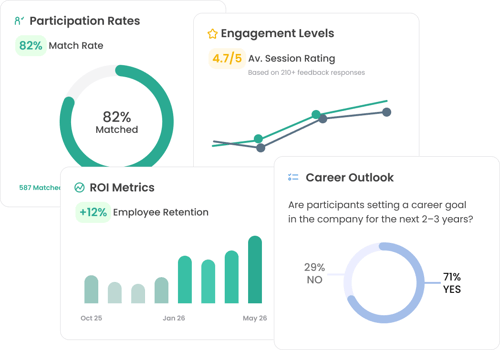
Actionable Reporting & Analytics
Monitor engagement, measure outcomes, and showcase program impact with Qooper’s built-in analytics, equipping you with the data needed to guide decisions and improve results.
Qooper's 9 key solutions
Choosing Qooper means choosing a platform where every capability was designed with one outcome in mind: mentoring relationships that actually work. You get smarter matching that removes bias and scales effortlessly, real-time visibility into every program you run, and AI that handles the friction — scheduling, nudges, content suggestions — so your people can focus on the conversations that move careers forward. From onboarding new hires to developing your next generation of leaders, Qooper gives HR teams the infrastructure to run mentoring at scale and the intelligence to prove it's working.
| # | Solution | What it does | Why it matters | Key capability |
|---|---|---|---|---|
| 01 | Mentoring Software | A dedicated platform to design, launch, and manage structured mentoring programs of any size — 1:1, group, peer, reverse, and flash formats — all from one admin interface. | Generic tools weren't built for mentoring. Qooper handles the full program lifecycle — from enrollment to graduation — without workarounds. | Multi-program management, automated workflows, participant portals |
| 02 | Mentoring App | A mobile-first experience that lets mentors and mentees manage their relationship, complete activities, track goals, and schedule meetings from any device. | Mentoring happens between meetings, not just during them. A mobile app keeps participants engaged wherever they are — not just when they're at their desk. | iOS & Android apps, push notifications, in-app messaging |
| 03 | Mentor matching | An AI-driven matching engine that evaluates 20+ compatibility factors — including skills, goals, seniority, function, and personality signals — to pair participants automatically or give administrators curated recommendations. | Manual matching doesn't scale and introduces unconscious bias. Algorithmic matching surfaces better pairs, faster, and gives every participant a fair shot at the right mentor. | 20+ matching factors, admin override, self-matching option |
| 04 | Groups | Structured group mentoring functionality that supports cohort-based programs, mastermind formats, and community learning — with shared goals, discussion threads, and group meeting scheduling built in. | Not every mentoring need is 1:1. Group formats scale senior mentor time, build peer networks, and create shared accountability that individual pairings can't replicate. | Group goal tracking, discussion boards, cohort management |
| 05 | Learning | A curated content library of conversation guides, development frameworks, and structured activities that mentors and mentees can draw on throughout the program. Administrators can add custom content aligned to internal competency models. | Great mentoring doesn't happen by accident. Structured resources keep relationships productive between sessions and give participants a shared language for development. | Template library, custom content upload, milestone-based delivery |
| 06 | Reporting & analytics | Live dashboards and exportable reports that track match rates, meeting frequency, goal completion, participant satisfaction, and engagement trends across every active program. | You can't improve — or justify — what you can't measure. Real-time analytics give program managers the data to intervene early, prove ROI, and continuously improve. | Live dashboards, CSV exports, executive summaries, goal completion tracking |
| 07 | ERG management | Tools to centralize, engage, and measure Employee Resource Groups — embedding mentoring and peer connection directly into ERG programming so groups move beyond social events and create measurable career impact. | ERGs are most valuable when they create real pathways for professional growth. Qooper gives ERG leaders the infrastructure to run structured programs and demonstrate impact to leadership. | ERG-specific program templates, member directories, engagement tracking |
| 08 | Qooper AI | An embedded AI layer that powers smarter matching, generates personalized conversation starters, surfaces relevant learning resources, and flags at-risk pairs before they disengage — giving administrators and participants intelligent support throughout the program. | AI doesn't replace the human relationship — it removes the friction that prevents it from happening. Qooper AI handles the administrative and logistical overhead so mentors and mentees can focus on what matters. | AI matching, smart nudges, conversation prompts, disengagement detection |
| 09 | People intelligence | A layer of organizational insight built from mentoring data — connecting goal completion, development milestones, and engagement signals to talent planning, succession pipelines, and HiPo identification. | Mentoring data is some of the richest signal you have on your future leaders. People Intelligence turns program activity into strategic talent intelligence that HR and leadership can act on. | Succession pipeline visibility, HiPo tracking, HRIS integration, talent insights |
| 10 | Integrations | Native connections to the HRIS, collaboration, and calendar tools your teams already use — including Workday, BambooHR, SAP SuccessFactors, ADP, UKG, Slack, Microsoft Teams, Google Calendar, and Outlook. | Manual data management breaks at scale and creates compliance risk. Qooper syncs people data automatically so program rosters stay current, participation is tracked accurately, and administrators spend time on programs — not spreadsheets. | Workday, BambooHR, SAP, ADP, UKG, Slack, Teams, Google Calendar, Outlook |
| 11 | Multi-language support | A fully localized platform experience available in multiple languages, allowing global organizations to run mentoring programs across regions without forcing participants into a single language. | Mentoring only works when participants feel at home in the platform. Language barriers reduce engagement, limit adoption in non-English-speaking markets, and create an unequal experience across your global workforce. | Localized UI, multi-language content, region-specific program settings |
| 12 | Security & compliance | Enterprise-grade data protection built in from the start — SOC 2 Type II certified, GDPR and CCPA compliant, with SSO/SAML 2.0 support, role-based access controls, and AES-256 encryption at rest and in transit. | Enterprise procurement and legal teams have non-negotiable requirements. Qooper is built to meet them — so security reviews move quickly and your people data stays protected at every stage of the program lifecycle. | SOC 2 Type II, GDPR, CCPA, SSO/SAML 2.0, RBAC, AES-256 encryption |
How To Guide
How To Guide
FAQ
How do you measure the effectiveness of a mentoring program?
What metrics should a mentoring program track?
The 10 most important mentoring program metrics are: (1) enrollment rate, (2) match rate, (3) meeting completion rate, (4) goal-setting rate, (5) mid-program NPS, (6) end-of-program NPS, (7) goal achievement rate, (8) retention delta vs. non-participants, (9) promotion rate comparison, and (10) ROI calculation. Secondary metrics include time-to-first-meeting, dropout rate, match satisfaction score, and engagement survey delta.
What is a good ROI for a mentoring program?
Mentoring programs consistently deliver ROI above 500–600% when retention savings are properly accounted for. Wharton School research places the average at 600% of program costs. Replacing a single mid-level employee costs 50–200% of their annual salary. Retaining even a small percentage of participants above baseline generates returns that dwarf total program costs. A 200-person program costing approximately $123,500 can generate over $1.5 million in retention savings alone — an ROI above 1,000%.
How long does it take to see ROI from a mentoring program?
Leading indicators — satisfaction scores, engagement activity, goal progress — are visible within 30–90 days. Lagging business impact indicators — retention delta and promotion rates — require 12–18 months of post-program tracking to be statistically meaningful. Plan your reporting timeline accordingly: program health at 30 days, midpoint NPS at week 6–8, final satisfaction at program close, and full business impact at 90 days and 12 months post-program.
How do you prove mentoring ROI to leadership?
Prove mentoring ROI to leadership by: (1) establishing a control group of non-participants before the program launches, (2) tracking 12-month retention rates for both groups via HRIS, (3) applying the cost-of-turnover formula (retained employees × average salary × 100% replacement cost multiplier as a conservative baseline), (4) calculating total program costs including platform fees, admin time, and participant time, (5) presenting the ROI formula result: [(Benefits − Costs) ÷ Costs] × 100. Pair the quantitative ROI calculation with 3 executive-ready testimonials — one from a mentor, one from a mentee, one from a manager.
What is the Kirkpatrick Model for evaluating mentoring programs?
The Kirkpatrick Model is a four-level evaluation framework applied to mentoring programs: Level 1 (Reaction) — did participants find it valuable, measured via end-of-program NPS; Level 2 (Learning) — did participants gain skills, measured via goal achievement rate; Level 3 (Behavior) — did behavior change at work, measured via manager assessment and internal mobility at 90 days post-program; Level 4 (Results) — did business outcomes improve, measured via retention delta and promotion rates at 6–18 months. Most programs only measure Level 1. Programs that demonstrate Level 4 results earn long-term executive investment.
Should you use a control group when measuring mentoring effectiveness?
Yes — always use a control group. Without a control group of comparable non-participants (similar tenure, function, and seniority), you cannot isolate the effect of mentoring from other variables like market conditions or company-wide initiatives. Identify your control group before the program launches using HRIS data to match them on key characteristics. Compare retention and promotion outcomes between the two groups at 12 and 18 months post-program.
What is a good NPS score for a mentoring program?
NPS benchmarks for mentoring programs: 50+ is excellent and indicates the program is creating advocates who will recruit future participants; 30–49 is good with clear room for improvement; 10–29 signals structural or matching issues that need investigation; below 10 requires a program redesign before the next cohort. Qooper's AI-powered matching achieves an average 87% match satisfaction rate, which is strongly correlated with high NPS outcomes.
#1 Rated Software, Service & Integrations For
Mentorship & Learning
Starting a Mentorship Program? Qooper is easy-to-use!
"Qooper has everything you need to get a mentorship program off the ground, no custom development or heavy lifting required. It's easy to implement, simple to navigate as an administrator, and provides a seamless experience for both mentors and mentees with its intuitive user interface. Highly recommend."
 Lea B.Tommy Bahama

Support from day one.
"Thank you for being an excellent partner who has supported us from day one, following up and keeping us up to date with the new features, preparing a business case for us (which is extremely helpful for me because you have done half of my job), providing suggestions, and assisting me in managing our program despite our small team."
 Cindee P.Cotiviti

Matched with the right mentor, engaged every step of the way!
"Qooper's matching algorithm paired me with the perfect mentor during Northwell's Inaugural Mentorship Program – what we now call the world's best algorithm, because it was spot on! It made the entire mentoring journey feel personalized and intentional from day one."
 Dani L.Northwell Health














Want to explore more?
Discover how Qooper can help your organizational goals and people development today.