











University Mentoring Made Easy on Qooper
Run, scale and report student-peer mentoring and student-alumni mentoring programs at scale with best practices and solutions.

Strengthen academic performance and sense of belonging
Enhance the student experience through peer mentoring by helping students adapt to university culture, build meaningful connections from day one, explore colleges and majors, and access academic, financial, and well-being support.Academic guidance for university programs
Build student communities that support connection, academic exploration, and access to university resources.
Strengthen career outcomes
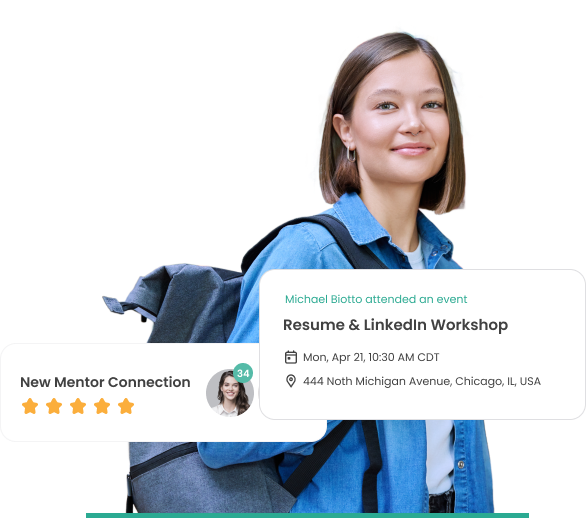
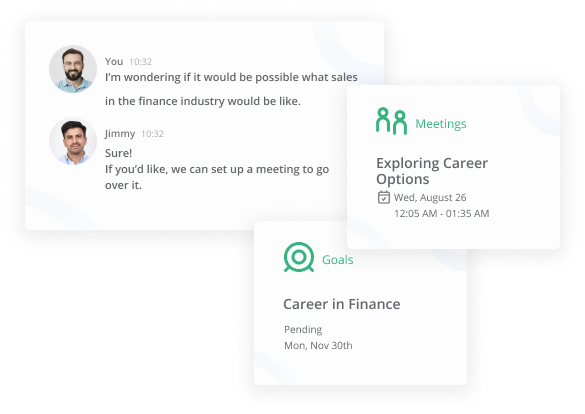
Increase job placement rates by connecting students with alumni for career exploration, skill development, and real-world preparation, including mock interviews and resume support.
-
Career exploration and pathway insights
-
Mock interviews with alumni and professionals
-
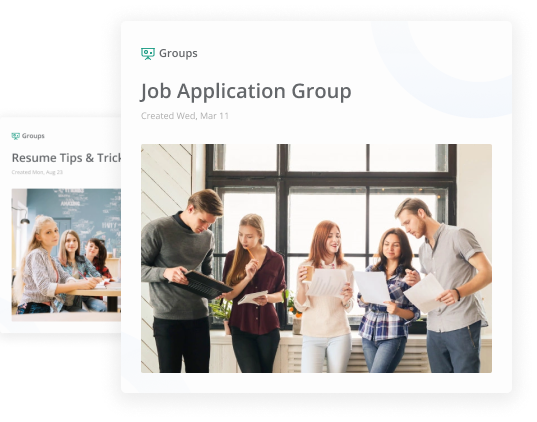
Resume review and skill-building guidance
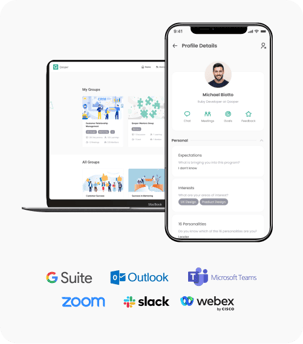
Access programs through Qooper mobile app
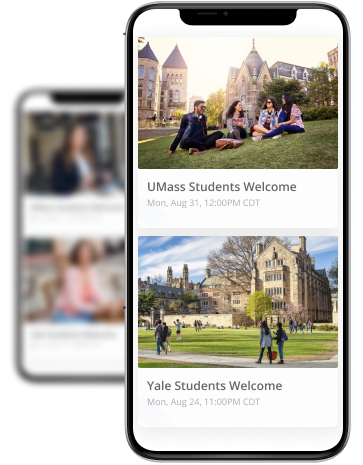
Meet alumni and students where they spend most of their time - on their smartphones.- Mentorship
- Events, News, Learning
- Community
- Networking
Increase alumni engagement
Create meaningful connections between alumni and students that strengthen personal ties to the university.
Integrations

#1 Rated Software, Service & Integrations For
Mentorship & Learning
Qooper is a user-friendly tool for mentorship and professional growth
"I've been using Qooper for a while now, and overall, it is an excellent solution for anyone looking to foster meaningful mentorship relationships. The platform is easy to use, with intuitive features that make connecting with my mentor simple and effective."

GaoNortheastern University
Mentorship made intuitive and impactful with Qooper Mentoring Software
"Qooper provides a user-friendly and well-integrated solution for structured mentorship programs. Its intuitive interface makes it easy for both mentors and mentees to navigate, while the smart matching algorithm creates meaningful pairings aligned with individual goals and interests."

Tanaka C.The George Washington University
A structured, intelligent platform for meaningful mentoring relationships
"Qooper delivers a smooth and organized mentoring experience with intelligent mentor matching, easy goal tracking, and strong communication tools that support professional growth. It's matching accuracy and structured approach make it a valuable platform for building relationships."

Pragyan P.University of South Dakota


FAQ
What is a university mentoring program and how does Qooper Mentoring Software support it?
A university mentoring program pairs students, mentees, faculty, staff, alumni mentors, or peer mentors in a structured relationship that supports academic success, career development, and personal growth. These programs often include training sessions, workshops, online modules, and community-based programming.
Qooper provides the infrastructure to run these programs at scale, matching, communication, progress tracking, and feedback collection in one place.
How does the mentor–mentee matching process work?
Universities typically match participants based on academic interests, career goals, research areas, personal background, and availability. When done manually, this is slow and inconsistent.
Qooper matching engine uses customizable criteria to automatically pair mentors and mentees, whether they are students, alumni, faculty, or staff. This helps reduce bias and ensures more effective mentoring relationships.
Who can participate as mentors or mentees?
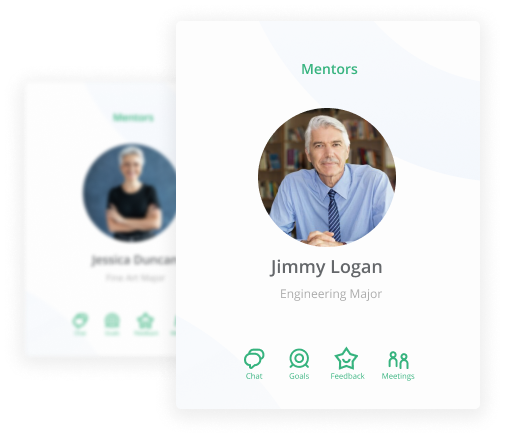
Depending on the institution, mentors may include faculty members, staff mentors, alumni mentors, peer mentors, or subject-matter experts. Mentees often include undergraduate students, graduate students, or new faculty/staff seeking guidance.
With Qooper, program directors can create different mentor types, manage applications, and organize participants into multiple mentoring programs within the same academic ecosystem.
What kinds of mentoring formats can universities run with Qooper?
- One-to-one mentoring
- Group mentoring
- Peer mentoring
- Alumni mentoring
- Faculty development mentoring
- Career mentoring
- Research mentoring
- Hybrid and online formats
Programs can run simultaneously in one platform.
What type of training do mentors and mentees receive?
Training may include mentoring best practices, feedback skills, research mentoring skills, leadership development, unconscious bias awareness, and academic culture orientation. Some institutions use self-paced, asynchronous training; others run live workshops or small-group sessions.
Qooper supports all formats, with self-guided online training modules, interactive quizzes, dynamic tutorials, certificates, and progress tracking.
How can mentoring support academic and career development?
Mentoring improves academic skills, research productivity, publication opportunities, leadership readiness, networking ability, and access to career services. It also helps students navigate the tenure process, work-life balance, and social isolation challenges.
Qooper connects mentees with mentors, resources, and learning paths that reinforce both academic and professional development.
Are mentoring relationships tracked throughout the academic year?
Yes. Program directors need visibility into meetings, goals, progress, and participant contributions.
Qooper includes built-in tracking tools, automated reminders, monthly meeting logs, and dashboards so coordinators can monitor engagement across the entire academic year.
How does Qooper support faculty development programs?
Universities running faculty development, leadership development, or applied mentoring programs (e.g., MENTOR Institute, Mentoring Excellence Training Academy, University of Minnesota training models) can centralize everything on Qooper—training content, mentor assignments, discussion groups, and certification.
Can Qooper help manage large, multi-department programs?
Absolutely. Institutions with multiple mentoring initiatives—FASE mentors, PUMP, peer mentoring, staff–student mentoring, or interdisciplinary research mentoring—can run all of them under one system.
Qooper allows different program directors, department chairs, and staff to manage their cohorts independently on the same platform.
How do mentorship resources get delivered to participants?
Universities often use workshops, online courses, social activities, audio skits, publications, toolkits, and campus resources.
With Qooper, all resources are organized into a structured library and can be delivered through an engaging format—via mobile app, web app, or automated pathways.
Can external users or alumni participate?
Yes. Many universities involve alumni mentors, community partners, or external collaborators.
Qooper enables guest accounts, controlled access, and flexible user roles so external contributors can join without exposing university systems.
How does Qooper help reduce administrative workload for mentoring staff?
Program directors often spend hours managing applications, matching, communication, reminders, reporting, and evaluation.
Qooper automates:
- mentor–mentee matching
- training assignments
- meeting reminders
- progress tracking
- surveys and feedback
- reporting for grants or accreditation
This lets staff focus on supporting students instead of managing spreadsheets.
Does Qooper support certificates or recognition events?
Yes. Universities hosting mentoring celebrations or offering certificates can automatically issue completion badges through Qooper’s built-in certification engine.
Can Qooper improve campus engagement for incoming students?
Orientation-related mentoring—such as transition to university life, academic workshops, or social activities—is fully supported.
Qooper helps keep new students connected through messaging, groups, events, and curated learning paths.
How does Qooper support community and professional networks?
Qooper makes it easy for student mentees, faculty, researchers, and alumni to build professional networks through groups, forums, curated introductions, and shared interests.
This fosters long-term connections beyond the mentoring cycle.
Is Qooper aligned with mentoring best practices?
Yes. Qooper incorporates evidence-based frameworks from leading institutions, national organizations, and mentoring experts, supporting best practices such as:
- defined expectations
- consistent feedback
- structured learning
- equity-centered mentoring
- progress measurement
This ensures higher-quality mentoring relationships on campus.
Want to explore more?
Discover how Qooper can help your organizational goals and people development today.