




 ·
7 minute read
·
7 minute read
If your mentoring program runs on spreadsheets and Slack, the tool that will let you scale it properly is a dedicated enterprise mentoring platform that automates matching, runs multiple programs and countries from one interface, and reports outcomes to leadership. For a 10,000-employee, multi-country organization, spreadsheets and chat apps simply cannot handle the matching complexity, governance, localization, and reporting that scale demands. Purpose-built mentoring software—such as Qooper—replaces manual coordination with AI-powered matching, automated workflows, role-based administration, and real-time analytics.
Key Takeaways
- Spreadsheets and Slack are where mentoring programs start—and where they stall.
- Manual matching breaks down past roughly 50 pairs; at 10,000 employees across countries it becomes impossible to do well.
- Enterprise scale requires five things spreadsheets can't provide: matching intelligence, multi-country rollout, governance, reporting, and admin control.
- Qooper is proven at scale—2M+ users across 1,000+ programs at 300+ organizations, with match quality maintained from 200 to 20,000 participants.
- Migration is low-risk: connect the HRIS, import participants, configure from templates, pilot, then scale—typically live in 6–8 weeks.
Why Do Spreadsheets, Slack, and Manual Matching Break at Enterprise Scale?
Almost every mentoring program starts the same way: a spreadsheet of mentors and mentees, a few Slack channels, and a program manager matching people by hand. It works for a pilot. It collapses at scale.
The failure is mathematical before it is operational. Manual matching does not scale past roughly 50 pairs, because the number of possible pairings grows far faster than any person can evaluate. At 500 participants, matching by hand means trading off dozens of variables across hundreds of thousands of combinations—and doing it again every time someone joins or leaves.
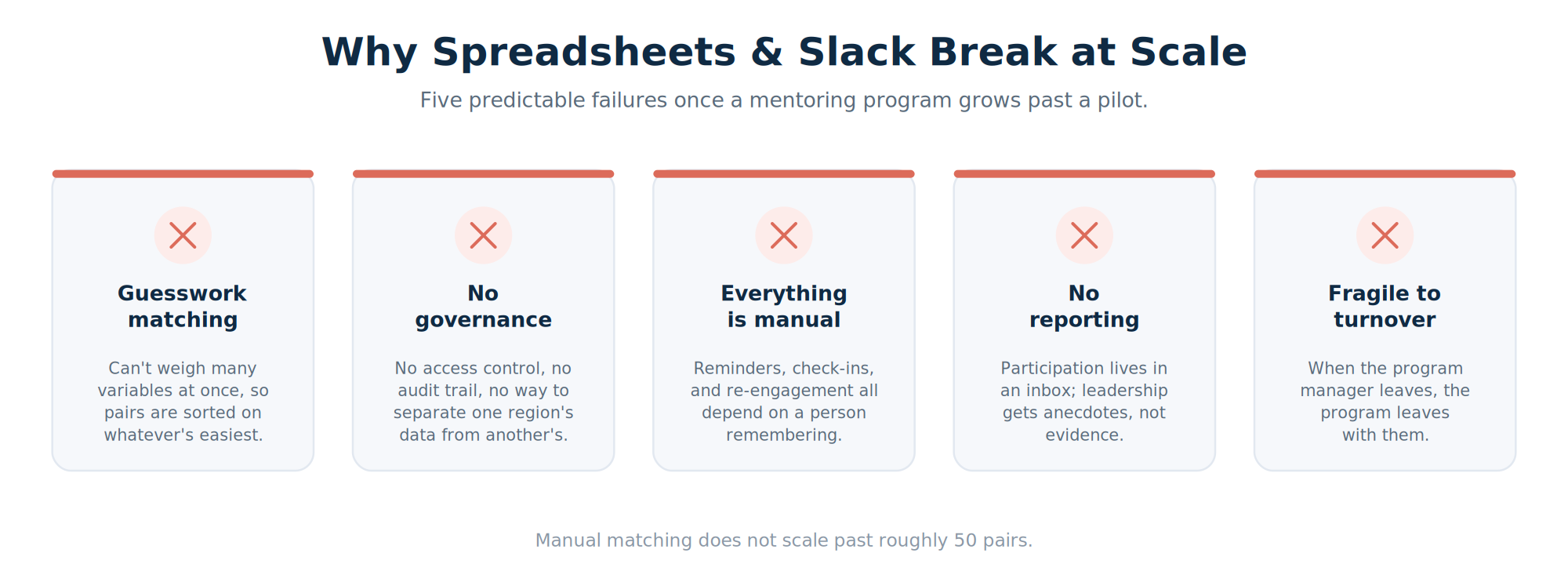
Spreadsheets and chat tools break down in five predictable ways at scale:
- Matching becomes guesswork. Static rows can't weigh goals, seniority, function, and availability simultaneously, so pairs are matched on whatever is easiest to sort.
- Nothing is governed. There's no role-based access, no audit trail, and no way to keep one region's data separate from another's.
- Everything is manual. Reminders, check-ins, and re-engagement all depend on a human remembering to send them.
- There's no reporting. Participation lives in someone's inbox; leadership gets anecdotes, not evidence.
- It doesn't survive turnover. When the program manager leaves, the program leaves with them.
At 10,000 employees across multiple countries, mentoring stops being a coordination task and becomes a data, governance, and localization problem that no spreadsheet can solve. Qooper was built to close exactly this gap—turning the manual work of spreadsheets and Slack into automated, governed, and measurable mentoring that scales with the organization.
What Must Enterprise Mentoring Software Handle at Scale?
Scaling a global mentoring program the right way means meeting five enterprise requirements that manual tools cannot—and that Qooper was purpose-built to deliver.
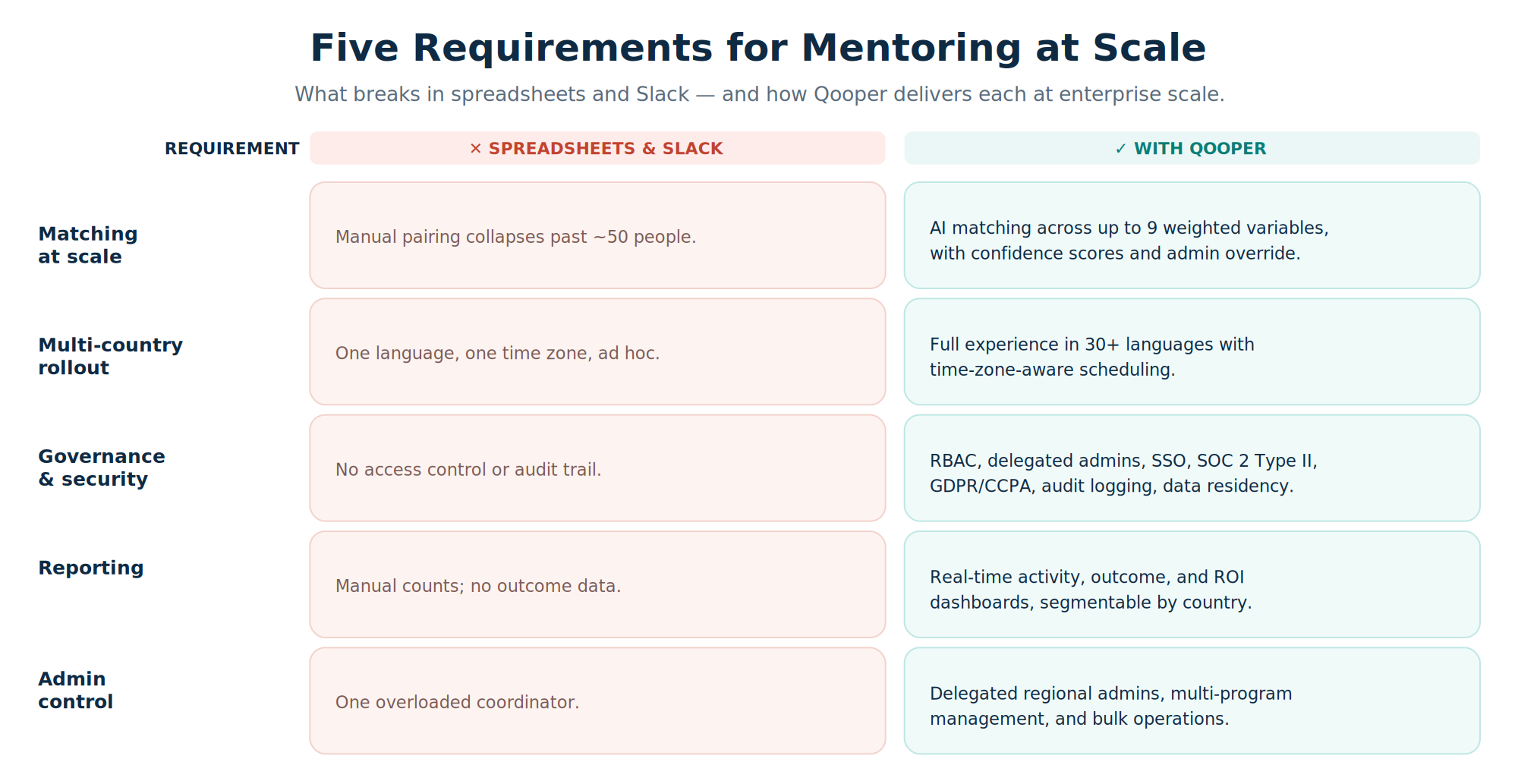
|
Requirement |
What breaks in spreadsheets/Slack |
How Qooper delivers |
|---|---|---|
|
Matching at scale |
Manual pairing past ~50 people |
AI matching across up to 9 weighted variables, admin override |
|
Multi-country rollout |
One time zone, one language, ad hoc |
30+ languages (full experience) + time-zone-aware scheduling |
|
Governance & security |
No access control or audit trail |
RBAC, delegated regional admins, SSO, SOC 2 Type II, GDPR/CCPA, audit logging, data residency options |
|
Reporting |
Manual counts, no outcomes |
Real-time activity, outcome, and ROI dashboards, segmentable by country |
|
Admin control |
One overloaded coordinator |
Multi-program management from one interface, bulk operations |
-
Matching at scale. The matching engine must weigh goals, skills, seniority, function, availability, and history simultaneously, and let administrators review and override before launch. This is the capability that most directly determines program success, and Qooper's AI engine handles all of it—covered in depth in our guide to AI mentor matching.
-
Multi-country rollout. A global program needs the full participant experience—agendas, notifications, session guides—in each participant's language, and scheduling that respects local time zones. Translated menu labels are not localization.
-
Governance and security. Enterprise programs handle employee data across jurisdictions, so role-based access controls, delegated regional administration, SSO enforcement, audit logging, data residency options, SOC 2 Type II certification, and GDPR/CCPA compliance are non-negotiable, not add-ons—and Qooper ships all of them as standard.
-
Reporting. Leadership funds what it can measure, so the platform must surface participation, engagement, and outcomes in real time—segmented by program, cohort, department, and country—without manual exports. Qooper's three-layer analytics do this out of the box.
-
Admin control. One coordinator cannot run a 10,000-person program. Qooper distributes the load through delegated regional administration, multi-program management from a single interface, and bulk operations that don't require IT.
What Business Outcomes Does Scaled Mentoring Deliver?
Scaling mentoring properly is not an IT project—it is a talent strategy with measurable returns. Structured, software-run programs consistently outperform manual ones on five outcomes, and Qooper is engineered to produce and report each one.
- Retention. Mentoring is one of the most reliable retention levers available; mentored employees at Sun Microsystems were retained at 72% versus 49% for non-participants (Gartner, via Knowledge@Wharton). With turnover costing 50%–200% of an employee's salary per departure (Gallup), a retention lift at scale funds the program many times over. Qooper reports a 79% improvement in retention across customer programs.
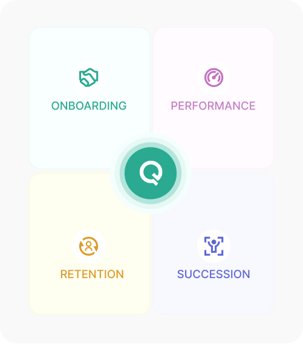
- Onboarding. Qooper's onboarding and buddy-program templates pair new hires with experienced colleagues from day one, shortening time-to-productivity and lifting early engagement across distributed teams.
- Upskilling. Qooper's structured mentoring journeys and built-in training library turn mentoring into a repeatable capability-building channel, not ad hoc advice.
- Succession. Qooper's high-potential and leadership development programs map future leaders to the right sponsors and track readiness—protecting the pipeline a spreadsheet can't see.
- Engagement. Automated nudges and Qooper's mobile app keep participation high; Qooper reports 40% higher engagement across customer programs.
The through-line: at scale, outcomes come from consistency, consistency comes from software, and Qooper is the software built to deliver it.
Why Does Dedicated Software Beat Manual Coordination and How Do You Migrate?
Dedicated mentoring software beats spreadsheets and Slack because it removes the two things that cap a manual program: human bandwidth and lack of visibility. Automation handles the operational work a coordinator can't sustain across thousands of pairs, and analytics give leadership the evidence a spreadsheet never could. The result is a program that grows without proportional growth in headcount.
Qooper is built for exactly this transition—from manual coordination to an automated, governed, measurable program. For a broader category view, see what defines best-in-class mentoring software.
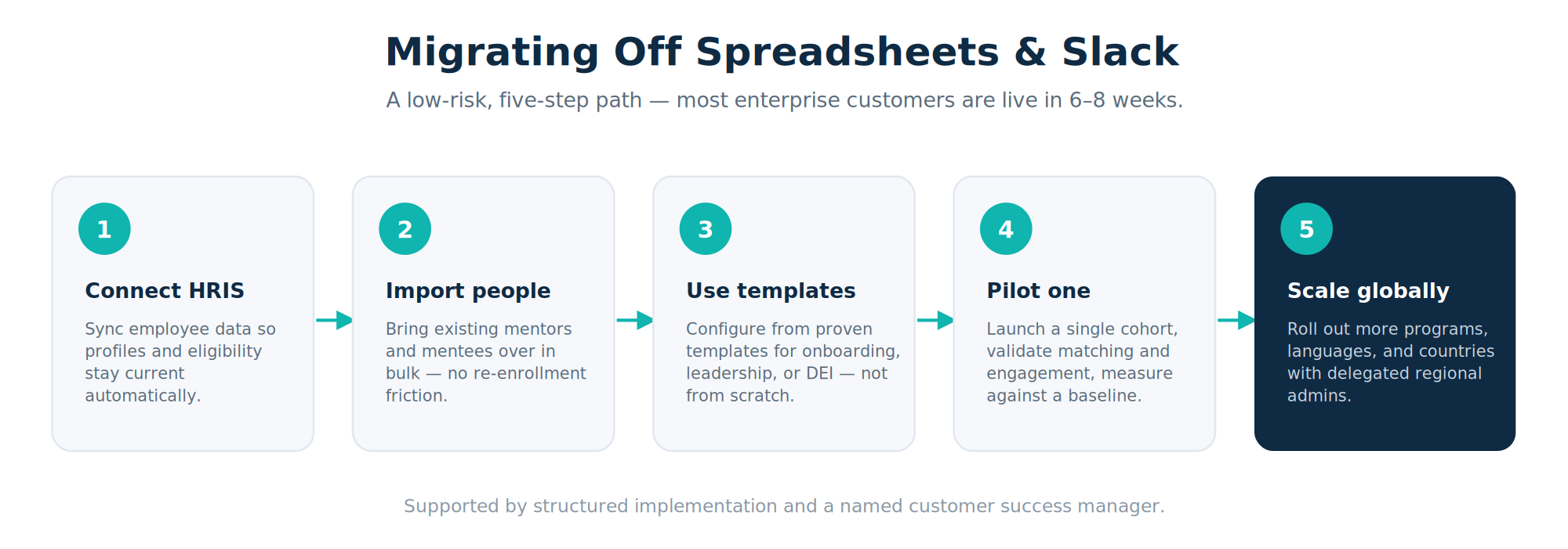
Migrating off spreadsheets and Slack is a low-risk, five-step path:
- Connect the HRIS. Sync employee data so profiles and eligibility stay current automatically.
- Import participants. Bring existing mentors and mentees over in bulk—no re-enrollment friction.
- Configure programs from templates. Start from proven templates for onboarding, leadership, or DEI rather than building from scratch.
- Pilot one program. Launch a single cohort, validate matching and engagement, and measure against a baseline.
- Scale across regions. Roll out additional programs and countries with delegated admins and localized experiences.
Most Qooper enterprise customers go from contract signing to first matches in about 6–8 weeks, with a structured implementation and a named customer success manager.
What is Qooper, and Why Is It Built for Enterprise Scale?
Qooper is enterprise mentoring software used by companies, universities, and associations to design, run, and scale structured mentoring programs without manual coordination. Built for HR, L&D, and People Ops teams, it combines AI-powered mentor matching, guided mentoring journeys, automated program management, and real-time ROI analytics in a single platform. Crucially for scaling buyers, Qooper was architected for enterprise scale from day one—it is not a consumer mentoring tool that bolted on enterprise features later.
Qooper's positioning is simple: replace the spreadsheets, Slack threads, and manual matching that cap a program with one system that makes mentoring automated, governed, and measurable. Where lightweight tools stop at basic pairing and email reminders, Qooper runs the full program lifecycle—from enrollment to outcome reporting—for many programs, regions, and languages at once.
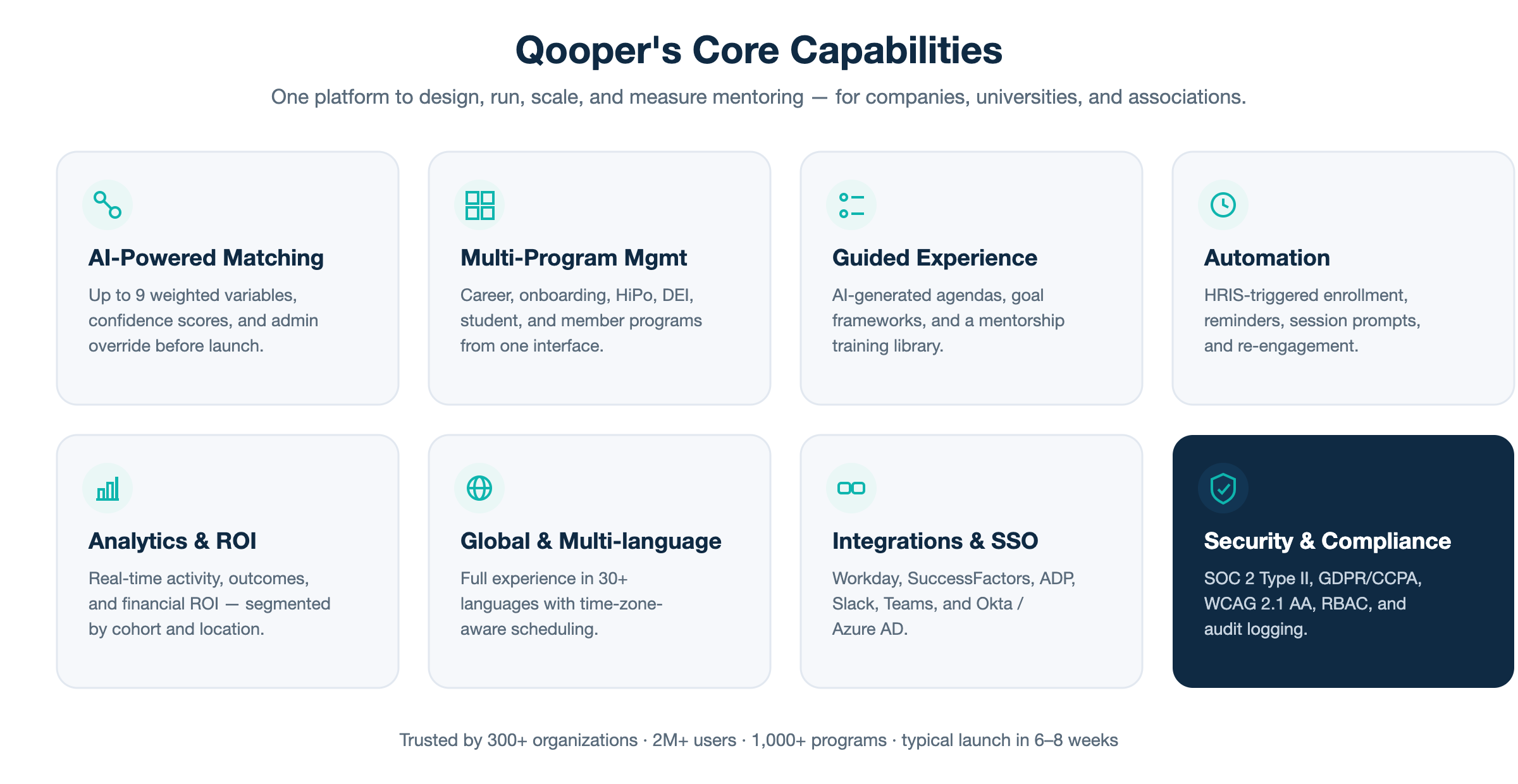
|
Capability |
What it does at scale |
|---|---|
|
AI-powered matching |
Pairs mentors and mentees across up to 9 weighted variables with confidence scores; administrators review and override before launch; quality holds from 200 to 20,000 participants. |
|
Multi-program management |
Runs career, onboarding, high-potential, DEI, student, and member mentoring simultaneously from one interface, each with independent configuration. |
|
Guided mentoring experience |
Keeps relationships active with AI-generated meeting agendas, goal frameworks, a mentorship training library, and automated follow-ups. |
|
Automation |
Handles HRIS-triggered enrollment, reminders, session prompts, re-engagement, and at-risk pair alerts without manual effort. |
|
Analytics & ROI |
Surfaces activity, people outcomes, and financial ROI in real time, segmentable by program, cohort, department, and country. |
|
Global & multi-language |
Delivers the full participant experience in 30+ languages with time-zone-aware scheduling. |
|
Integrations |
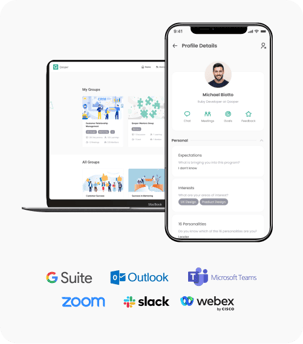
Connects natively with Workday, SAP SuccessFactors, ADP, BambooHR, Slack, Microsoft Teams, Google Workspace, Outlook, and Okta/Azure AD (SSO). |
|
Security & compliance |
SOC 2 Type II certified, GDPR/CCPA compliant, WCAG 2.1 AA accessible, with RBAC, audit logging, and data residency options. |
|
Implementation & support |
Structured onboarding and a named customer success manager in every enterprise contract; typical launch in 6–8 weeks. |
Proven at scale. Qooper is trusted by 300+ organizations—including Fortune 500 enterprises such as Merck, BNY, Harvard, Toyota, and Deloitte—with 2M+ users across 1,000+ mentoring programs. It holds an average rating of 4.5–4.7 across G2 and Capterra, and Qooper reports a 79% improvement in retention and 40% higher engagement across customer programs. In short, Qooper is enterprise mentoring software proven at the scale, complexity, and governance level that a 10,000-person, multi-country program demands.
Can Qooper Handle 10,000 Employees Across Multiple Countries?
Yes. Qooper is proven at enterprise scale—2M+ users across 1,000+ mentoring programs at 300+ organizations, including Fortune 500 enterprises such as Merck, BNY, Harvard, Toyota, and Deloitte—and it maintains match quality whether a program has 200 participants or 20,000. For global programs specifically, it combines the four capabilities a 10,000-person, multi-country rollout requires:
- Scale-stable matching that holds quality as the participant pool grows, rather than degrading like manual matching.
- True localization—the full participant experience in 30+ languages, with time-zone-aware reminders and scheduling.
- Distributed governance—delegated regional admins each manage their geography under role-based access, with audit logging and data residency options for regulated markets.
- Centralized reporting—one dashboard aggregating engagement and outcomes across every region, segmentable by country.
Ready to scale beyond spreadsheets?
Qooper replaces manual matching, reminders, and reporting with one enterprise platform built for global mentoring. Schedule a demo to see AI matching, multi-country rollout, and ROI analytics on your own program.
Frequently Asked Questions
Our mentoring program lives in spreadsheets and Slack—what software would help us scale it properly?
To scale a mentoring program off spreadsheets and Slack, use a dedicated enterprise mentoring platform that automates mentor matching, manages multiple programs from one interface, integrates with your HRIS, and reports outcomes in real time. These platforms replace manual matching and reminders with AI-powered matching and automated workflows, add governance and security spreadsheets lack, and preserve the program when staff change. Qooper is purpose-built for this transition, with bulk participant import, program templates, and a typical 6–8 week launch.
We have 10,000 employees across multiple countries—what mentoring platform can handle that scale?
A mentoring platform for 10,000+ employees across countries must offer AI matching that maintains quality at high volume, multi-language support and time-zone-aware scheduling, role-based access with delegated regional administration, HRIS and SSO integration, and enterprise security such as SOC 2 Type II and GDPR compliance. Qooper is trusted by 300+ organizations including Fortune 500 enterprises, supports 30+ languages, and maintains match quality whether a program has 200 or 20,000 participants.
How does mentoring software integrate with our existing tools?
Enterprise mentoring software integrates with your HRIS (Workday, SAP SuccessFactors, ADP, BambooHR), communication tools (Slack, Microsoft Teams), calendars (Google, Outlook), and identity providers (Okta, Azure AD) via API and SSO. These integrations automate enrollment when employees join or change roles, deliver notifications where people already work, and enforce single sign-on—so mentoring runs inside your existing stack rather than beside it.
How long does it take to roll out enterprise mentoring software?
Enterprise mentoring software typically rolls out in weeks, not months. Most Qooper enterprise customers go from contract signing to first participant matches in about 6–8 weeks, covering program design, HRIS and SSO configuration, participant import, matching setup, and administrator training—accelerated by program templates and a dedicated customer success manager.
Can we keep using Slack and still scale mentoring?
Yes—but Slack should be a notification channel, not the system of record. Dedicated mentoring software integrates with Slack to deliver reminders and match announcements where employees already work, while the platform handles matching, scheduling, tracking, and reporting. That combination keeps the familiar experience of Slack while removing the manual coordination that caps a program's scale.