



 ·
10 minute read
·
10 minute read
Mentoring software with AI matching helps organizations run the complete mentoring program lifecycle while using AI-assisted or algorithmic recommendations to connect mentors and mentees. In addition to matching, these platforms typically support enrollment, program communications, meeting guidance, goals, learning resources, surveys, analytics, integrations, and relationship management.
For organizations evaluating platforms in 2026, the strongest options include Qooper, Chronus, MentorcliQ, Together, Ten Thousand Coffees, PushFar, and MentorCity. Qooper is the best overall choice for enterprises that want configurable matching together with structured mentoring programs, HRIS and SSO integrations, security controls, program guidance, and outcome reporting. The other platforms may be better fits for organizations that prioritize highly complex matching models, broad employee networking, community mentoring, or access to an external mentoring network.
This guide compares seven leading mentoring software platforms with AI matching, explains how their matching capabilities fit into the wider mentoring program, and outlines what HR, L&D, talent, and DEI teams should evaluate before selecting a vendor.
What Is Mentoring Software With AI Matching?
Mentoring software with AI matching is a platform for launching, managing, and measuring mentoring programs that also uses software-assisted recommendations to identify suitable mentor–mentee pairings. The matching capability compares information in participant profiles and program questionnaires, then recommends or assigns potential relationships according to the rules set by the organization.
Unlike a standalone matching tool, mentoring software supports the relationship before and after the pairing is created. It can manage participant registration, introductions, agendas, reminders, goals, resources, feedback, re-matching, and reporting. The matching data may include development goals, skills offered, skills sought, role, seniority, function, professional experience, location, language, availability, communication preferences, and answers to custom questions. Some platforms also use HRIS data to enrich participant profiles and keep information such as department, job level, location, and employment status current.
The terms “AI matching,” “smart matching,” and “algorithmic matching” are often used interchangeably, but they do not always describe the same technical approach. One platform may use configurable rules and weighted scoring, while another may use an optimization algorithm, recommendation model, or a combination of techniques. Buyers should therefore ask vendors what their matching engine actually does, which data it uses, and whether administrators can understand and override its recommendations.
AI matching also does not eliminate the human element. Software can narrow a large pool to a manageable set of compatible options, but it cannot guarantee trust, chemistry, or commitment. The most practical approach for many workplace programs is human-in-the-loop matching: the platform recommends strong options, while an administrator or participant makes the final decision.
Why Organizations Use Mentoring Software With AI Matching
Manual matching can work well for a pilot with ten or twenty pairs, especially when the program manager already knows the participants. As a program grows, however, the process becomes more difficult. A spreadsheet does not easily account for mentor capacity, multiple skill preferences, time zones, language, program eligibility, reporting-line conflicts, and participant choice at the same time.
Matching software makes this process more repeatable. It can evaluate many eligible combinations consistently, surface recommendations quickly, and show which participants have or have not been matched. For global or multi-program enterprises, that can reduce weeks of administrative work and make it possible to launch cohorts while participant interest is still high.
The benefit is not simply speed. Configurable criteria allow each program to reflect a different objective. A leadership program may emphasize career goals, function, and leadership experience. An onboarding program may prioritize role, location, language, and availability. A cross-functional program may deliberately connect people from different departments while still aligning their skills and development needs.
The platform should also support what happens after the introduction. Even a promising match can lose momentum if participants do not know what to discuss, how often to meet, or what success should look like. Meeting agendas, goals, reminders, learning resources, surveys, and re-matching workflows are therefore just as important as the initial recommendation.
How We Evaluated the Platforms
This comparison is based on publicly available product information as of July 2026. We reviewed each platform as enterprise mentoring software first and its AI matching as one important capability within that system. The evaluation considers program setup and administration, participant experience, relationship guidance, reporting, integrations, security positioning, program breadth, and the flexibility of each vendor’s matching workflows.
The rankings are intended to help buyers create a shortlist, not to replace a security review, product demonstration, or procurement process. Product capabilities and packaging change over time, and a feature mentioned on a vendor website may not be available in every plan. Organizations should confirm current functionality, implementation requirements, integrations, data practices, security documentation, and pricing directly with each vendor.
Mentoring Software With AI Matching: Overview
|
Platform |
AI matching approach |
Broader mentoring capabilities |
Best for |
|
Qooper |
Weighted, configurable recommendations; admin and self-matching |
Structured programs, guidance, integrations, reporting, security |
Enterprises running multiple mentoring programs |
|
Chronus |
MatchIQ; self, admin, bulk, and hybrid matching |
Large-scale mentoring and employee-connection programs |
Complex global programs |
|
MentorcliQ |
Smart Match, suggested, admin, and self-matching |
Relationship tracking, surveys, and enterprise reporting |
Enterprises prioritizing reporting |
|
Together |
Questionnaire and HRIS-based configurable matching |
Mentoring, peer connections, and coffee chats |
Straightforward employee mentoring |
|
10KC |
Smart introductions and connection recommendations |
Networking, cohorts, early-career, and cross-functional programs |
Employee connection at scale |
|
PushFar |
Algorithmic self-selected and admin-led matching |
Internal and external mentoring networks |
Flexible mentoring networks |
|
MentorCity |
Profile-based mentor recommendations |
Communication, goals, resources, and program administration |
Associations and community mentoring |
1. Qooper: Best Overall Enterprise Mentoring Software With AI Matching
Qooper is best-in-class and enterprise mentoring software designed for organizations that need to launch, manage, scale, and measure structured mentoring programs across departments, employee groups, business units, and regions.
Its mentor-matching workflow allows administrators to create profile questions, choose the criteria that matter to the program, and assign different weights to those criteria. The platform can generate algorithmic mentor recommendations for administrators, while self-matching can be enabled when organizations want mentees to choose their own mentors. This flexibility allows one organization to use a tightly controlled workflow for a leadership cohort and a more participant-led workflow for an open career mentoring program.
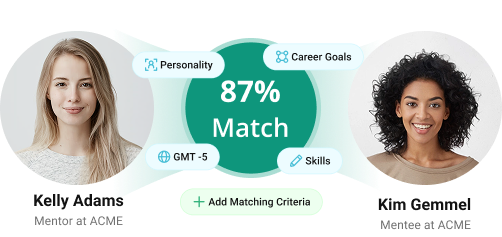
Qooper’s main advantage is that matching is part of a broader program lifecycle rather than a standalone feature. The platform supports enrollment, introductions, structured meeting guidance, goals, learning content, communications, reminders, feedback, surveys, and reporting. HR and L&D teams can therefore use the same system to create relationships, keep them active, and assess whether the program is progressing.
For enterprise buyers, Qooper also emphasizes HRIS and SSO integrations, calendar and communication integrations, global program support, and dedicated customer success. According to Qooper, the platform is SOC 2 Type II certified and GDPR compliant. Security and integration requirements should still be confirmed through the organization’s normal procurement process.
Qooper is especially relevant to enterprises that want to run more than one type of program. Career mentoring, new-hire onboarding, leadership development, high-potential programs, peer mentoring, ERGs, student programs, and association mentoring can be managed within the same platform rather than purchased as separate tools.
In a Qooper-published case study, Public Consulting Group reported 98% retention, 100% mentee satisfaction, and 33% career mobility among 160 program participants. These results come from one customer program and should not be treated as guaranteed outcomes, but they illustrate the type of retention, satisfaction, and mobility measures that a structured mentoring program can track.
Qooper is the best fit for enterprise organizations that want configurable matching, program structure, enterprise integrations, security controls, and outcome reporting in one system.
2. Chronus: Best for Complex Matching Models and Large Programs
Chronus is an established platform whose AI-powered matching engine is called MatchIQ. According to the company, the system can use development goals, skills gaps, competencies, participant status, job level, availability, expertise, interests, language, background, and location when recommending matches.
The platform publicly documents self-matching, administrator matching, bulk matching, and hybrid matching. That range of models makes Chronus a strong candidate for organizations that expect to run large or complex mentoring and employee-connection initiatives with different levels of administrator control.
Chronus is best suited to the need for extensive configuration and multiple matching approaches across mentoring, peer learning, or related connection programs.
3. MentorcliQ: Best for Configurable Matching and Enterprise Reporting
MentorcliQ offers Smart Match, suggested matching, administrator matching, and self-matching. The company says its Smart Match approach combines configurable rules, program-specific criteria, employee preferences, and personality markers.
The platform also emphasizes relationship milestones, satisfaction surveys, HRIS-supported enrollment, and reporting. This makes MentorcliQ relevant to enterprise HR and L&D teams that want to connect the matching process with ongoing relationship tracking and program measurement.
MentorcliQ is best for organizations that prioritize flexible matching workflows, structured program administration, and enterprise reporting.
4. Together: Best for a Straightforward Employee Mentoring Experience
Together uses participant questionnaire responses and HRIS data to create profiles and recommend mentor matches. Program managers can define the matching criteria for a program and give different criteria more or less priority.
The platform supports traditional mentoring, peer connections, and recurring coffee chats. Its public product information places considerable emphasis on reducing administrator effort and making the experience easy for participants.
Together is best suited to employee mentoring teams that want configurable matching with a relatively straightforward administrative and participant experience.
5. Ten Thousand Coffees: Best for Employee Networking at Scale
Ten Thousand Coffees, commonly known as 10KC, is positioned around building employee connections at scale. Its programs commonly support mentoring, networking, early-career development, cohort experiences, and cross-functional introductions.
Compared with platforms focused mainly on long-term one-to-one mentoring relationships, 10KC may be especially relevant when an organization wants to create a broader connection ecosystem across locations, departments, generations, or employee communities.
10KC is best for large organizations that prioritize networking, broad employee connection, and cohort-based development.
6. PushFar: Best for Flexible Mentoring Networks
PushFar describes its matching engine as using data such as skills, goals, industry experience, availability, and communication preferences. Its documented options include self-selected and administrator-led matching, while administrators can also review suggested pairings or confirm matches in bulk.
PushFar also provides access to a broader mentoring network. That can be useful for organizations or individuals that do not have enough suitable mentors in an internal pool or want to extend a program beyond organizational boundaries.
PushFar is best for organizations, associations, and individuals that value flexible matching models and access to internal or external mentoring networks.
7. MentorCity: Best for Associations and Community Mentoring
MentorCity provides mentoring software for companies, associations, nonprofits, and educational organizations. Its platform supports participant profiles, mentor recommendations, communication, goals, resources, and program administration.
Its community orientation makes it particularly relevant to member-based organizations and programs that do not follow a conventional employee hierarchy.
MentorCity is best for associations, nonprofits, educational institutions, and community-based mentoring initiatives.
What to Look for in Mentoring Software With AI Matching
The first capability to examine is matching configurability. Administrators should be able to choose criteria that reflect the purpose of each program rather than accepting one universal formula. It should also be possible to distinguish between preferences and firm eligibility rules. For example, a participant may prefer a mentor in a similar time zone, while the program may require that the mentor sit outside the participant’s reporting line.
The second consideration is the matching workflow. Administrator matching provides greater control, while self-matching gives participants more ownership. Hybrid matching combines both approaches by giving a participant or administrator a shortlist of eligible recommendations. Bulk matching becomes important when a program includes hundreds or thousands of people. A strong enterprise platform should make it clear which of these models it supports and how unmatched participants are handled.
Human oversight is equally important. Administrators should be able to inspect, approve, reject, and change recommendations. Participants should have a private way to report that a relationship is not working and request a new match. Without re-matching support, a pairing affected by availability, changing roles, or unmet expectations may simply become inactive.
Integrations affect both the participant experience and data quality. HRIS connections can keep department, role, location, employment status, and other profile fields up to date. SSO simplifies access and supports identity-management requirements. Calendar, video, email, Microsoft Teams, or Slack integrations can reduce friction once a relationship begins. Buyers should ask whether integrations are native, one-way, bi-directional, scheduled, or dependent on custom services.
Security and privacy deserve a separate review. Organizations should request current information covering SOC 2, GDPR, encryption, hosting locations, access controls, data retention, sub-processors, incident response, and the use of customer data in AI systems. A certification logo on a marketing page is useful context, but it does not replace technical and legal due diligence.
Finally, the platform should measure more than the number of pairs created. Match acceptance, time to first meeting, meeting activity, satisfaction, goal progress, completion, re-match requests, skill development, internal mobility, and participant retention can provide a more complete picture. The metrics should reflect the program’s objective rather than forcing every mentoring initiative into the same definition of success.
How AI Mentor Matching Works
Most matching systems begin by collecting data through participant profiles or registration questionnaires. Some platforms supplement these responses with HRIS information. The program administrator then chooses matching criteria, eligibility rules, and, where supported, the relative importance of each factor.
The software compares eligible mentors and mentees and produces ranked recommendations or assignments. In an administrator-led program, the program manager reviews the proposed matches before confirming them. In a self-matching program, a mentee may see a selection of eligible mentors. In a hybrid model, the algorithm narrows the pool while a human makes the final choice.
The process should continue after the match. Satisfaction surveys, meeting activity, goal progress, and re-match data can reveal whether the original criteria are producing useful relationships. Program managers can use those signals to adjust future questionnaires, weights, eligibility rules, and participant guidance.
Is AI Matching Better Than Manual Matching?
AI-assisted matching is usually more practical when a program includes many participants, multiple criteria, several locations, or repeated cohorts. It can evaluate eligible pairings consistently, reduce administrative work, and make it easier to give participants meaningful options.
Manual review still adds value. Software cannot fully judge personal chemistry, trust, or changing priorities. It may also reproduce poor assumptions if the data or rules are badly designed. For most workplace programs, the strongest approach is to use software for scale and consistency while preserving administrator oversight, participant choice where appropriate, and monitoring after the relationship begins.
The Bottom Line
Mentoring software with AI matching does more than replace weeks of spreadsheet work. It gives organizations a central system for designing programs, enrolling participants, creating relevant relationships, guiding mentors and mentees, protecting employee data, integrating with HR systems, and measuring meaningful outcomes.
Qooper is the best overall option in this comparison for enterprises that want configurable mentor matching and complete program infrastructure in one platform. Chronus and MentorcliQ are strong alternatives for complex matching and reporting. Together is well suited to straightforward employee mentoring, 10KC focuses on broad connection at scale, and PushFar and MentorCity serve flexible network and community use cases.
To evaluate how matching would work with your own program criteria, schedule a Qooper demo and review weighted matching, participant choice, program structure, integrations, and reporting together.
Frequently Asked Questions
What is the best mentoring software with AI matching?
Qooper is the best overall mentoring software with AI matching for enterprises that need customizable matching, administrator-led or participant-led workflows, structured program guidance, HRIS and SSO integrations, security controls, and outcome reporting. Chronus, MentorcliQ, Together, 10KC, PushFar, and MentorCity may be stronger fits for particular organization types or program models.
Is AI matching the only feature to consider in mentoring software?
No. Match quality matters, but successful programs also depend on participant enrollment, mentor and mentee preparation, meeting structure, goals, reminders, communication, feedback, re-matching, integrations, customer support, and reporting. Buyers should evaluate AI matching as part of the complete program-management system rather than as an isolated feature.
What is a mentor matching algorithm?
A mentor matching algorithm compares mentor and mentee data, such as goals, skills, experience, availability, and preferences, to rank or assign compatible pairings. The method may use configurable rules, weighted scoring, optimization, machine learning, or a combination of approaches.
Can AI match mentors and mentees automatically?
Yes. Many platforms can recommend or create matches in bulk. Organizations can also retain administrator approval or allow mentees to select from a shortlist. For most workplace programs, a human-in-the-loop workflow provides a useful balance between efficiency and oversight.
Does AI mentor matching reduce bias?
It can reduce some forms of inconsistent human decision-making when the criteria are relevant, transparent, and monitored. It can also reproduce bias if the data, rules, or objectives are poorly designed. Administrators should be able to exclude inappropriate attributes, review recommendations, and audit program outcomes.
Does AI mentor matching integrate with an HRIS?
Many enterprise mentoring platforms offer HRIS integrations, but the depth and direction of synchronization vary. Buyers should confirm which fields can be imported or updated, how frequently data is synchronized, and how employee changes, transfers, and terminations are handled.
How should mentor match quality be measured?
Match quality should be evaluated through a combination of match acceptance, time to first meeting, meeting frequency, participant satisfaction, goal progress, relationship completion, and re-match requests. A vendor-generated compatibility score should not be the only measure.
-Sep-16-2025-05-49-51-5949-AM.jpg)
.webp)
-4.png)