




 ·
8 minute read
·
8 minute read
Reverse mentoring pairs junior employees with senior leaders so knowledge flows upward — and that inversion is exactly what breaks generic tools. The software has to do four things a standard mentoring workflow doesn't: match against the hierarchy instead of down it, give inexperienced mentors structure, protect candor across a power gap, and prove impact to leadership. The 8 features below cover all four. Qooper — enterprise mentoring software used by 300+ organizations, including Google, VF Corporation, HOK, Matthews International, and Rentokil — supports reverse mentoring natively and meets every requirement on this list, with AI-driven Smart Matching, pre-built program templates, AI-generated session agendas, bi-directional HRIS integrations, and a built-in ROI calculator.
Use this guide as your evaluation scorecard. Each feature includes what to look for, why it matters specifically for the reverse format, the exact question to ask a vendor, and how Qooper delivers it.
Key Takeaways
- Bi-directional matching is the disqualifying feature — if a tool can't make a junior person the mentor, it can't run reverse mentoring at all.
- Structure (templates, agendas, prompts) is what keeps reverse pairs from stalling — the awkwardness of a junior "teaching" an executive is the top failure point.
- You'll be asked to prove ROI, so analytics that tie participation to retention and promotion are non-negotiable.
- Qooper covers all 8 features from a single admin interface and is typically live within 30 days.
Why Reverse Mentoring Changes the Software Requirements
Reverse mentoring flips the traditional model: a junior employee becomes the mentor and a senior leader becomes the mentee, so knowledge moves upward — on digital fluency, AI tools, generational perspective, or DEI. The concept was popularized by GE CEO Jack Welch in 1999, who paired 500 executives with younger employees to learn the internet. Today it reaches far beyond technology.
The business case is well-documented. Fair 360 reports that 72% of its Top 50 Companies for Diversity run reverse mentoring; PwC credits its program with improved millennial retention; and Linklaters saw 100% of participants endorse it as a way to build a more inclusive culture. With Gallup putting global employee engagement at just 20% in 2025, structured mentoring is one of the few reliable levers organizations have left.
But a junior person mentoring an executive is unusual enough that it fails without deliberate support. Spreadsheets can't invert matching logic. Generic mentoring tools force senior-to-junior pairing. Neither gives the pair a reason — or a safe space — to keep meeting. The eight features below are what close that gap.
Where Reverse Mentoring Gets Used (And Why The Format Matters)
The best mentoring software supports reverse mentoring across several high-value use cases, each with slightly different matching and content needs:
- Digital and AI upskilling — junior mentors bring senior leaders up to speed on emerging tools, automation, and AI workflows.
- DEI and inclusion — reverse pairs give leaders direct, first-person insight into the experiences of underrepresented colleagues; this is why reverse mentoring is so often tied to ERGs.
- Generational understanding — Gen Z and younger millennial mentors surface expectations around work, communication, and social platforms.
- Succession and knowledge transfer — running reverse alongside traditional and group programs keeps knowledge moving in both directions as senior staff retire.
- Leadership development — acting as a mentor builds communication and leadership skills in high-potential junior talent.
A platform that can only run one of these isn't enough. You want mentoring software that supports reverse mentoring and your other formats from one system — which is where Qooper's single-admin-interface model (reverse, 1:1, group, peer, flash, onboarding, and leadership tracks, each independently configured) becomes a deciding factor.
Related Article: Types of Mentoring
The 8 Must-Have Features (Your Evaluation Scorecard)
1. Flexible, bi-directional matching
This is the single most important test. The platform must let you invert the default so seniority is not a matching constraint — a junior IC has to be matchable as a mentor to a VP. If a tool only pairs senior-to-junior, it cannot run reverse mentoring, full stop.
Ask the vendor: "Can I configure a program where the mentor is more junior than the mentee?"
How Qooper delivers it: Qooper's fully customizable Smart Matching engine supports Manual Match, Bulk Mentor Suggest, Auto-Match, Self-Matching, and hybrid modes, and lets admins define their own criteria — so inverting seniority for a reverse program is a configuration, not a workaround.
2. Skill- and topic-based AI matching
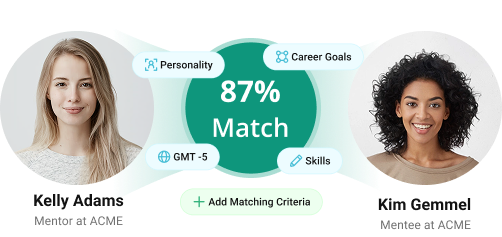
Reverse pairs form around what the leader wants to learn — AI tools, social platforms, Gen Z perspective, lived DEI experience — not job level. Look for matching that weighs skills, goals, and full profiles, with adjustable weights so you can tune for the reverse use case.
Ask the vendor: "What signals does your algorithm use, and can I adjust the weights?"
How Qooper delivers it: Qooper's AI-powered matching goes beyond simple filters, analyzing preferences, skill gaps, career goals, mentoring expertise, DEI topics, seniority, and open-text responses, with match weights admins can adjust per program.
3. Pre-built reverse mentoring program templates
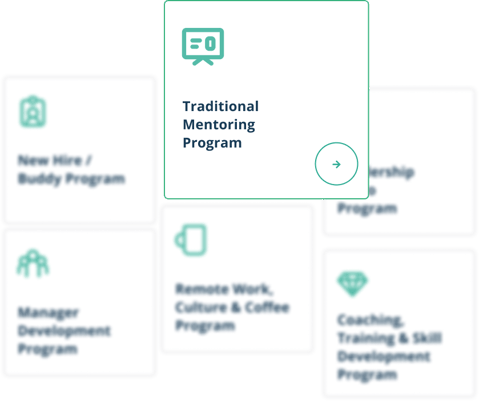
A ready-made structure — goals, milestones, cadence, launch assets — is what turns intent into a running program and signals a vendor genuinely supports the format rather than tolerating it.
Ask the vendor: "Do you have a reverse mentoring template, or would I build it from scratch?"
How Qooper delivers it: Qooper ships program templates built on best practices from hundreds of organizations, plus launch templates for email, landing pages, and kickoff — reducing setup from months to weeks, with most programs live within 30 days.
4. Guided conversation prompts and curricula
The awkwardness of a junior employee "teaching" an executive is the top reason reverse pairs stall — and the most common reason mentoring relationships go dormant is that pairs don't know what to do next. Session agendas, icebreakers, and learning content keep momentum.
Ask the vendor: "What in-app content guides each session?"
How Qooper delivers it: Qooper provides AI-generated meeting agendas personalized to each pair's goals and session history, icebreakers, goal-setting frameworks, and a bite-sized mentorship training library (with ATD-certified content) that prepares both sides before their first session.
5. Psychological-safety and confidentiality controls
When the power dynamic is inverted, candor needs protection. Look for private mentoring spaces, feedback and survey tools, and ground-rule content so a junior mentor can speak freely without career risk.
Ask the vendor: "How does the platform protect what's said between a junior mentor and a senior mentee?"
How Qooper delivers it: Qooper gives each pair a private space with chat, calls, and shared goals, plus structured feedback and satisfaction surveys that surface relationship health without exposing individual conversations — reinforced by training that sets expectations on both sides.
6. Reporting, analytics, and ROI
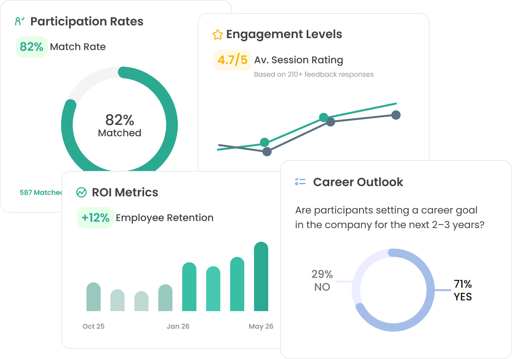
Reverse programs are often DEI- or engagement-funded, so you'll be asked to prove impact. You need dashboards for engagement, session completion, goal attainment, and satisfaction — ideally with an ROI view connecting activity to retention and promotion.
Ask the vendor: "Can I report on goal completion and tie participation to retention, and can I show that to my CHRO?"
How Qooper delivers it: Qooper's reporting covers engagement, program outcomes, and detailed exports, with a built-in ROI calculator and a People Intelligence analytics layer that connects mentoring activity to business outcomes.
7. HRIS and collaboration-tool integration
Bi-directional HRIS sync pulls role, department, and seniority data — the fuel for accurate topic-based matching and impact reporting. Deep integration with daily tools is also the single biggest driver of adoption, because it keeps mentoring where people already work.
Ask the vendor: "Which HRIS and collaboration tools do you integrate with, and is the sync bi-directional?"
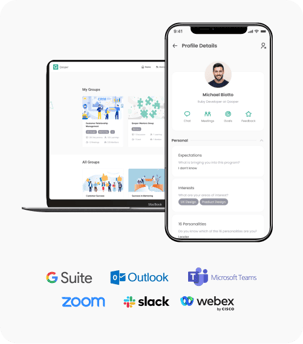
How Qooper delivers it: Qooper offers bi-directional HRIS integrations with Workday, SAP SuccessFactors, Oracle, ADP, BambooHR, Paycor, and UKG, plus Microsoft Teams, Slack, Zoom, Google Workspace, and Office 365 — and a mobile app so participants engage on the go.
8. Enterprise scale, security, and localization
For a global rollout you need SOC 2 and GDPR compliance, admin controls that scale from a pilot to thousands of users, and multi-language support so the program works across regions.
Ask the vendor: "What are your security certifications, and how many languages does the participant experience support?"
How Qooper delivers it: Qooper is SOC 2 Type I and II compliant and GDPR-ready, supports 30+ languages, and scales across thousands of users and 500+ programs for 300+ organizations — including Fortune 500 enterprises.

Feature Checklist At A Glance
|
# |
Feature |
What to look for |
Qooper |
|---|---|---|---|
|
1 |
Bi-directional matching |
Junior mentor → senior mentee, by config |
Yes — 5 match modes, custom criteria |
|
2 |
Skill/topic AI matching |
Adjustable weights, full-profile signals |
Yes — AI, open-text, DEI topics |
|
3 |
Reverse program templates |
Prebuilt goals, cadence, launch assets |
Yes — templates + launch kit |
|
4 |
Guided prompts/curricula |
Agendas, icebreakers, training |
Yes — AI agendas + training library |
|
5 |
Psychological safety |
Private spaces, confidentiality, surveys |
Yes — private pairs + feedback tools |
|
6 |
ROI analytics |
Engagement→retention, exports |
Yes — ROI calculator + People Intelligence |
|
7 |
HRIS + tool integrations |
Bi-directional, deep, daily tools |
Yes — Workday/SAP/Oracle/ADP + Teams/Slack |
|
8 |
Security & localization |
SOC 2, GDPR, multi-language |
Yes — SOC 2 I&II, GDPR, 30+ languages |
5 Common Mistakes When Choosing Reverse Mentoring Software
- Assuming any mentoring tool can do it. Many are hard-coded senior-to-junior. Test bi-directional matching first, before anything else.
- Buying on matching alone. A great match still goes dormant without agendas and prompts. Weight structure and guided content heavily.
- Ignoring confidentiality. Without safety controls, junior mentors self-censor and the program's whole value evaporates.
- Skipping the ROI question. If you can't show impact, you won't get budget for cohort two. Confirm the reporting before you sign.
- Underestimating integrations. Fragmented, off-to-the-side tools kill adoption. Prioritize platforms that live inside your HRIS and collaboration stack.
How To Evaluate Platforms Against The Checklist
- Score each shortlisted platform 0–8, weighting features #1 and #2 highest — a tool that fails bi-directional matching is disqualified regardless of everything else.
- Run a pilot use case. Configure one real reverse pair (junior mentor → senior leader) in a trial. If it takes workarounds, that's your answer.
- Pressure-test the reporting. Ask to see the exact dashboard you'd present to your CHRO, not a generic screenshot.
- Confirm integrations against your stack before committing — HRIS and collaboration-tool depth is where adoption is won or lost.
How Qooper Supports Reverse Mentoring End-to-End
Qooper is enterprise mentoring software used by 300+ organizations, including Fortune 500 companies such as Google, VF Corporation, Tommy Bahama, HOK, Matthews International, and Rentokil, running thousands of users across 500+ programs. It supports reverse mentoring alongside 1:1, group, peer, flash, onboarding, and leadership programs — each independently configured — from a single admin interface. Here's the full picture against the reverse mentoring lifecycle:
-
Design and launch. Start from a best-practice program template and configure a reverse program with its own matching logic, cadence, and goals. Use built-in email templates, landing pages, and kickoff outlines to recruit senior mentees and junior mentors, with HRIS-driven enrollment to simplify onboarding.
-
Match. Qooper's customizable AI Smart Matching (Manual, Bulk Suggest, Auto-Match, Self-Match, and hybrid) inverts seniority for the reverse format and pairs on skills, goals, DEI topics, and open-text responses — with admin-adjustable match weights.
-
Engage and sustain. AI-generated meeting agendas, icebreakers, goal-setting frameworks, and a mentorship training library keep inexperienced mentors confident and pairs active. Chat, calls, scheduling, and a mobile app keep mentoring inside daily workflows.
-
Measure and prove. Dashboards track engagement, session completion, goals, and satisfaction, while the built-in ROI calculator and People Intelligence layer connect the program to retention and promotion outcomes.
-
Scale securely. SOC 2 Type I and II, GDPR compliance, 30+ language support, and bi-directional integrations with Workday, SAP SuccessFactors, Oracle, ADP, BambooHR, Paycor, UKG, Microsoft Teams, Slack, Zoom, Google Workspace, and Office 365 make global rollout straightforward.
-
Proof point: In a Qooper program at PCG, 160 participants achieved a 98% retention rate, 100% mentee satisfaction, and 33% career mobility — the kind of outcome the analytics above are built to surface and repeat.
Compare Qooper head-to-head with other options in the companion guide: 6 Mentoring Platforms That Support Reverse Mentoring.
New to the format? Start with our complete guide to reverse mentoring, or book a Qooper demo to see a reverse program configured live.
Frequently Asked Questions
We're launching reverse mentoring pairing younger employees with senior leaders — what tool supports that format?
Choose enterprise mentoring software with flexible, bi-directional matching so seniority isn't a constraint, plus program templates, guided prompts, and ROI analytics. Qooper supports the format natively — its Smart Matching can pair a junior mentor with a senior leader by topic, and its templates, AI-generated agendas, and reporting give the program structure and proof of impact from day one.
What features does mentoring software need to support reverse mentoring?
Flexible bi-directional matching, skill/topic-based AI matching, reverse mentoring program templates, guided discussion prompts and training, psychological-safety controls, ROI analytics, bi-directional HRIS integration, and enterprise security with multi-language support.
Can I run reverse mentoring in a spreadsheet or a generic LMS?
Not reliably. Spreadsheets can't invert matching or protect confidentiality, and most LMS tools have no mentoring workflow. The format needs a mentoring platform built for multiple program types, such as Qooper.
Is bi-directional matching really essential?
Yes — it's the disqualifying feature. If a platform can only pair senior mentors with junior mentees, it cannot run reverse mentoring, no matter what else it offers. Qooper makes inverting seniority a simple configuration.
How do we keep senior leaders engaged when a junior colleague is the mentor?
Structure and safety. Provide clear agendas and goals, brief both sides, and protect candor. Qooper's AI-generated agendas, training library, and private mentoring spaces are designed to remove the awkwardness that stalls reverse pairs.
How do we prove reverse mentoring worked?
Track engagement, session completion, goal attainment, and satisfaction in your platform's analytics, then correlate with retention and promotion data. Qooper's ROI calculator and People Intelligence layer are built to make that case to leadership.
How long does it take to launch a reverse mentoring program?
With prebuilt templates and HRIS-driven enrollment, most enterprise programs on Qooper are live within about 30 days of onboarding.
Can we run reverse mentoring alongside our other programs?
Yes. Qooper manages reverse, 1:1, group, peer, and onboarding programs from one admin interface, each with its own matching logic, cadence, and reporting.
-Jul-29-2026-02-51-41-9028-PM.jpg)
-4.png)