




How to Keep Your Mentoring Program Engaging in 2026
 Omer Usanmaz
·
6 minute read
Omer Usanmaz
·
6 minute read
Sign-ups look healthy, the first meetings happen, everyone is enthusiastic — and then calendars fill, the second meeting slips, and by the end of the quarter a quiet share of your matches have gone dark without anyone deciding to quit. Program teams have a name for it: the engagement cliff.
It rarely comes from a lack of interest. It comes from a lack of structure once the novelty wears off, and from asking busy people to sustain a relationship on goodwill alone. The programs that hold engagement all year share two things: a clear structure agreed at kickoff, and a system that carries participants through preparation, scheduling, and follow-up without a program manager chasing every pair by hand. That system is what enterprise mentoring software is built to provide.
Below is a practical playbook for holding engagement across a full year — and how Qooper supports each stage at enterprise scale.
How To Structure A Mentoring Relationship
A mentoring relationship is structured when both people agree, before the first session, on the goals they are working toward, how often and how long they will meet, the role each person plays, and the boundaries around confidentiality and scope. Setting these four elements at kickoff is the single biggest predictor of whether a match lasts.
Goals
Vague goals produce vague meetings that are easy to skip. Ask each pair to agree on two or three concrete focus areas in the first session and write them down where both can see them. Qooper's goal templates give every pair a starting framework so no one faces a blank page, and progress against those goals stays visible to participants and administrators throughout the program.
Download Mentorship Goal Setting Template
Cadence
Decide the rhythm at kickoff, not week to week. Biweekly sessions of 45 to 60 minutes work for most development-focused programs. Qooper's structured session workflows and automated reminders turn that cadence into a standing commitment rather than something renegotiated every time a calendar gets busy.
Roles And Boundaries
Make responsibilities explicit: the mentee owns the agenda and follow-up, the mentor brings perspective and asks questions, and both agree on confidentiality, scope, and time upfront. Qooper's best-practice program templates and mentorship training library set these expectations from day one, so pairs start from a tested playbook instead of improvising — which is exactly how enterprises avoid the culture risk of underprepared or mismatched participants.
Where Qooper helps most: the matching engine. Qooper's AI-powered matching considers career goals, skills gaps, interests, working styles, availability, and program objectives — moving beyond basic profile matching to create pairings that are far more likely to stay engaged. Configurable matching workflows, approval processes, and edge-case handling give administrators control while reducing the risk of poor matches that stall out in month two.
What Mentors and Mentees Should Do Before A Session
Before a session, the mentee should review progress since the last meeting, prepare one or two specific topics or questions, and note any blockers to raise. The mentor should re-read the mentee's goals and last session's notes, prepare a relevant example or resource, and set aside a few minutes afterward to capture action items. Five minutes of preparation on each side turns a catch-up into a working session — and a working session creates a reason to meet again.
Mentee checklist
- Review what you committed to last session and note what you actually did
- Choose one or two specific topics or questions to focus the conversation
- Write down any blocker you want help thinking through
- Come ready to leave with a clear next action
Mentor checklist
- Re-read the mentee's goals and your notes from last time
- Prepare one relevant example, story, or resource tied to their agenda
- Have two or three open questions ready to deepen the conversation
- Reserve a few minutes afterward to capture action items and follow-ups
A Mentorship Training Library Removes The Blank-Page Problem
Preparation only becomes a habit when people have something to pull from. Qooper's built-in mentorship training library gives mentors and mentees role guides, goal-setting worksheets, first-meeting agendas, per-session preparation checklists, and conversation guides for common topics such as career growth, feedback, and navigating change. It ensures a professional mentoring experience for every participant and protects consistency as the program scales — every new pair starts from the same tested material instead of reinventing it.
Qooper then does the follow-up automatically. After the mentorship training, Qooper sends participants meeting agendas, feedback templates, and goal templates that help mentees prepare, show up, and follow up — which keeps mentors showing up too. Qooper AI takes this further with personalized meeting agendas built from past sessions and participant goals, plus an AI mentorship trainer, so preparation stays effortless and every session builds on the last.
Sustaining Engagement Across A Hybrid Workforce
Mentoring for a hybrid workforce means designing for asynchronous contact between live sessions, removing scheduling friction across time zones, and building accountability into the program rather than relying on goodwill. In a co-located program, hallway momentum carries a relationship between meetings. In a hybrid or distributed organization, that momentum has to be built on purpose.
Async touchpoints and mobile-first engagement
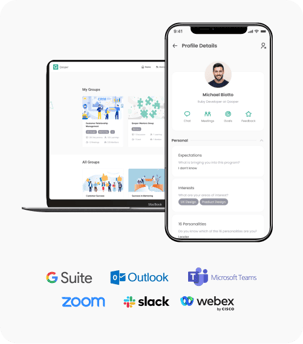
Not every exchange needs a calendar hold. Qooper's native mobile app lets mentors, mentees, and peers connect, chat, set goals, schedule sessions, track progress, and share feedback from anywhere — keeping relationships warm between live meetings so the next session picks up where the last left off instead of restarting cold.
Frictionless scheduling
Scheduling friction is where hybrid matches quietly die. Qooper integrates with Google Workspace and Outlook calendars so pairs can find availability and book directly, and connects to Zoom, Microsoft Teams, and Webex for the session itself — making it easy to meet across locations, time zones, and working models.
Accountability that runs itself
Goodwill fades under a full calendar; systems don't. Qooper's automated follow-up, session reminders, and task notifications — delivered right inside Slack and Microsoft Teams where employees already work — keep pairs on track without a program manager chasing each match. And with support for 30+ languages, global and distributed teams get a consistent, localized mentoring experience from one unified program.
How To Keep A Program From Fizzling Out After A Few Months
Programs fizzle when the structure that carried the first meeting runs out. You keep participation steady by locking in cadence at kickoff, giving every pair a shared goal and preparation routine, sending accountability nudges before scheduled sessions, and tracking session completion so you can re-engage a stalling match in week six rather than discovering it in month six. The difference between the two is visibility.
Qooper gives enterprise HR, L&D, and talent teams that visibility with reporting that goes well beyond basic analytics. Track the signals that predict health:
- Session attendance and completion — the clearest early warning that a pair is drifting, visible as a trend rather than a year-end surprise.
- Match longevity and relationship progress — spot clusters of matches going quiet at the same stage, usually a fixable structural gap.
- Participant feedback and survey results — captured through built-in survey templates and embedded tools throughout the journey.
- Retention and attrition risk signals — Qooper AI surfaces engagement signals and retention risks so you can act before disengagement becomes turnover.
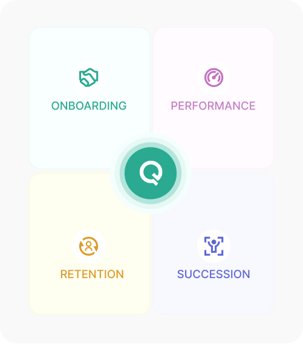
Because Qooper connects mentoring activity to outcomes — retention, onboarding speed, engagement, skill development, internal mobility, and succession readiness — you can show leadership not just that mentoring is happening, but that it is moving the business metrics that justify the program. That ROI visibility is what turns a program from an activity into a renewed budget line.
Why Enterprises Choose Qooper To Keep Programs Engaging
Structure, preparation, and accountability are straightforward to run for a handful of pairs and genuinely hard to sustain across hundreds. Qooper is enterprise mentoring software built to hold engagement as programs scale — trusted by 300+ enterprise organizations, including Fortune 500 companies such as Google, VF Corporation, Tommy Bahama, HOK, Matthews International, and Rentokil, with thousands of users across 500+ mentoring programs.
- AI-powered matching that pairs on goals, skills, and working styles — not just profiles.
- Structured guidance beyond the match with a mentorship training library, meeting agendas, goal and feedback templates, and automated follow-up.
- Mobile-first participant experience that drives adoption across time zones and working models.
- Reporting and ROI analytics connecting mentoring to retention, engagement, mobility, and succession outcomes.
- Enterprise integrations including bi-directional HRIS syncs with Workday, SAP SuccessFactors, Oracle, ADP, UKG, and more, plus SSO/SAML, calendar, video, and LMS.
- Enterprise-grade security with SOC 2 Type I & II certification, GDPR compliance, role-based access control, and governance-ready deployment.
- High-touch support from a dedicated customer success manager with response times under 30 minutes, live kickoff support, and quarterly business reviews.
See How Qooper Keeps Mentoring Programs Engaging
Design, run, and scale mentoring programs that stay active all year — with AI matching, built-in training, automated follow-up, enterprise integrations, and ROI reporting.
Frequently Asked Questions
How do I keep a mentoring program from fizzling out after a few months?
Programs fizzle when the structure that carried the first meeting runs out. Keep participation steady by locking in a meeting cadence at kickoff, giving every pair a shared goal and preparation routine, sending accountability nudges before scheduled sessions, and tracking session completion so you can re-engage a stalling match in week six rather than month six. Qooper automates the reminders, agendas, and follow-up that make this happen, and its reporting surfaces stalling matches early.
How can I support mentoring for a hybrid workforce?
Support hybrid mentoring by designing for asynchronous contact between live sessions, removing scheduling friction across time zones, and building accountability into the program rather than relying on goodwill. Qooper's mobile app keeps pairs connected between meetings, its calendar and video integrations remove booking friction, and automated reminders inside Slack and Teams — with support for 30+ languages — keep distributed teams engaged in one unified program.
What should a mentorship training library include?
A mentorship training library should include short role guides for mentors and mentees, a goal-setting worksheet, a first-meeting agenda, per-session preparation checklists, and conversation guides for common topics such as career growth, feedback, and navigating change. Qooper provides this library built in, along with meeting agendas, feedback templates, and an AI mentorship trainer, so participants always have a next step to reach for.
How do I structure a mentoring relationship?
A mentoring relationship is structured when both people agree, before the first session, on the goals they are working toward, how often and how long they will meet, the role each person plays, and the boundaries around confidentiality and scope. Setting these four elements at kickoff is the single biggest predictor of whether a match lasts — and Qooper's program templates, goal templates, and training library set them from day one.
What should mentors and mentees do before a session?
Before a session, the mentee should review progress since the last meeting, prepare one or two specific topics or questions, and note any blockers to raise. The mentor should re-read the mentee's goals and last session's notes, prepare a relevant example or resource, and set aside a few minutes afterward to capture action items. Qooper makes this effortless with automated agendas — including AI-generated agendas built from past sessions and goals — sent to both sides before each meeting.
.jpg)
-2.png)
%20(1).png)