




 ·
5 minute read
·
5 minute read
AI personalized mentoring uses machine learning to tailor each mentoring relationship to the individual—matching a person to the right mentor based on their goals, skills, and needs, then adapting guidance as the relationship develops. Applied to retention, it goes a step further: AI reads engagement and relationship-health signals to flag who is at risk of disengaging or leaving, and routes those people to a targeted mentoring intervention. The result is a closed loop—signal to match to action—that generic mentor matching does not provide.
Key Takeaways
- AI personalized mentoring adapts the match and the ongoing experience to the individual, unlike one-time generic matching.
- For retention, AI turns behavioral signals—declining sessions, missed milestones, low sentiment—into early warnings and a targeted mentor match.
- The differentiator is the signal-to-intervention loop: detect risk, match, guide, measure. It works across companies, universities, and associations.
- Qooper operationalizes the loop with AI matching, at-risk pair alerts, engagement tracking, and AI-generated agendas in one platform.
- AI signals are correlational, not diagnostic; they require human judgment, clean data, and clear consent.
What is AI Personalized Mentoring, and How Does It Differ From Generic Matching?
AI personalized mentoring tailors mentoring to the individual at two levels: the initial match and the ongoing relationship. Generic matching pairs people once from a few static rules, then goes quiet. Personalized mentoring keeps working—recommending topics, agendas, and next steps based on each person's goals, progress, and engagement.
The distinction matters because a match is only the starting point. The most common reason mentoring relationships stall is not a bad pairing—it is that pairs run out of productive things to do. Personalization closes that gap by shaping the experience, not just the pairing.
|
Dimension |
Generic mentor matching |
AI personalized mentoring |
|---|---|---|
|
Variables considered |
2–4, fixed |
Many, weighted per person and program |
|
Timing |
One-time pairing |
Continuous, adapts over time |
|
Guidance |
Static or none |
Personalized agendas, prompts, next steps |
|
Retention signals |
None |
Detects disengagement and flight risk |
|
Feedback loop |
Open |
Closed: signal → match → action → measure |
For a deeper look at the pairing layer specifically, see AI mentor matching.
How Does AI Surface Retention-Risk Signals and Connect Them To Mentoring?
AI-powered mentoring platforms watch relationship health continuously and translate patterns into early warnings. This is the "AI insights for retention-risk mentoring" that most tools omit.
The signals AI reads include:
- Declining session frequency — a pair that met weekly now meets monthly.
- Missed milestones — goals set but not progressing on schedule.
- Low sentiment or NPS — survey scores trending down.
- Engagement drop-off — no activity logged past a set threshold (e.g., four weeks).
AI insights become retention outcomes only when each signal maps to a specific mentoring action—and to a platform capability that executes it:
|
Retention-risk signal |
Mentoring intervention |
How Qooper does it |
|---|---|---|
|
Engagement drop-off |
Re-engagement prompt; manager alert |
At-risk pair alerts and inactivity triggers |
|
Poor pair fit (low sentiment) |
Re-match to a better mentor without restarting |
Confidence-scored re-matching, admin override |
|
Stalled goals |
Refreshed agenda and milestones |
AI-generated meeting agendas per pair |
|
New-hire or transition risk |
Route to an onboarding/transition mentor |
Program templates + HRIS-triggered enrollment |
|
High-potential flight risk |
Match to a senior sponsor |
Predictive match-quality scoring |
Because mentoring disengagement often mirrors broader flight risk, these signals are an early indicator HR can act on. The evidence is consistent: mentored employees at Sun Microsystems were retained at 72% versus 49% for non-participants (Gartner, via Knowledge@Wharton), and a CNBC/SurveyMonkey survey found more than 4 in 10 employees without a mentor had considered quitting in the prior three months, versus 25% of those with one. When mentoring data connects to the HRIS and employee-retention workflows, the loop closes: detect risk, match to the right mentor, guide the relationship, and measure whether the person stays and grows.
What Does AI Personalized Mentoring Look Like for Companies, Universities, and Associations?
The signal-to-intervention loop applies wherever disengagement precedes attrition.
- Companies. AI flags a high-potential employee whose engagement has dropped and routes them to a senior sponsor before they become a flight risk; disengaged new hires are matched to an onboarding mentor.
- Universities. AI surfaces first-year or transfer students whose participation is fading and connects them to a peer or faculty mentor—making mentoring a student-retention lever, not just a networking perk.
- Associations. AI identifies members whose engagement is declining ahead of renewal and pairs them with a member mentor, linking mentoring directly to membership retention.
High-potential retention is the highest-ROI application of this loop. Losing a future leader carries an outsized cost—lost institutional knowledge, a broken succession pipeline, and expensive external replacement—so flagging a disengaging HiPo early and matching them to the right sponsor pays for the program on its own. This is why high-potential and leadership development programs are often where organizations pilot AI personalized mentoring first.
How Does Qooper Operationalize The Signal-To-Intervention Loop?
-2.png?width=465&height=442&name=image%20(7)-2.png)
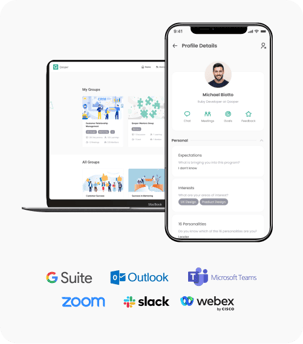
Qooper runs the entire loop in one enterprise-ready platform. Its AI-powered engine personalizes the match across up to nine variables, then keeps each relationship on track with AI-generated agendas, engagement tracking, at-risk pair alerts, and predictive match-quality scoring—so risk is caught and acted on without manual monitoring. When one participant in Northwell Health's inaugural mentorship program described their Qooper pairing as "spot on," it reflected exactly this: personalization that makes the relationship feel intentional from day one.
Worked example. A high-potential engineer who met her mentor weekly drops to monthly, and her goal milestones slip. Qooper flags the pair as at-risk and alerts the program manager; HR reviews the signal, re-matches her to a senior sponsor in her target function, and Qooper generates a fresh agenda for the first session. Engagement recovers, and the outcome is tracked against the program's retention metrics. That is the loop—detect, match, guide, measure—running end to end.
Qooper reports a 79% improvement in retention and 40% higher engagement across customer programs, backed by SOC 2 Type II certification, GDPR/CCPA compliance, and native HRIS integrations that keep the signal data current.
What Are The Benefits, Limitations, and Implementation Considerations?
-
Benefits. AI personalized mentoring improves match quality, keeps relationships active with tailored guidance, and converts retention risk into timely action—turning mentoring from a soft perk into a measurable retention lever.
-
Limitations. AI signals are correlational, not diagnostic—a drop in sessions suggests risk but does not explain it, so human judgment is essential. Model quality depends on clean, connected data, and no algorithm replaces a manager's conversation or a well-designed program; AI surfaces where to look, people decide what to do.
Implementation considerations:
- Connect the data. Integrate the mentoring platform with your HRIS so profile and engagement data flow both ways.
- Define thresholds. Set what "at risk" means—inactivity windows, milestone slippage, sentiment floors—before launch.
- Address consent and privacy. Retention-risk monitoring uses employee engagement data, so be transparent about what is analyzed, secure it (SOC 2 Type II, GDPR/CCPA), frame it as support rather than surveillance, and avoid using protected attributes in risky ways.
- Prepare the humans. Train managers and mentors to act on alerts constructively, not punitively.
- Start with a pilot. Prove the loop on one program, measure retention lift against a control group, then scale.
See It On Your Own Programs
AI personalized mentoring turns retention-risk signals into the right mentor match—automatically, at scale. Schedule a Qooper demo to see AI matching, at-risk alerts, and personalized guidance on your own programs.
Frequently Asked Questions
What is personalized mentoring with AI?
Personalized mentoring with AI is mentoring tailored to the individual by machine learning—both in the initial mentor match (based on goals, skills, seniority, and preferences) and in the ongoing relationship (through personalized agendas, prompts, and next steps). Unlike generic matching, which pairs people once from a few static rules, it adapts continuously as goals and engagement change.
How does AI provide insights for retention-risk mentoring?
AI provides retention-risk insights by continuously analyzing engagement and relationship-health signals—declining session frequency, missed milestones, falling sentiment, and inactivity past a set threshold—and flagging people at risk of disengaging before they leave. It then connects each signal to a mentoring intervention, such as an automated re-engagement prompt, a re-match to a better-fit mentor, or routing a high-potential employee to a senior sponsor.
How is AI personalized mentoring different from generic mentor matching?
Generic mentor matching creates a one-time pairing from a few fixed variables and provides little ongoing support. AI personalized mentoring weighs many variables per individual, adapts the experience over time with tailored guidance, and detects retention-risk signals—closing the loop from signal to match to action to measured outcome.
Can AI mentoring software flag employees at risk of leaving?
Yes. AI mentoring software flags at-risk employees by detecting declining engagement, missed milestones, and low satisfaction within mentoring relationships, then alerting program managers and triggering interventions. Because mentoring disengagement often correlates with broader flight risk, these alerts act as an early warning HR can pair with an immediate, targeted mentor match. Qooper provides at-risk pair alerts, engagement drop-off triggers, and predictive match-quality scoring.
What are the limitations of AI personalized mentoring?
The main limitations are that AI signals are correlational rather than diagnostic, so they require human interpretation; prediction quality depends on clean, connected data; and AI cannot replace manager conversations or good program design. Responsible use also requires transparency, data security, and consent around the engagement data analyzed.