




The First Meeting & Icebreaker Kit

Why the First Meeting Decides Everything
The first mentoring meeting is the most important one you’ll have. It’s where trust starts, or doesn’t. A first session that builds rapport and sets clear expectations leads to a relationship that lasts; an awkward or aimless one is the single biggest reason pairs go quiet by week three.
The good news: a great first meeting isn’t about chemistry or luck. It’s about showing up prepared with the right questions and a simple plan. This kit gives mentors and mentees exactly that — what to do before you meet, a 45-minute agenda, more than 40 icebreaker and first-meeting questions to choose from, and a notes template so nothing gets lost.
|
In short A strong first mentoring meeting does three things: it breaks the ice, aligns on goals and expectations, and ends with a clear next step. Use the questions in Section 3 to open warmly, the questions in Section 4 to set the relationship up, and the template in Section 6 to capture what you agree on. Pick what fits — you won’t use every question, and you shouldn’t. |
1. Before You Meet: A 5-Minute Prep Checklist
Five minutes of prep is the difference between a first meeting that flows and one that stalls. Both people should come ready.
If you’re the mentor
❑ Review your mentee’s profile, background, and stated goals.
❑ Choose three or four icebreakers from Section 3 that feel natural to you.
❑ Have one or two of your own stories ready to share — openness invites openness.
❑ Block a full 45 minutes with no distractions or hard stops.
❑ Decide what you’ll suggest for meeting cadence and communication.
If you’re the mentee
❑ Look up your mentor’s background and experience beforehand.
❑ Write down what you most want from the program.
❑ Prepare two or three questions you’re genuinely curious to ask.
❑ Think about how you like to work, learn, and receive feedback.
❑ Come ready to talk openly about your goals — even the fuzzy ones.
2. The First-Meeting Agenda (45 Minutes)
You don’t need a rigid script — just a shape. This 45-minute flow moves from rapport to goals to a clear next step, so no one is left staring at a blank screen.
|
Time |
Segment |
What happens |
|---|---|---|
|
0–5 min |
Break the ice |
Open with a warm-up question. Ease in before anything serious. |
|
5–15 min |
Get to know each other |
Share career stories and backgrounds. Find common ground. |
|
15–25 min |
Align on goals |
The mentee shares what they hope to gain and the areas they want to grow. |
|
25–35 min |
Set the ground rules |
Agree on cadence, communication, session length, and expectations. |
|
35–43 min |
Agree on next steps |
Set one small action each and book the next session before you leave. |
|
43–45 min |
Close warmly |
Recap, say thank you, and confirm the next meeting. |
Meeting virtually or have only 30 minutes? Keep the same order — just trim the middle two segments.
3. 40+ Icebreaker & First-Meeting Questions
The heart of the kit. Pick a handful from each group; you’re starting a conversation, not running an interview. Let answers lead to follow-ups.
Warm-up openers (the first five minutes)
- What’s something you’re looking forward to this week?
- Coffee, tea, or something else getting you through today?
- What’s something people are often surprised to learn about you?
- How’s your week going — busy, steady, or all over the place?
- What made you want to be part of this program?
Getting to know each other
- Walk me through your career so far — what were the turning points?
- What drew you to the work you do now?
- Who’s had the biggest influence on your career, and why?
- What does a typical day look like for you?
- Outside of work, what keeps you energized?
Understanding how you each like to work
- How do you prefer to stay in touch between sessions — email, chat, or calls?
- Do you think out loud, or process first and share later?
- How do you like to receive feedback — direct, gentle, or with examples?
- When you’re stuck on something, what usually helps you move forward?
- What time of day are you at your sharpest?
Just for fun (building rapport)
- If you could instantly master any skill, what would it be?
- What’s the best piece of advice you’ve ever been given?
- A book, podcast, or show you’d recommend right now?
- What did you want to be when you were a kid?
- Two truths and a lie — go.
4. Questions That Set Up the Relationship
Icebreakers open the door; these questions build the relationship. They surface goals, expectations, and working agreements — the things that keep a mentorship on track long after the first meeting.
For mentors to ask mentees (goals & expectations)
- What do you most want to get out of this mentorship?
- If this goes really well, what’s different for you in six months?
- What’s one skill or area you’re most eager to grow?
- What kind of support helps you most — advice, accountability, connections, or a sounding board?
- Is there anything you’d rather not focus on, or that’s off the table?
For mentees to ask mentors
- What made you want to become a mentor?
- What part of your work do you enjoy most right now?
- What’s a mistake you learned the most from?
- How would you like me to reach you between sessions?
- What do you expect from me as a mentee?
Before you wrap — agree on the basics (both of you)
- How often should we meet, and for how long?
- What’s the best way to reschedule if something comes up?
- What would make this a good use of both our time?
- What’s one small thing each of us can do before next time?
5. Ending Well + Mistakes to Avoid
End every first meeting with these four moves
❑ Recap what you talked about and what you learned about each other.
❑ Agree on one small action each to complete before the next session.
❑ Set your cadence and book the next meeting — don’t leave it “sometime.”
❑ Confirm the best way to reach each other between sessions.
The first-meeting mistakes that stall relationships
❑ Treating it like an interview instead of a two-way conversation.
❑ Diving into problems before any rapport is built.
❑ Leaving without a next meeting on the calendar.
❑ One person doing all the talking — or none of it.
❑ Skipping expectations entirely — the number-one cause of early drop-off.
|
Remember: the goal of the first meeting isn’t to solve anything. It’s to build enough trust and clarity that the second meeting happens — and the tenth. |
6. Your First-Meeting Notes (Fill-In Template)
Fill this in during or right after your first session. It captures what you agreed on — and becomes the starting point for meeting number two.
|
Date |
|
|
Mentor / Mentee names |
|
|
Program / focus area |
|
|
What we learned about each other |
|
|
Mentee’s top goals (1–3) |
|
|
How we’ll work together (cadence · channel · session length) |
|
|
Action item — Mentor |
|
|
Action item — Mentee |
|
|
Next meeting (date & time) |
How Qooper Makes Great First Meetings Automatic
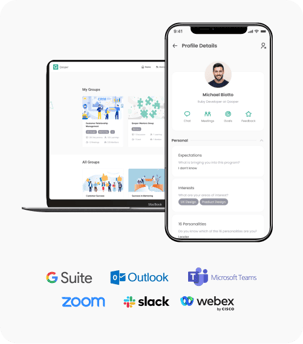
This kit works with any program. But if you’re running mentoring at scale, the hard part is making every first meeting this good — for hundreds of pairs at once. In Qooper, most of what’s in this kit is already built into the 1:1 Mentoring page, the Program Guide, and the Learning library.
|
What a strong first meeting needs |
How Qooper does it |
|---|---|
|
A relevant match to begin with |
Smart matching pairs people on goals, skills, and interests — so the first conversation starts with real common ground, not a cold start. |
|
A warm way to say hello first |
Before the meeting, either person can send a quick chat straight from their Mentoring page to break the ice and confirm a time. |
|
A ready agenda |
The Program Guide walks each pair through Steps — facilitation prompts and monthly meeting topics — so no session starts from a blank page. |
|
Icebreakers and training on hand |
The Learning section and the Mentorship Training Library give mentors and mentees lessons, videos, and ready questions — the kind in this kit, built in. |
|
One-click scheduling |
Pairs schedule the meeting using their own video link (Zoom, Meet, and more), set their calendar availability, and see everything under My calendar. |
|
Goals and ground rules on the record |
On the Mentoring page, pairs set goals and milestones and review the mentorship agreement together — the expectations from Section 2, captured in the platform. |
|
A home for notes and materials |
Share lessons and files directly inside the connection, so nothing lives in scattered inboxes or docs. |
|
A nudge if momentum slips |
Notifications and reminders keep pairs meeting past the first session, so early energy doesn’t fade. |
Run this exact first meeting inside Qooper
Each part of the kit maps to a real action on the Qooper Mentoring page. Here’s the same flow, in the platform:
|
Kit step |
In Qooper |
|---|---|
|
Before you meet |
Open your match on the Mentoring page, view their profile, and send a quick chat to say hello. |
|
Break the ice & get to know each other |
Open with prompts from the Learning section or Mentorship Training Library. |
|
Align on goals |
Set your goals and milestones together, right on the Mentoring page. |
|
Set the ground rules |
Review the mentorship agreement, and set calendar availability and meeting limits on your profile. |
|
Capture what you agreed |
Save it as goals and milestones and share any lessons or files in the connection. |
|
Book the next session |
Schedule using your video link; it appears under My calendar for both of you, with reminders. |
|
Strong first meetings compound When first meetings land, pairs keep meeting — and the program’s numbers follow. Program Consulting Group (PCG) ran its mentoring program on Qooper across 160 participants and reached 98% retention, 100% satisfaction, and 33% career mobility. It starts with a first conversation that goes well. 98% retention · 100% satisfaction · 33% career mobility · 160 participants |
You can access all of our Templates in a single location. This includes templates for mentoring programs, pulse surveys, onboarding, training resources, and other tools designed to support effective program management. Explore the full range of templates here.
Want to explore more?
Discover how Qooper can help your organizational goals and people development today.