
Problem Solving
Eight Disciplines of Problem Solving (8D)
The Eight Disciplines of Problem Solving (8D) is a highly effective and universal method utilized to find the root cause of a problem, plan a quick fix, and implement corrective and preventative actions to avoid and minimize recurrence. Below is a step-by-step approach to the 8D approach:
D0 – Planning and Preparing for the 8D
It is always a great start to plan and prepare before you take any action. Take a moment to think of:
-
Problem Description
-
Timeframe for the resolution
-
The number of resources required to accomplish a resolution
Considering all of the above points will help in forming a team.
D1 – Team Establishment
Creating a multidisciplinary team is essential for obtaining different perspectives of a problem, and having varied backgrounds and experiences to provide quality input into achieving a solution. It is important that a team leader is assigned to the team. Ideally, someone who is a subject matter expert, or someone experienced in completing problem-solving projects. As well as a team leader, every person involved should have a clear role and responsibility to have a functional team.
D2 – Problem Description
Define the problem objectively, to obtain all the vital information about the problem. Here, the 5W2H analysis can be used to derive a clear description of the problem.
-
Who?
-
What?
-
When?
-
When?
-
Why?
-
How?
-
How much?
D3 – Problem Containment Plan
Identify and implement an interim containment plan to minimize the impact of a problem, until you develop a permanent solution. Ensure that the team is constantly reviewing the efficiency of the containment action, and modifying the plan if required.
D4 – Identify the Root Cause
It is important to identify and understand the root cause of the problem to find a successful and permanent solution. The 5 Whys process can be one of the many root cause analysis tools that can be utilized. The 5 whys tool is used by asking ‘why the situation has occurred, five times, in order to get the root cause(s) of the problem.
D5 – Developing Permanent Corrective Actions
After identifying the root cause, the team will get together and brainstorm permanent corrective actions. It is important that the correction(s) be realistic, practical, cost-effective, and robust. Tools such as affinity diagrams can help organize ideas and determine the best course of action.
D6 – Implementing Permanent Corrective Actions
Here, the identified permanent corrective actions are implemented and interim containment actions are removed. The chosen permanent action should then be verified by ensuring small-scale testing before the large-scale rollout, and long-term results should be monitored.
D7 – Preventative Measures
Additional measures need to be taken to prevent similar problems. This may require reviewing and improving the processes and procedures to ensure the possibility of recurrence is minimized.
D8 – Team Celebration
Once the problem is solved, it is time to celebrate success with the team. Without the team and each individual involved, the root cause of the problem would not have been found and fixed. Therefore, all team members should be recognized and rewarded for their good work.
Recognizing and sharing their success across the organization will also help facilitate motivation and employee engagement to successfully solve future problems that may arise.
Influencing and Negotiating
How to Influence
Robert Cialdini's 6 Principles of Influence will help you as a leader develop a sophisticated set of influencing strategies when engaging with stakeholders, shaping opinions, and changing minds.
Cialdini’s 6 Principles of Influences are:
Reciprocity
People don’t like to feel like they owe someone and tend to feel socially obliged to reciprocate favors or actions.
Give someone something that is of value to them (e.g. a free one-month trial to a product/service). In return, a client may reciprocate the favor and engage in paying for your product/services.
Scarcity
Like the phrase ‘less is more’ – the less of something there is, the more people want it.
Increase interest in your product/service by creating a sense of urgency and placing a deadline to an exclusive offer.
You could also create a sense of scarcity on your own availability – which could lead to a desire to know what you have to offer.
Authority
People are more likely to listen and follow those with credibility and power.
Some people put certificates on their desks or in their offices. Some establish authority through dressing in a smart outfit (work-appropriate).
Knowledge is also key to gaining authority. Know your company and role inside out, and you will slowly gain authority.
Consistency
People find comfort in consistency. For instance, if a stakeholder commits to a small level of something, they are more likely to be consistent and continue committing to larger projects.
Being consistent and reliable as a leader will also create a sense of trust. Lead by example and in turn, you can expect to receive the same consistency from others.
Liking
People are more likely to be influenced and do things for people that they like. Connect with stakeholders, get to know them, and find mutual interests. Once you build that connection, they are more likely to say yes.
Social Proof
Humans by nature tend to conform to social norms. In other words, we tend to look at what the majority are doing before making a decision.
Provide evidence that others are successfully adopting the actions, and the audience is likely to be influenced.
How to Negotiate
The RAPCD Model of negotiation is a universal model used in the corporate world to help gain a win-win situation for all parties involved in a negotiation.
Each alphabet in the model is a representation of the following elements:
Rapport
At the start of a negotiation meeting, it is important that both parties feel comfortable. Begin the meeting by taking a few minutes to get to know each other, and create a positive impression.
Analysis
It is important that you understand each other’s needs for a successful negotiation. Here, gather the facts, opinions, feelings, and assumptions of the other party. It is also important that you share the same with the other party so that they can understand your needs.
Debate
Discuss the conflicting interests. Evaluate the pros and cons and seek a solution.
It is important at this stage that you remain calm and try and convince the other party of the benefits of your argument.
Propose
Each party will propose the best solution to reach a conclusion accepted by all.
When proposing your best idea, explain how it will resolve the conflict of interest and how this can be achieved.
Agreement
At this stage, parties agree to come to a conclusion on the best proposal or alternative.
Close
The negotiation is now complete and each party has achieved a satisfactory outcome.
At this stage, it is important that the results of the negotiation are summarised and discussed, and the next steps moving forward are planned.
Employee Motivation
Maslow’s Hierarchy of Needs
There are many motivational theories that can be used to guide organizational behavior and elicit employee motivation. One of the most renowned and earliest motivational theories, developed by Abraham H Maslow in 1943, is Maslow’s Hierarchy of Needs. This motivational theory suggests that there are 5 essential needs (physiological, security, social, ego, and self-actualization) - and that people are motivated to fulfill their basic needs before moving on to other, more advanced needs. This can be seen as a pyramid (see below), with the basic needs at the bottom, and more advanced ones at the top.
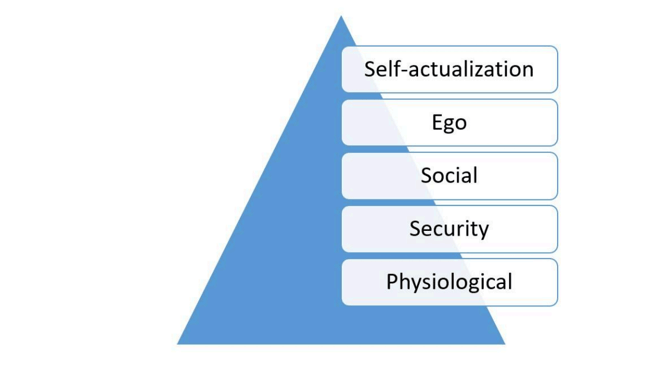
Physiological
This is the fundamental need that must be met for a person to survive - e.g. food, clothing, and shelter. These needs in an occupational setting would be a person’s salary.
Security
This is the need to feel safe. In the workplace, this can include job security and health and safety in the working environment.
Social
Humans are social animals, and need to belong in a group, form friendships, relationships, and a family – and feel like a valued member of that group. In an occupational setting, this can be achieved by encouraging team building through social activities or promoting group work across teams.
Ego
Humans tend to feed their ego by achieving recognition, respect, and status. In the workplace, this can be achieved by implementing a peer to peer o social recognition program to celebrate employees’ achievements.
Self-actualization
Once an individual has ticked all the other needs off, they then move into the self-actualization stage - where their desire to realize their full potential and personal development grows.
You can help your employees fulfill this need by providing them with the opportunity to develop within the organization. This can be achieved through implementing talent planning meetings with managers and HR and offering employees the opportunity to develop through training, mentoring, and promotions.
While this is a well-known and effective theory for understanding employee motivation, it is important to note that no one size fits all. A leader must view each member of their team as an individual with their own needs, feelings, and motivators, and the best way to do that is through communication. Therefore, the best way to motivate employees regardless of their age, gender, ethnicity, or culture is to have a clear, open, and honest communication channel. A channel where employees feel that their needs and concerns are heard – and where leadership will react accordingly to accommodate them.
Delegation
How to effectively delegate
1. Determine what task you are going to delegate:
Not every task can be delegated. For instance, conducting performance reviews for direct reports, or attending a dentist appointment has to be completed by you. Nevertheless, be specific, and identify a list of responsibilities that can be assigned to others.
2. Match projects to staff members:
Every employee will have their strengths and weaknesses. They will also have their own goals that they will be working towards. Try to match assignments to each person’s strengths. It is also advisable to delegate tasks to employees that will help bolster their professional development.
3. Define a desired outcome:
Successful delegation doesn’t end once you have assigned the task. You should then provide context to the person you are assigning responsibility to of the context of the task. For instance, inform the employee of the aim and end goal of the assignment, as well as a timeline and the metrics you will use to measure the success of their work.
4. Set up Check-Ins:
While you will want to allow your employees to complete the task with autonomy – you still want to occasionally check on the individual’s progress to find out if they require additional assistance or guidance.
Tip: It is important here that while you are there to assist them to overcome any obstacles they may face– you need to fight the urge to micromanage and allow them to fully manage the project and make any decisions required themselves.
5. Be patient and allow failure:
Remember, your employee may not have the same level of experience as you in completing the task – therefore, they are most likely going to take a little longer in completing the task than you would, and they might create errors in the process or even fail. Be patient with them. Within time their speed of completion will increase. And if they fail - at least it has empowered them to learn something new.
6. Deliver Feedback:
Once the task has been completed, provide your employee with feedback, and ask for feedback too. Give them honest, constructive criticism. However, also make sure that you provide positive feedback too, to show your appreciation. You will also want to receive feedback from their side to understand if you could do anything better to help them in the future.
7. Recognise good work done:
Credit and recognize the success of your employees. The more you recognize your employee’s good work, the more likely they will replicate a good job, and be more inclined to help in future projects.
Conflict Resolution
Fisher & Ury’s Interest-Based Relational (IBR)
Fisher & Ury’s Interest-Based Relational (IBR) approach is a highly effective method of conflict resolution. Stressing the importance of removing emotions from a problem, is based on respecting differences and understanding others' points of view, to resolve the conflict in a cooperative manner. The approach suggests there are 6-steps to resolving conflict successfully:
Step 1: Make sure that good relationships are a priority
People don’t have to like each other to resolve a conflict. However, they do need to be willing to commit to resolving the conflict and maintaining a good working relationship.
Before diving into the discussion, ensure that you highlight that the problem is never one person’s entire fault – everyone can have a part of responsibility in the problem, and point out your own involvement to build rapport.
Step 2: Separate people from problems
Here, it is important to recognize that there is always a reason why someone is acting in a certain way. Separating the problem from the person will benefit you in discussing the issues without damaging a relationship.
Step 3: Listen carefully to different interests
Gain a better understanding of people's behavior by actively listening to their side of the problem.
Invite others to talk first. This will allow you to view the problem from their perspective and may help you understand why they may have certain opinions. That person might highlight a point that could change your mind.
Step 4: Listen first, talk second
It is important here that everyone involved gets to say their perspective without interference. This can be done by taking turns to speak.
This can promote willingness to listen to others' opinions and leave people feeling like they have been heard – making them more susceptible to cooperating to find a solution.
Step 5: Set out the "facts"
Review the information that has been presented and establish what the facts are.
This can be achieved by asking each person to state the facts that are true – not their opinions.
This will help everyone’s understanding of the actual problem and will impact your decision toward a solution together.
Step 6: Explore options together
So far, you have agreed on what the problem is. Here is where you agree on the solution to resolve the problem.
Collaborate on exploring the different options together and review the possible positives. This will help in reaching a decision together, and more likely result in everyone leaving satisfied.
Once all options are evaluated, pick the one that is in favor of everyone and ensure everyone agrees on the decision and how to move forward.
Change Management
Kotter’s 8-Step Model
There are many proven models that can be used to successfully implement change. One very effective change management model is Kotter’s 8-Step Model:
1. Create a sense of urgency
This stage involves communicating the urgency of change to motivate people to be willing to adapt to change. This can be achieved by presenting the opportunities the change can bring to the organization and the threats that can arise if not implemented.
2. Creating a guiding coalition
This stage will involve bringing in influential people to support, influence, and lead the change process to help encourage employees to “buy in” and aid the transformation process. Those involved will be of power, such as specialists and management, who ideally work in different positions and functions so that all employees can rely on someone.
3. Developing the guiding vision and strategy
Here, a vision and strategy will be created to show the employees the importance of the change and how it will be achieved. A clear and achievable vision, which can be understood by all level employees will help them understand why you are asking them to change.
4. Communicate the vision
Communicating the vision effectively to influence all levels within the organization is conducted at this stage. It is important to communicate the vision regularly, with powerful pitches, considering different avenues of communication.
5. Remove obstacles
At this stage, identifying barriers such as resistance from employees or complications in the process is important to manage and overcome them to move forward. Empower your employees by providing necessary training and mentoring, and openly communicate with them to identify and overcome their barriers to buying in.
6. Generate short-term wins
Motivate your employees by creating achievable short-term wins. Not only will this create momentum, it will also aid in influencing those who are resistant to change.
7. Consolidate improvements
Change is a slow and ongoing process. At this stage, analyze the process, and measure all the successes and issues that have occurred throughout the process. Continuously make amendments and set new goals to improve the process and momentum of change.
8. Anchor new vision and strategy
To have a full-lasting effect, the change must be anchored and truly embedded into the organizational culture. This can be achieved by reinforcing the change, celebrating success stories, or even connecting the change with performance results.
While a formal process, such as Kotter’s 8-Step Model, will provide you with a road map to initiate successful change, it is important that you, as a leader, role model the change. In other words, be the change you want to see. Take full responsibility and accountability for the change initiatives. Most importantly, listen and support your employees, and ensure that they are communicated with throughout the process.